


You have probably heard about the problems – to put it gently – some people have been having with GM vehicles (the Cadillac Escalade, especially) that are equipped with the 6.2 liter V8 engine. The problems include total engine failure within weeks or months of leaving the dealer’s lot. The National Highway Traffic Safety Administration is now “investigating” this again – in the wake of a previous recall (25V-274) involving the 6.2 liter V8.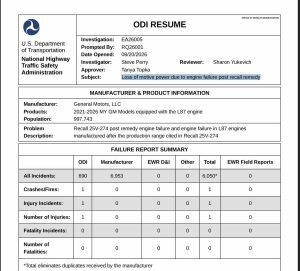
That recall arose as a result of “manufacturing defects with the crankshaft and connecting rods that could lead to a catastrophic engine failure.” That did lead is more accurate. This writer knows of at least one instance – involving a brand-new Escalade that needed a new engine within weeks of leaving the dealership. There are about 7,000 others, according to NHTSA.
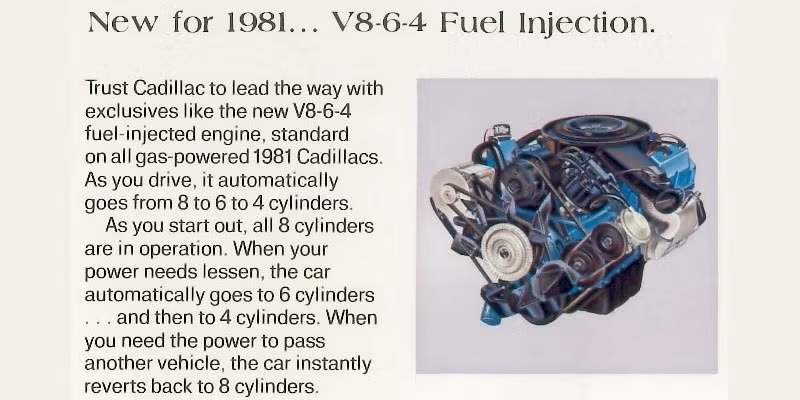
It brings back memories of the infamous V8-6-4 that Cadillac brought ought in 1981 as the standard powerplant in most models (except the Seville, which offered it as an option).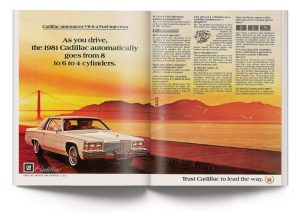
The V8-6-4 was an early attempt at what is marketed today as cylinder deactivation or variable displacement “technology” – which just means shutting down some of a V8’s cylinders to try to increase fuel economy. Instead, it increased warranty claims. The V8-6-4 engine ran rough (especially when four of the V8’s cylinders were deactivated), with owners complaining about “vibrations” and “shuddering.” Since it was a single throttle body design (i.e., just one carburetor-like TBI injector fed gas to a common intake manifold) fuel flowed to all the V8’s cylinders, including the ones “deactivated.” This led to rich-running, eye-watering exhaust and problems with the catalytic converter. The kicker? The V8-6-4’s mileage advantage was essentially nothing – about 2-3 MPG overall. Unsurprisingly, the V8-6-4 was a one-year-only wonder. But compared with this 6.2 V8, it was a fine example of automotive excellence.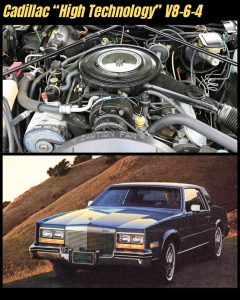
The V8-6-4 just ran poorly. But it did run. The 6.2 V8 stops running – which tends to happen when there’s a catastrophic mechanical failure with the reciprocating assembly. That’s what happened to the engine in the Escalade owned by a person known to me – who ended up having to wrestle with GM for months before GM finally agreed to take the Turducken back.
Initially, GM wanted the customer who bought the Turducken to accept a replacement engine. This sounds reasonable until you realize that a vehicle with a replaced engine is something like a badly wrecked vehicle that was welded back together; i.e., it is damaged goods. The record will be there and it will crater the thing’s resale value. Also, replacing a defective engine with a similarly defective engine isn’t exactly confidence inspiring. Even if the replacement engine isn’t defective, the not-so-mere act of replacing an engine in any newish vehicle is fraught with myriad potential future failure points because of all the things that have to be corrected reconnected, such as wiring harnesses and so on. Powertrain assemblies are pretty much just dropped in as a vehicle comes down the assembly line (in some cases, the body is dropped on the powertrain). Once everything is together, taking it apart – and putting it back together correctly is high-order electro-mechanical surgery; if you remember the old Star Trek episode, Spock’s Brain – you will have some idea.
Besides which, how angry – and depressed – would you feel after spending six figures on a brand-new top-of-the-line Cadillac to hear the engine go clunk and feel it roll to a dead stop by the side of the road like a Yugo GV someone forgot to fill with oil?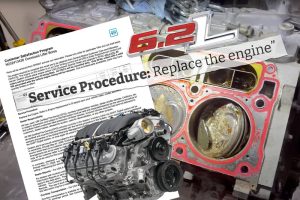
GM had – has – something of a problem on its hands. One it has probably made worse by not doing what it ought to have done in the first place, because it would have been the right thing to do as well as the smart thing to do (in order to preserve its reputation). That thing would have been to just buy back every Turducken it sold for what people paid and maybe something more for their trouble. Plus a huge apology. Instead, GM offered to “inspect” the suspected engines and recommended that owners use a thicker (higher viscosity) oil.
Oy vey.
First, how do you “inspect” an engine’s lower end – its crank and main bearings, etc. – without at least partially disassembling the engine? The answer bees you don’t – because you can’t. It’s like “inspecting” a tranny to ascertain whether “she” is in fact a he with its pants on. At the very least, you’ll need to to do a Crocodile Dundee.
The thicker motor oil thing is just hilarious. Back in the day, there was a product called Motor Honey that you could buy at parts stores such as Pep Boys. Motor Honey was a thickening agent you poured into the engine. Its purpose was to temporarily cover up the symptoms of a tired and failing engine, such as blue smoke coming out of the tailpipe, indicating loose/worn rings and other serious problems and to quiet noisy lifters and clacking valves. Thicker oil does basically the same thing; i.e.. it serves to mask the underlying problem.
This is what Cadillac suggested that people who bought six figure Escalades ought to do. And why did Cadillac do it? The same reason it did it before – for the sake of compliance. People who buy Cadillacs by definition are people who can afford to spend more on gas. But the government insists everyone must use less gas (excepting the government itself, of course) and so it imposes “fuel efficiency” (as well as “emissions”) requirements that are very tough for an eight cylinder engine to comply with. The “solution” The V8-6-4 and other iterations of cylinder deactivation and variable displacement “technology” as well as super-thin oil int he crankcase. With all the consequences that come along for the (short) ride.
It makes you want to reach for the bottle, doesn’t it? No doubt many of the people who bought one of these six figure Turduckens have already done just that.
. . .
If you like what you’ve found here please consider supporting EPautos.
We depend on you to keep the wheels turning!
Our donate button is here.
If you prefer not to use PayPal, our mailing address is: EPautos 721 Hummingbird Lane SE Copper Hill, VA 24079








What’s old is new again…
I just wanted to clarify that they were honoring the warranty terms. Lemon laws have to be strong otherwise forcing buybacks because of failures would be abused easily.
ZDDP additive – It’s soo thick I suspect it’s the same thing.
Speaking of Hydraulics
Hi Steve,
At some point – assuming I’m not living in a van down by the river – I will replace the fat tappet cam in the TA’s 455 with a roller unit. I gather it’s an easy way to gain significant power without screwing the driveability (all else being equal) and no more worries about ZDDP.
“The thicker motor oil thing is just hilarious.”
This isn’t as off as you’re assuming.
A significant part of the problem with engine reliability lately has been the push to zero weight ultra thin engine oil. No engineer wanted to go this thin on purpose. It’s for efficiency and that’s all.
The move from 10W to 5W was in some part, too. It was partially driven by actual engineering and need, as modifiers improved the could get conventional oil in 5W to flow better in cold temps so you got some benefit of synthetic without the cost. That oil helps reduce cold start wear.
Anyway, the suggestion to use thicker oil was also something other manufacturers have said, such as Subaru when an engine would experience higher than normal consumption with 0W20 using 5W20 or 5W30 can reduce it without any reduction (and in some tests an improvement) in engine wear. And they give conflicting suggesting, one version (naturally aspirated) saying 0W20 while the turbo saying to use 5W30. The engine shares a lubrication circuit but the turbo would be burnt up using 0W20, which is telling, and the engine otherwise is fine with 5W30 so it’s not a clearance and tolerances issue. 5W flows just fine where 0W does.
-anon
Damn – so many 1/2 truths and misinformation about oil. It really is a religion.
So let’s state the facts. The cold weather rating ie the 1st number in 0W-20 relates to viscosity at cold temps. Really cold temps! So cold they are irrelevant to any discussion about viscosity at normal ambient temperatures.
Each winter rating corresponds to a specific testing temperature used to measure cold-cranking and pumpability at specific cold temperature.
0W: Tested at -35°C (-31°F)
5W: Tested at -30°C (-22°F)
10W: Tested at -25°C (-13°F)
The oil actually needs be this cold to get to that viscosity rating as the long chain polymer molecules in oil shrink with decreasing temperature.
How many of you are actually operating in -20F to -30F? Yeah a few in northern latitudes during the dead of winter. I’ll give the guys in ND, AK, MN and a few other select places a pass.
So saying 0W-20 has less viscosity at normal room temps or actual engine operating condition is just erroneous.
All this boo hooing over 0W is just irrelevant to most of us.
The Second Number: The number after the hyphen (like the 30) measures the oil’s thickness at normal engine operating temperatures (100°C or 212°F).
And half of the male population somehow thinks 212F is way too hot for oil and they want to run it at 180-190F based on what grandpa told them 50 years ago.
So by the time you get to normal engine operating temp your 0W-20 or 5W-20 are basically running in the same viscosity ranges that are allowed by SAE spec. Sure there is minor variation based on brand and additive packages to the oil but they have defined viscosity ranges and to be rated 20w at operating temp – the oil has to meet that test spec.
But blaming all these engine problems on 0W multi viscosity oils is just scapegoating by the uninformed.
Ah, you forget how oil thins out of grade and shear stability. Those generally tend to happen worse with 0W with wide spreads and that to solve this they’re moving to 0W16 and 0W8.
Engines are running very thin oil at operating temps.
Couple this with too long maintenance intervals and you have the components necessary for accelerated wear.
The facts are there. A company like GM or Toyota can make an engine, in the case of the small block Chevy for many decades but when they start spec’ing ultra light MPG oil they start blowing up in large numbers, whole years productions?
Have they gutting manufacturing? Sure. That happened long ago. They haven’t made leaps in manufacturing technology for a while and things were stable. Something caused a step function in failure rates.
Back to your quasi-scientific hand waving apologies for the enshitification.
“ Something caused a step function in failure rates.”
COVID was a big deal – it’s hard to run dynos and proving grounds durability testing when you’ve been told to work from home.
Sr. management has also forced a severe reduction in prototype fleets and real testing. They were sold a bill of goods that modeling and simulation is just as good.
“ Something caused a step function in failure rates.”
It’s awfully hard to run dynos and durability testing at proving grounds when your workforce is forced to work from home.
Then there is the issue of Sr. Management having been sold a bill of goods that computer modeling and simulation is superior to dyno testing.
Prototype fleets at all OEM have been cut from 200+ cars at each phase to make the order of 80-100. I’ve lived it.
Probably not any single one of these but certainly they all contribute.
“ Ah, you forget how oil thins out of grade and shear stability. Those generally tend to happen worse with 0W with wide spreads and that to solve this they’re moving to 0W16 and 0W8.
Again 1/2 truths.
Used oil analysis will tell you if your oil has been sheared down.
How many people are actually doing an oil analysis vs all the bitching, speculation, and misinformation that is going on out in interwebz and AI land.
Answer: virtually none.
It’s always amazing to me the number of people that will spend $50k on a car or truck then go to jiffy lube and have god knows what put into it.
Same with the rash of wet belt failures. Not saying wet belts are a great idea but I know for fact that lots of them have failed because the owners / dealers / Indy lube shops aren’t using the oils spec’d for wet belts.
>go to jiffy lube and have god knows what put into it.
To include “absolutely zero new oil,” having drained the old.
(Hearsay to me, but I trust the source.)
Morning, Adi –
Years ago – back in the early 2000s, when I still lived in Northern Va and so did my parents, I got a call from my mom asking whether I could stop by to look at her car. She said there was oil on the floor of the garage. So I went over there and got under the car to have a look. What I found was an oil drain plug as loose as a hillbilly’s teefus. She had without my knowledge taken her car to Jiffy Lube and some ape had crossthreaded the drain bolt and ruined the threads. Luckily, not enough oil was lost to seize up the engine and I Heli-coiled the damaged thread. This sort of thing is not uncommon.
When the auto companies took the lead(Pb) out of the bearings, there was a learning curve on where to run the tolerances during manufacturing. The ‘new’ aluminum bearings were harder and didn’t ‘absorb’ the shock of small debris like machining chips or casting sand. At the same time, the oil companies were removing friction modifying metals like zinc. Eventually it was learned that the bearing clearances had to be adjusted. Another problem was that sometimes the solution to a manufacturing problem requires a major investment to modernize.
except most of the lead came out of bearings in 2008-2010 era and doesn’t explain the recent rash of failures by GM and Toyota
“At the same time, the oil companies were removing friction modifying metals like zinc.”
ZDDP (zinc) isnt some miracle additive. Nor has it been removed entirely from oils.
Too much ZDDP is as bad as too little. Then there is the issue of how much Calcium is in the additive package and whether that is preventing ZDDP from working as it should.
The situation leading to these engine failure is not simple and to just try to pin it to a single factor like ZDDP level is not a serious attempt at understanding what is happening.
But it suits the dogma of oil religiosity well.
Now I’m thinking, with all of these ruined newer Escslades with very few miles and blown engines all over the USA, would it be feasible to buy one for very little $ and spend maybe $10,000 to have a crate engine installed? I know it wouldn’t be feasible in an emission-check state, but I’d imagine it would work in a state like mine (WV)
What happens in West Virginia, STAYS in West Virginia…
425, 429, 472, 500. These were really good quality V8 engines, made enough torque to pull around 5000 lbs of Hebrew canoe. I never heard of one failing. Many hot rodder used them, they were quality without being excessively heavy and swapped into a smaller lighter vehicle were a very nice alternative to a Chevy, Ford, or Dodge.
Though I never liked big gaudy Caddy’s, as I’ve aged I’ve come to appreciate their virtues. Cadillac came into existence by building a better quality engine, damn GM and the feral government for what they did. And the academic postgraduate engineer who they hire now.
Indeed, Ernie!
Nothing like a FWD burnout in an early ’70s Eldorado! https://www.youtube.com/watch?v=dMFnxqAT-_g
I can only imagine with that big 500 under the hood!
Cylinder deactivation never seems to work out. Honda’s V6 in the Pilot and Ridgeline consume up to a quart of oil per tank of fuel. They expect it. They tell you that’s normal.
They close off the intake and exhaust valves, creating an air spring in the deactivated piston. But that causes oil to leak past the rings and into the combustion chamber. This is normal. It is BY DESIGN.
When I was researching the new body Ridgline I was pretty much sold until I found out about this “feature.” That people would pay for this was nuts. Apparently someone modified one of the sensors to never activate the deactivation program but of course you have to track the part down and buy it in some back alley of the Internet. And if it is discovered you’ll be treated like Sam Lowry after the Central Services tech found Tuttle’s modification to the ducts.
Morning, RK!
A quart of oil burned with every tank of fuel is outrageous – not to mention likely to prematurely ruin the catalytic converters ($$) too.
Dad bought a Sedan d Ville with the 8-6-4 engine, not because he wanted that engine but it was time for a new car. I think it was the shortest period of vehicle ownership ever for him. What it did for General Motors was it made him a Lincoln Town Car driver for the rest of his life.
It’s things like this that make the well-to-do shun Cadillac and drive Lexus.
You know your getting old when you remember when Saturns first came out and they had a problem with the coolant used in the first thousand or so cars so they had the owners return the cars and they were given new ones. Forty years later GM has forgotten that pissed off owners probably won’t buy another one and pissed off people tell everyone who screwed them.
Sadly due to GovCo’s regulations most car companies are having lots of problems with engines and transmissions. Thanks GovCo,
So, you finally got around to using a clip from Spock’s Brain; the worst episode, ever. It is truly the 8-6-4 of the entire franchise.
Well done, Eric.
What is brain? But you know Mark by the standards of the current franchise it’s high drama.
Hi Landru,
That episode (per Mark) gets a lot of grief. I kind of liked it! I think it is far from the worst of the original series episodes. There are many contenders for that title. For instance, Catspaw.
Antoinette Boyer was hot…can I get a HEY, NOW!
Of course their society was a matriarchy and the men were treated as slaves.
It crossed over a lot of story tropes. The McGuffin plot of looking for the brain. The central all knowing authority and the child-like society it causes. The count down until Spock dies.
Very formulaic episode, feels like the writers just phoned it in that week. But excellent script to tell young writers what not to do!
Problems like the 6.2l engine are not new. I can think of numerous examples of failures like this at gm’s crosstown rival. The only difference being how ‘viral’ this problem has become. As the manufacturers took the lead out of bearings(compliance); switched to thinner oil(with fewer additives); increased the power density, and finally, tell the customer that 10k oil change intervals are fine, there should be no surprise that this is happening.
Hi Auto,
Except some companies (e.g. Toyota) did this well. I have a 204k 2014 Highlander which takes 0W20 that is changed every 10k miles. It is a great vehicle. I would buy another one in a heartbeat, except they now have all the garbage tech that I don’t want.
The Escalade’s motor failed at 11k miles. It made it a total of two oil changes. GM refused to acknowledge the problem, except the dealership’s service manager knew it had become one and GM’s own recording devices (within the car) told on them.
In a way I am thankful it happened because I realized how poorly cars with the new CAFE requirements and excessive and needless tech were manufactured. Everything in my garage is now 10 to 25 years old.
I will never buy a new car again. I will resort to horseback first.
Damn you women spouting facts and leading by example!
Now if only we could get the real men to stop whining about oil viscosity, 3000 mile oil change intervals, and to stop buying new cars.
Hi Barney,
I am all for discussing the boycott of new cars. Simpler, well made vehicles less the tech would be nice.
I think we can move away from the man vs woman saga. Otherwise, it is a continuous beating of a dead horse.
It would be beating a dead horse except there are now a handful of commenters who are bringing it up on EVERY SINGLE TOPIC. It has gotten to the point of unpleasantness on this forum, much like many other sites/forums have been ruined by the proliferation of these tired old whiners.
I agree with you about boycotting new cars. I have a 2021 Bronco that isn’t too horrible with the tech (it even has a key ignition!) but is still enough to be mildly annoying. Any more nanny tech is a serious no-go.
Hi MQ!
This may up your mood: Yesterday, my young apprentice came by – he is 24, my buddy’s nephew – in his ’05 Mustang GT he recently bought. There is hope…
That is cool. I had a 1998 Mustang that I loved the way it handled on curves as it had nearly perfectly balanced weight distribution front and back being rear wheel drive. I freaked a couple friends out on Georgetown Pike the way I took those curves in it lol.
I rented an ‘04 convertible in Colorado and definitely appreciated the handling there on some genuinely scary curves! Your friend’s nephew should have some fun in it!
Morning, MQ!
Georgetown Pike… good memories, there. I used to take it all the time. On the young apprentice and his ’05 Mustang. He wants to install a Bullitt GT shaker, exhaust and maybe even a more aggressive final drive. I’ll prolly help him with some of this. It makes me happy.
RG,
The only problem with operating an older vehicle is that certain state governments (like MA, MN, CA, and the states that follow CA) are effectively outlawing older cars. What they’re doing is increasing registration fees; tightening emissions regs; and resorting to other tricks that amount to a de facto ban. They’re using the regulatory apparat to “nudge” us into newer vehicles. You can learn more about it here: https://youtu.be/_tthZFbj-V4?si=MsT_K1n4ph6YfeH1
BTW, she’s only one of many YouTubers covering this. The first video I saw about this was from an older guy.
Here’s another video about measures governments are taking to enact a de facto ban on older cars: https://youtu.be/p9ejPPBWAOM?si=hSajc7i7ixkzX0iu
Hi Mark,
No doubt the states (especially the blue ones) have been trying this. I believe the MN law where they hoped to remove classic cars from driving at night was stalled due to public uproar. We all know CA is crazy.
The problem with what the states trying to accomplish this is it hurts the poor more than anybody. There are two things that Uncle Sam and his 50 crazy sisters are going to have a hard time disallowing – guns and cars. Americans get very angry when you touch either of them.
Also, as I have learned in life…there is always a loophole. That the USSA still allows the import and sale of 25 year and older cars onto their shores shows they haven’t taken any definite steps to stop older vehicles from being sold or driven. Don’t be surprised when Americans driver licenses change to more lenient states where their cars can be registered. If members of Congress can be elected to districts that they don’t live in we, as sure as hell, can cars to states we don’t live in….they can’t catch us all.
And let’s be clear here. CA has had the same year emissions cutoff (1975) since 2004. Yeah they did pull a fast one by eliminating the 30 year old rolling cutoff but it’s also not exactly like they just recently changed the emissions cutoff.
CA has a very large vintage car culture.
“CA has a very large vintage car culture.”
Good point, Barney. I forgot about that. Yes, they do. I have watched (on TV) many vintage car shows that have taken place in Monterey and Burbank. Not to mention the amount of Cars & Coffee events that they have out there.
Friends Of Steve McQueen Car & Motorcycle Show At Boys Republic
in Chino, just up the road from where I live.
https://www.youtube.com/watch?v=GjWMsqgm9X0
If you are into vintage aircraft, you might want to visit Planes of Fame, also in Chino.
https://planesoffame.org/aircraft
They have the only Mitsubishi A6M5 (“Zero”)still in flying condition, among many other classic aircraft.
Barney,
Based on my personal experience, the two significant challenges when driving older vehicles are:
1. Parts availability, especially OEM.
2. Knowledgable technicians who are qualified and experienced on your particular vehicle.
Valid points to a degree but both are easily overcome depending on what cars we are talking about.
1) If you’re into obscure vehicles sure parts are a challenge. If you are into VW, Porsche, old Mustangs, Corvette, F150’s, et al, there is an abundant repop market.
As far as technicians – DIY. If you can’t DIY – revert to #1 above. Common cars that are easy to work on aren’t a problem – trying to keep a obscure low volume relic running will require more dedication to find someone that can work on them that isn’t learning on your dime. If millions of them were built, there will be someone that knows how to work on them.
In most cases both items above are just lame excuses for a lack of will and a justification for weak will, over commercialized men to run out and buy a new vehicle further cucking themselves to the control grid closing in around them.
My God, “Barney”!
For once, I agree with you. You’re right. It is not difficult to keep an old car mechanically viable if (a) you can turn a wrench and (b) the car is not an uncommon model unsupported by the aftermarket. My TA is 50 years old and Pontiac has been out of business for 15 years. The last Pontiac V8 was made 40-something years ago. Yet I can easily get any mechanical part I need for the TA because it is popular and supported by the aftermarket.
Thanks for the insults, Barney. As matters of fact,
1. Yes, there is a brisk business in aftermarket parts, body as well as mechanical & electronic.
2. Yes, there are skilled technicians with both the knowledge and equipment to keep older models running. In Corona, CA, where I live, “The Man” is Jon Kinne, better known as Jonny Lightning. His yard is a feast for the eyes, if you dig older models.
Do you know where to find a remanufactued ECM for a 1989 F150, when the usual sources come up empty? Jon does.
Do you have the diagnostic equipment and technical knowledge to deal with OBD1 (not OBD2)? Jon does.
Also as a matter of fact, I used to do a significant amount of my own work, but at age 77, I no longer care to, e.g., drop the trannie (Borg Warner T18) on my F150 to replace the t.o. brg., which I have done.
I also do not care to schlep the front rotors down to the local auto machine shop, one in each hand, to have them resurfaced, which I also have done (hint: they are heavy). I own only one vehicle at this point, so I do not have a “parts chaser” vehicle, which at times in the past I did have (typically a BMW sedan, of which I have had 4). But, living on a fixed income, I decided I do not need upkeep on 2 vehicles, and every good boy needs a pickup, so the F150 stays.
Hell, I don’t even change my own oil anymore. Big O is 3 blocks away, and they put it on the rack and check the undercarriage, whereas I would have to crawl on my belly on an oily driveway (minor oil leak), and tote the used oil to a recycling facility. Recently, oil change @ Big O discovered one tire severly cracked (blowout waiting to happen) on the *inside* face, of which I was not aware, because it is not readily apparent with the vehicle on the ground. So, yeah, they sold me one tire plus an alignment (toe was out of spec on the wheel with the bad tire), but I walked out with peace of mind and a vehicle which handles properly, for what I consider a reasonable price.
I neither want, nor can I afford, a new pickup (dual cab, short bed, jacked up body, useless electronic geegaws, exorbitant price).
I intend to keep driving my *paid* *for* single cab, eight foot bed ’89 F150 with roll up windows *forever*, if not longer.
“Weak will”? I once hiked the Grand Canyon (down Bright Angel, out South Kaibab) in one day, without food or water, just to prove I could do it). (On average, about 4 people die on that trail every month).
As far as cojones, by actual measurement (no brag, just fact) my “equipment” is ~1.5 times average size. GF, whom I have known for nearly 58 years (since we were both 19) tells me I am “the best.” At 19, she was a pretty girl; at 77, she is a beautiful woman, with many skills.
She is coming to town tomorrow, and I expect we will have a fun weekend.
Ya’ll have good time now, y’ hear?
I don’t know where this bimbo lives, but I’ll wager it is *NOT* California. Her accent sounds more like Illinois, to me.
I *do* live in CA, and my daily driver is a 1989 F150, bought new in July 1989. Registration fees paid July 2026 were $191.
>tightening emissions regs
Allowable emissions are determined by make, model and year of manufacture, and are *NOT* subject to modification by DMV, CARB, or any other entity, including the manufacturer.
Biennial emissions testing is required for any vehicle newer than 1975 model year and are *not* costly, although repairs to bring a vehicle into compliance may be, depending on the vehicle’s condition.
FWIW, the only time I had a cost was when the original catalytic converter hung it up, at ~25 years. Every year before and since, my Ford has passed smog check with flying colors.
Want a high powered auto which never requires smog check? Build your own from scratch, or buy a kit, less engine, and drop in a pre 1975 engine. CA emissions regs for such vehicles are determined by the year of manufacture of the engine, not the chassis.
RE: auto insurance
California law requires auto insurance companies to give a 20% discount to drivers who meet specific safety and experience rules. This is IN ADDITION TO the insurance company’s own rating structure, which generally rewards safe drivers with significantly lower premiums.
All great points Adi about the specifics of CA.
I get so tired of all the AI clickbait & rage bait on the web and the people running around mindlessly parroting it with zero thought about what’s actually going on.
Yeah, “Chicken Little Brains” so to speak.
(My own self assigned “Indian name” is “Runs With Scissors”.)
And I certainly *do* *not* want to hear about “climate change” from a pompous ass like Albert Gore, who studied “political science” @ Harvard, and brags about growing tobacco, which is proven to cause cancer when smoked or dipped.
Unlike Albert, I *do* have a scientific and engineering background. My first full time job, after graduating from the “downstream school” in Cambridge @ age 20 with one scientific publication to my credit, was with a consulting firm in Bedford MA, where I mainly wrote software to correlate and analyze measurements of ambient air quality due to power plan emissions (SO2).
You want an expert opinion on climate change? Consult an actual expert, such as my old rugby buddy, Ron Prinn.
https://web.mit.edu/rprinn/
“ Thanks for the insults, Barney. “
Not sure why you feel insulted Adi. Seems to me you’re doing a good job keeping your F150 on the road.
But hey if you want to give up on your old F150 and go out and buy a new one because of the two excuses (parts and labor) so be it. I’ll stand by my comment. Strange since that doesn’t seem to be your intent.
>Seems to me you’re doing a good job keeping your F150 on the road
“I get by with a little help from my friends,” as the song says.
>But hey if you want to give up on your old F150 and go out and buy a new one
Never going to happen, for reasons I previously stated.
Hi Raider Girl,
I concur…I did break down and buy a 2013 Lexus last year because my 2007 Avalon daily driver is at 311K miles and my 2002 Tacoma is at 287K….the 3.5L V6 in the Lexus and Avalon is a solid engine and if you keep them maintained, which is longterm a bit expensive if you are driving over the mountain fairly often, they will last almost forever. Toyota products have been very solid for me. Of our five vehicles we have four Toyotas and one Lexus. I would never buy a post 20th century American car personally. That said, I would not mind an old F150 with a long bed and a manual transmission and a 67 Karman Ghia
Hi Giuseppe,
A 2013 Lexus is a great vehicle. Like you I have only owned Japanese vehicles. Hubby buys me the German vehicles, which I do like, but whenever I needed to buy a car it has always been a Honda, Isuzu, or Toyota. None of them have ever left me on the road side.
Hopefully, you are able to get another 100k from it.
My Grandpa had a 1978 Ford F350 which he kept in meticulous condition. I regret not buying it from him. If I was a bit smarter in my youth I would have.
Amen that, Giuseppe!
My sister still has our mom’s old RX300. They still drive it regularly. It is 27 years old and pushing 250,000 miles.
RG, when you say that GM wouldn’t acknowledge the failure, are you saying that GM wouldn’t honor the warranty and replace the engine? Or, are you saying that GM would not repair the vehicle the way you wanted the problem fixed?
Hi Auto,
They refused to admit that the engine locking up was an issue. They kept telling us this never happened and they never heard of the Cadillac’s 6.2 liter V8 being problematic. The service manager at the dealership said he was noticing an issue with these engines and ours was not the first he had seen. GM then told us they would install a refurbished engine and we hit the roof.
The more I researched we were not the only ones with this issue…other Escalades, Silverados, Sierras, etc. were facing similar problems.
They eventually lemon lawed it, but it was a hell of a fight.
>GM then told us they would install a refurbished engine
That is totally unacceptable.
That is the warranty policy of the company and it happens hundreds of times PER DAY. The fight comes when the customer wants something different than the warranty policy dictates. In addition, the dealer is a middleman. If the dealer repairs a vehicle any other way other than the approved warranty policy method, then they risk not getting reimbursed by GM. The dealer is not GM and therefore has no authority over the repair, nor does it have the root cause analysis of these, nor any other failures. Finally, NO company will ever admit that they created a defective product unless forced to. I’m not defending the company or the failures as it is an example of how not to run a business.
Well, GM made such a crappy product and it was such a fight to get our money back we have made the decision not to ever buy a vehicle from them. Is the bad publicity worth to GM? It seems like it.
A refurbished engine on a 95k SUV would have decimated the FMV to about $40k (if not lower). We weren’t taking a hit from every which way to Sunday.
100 percent, RG –
If the engine had failed two or three years after you bought the vehicle, it would still suck – and you’d have an obvious warranty claim. But a catastrophic failure that happens almost immediately after purchase warrants a full refund/buyback.