

Here’s the latest reader question, along with my reply!
Sean asks: have been following your site for years now and always recommend it to my friends that are into cars. I have a 2010 Lexus GS350 and a 2017 Cadillac XTS that I inherited from my dad.
I drive very little right now and use mostly the Cadillac, leaving the Lexus in the garage. The Lexus has a little over 80,000 miles on it. I changed the battery back in March after 9 years and try to start the car and drive it a few miles every week. Recently when I went to start it the battery didn’t have enough charge to turn the engine over. I jumpstarted it with the Cadillac and it runs fine. It got me looking into trickle chargers and trying to figure out how long to drive the car to charge the battery. It’s an ordeal to jumpstart the car inside a small garage, so I really want to avoid doing that again as much as possible.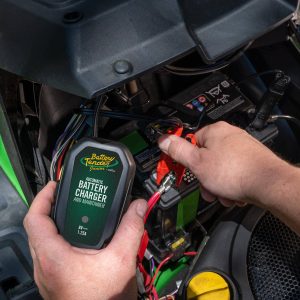
I know you have your ’76 classic Trans Am that sits unused for long stretches and I was wondering what you do about the battery. There is a lot of conflicting information online about how long to drive a car in order to charge a battery fully, some say it takes 500 miles, while others say the alternator will never full charge and it requires a trickle charger. What are your thoughts and experience with these things? Is there anything else I should be doing?
I tried to reach out to you through your site but haven’t heard back, so I figured I’d drop you an email. If I am having these questions I am sure some of your readers have them too and it would make a good article. I did look into your previous posts and found one addressing my question but it did not answer it fully.
Everyone tells me to keep the Lexus, I bought it as an off lease in 2013 with 32,000 miles on it and use synthetic oil and transmission fluid, I put tires on a couple of years ago too. The Cadillac only has 21,000 and my 1950’s Brooklyn Gangster father wanted me to keep that car, so for sentimental reasons alone I am going to keep it. I kind of like the idea of having two functioning cars. The Lexus still feels like a brand new car and it is fun to drive. The Cadillac squeaks when you hit a bump and has one brake rotor that has warped a bit which to me makes no sense considering how little it was driven. GM cars scare me, but seeing how I have it, I can’t really part with it yet. My dad loved his Cadillacs and would trade them in every few years for a new one except in the mid 80’s when they made them so small and unreliable. He went to Lincolns, an ’84 Mark VII and then an ’85 Continental before going back to Cadillac in ’89. I first inherited my mother’s ’86 Coupe de Ville and it proved to be so unreliable that I was afraid to drive it after getting stuck several times. I understand that was one of the worst cars Cadillac ever made. By 50,000 miles it broke down several times a year even if it still looked like new. I wax these cars more than I drive them at this point, it is my therapy and gym membership.
My reply: The key thing is to try to keep the battery fully charged during periods of non-use. This is the primary purpose of the trickle charger/battery tender.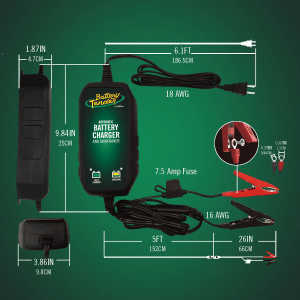
If the vehicle is left unused for weeks/months, the battery is likely to lose at least some of its charge during that time. It may not be enough to prevent you from starting the engine, assuming there’s enough power to turn the starter (in modern cars like yours, with EFI, the voltage must also be sufficient to power up the EFI system) but you’ll be starting out with a low-charged battery. Once the engine is running, the alternator will generate electricity to power the vehicles’ electrically powered systems (e.g., ignition, accessories such as lights and so on) as well as recharge the battery. However, if you only drive a short distance, the alternator may not have time to fully recharge the battery. It might be necessary to drive the car for an hour or more. The difficulty there lies in knowing how long you’d need to drive to get the battery back to “full.”
The battery tender/trickle charger will prevent this low-charge situation by “topping off” the battery while the vehicle sits. I have battery tenders for all my old vehicles that sometimes sit for months. Most of these come with a pigtail connector that make it super easy to plug the car in, so to speak. They also usually have a charge status indicator – green for fully charged and red for not yet. Basically, you connect the trickle charger’s + and – negative leads to the corresponding battery terminals. You usually have the option of the alligator clamps – which have to be clamped on and off – or the pigtail connector already mentioned that lets you connect/disconnect without even raising the vehicle’s hood (just run the pigtail through the grill, etc.)
Battery tenders/trickle chargers run about $40 and will save you money (on replacement batteries) as well as hassle. You’ll also avoid working your vehicle’s alternator excessively. Money very well spent!
. . .
If you like what you’ve found here please consider supporting EPautos.
We depend on you to keep the wheels turning!
Our donate button is here.
If you prefer not to use PayPal, our mailing address is: EPautos 721 Hummingbird Lane SE Copper Hill, VA 24079