


One of the most under-reported stories of the year is what’s beginning to happen this year and will reach a crescendo next year. That being the huge tsunami of off-lease EVs that are in the process of being offloaded at car dealerships – to the tune of more than half a million of them.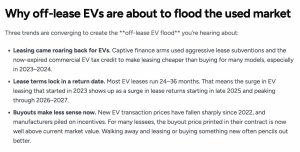
Put another way: A majority of EVs sold over the past four years were in fact leased – which is understandable given how expensive EVs are. Leasing being chiefly a way to get into more car than you can afford or are willing to pay for.
In other words, they were rented – which is the smart move when it comes to something expensive that loses value fast. It is why most luxury vehicles are also leased. A new Mercedes that lists for $60,0000 today is likely to be worth only half as much by the time you pay it off six years from now. EV depreciation is even worse, though – for one good reason. While a luxury car loses value because much of its value is tied up in it being new – the latest thing – it is still just as viable as transportation after six years. If it was able to go 400 miles on a tank of gas when it was new, it will still go that far on a tank of gas after six years – or even 26 years.
A battery powered vehicle, on the other hand, will inexorably go less far as time goes by because batteries inexorably, gradually, lose their capacity to receive and retain a full charge. Like bankruptcy, it usually happens slowly – and then all at once. Everyone who owns a smartphone, laptop or other battery-powered electronic device knows how it goes. One day, you notice the device needs a charge sooner than it used to. This becomes more and more and more sooner – until the device won’t charge at all. Sometimes, you can still use the device, if you keep it plugged in.
EVs, on the other hand, cannot be driven while they are plugged in. And while it might be economical to buy a new battery for an aging smartphone or laptop, it’s disproportionately expensive to replace an aging EV’s dying battery pack. There is a kind of double-whammy effect. By six years old, the EV has depreciated massively because it is now common knowledge that an old EV has an old battery and is likely for that reason to soon be a bricked EV – but the cost of a replacement EV battery is so great that it’s not worth replacing it. Not many people will put a $20,000 new roof on an old house that’s riddled with termites and structural damage. Just as not many are going to spend $10,000 or $15,000 to put a new battery in an EV that’s worth maybe $30,000 – and not just because of that unfavorable value proposition.
You can lease a new EV to lower the monthly cost of driving an EV. But when the EV needs a new battery – if you own the EV – you’ve got to either buy a new battery outright (who has that ind of cash?) or put the cost on a credit card and make exorbitant payments due to the monthly interest charges, as you’d have to do if you owned an older, out-of-warranty vehicle that needed a new transmission or other major repair. This is often worth doing with an otherwise serviceable older vehicle because the cost of replacing a transmission, while high, isn’t disproportionate to the worth of the vehicle and because it’s a manageable cost (typically $3,000-$5,000 for most late model vehicles). It is rarely worth doing with an older EV – because a new battery can easily cost $10,000-$15,0000 and there aren’t many credit cards that even have charge limits that high and also because even with a brand-new battery, the thing will still depreciate alarmingly quickly because everyone knows the clock is ticking (again).
So you can imagine the delight at dealerships around the country, as this tsunami of aging EVs with aging batteries washes up on their lots.
There will be fire sales abounding – in more than just the usual sense, probably (the older the EV, the more likely it is that its aging battery pack has developed tendrils within its lattice and will spontaneously combust in the next new owner’s garage).
For some, it may be tempting to consider buying an off-lease EV for half (or more) off what the thing stickered for just three or four years ago. Especially given the alarming uptick in the cost of gasoline triggered by the attack on Iran. It is not implausible that the cost of a gallon of regular unleaded could be $5 by summer. Maybe sooner. It makes something that does not need gas at all seem like a wise buy.
When an EV cost $50,000 new and gas cost $3 per gallon it was hard to make a case for “saving money” by purchasing one. But when gas costs $6 per gallon and the EV can be yours for $25,000 it’s a different story.
Just try to keep in mind what you may be buying into.
. . .
If you like what you’ve found here please consider supporting EPautos.
We depend on you to keep the wheels turning!
Our donate button is here.
If you prefer not to use PayPal, our mailing address is:
EPautos
721 Hummingbird Lane SE
Copper Hill, VA 24079
PS: Get an EPautos magnet or sticker or coaster in return for a $25 or more one-time donation or a $10 or more monthly recurring donation. (Please be sure to tell us you want a magnet or sticker or coaster – and also, provide an address, so we know where to mail the thing!)
If you’d like a Baaaaa hat or other EPautos gear, see here!










I’m very busy lately, but this made me think a bit. Bear with me. See, my GF likes the idea of an EV for the idea that there are less failure points and less maintenance. Is that true? I’m not so sure. But she sure as fuck has rotten luck with vehicles.
But, doubtless, the primary drive for having an electric car would be exorbitant cost of gas. Will these prices last? Well, as I see oil and gas infrastructure being blown to bits as we speak, it doesn’t look good.
Even then, I am unsure a discounted EV would be worth it to your average person living on a grid. But I am not. I will be installing a 4,500 watt solar electric system for my garage and lab soon, regardless if I have an EV. Most of it was already bought a few years back. That wattage will largely go unused for some time. Eventually, I *might* have an instrument or two that are hungry for current. In the meantime…
I checked out there. Here is an example of what is available:
https://www.arizonahybridcars.com/details/used-2017-chevrolet-bolt-ev/121491309
A 2017 Chevy Bolt for $10k.
They go ahead to enumerate the total cost: About $11,200. It is said to have a “new” battery, which I think might be a few years old because it is said to be under warranty ’til 2030 or 141k miles. It now has 82k miles. Range: 220-240 miles. The range might be optimistic. The new battery might actually be due to a recall in which the original batteries were catching fire. Not a great sign…
Now, I’d need or want a Level II charger as well. Here is one for around $500:
https://www.amazon.com/Grizzl-Ultimate-Electric-Certified-Hardwired/dp/B0D9HV151X
So, what if we were in for this $11,700? Using *mostly* free electricity?
If gas is at $3/gallon (closer to $4, now), $11,700 buys 3,900 gallons of gas. In a 30 MPG ICE car, this would give you 117,000 miles. SO, if I could squeeze 117,000 more miles out of this Chevy Bolt, it would pay for itself in completion. That would be about 200k miles on the car.
Possibly, then you could put a new battery in the car, if that will be possible. That’s another question. And would the rest of the car remain intact? Replacing the battery at that time might cost another $10k or more. Kind of silly, as you can buy 66kWh of LiFePO4 batteries for less (~$7,500 ), but then there is installation.
Is it worth the trouble? At $3/gallon, perhaps not. At $5 or $6/gallon, maybe so.
‘Would you buy a three-year-old EverReady?’ — eric
This is weapons-grade snark, Eric.
I’m short-listing you for a Pulitzer.
Thanks, amigo!
Robert Conrads finest…
“Go ahead, knock it off….I dare you…”
https://www.youtube.com/watch?v=HA6mksFu2vc
The double entendre is hysterically entertaining…
Interesting. While all hybrid systems are built different. Some put the ‘starter/generator’ in-line in the torque convertor area. If this is toyota/lexus’s system then I can see why you can’t fix it affordably.
So in my brain, all the big Manuf. lobbied and wanted tighter and tighter regs, to limit competition, now their cars are so complex, it’s costing them small fortune’s in warranty work.
Yep, but a warranty is like any other kind of insurance. They’ll be happy to take your money, then when it comes time to honor the contrace, there will always be a weasel word, phrase, or codicil which somehow allows them to not pay. Or they simply don’t pay and dare you to fight them.
In reality, it isn’t costing them much in warranty work.
>cost of a gallon of regular unleaded could be $5 by summer.
$5.259 cash price for 87 octane Arco yesterday in ZIP code 92882.
Credit card price for 91 octane $5.659 @ same station.
Diesel is >$6
Eleven cent cotton and forty cent meat
How in the world can a poor man eat
Mules up high, cotton down low
How in the world can they raise the dough
— Porter Wagoner, Eleven Cent Cotton
I’ve been getting pre-roll ads for Hertz lately. The 5 second spot is pretty simple, a high style close up pan of an automobile grill and a crooner singing “Hertz cars are new.” Pretty effective ad since I’m able to recall it after a few days of seeing it.
But why are Hertz cars all new? Not withstanding the fact that rental fleets have very high turnover because they want to get them sold off before they start being maintenance problems. Remember back in 2021 when they went all-in on EVs? Well, that didn’t work out so well, so they just dumped 30,000 of them on to the used EV market.
If you read the linked article near the end there’s another article about the problems people are having with the used Teslas. From that second article: Pandey says this is when it dawned on him why Hertz was trying to offload these EVs. “I realized why they were trying to get rid of those Teslas. If anything happens to a Tesla, then the bill is too high.”
I’ve heard the “saving money on gas” as justification for an EV purchase repeatedly as of late, but most people aren’t aware of what they pay for electricity every month because the bill is on autopay, deducting the balance from their checking account with maybe a notification email of the number.
Americans are weenies about gas prices but most are oblivious about their other energy costs.
Just as EVs don’t really reduce emissions, but shift them from the tailpipe to the smokestack at the power plant, EVs don’t really reduce the cost of filling up, but merely shift it from the gas pump to the electric meter.
It makes sense to lease EVs and luxury cars not only because leasing makes them more affordable in the face of high prices and even higher depreciation, but also because if you buy them outright and keep them longer than five years, you’ll be stuck with some yooooooge repair bills. In the case of EVs, you’ll be stuck with dead or dying batteries.
What’s more, EVs can be permanently put out of commission not only by dead batteries, but also because either their software is no longer supported by the manufacturer, or their onboard computers can’t take any more software updates. (Ever had an older computer or smartphone suddenly start slowing down after you installed the latest update?)
In fact, renting EVs, whether by leasing or by transportation-as-a-service, is their entire business model.
I highly encourage leasing of new premium cars. I love buying used premium cars under warranty with low mileage.
Another whammy –I’m guessing most EVs have minimal amounts of recyclables. For all the bellyaching about “green” it turns out that the substations for fossil fuels aren’t particularly “eco-friendly”. Not sure where I read it, but worn or broken blades of wind turbines accumulate on the ground bc the carbon fiber (or whatever) they’re made of can’t be reused. Ditto the plastic cars and their toxic batteries.
“I’m guessing”
Translation: too lazy to use Google to educate myself before spouting off about stuff I know nothing about.
Bless your heart.
Not much recyclable in those turbine blades so they go to a landfill. Ditto for the concrete base. The turbine and metals are recycled as they are worth something.
https://letmegooglethat.com/?q=what+are+wind+turbine+blades+made+of
It’s not just EVs that are cost prohibitive to repair. My mechanic told me about a hybrid Lexus that’s heading to the junkyard due to a defective starter! The starter is part of the transmission and the cost of a new or rebuilt transmission exceeds the residual value of the car. In my case all my cars take a standard starter that probably costs less than two hundred dollars :).
As for buying a rolling firetrap? Still a hard no at the present time although a Baker parked in the driveway might have some appeal.