

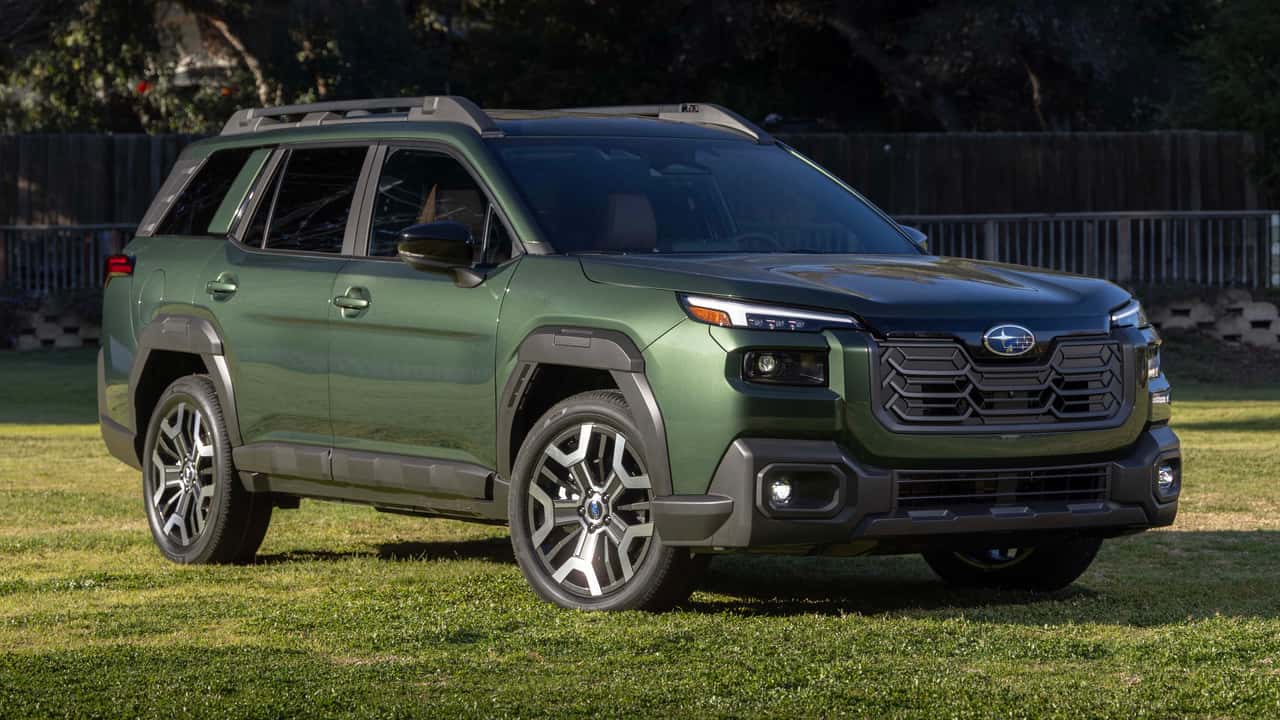

Subaru has really rolled the dice with the 2026 Outback. For one, it no longer looks like an Outback – because it no longer looks like a wagon. It has been restyled to look more like a crossover SUV.
It’s also a lot more expensive.
The Outback used to be one of Subaru’s more affordable models, with a base price under $30k.
The 2026 model is priced just shy of $35k to start – $5,000 higher to start than the 2025 model.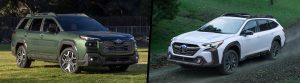
Will people buy in to the new look – and the new price?
What It Is
The Outback was Subaru’s mid-sized wagon. It now looks more like a mid-sized crossover SUV. Subaru is apparently hoping the more rugged looks will draw in buyers who want to drive a rugged wagon but don’t want to look like they’re driving one.
The new, more crossover-SUV-looking body also increases interior/cargo room.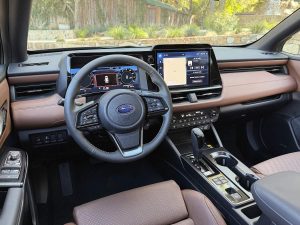
Prices start at $34,995 for the Premium trim – a $5k uptick from last year’s Outback wagon, which stickered for $29,995 to start. Some of the cost increase has to do with the restyle – and new standard equipment – including LED headlights, a power liftgate, synthetic leather (rather than cloth) upholstery, heated seats and a new/larger LCD touchscreen – but the major reason has to do with Trump’s tariffs, which have made vehicles made in Japan (and Korea and so on) much more expensive to sell here.
The Limited trim ($41,715) gets heated second row seats and a heated steering, a wireless charging pad and an upgraded eight speaker Harman Kardon audio system.
Both the Premium and the Limited come standard with a naturally aspirated (no turbo) 2.5 liter horizontally opposed “boxer” engine, paired with a CVT automatic and AWD.
The Limited XT ($44,365) gets a more powerful turbocharged 2.4 liter engine, plus a set of 19 inch wheels and a 360 degree camera system.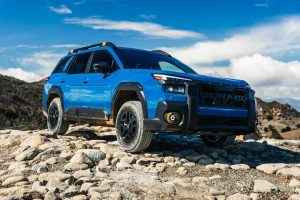
The Wilderness ($44,995) gets a lifted suspension, additional drive modes and a set of 17 inch wheels with all-terrain tires, plus all-weather floor mats and unique-to-this-trim front and rear styling/accents. The turbo’d 2.4 liter engine is standard.
Touring trims ($45,395) get real leather upholstery, ventilated front seats, the 360 degree camera system as well as the upgraded Harman Kardon stereo, phone charger pad and navigation. This one comes with the 2.5 liter (no turbo) engine.
The top-of-the-line Touring XT ($47,995) is basically the same as the Touring but comes with the stronger, 2.4 liter turbocharged engine – as well as a set of 19 inch wheels.
What’s New for 2026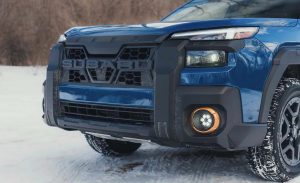
The Outback gets a major makeover, inside and out.
What’s Good
A bit more room for cargo than before.
Still available with – and without – a turbocharged engine.
More standard amenities than previously.
What’s Not So Good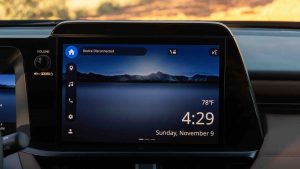
Much higher standard price than previously.
Only available with a CVT automatic.
Some creepy “driver assistance” tech is standard.
Under The Hood
One of the big differences between the Outback and the slightly smaller Forester – which shares similar styling – is that the Outback is available with more than just one engine.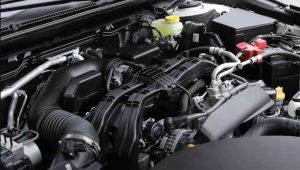
The Outback’s standard 2.5 liter (horizontally opposed, as are all Subaru engines) four cylinder engine is the Forester’s only available engine.
This engine touts 180 horsepower and also that it isn’t turbocharged, which reduces cost, complexity and pressure. Turbocharged engines make more power by pressurizing the incoming air and forcing it into the engine’s cylinders. This results in a more powerful explosion within the cylinders but it also results in more . . . pressure. More stress – applied to pistons and connecting rods and bearings. These parts can be made of stronger alloys so as to be able to handle the stress, but the fact remains that the turbocharged engine is subjected to more stress than an engine that isn’t pressurized. It also costs more because it has more components.
In this case, a great deal more.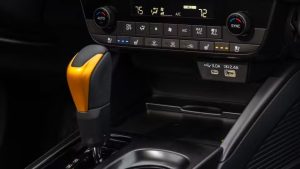
The least expensive Outback with its optionally available 2.4 liter turbocharged engine – which touts 260 horsepower – is priced $9,370 higher than the base-trim Outback with the standard 2.5 liter engine ($44.365 vs. $34,995). That does get you 80 more horsepower – and a zero to 60 time of about 6.2 seconds vs. about 8.8 seconds with the standard, non-turbocharged four. But if you’re not someone who doesn’t want to pay $9,370 more to get to 60 two seconds sooner – and likes the idea of owning an engine that’s under less pressure – it’s nice to have the choice.
On the other hand, there is no choice when it comes to transmissions. Both of the Outback’s engines are paired only with a CVT automatic, chiefly because of the fuel efficiency advantage. You may remember when Subarus with automatics came with five and six-speed automatics, like pretty much every other automatic-equipped car. Such transmissions have planetary gearsets and fixed forward speeds. They shift up – and down – as you drive. The problem is that each forward speed is a compromise. First upshifts to second when the vehicle’s speed is about where it would be advantageous to shift up – but it’s not as precisely advantageous (for maximum fuel economy) as a CVT, which continuously varies the relationship between engine speed and road speed such that the engine/transmission combo is always in just the right range for maximum fuel efficiency. The overall difference is typically about 3-5 MPG and that’s a difference that increasingly matters as gas prices continue to surge upward.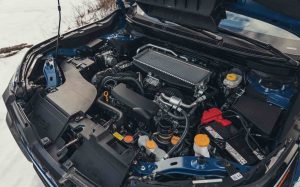
The CVT is what bumps the Outback’s mileage – with the standard 2.5 liter engine – to 25 city, 31 highway. Even when equipped with the much stronger 2.4 liter turbo’d engine, the Outback’s mileage is 21 city, 29 highway – a negligible difference. Something that’s exactly the same is that both of the Outback’s engines are regular unleaded engines. The optional turbocharged 2.4 liter engine does not require premium, which is a huge at-the-pump savings relative to other vehicles with turbocharged engines that require premium fuel to deliver not just the touted horsepower but also the touted mileage. For instance, the Mazda CX-50’s optional 2.5 liter turbocharged four (inline) comes with a “premium recommended” advisory. It can burn regular without risking damage – but the computer will dial back the boost (and for that reason, the power). Your mileage will also be less because the engine is optimized to burn premium fuel.
Every Outback comes standard with full-time “symmetrical” all-wheel-drive, which Subaru calls that because it splits the power flow equally to either side of the vehicle (not just front to back).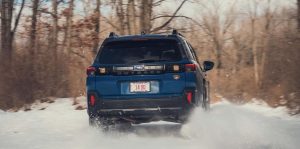
On The Road
Everything is relative – including people’s perception of what’s “slow” – and “fast.” The Toyota Prius used to be regarded as the eponymous “slow” car – because it took about 11 seconds to get to 60. The current Prius gets to 60 in just over six seconds – which makes it faster (quicker is more accurate) than two-thirds of the V8 powered muscle cars of the 1960s.
Relative to the current Prius, a vehicle like the Outback that takes about 8.8 seconds to get to 60 (with its standard engine) is “slow.” But relative to the previous generations of Priuses, the Outback is practically a Ferrari. One that gets pretty good gas mileage, too.
The better question to ask is whether the Ouback with its standard engine is underpowered. The answer to that question will hinge on what you expect. If you expect neck-snapping thrust, the Outback with its standard engine will feel underpowered. If you expect it to move forward in tandem with the cars beside you and ahead of you in traffic, it will feel powerful enough. It is not necessary to floor it to keep pace because 99 percent of the time, the drivers of the other cars around you are not flooring it, either. Most drivers just drive. They don’t race. Now, there are times when you might wish you had more power – as when you’re trying to pull out into traffic from a side street and the traffic is moving fast and there aren’t many opportunities to merge. You may sometimes need to wait a little longer – for a better opportunity – rather than pull out into traffic and have it close on you uncomfortably fast. But most of the time, the Outback with its standard engine is powerful enough and all of the time, it gets pretty good gas mileage – and cost you $9,370 less.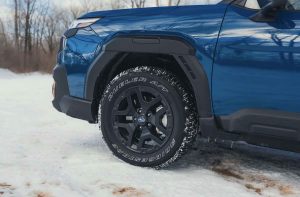
There’s also the option to go with the plenty-powerful 2.4 liter turbocharged engine, which enables this Subaru to accelerate as quickly as the Ferraris of the ’70s and the Mustang GTs (with V8s) of of the early 2000s.
That’s relativity for you.
Subaru does a pretty good job of programming the CVT automatic to be unobtrusive and to emulate the operating characteristics of automatics with set forward speeds that shift up and down. The CVT mimics this by varying the range – which manifests as varied engine RPM – as you accelerate. The main noticeable differences crop up when you floor it – and the CVT lets the engine spin to high RPM and it stays there (until you ease off the accelerator pedal) – and when you floor it and your coffee doesn’t slosh all over the center console. There is no “shift shock” with the CVT because there are no shifts (either up or down). This latter is one of the great positives of CVTs, in terms of smoothness. The biggest negative is the increased drivetrain noise that is chiefly increased engine noise arising from the engine running up to high RPM when you floor the accelerator pedal and keep it floored.
But that noise dies down as soon as you back off a little.
Just remember to change the CVT fluid at least as often as the manufacturer recommends (sooner, if you want to hedge the odds in your favor).
At The Curb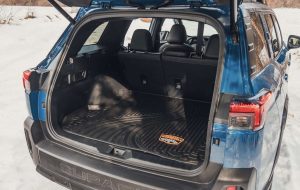
The new Outback looks a lot like the new Forester. They look so much alike, in fact, it is difficult to tell them apart at a glance unless you look at them parked side-by-side. Then you will see the Outback is larger than the Forester, which is 183.3 inches long and a compact-sized vehicle while the Outback is 191.7 inches long and so a mid-sized vehicle.
It is still about the same size as the old Outback, which was 191.1 inches long but it looks very different. The old Outback was a wagon, with a lower roofline and a “fast” (more steeply raked) windshield. It was also one of a very few wagons left, which set it apart (visually) from all of the crossovers and SUVs that are out there. Now, the interesting thing is that while wagons haven’t sold especially well in the United States – though they sell very well in Europe – the Outback wagon has been a consistently strong seller for Subaru for decades. Did Subaru make a mistake in restyling the Outback to look more like other crossovers?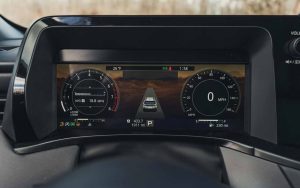
Time will tell.
The new Outback does have more interior space, including a total of 80.5 cubic feet of available cargo space with its second row folded forward (about a 5 cubic foot increase from the wagon’s 75.6 cubic foot total capacity) and the taller/boxier shape makes the available space both more accessible as well as more usable (in that larger, rectangular-shaped boxes can fit more easily inside a more rectangular-shaped opening and interior.
You also get an upgraded roster of standard amenities, including standard heated seats (these were previously optional, a power-opening liftgate and generally nicer interior materials (including synthetic leather seat covers; cloth used to be standard).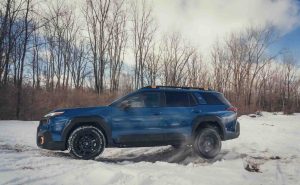
Wilderness versions are nearly as capable in adverse conditions as 4WD SUVs because they have just shy of 10 inches of ground clearance and that is what will get you through deep, unplowed snow and keep you from getting hung up by a protruding rock on a washed-out dirt road. AWD is important in terms of traction. But if you haven’t got lift, an AWD vehicle can be as stymied by deep snow and washed-out dirt roads as a vehicle without AWD.
The Rest
Subaru – like other car companies – is equipping its latest models with an eye-movement monitor that uses cameras built into the upper section of the LCD infotainment screen off to the driver’s right. This is not Subaru’s fault. It is a government mandate that goes into effect come the 2027 model year. Subaru – and many other manufacturers – are just being anticipatory of the mandate.
The good news is that – for now – you can blind the eye-movement monitor (and shut down the annoying parenting) using a piece of blue painter’s tape or electric tape. The bad news is that as time rolls on, the government will probably mandate that if you blind the eyes that want to watch you drive, the car will pull itself over and turn itself off.
In fact, the Outback already has something like that. It is called Emergency Stop Assist – and it stops the vehicle when the vehicle decides the driver is “unresponsive” (as in he fell asleep behind the wheel). This same tech could be used to stop the vehicle in the event the driver is disobedient.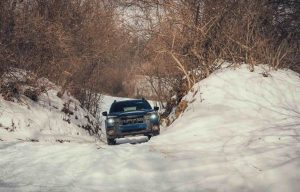
The Bottom Line
It’s probably not so much the styling change that buyers will take issue with as the Outback’s essential functional attributes haven’t been changed. It’s the chest-tightening $5k uptick in this formerly affordable Soobie’s base price that may prove a harder sell to people already pinched by the cost of $4 (and climbing) gas along with everything else.
. . .
If you like what you’ve found here please consider supporting EPautos.
We depend on you to keep the wheels turning!
Our donate button is here.
If you prefer not to use PayPal, our mailing address is:
EPautos
721 Hummingbird Lane SE
Copper Hill, VA 24079
PS: Get an EPautos magnet or sticker or coaster in return for a $25 or more one-time donation or a $10 or more monthly recurring donation. (Please be sure to tell us you want a magnet or sticker or coaster – and also, provide an address, so we know where to mail the thing!)
If you’d like a Baaaaa hat or other EPautos gear, see here!





Interesting. Our 2025 model came tariff-free, assembled in Lafayette, IN. AI tells me assembly for 2026 was shifted to Japan. Nanny-state features aside, very happy with it. Had no idea we’d get the last of its kind!
Morning, Dave!
In a very real sense, everything (well, most everything) made prior 2025 is the last of its kind in that almost everything being made right now and everything that will be made next year (2027) has or will have the creepy eye-movement monitoring system. I am glad you got yours before the deadline!
[…] https://www.ericpetersautos.com/2026/05/18/2026-subaru-outback/ […]
25 mpg city isn’t very appealing with gasoline soon to be $5/gallon, even outside Kalifornia.
But no (licensed from Toyota) hybrid powertrain available until 2027…
Wife has a 2025 model. Wanted to get it before the kill switch. I’m deluding myself b/c I think ours doesn’t have it… after all it’s “two lines of code” after all… At any rate, this is my 3rd; 1995, 2005, now 2025. Each has been progressively worse from a powertrain point of view.
1995 had the indestructible 2.2L, 5spd & mechanical front/rear differential. Only thing keeping that from going thru any depth of snow was the ground clearance. Once the bottom of the car bellied up to the snow, and the lifted the front wheels, it was over. Wheel bearings were a pain to replace. Handled like it was on rails.
2005 had 2.5L (yes, the head gasket), 4 speed auto and electromechanical front/rear differential. The 4 speed auto had a spin on transmission filter, how cool is that! Never stuck with a little higher ground clearance. Wheel bearings easy to replace. Crisp handling.
2025 has direct inject (only) and the CVT slushbox. Nanny-state controls. No guts. No handling, but a cushy ride. Got stuck! Screens galore. Thankfully, its my wife’s car and all I do is pay for it and sit in it. Would not have bought that for myself. Too milquetoast and nagging. Long term reliability is TBD, being so new. Shoulda kept those other two. I would not buy any new Subaru at all.
When it came time to replace my 2011 Honda Fit (RIP, totaled in what I thought was a minor parking lot accident) I went back in time to a 2005 Outback XT Limited 5MT. Very happy with my choice, though the Fit was great, too. I think Subaru was really killing it (like most Japanese automakers) from the mid-80s through the mid-00s. Our old 2004 Forester (sadly not the XT) was a great car, too. The 2014 Forester that replaced it (wife’s cars, both of them) is still nice but not as fun to drive and has more of a boat feel to it.
‘A $5k uptick … has to do with Trump’s tariffs.’ — eric
To quote the eminent jurist John RINO Roberts, “It’s a tax, not a penalty.”
Feel better now?
As I’m fond of saying in response to obnoxious bullshit like
Subaru’sTrump’s $5k price hike, “Can pay; won’t pay!“I liked the 2025 Outback much better. I bought a Crosstrek instead.
“This same tech could be used to stop the vehicle in the event the driver is disobedient.”
That’s better than the Emergency Stop Assist installed on Michael Hastings’ car.
Truth
I finally am able to buy a new car and have for years been wanting to get an Outback. The idea of a lifted wagon is appealing, for many reasons. But, now Subaru has destroyed that and made it look like a Casio watch on wheels. This thing look horrendous, but it must be attractive to a certain group of carpet eaters as this thing now looks like all of the rest of their vehicles. Now that the Outback looks like everything else, I have started looking elsewhere. The new RAV4 and CRV are at the top of the list, and the Maverick is on the list as well. I will have to wait until I get to the mainland to try them out to see what works.
Looks more “butch”. Will sell well in Seattle, gals with gals will eat that right up.
Tailgate may be an issue, not as much free space for all their cause celeb stickers.
I liked previous model this new one looks like shit lost the wagon looks Subaru is know for and price went way up I would buy the Forester myself.
I’ve seen a few around. Just can’t get passed the new look. It’s too hideous. Same for the new Forester. Can’t wait to see what they do with the rest of the lineup!
Uh-oh, there goes the carpet-muncher market.
Thats what I was thinking. Some rug munchers want to act feminine. Thats why they bought the outback, as they are the “gurl” in the “relationship.” OH well. They will have to move to a Jeep Cherokee.