

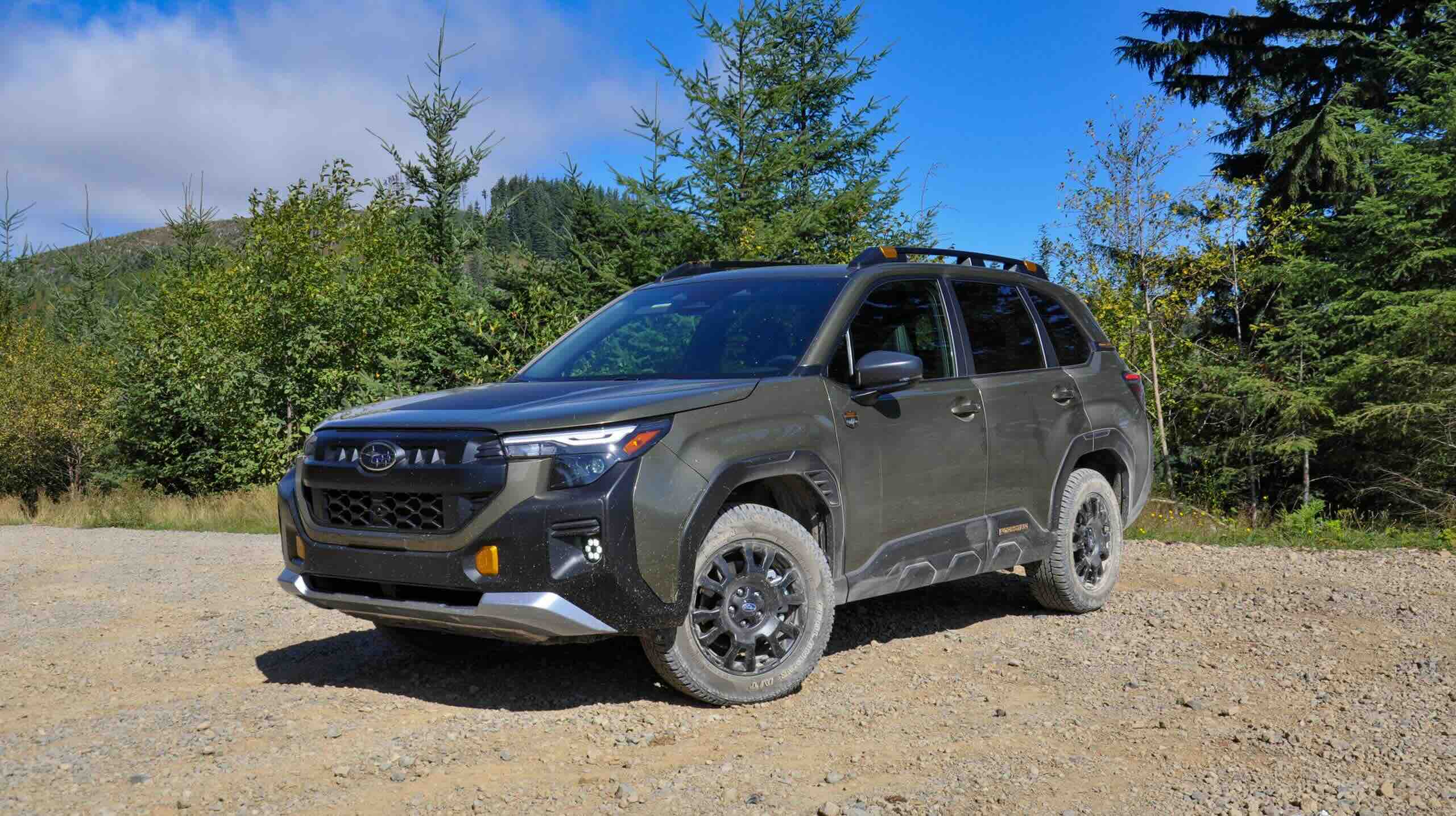

The Subaru Forester is among the most boring new vehicles on the market – and that’s probably why Subaru sells so many of them. It isn’t quick or powerful – but it is very practical and capable. AWD Subarus and specifically models like the Forester, which come with almost nine inches of ground clearance standard, are rightly revered for being near-unstoppable in the snow as well as affordable – and that’s attractive, in a new car market that seems to have chucked that concept into the ditch.
Now you can get even more capability – and for a lot less money than the same capability available in another Subaru, the Outback Wilderness. Because now you can get a Forester Wilderness – for about $6,600 less than the base price of an Outback Wilderness.
What It is
The Forester is a compact-sized, five-door crossover that’s similar in general layout to others in the class such as the Toyota RAV4 and Honda CR-V but differs from them and others that are available with more poor-weather capability in that the latter is standard with every Forester – and even more capability is available.
The Forester is also the only vehicle on the market – other than those sold by Porsche – that comes standard with a flat-four (or “boxer”) engine. This type of engine is not only different – which is nice in a market where so much is the same – it also offers some specific advantages over standing upright (and in-line) engines, too.
Forester prices start at $29,995 for the base trim – which comes standard with a 2.5 liter boxer four, a CVT automatic and AWD. Also standard is 8.7 inches of ground clearance, which is about two inches more than comes standard in other small crossovers such as the the Honda CR-V (7.8 inches) and the Toyota RAV4 (8.1 inches).
There are also Premium ($33,385), Sport ($36,105), Limited ($37,695), Touring ($41,595) and Wilderness ($38,385) trims.
The Wilderness trim ups the clearance to 9.3 inches and also adds suspension changes, a set of 17 inch wheels with Yokohama Geolander all-terrain tires, increased angles of approach and departure, a more aggressive final drive ratio, underbody skid plates, roof rails, body side cladding, LED foglights and StarTex water-repellent upholstery.
The Wilderness also gets a higher (3,500 lb.) maximum tow rating.
Subaru also offers hybrid versions of the Forester, but only in the Premium ($34,73), Sport ($37,930), Limited ($38,995) and Touring ($41,545) trims.
The Wilderness is not available with the hybrid drivetrain.
What’s New For 2026
The Wilderness trim package – which Subaru first offered with the mid-sized Outback in 2025 – is now available with the slightly smaller Forester for a great deal less money, chiefly because the Forester Wilderness does not have the 2.4 liter turbocharged engine that comes standard in the Outback Wilderness (which lists for $44,995 to start, so $6,6120 more than the base price of the Forester Wilderness.
What’s Good
Standard boxer engine isn’t turbocharged – so it’s not under pressure (and ought to last longer).
Grippy AWD system and generous ground clearance are both standard.
Wilderness package now available with the less pricey Forester.
What’s Not So Good
Tepid acceleration (zero to 60 takes about 8.4 seconds).
No optional (stronger) engine.
All trims except the Wilderness are only rated to pull 1,500 lbs.
Under The Hood
Regardless of trim, every Forester comes with the same drivetrain, consisting of a 2.5 liter “boxer” four paired with a CVT automatic and AWD. The engine touts 180 horsepower and 178 ft.-lbs. of torque at 3,700 RPM.
On the plus side: This Soobie’s engine is not turbocharged (many rivals’ engines are, including the Honda CR-V’s much smaller 1.5 liter engine) and that means one less thing to worry about having to replace or repair after the warranty expires. That goes for the engine, too – because engines that are not under pressure tend to hold up longer.
The horizontally opposed or boxer layout also gets the weight of the engine lower to the ground and distributes it evenly across the vehicle’s centerline which is good for balance and handling; this is one of the reasons why the Porsche 911 has a boxer engine.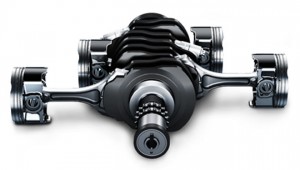
Gas mileage – 26 city, 33 highway – is very good, especially relative to rivals such as the CR-V, which offers no meaningful mileage uptick – just 28 city, 33 highway – despite having a much smaller 1.5 liter engine that needs a turbo (and that only makes 10 more horsepower).
On the minus side, the Soobie’s engine lacks the higher torque output that you get with a turbo engine that makes a vehicle feel that it has enough power relative to its weight. The CR-V’s 1.5 liter four, for instance, makes almost the same torque (179 ft.-lbs.) as the Soobie’s four but it comes online at just 1,700 RPM. This makes the Honda feel stronger than it actually is – though at the cost of pressure, which may mean more problems down the road, after the warranty has expired.
The boxer layout is also vulnerable to premature oil burning because when it is not running, the oil pools in the cylinder heads, where it can eventually seep past intake/exhaust valve guides into the cylinders. When upright engines aren’t running, the oil drains back into the oil pan.
Downstream, the CVT automatic – now standard in all Subaru vehicles except the BRZ sports car and the WRX – has helped greatly improve the fuel economy of Subarus, which used to be among the thirstier vehicles of their kind on the market. The downside is that CVT transmissions tends to accentuate the flaccid response/feel of engines that don’t make a lot of power and they produce more noise during full throttle mashing, as when you’re attempting to build up a head of steam to pass a slowpoke or merge with traffic.
All Foresters except the Wilderness are only rated to pull 1,500 lbs. The Wilderness is the exception because it has a beefed up transmission and heavy-duty cooling that ups that to 3,500 lbs. – but to get this you have to buy the Wilderness.
If you want a little more power, Subaru offers a hybrid drivetrain that augments the 2.5 liter boxer for with an electric motor/battery pack t produce 194 horsepower. The mains sell here is, of course, has mileage – which upticks to 35 city, 34 highway.
As mentioned earlier, the hybird option is not available with the Wilderness.
On The Road
Driving the Forester is not an exciting experience – and that’s just the point. Subaru isn’t selling excitement. At least not in the usual sense. It is the absence of excitement that’s the sell here. People who buy Subarus – the BRZ and WRX excepted – get excited by hundreds of thousands of miles of reliable driving; they are turned on by a vehicle that is doggedly tenacious when there’s snow on the road and that can handle terrible roads better than most anything that isn’t a lifted truck or 4×4 SUV.
The car press says it’s “sleepy” – meaning, it doesn’t get going quickly – and that’s both true and largely irrelevant, just as noting that a Corvette is terrible in the snow – also true – would be irrelevant to people who like (and buy) Corvettes.
When driven the way probably most people who buy Foresters drive Foresters, the boxer engine responds sufficiently and the CVT progresses (CVTs do not shift) smoothly and – for the most part – quietly. Only when you mash the accelerator pedal is at apparent there’s not exactly a big block V8 under the hood – and most people who buy Foresters don’t mash the accelerator pedal very often and aren’t bothered by the absence of neck-snapping response – because if they were, this thing wouldn’t sell.
And yet it does – very well.
Subarus – generally – are highly esteemed outside the suburbs, too because of their aplomb on country backroads that are often in poor condition and regularly covered with deep, unplowed snow.
Interestingly, the Wilderness’ ride is soft, especially on those bad roads. Probably much of the reason why has to do with the 17 inch wheels and tires, which have what used to be considered normal-height sidewalls, as opposed to the inch-high sidewalls of the tires commonly fitted to 19, 20 and 21 inch “rims.” These have very little give, or ability to flex/absorb impact forces – which helps sharpen steering response but also makes it so that every pothole is felt when you drive over it.
The Wilderness’ Geolander tires have give – because you want that when driving on uneven, rocky, washed out terrain. It also helps smooth out the lumps on paved roads, too.
At The Curb
The Forester Wilderness can be seen as a lower-priced alternative to the Outback Wilderness. The latter’s a little larger, has a bit more room for cargo – and comes standard with the stronger (2.4 liter turbo) engine. But the two look similar – and both have essentially the same upgraded equipment that makes for a vehicle that can be confidently driven down into a field or up a ragged gravel road that would be hard-going for a vehicle with less ground clearance and which didn’t have the extra leverage of the lower final drive ratio you get with the Wilderness equipment. It’s not a rock-crawling 4×4 – but it’s not far from being one.
The wheelwells have matte-black-finished hard plastic arches and there’s similar stone-chip-resistant material protecting the rocker panels and the lower sections of the front clip, too. Bronze anodized trim, prominent “Wilderness” badging and a large matte-black decal on the hood create a rugged look – but it’s the 9.3 inches of clearance and Geolander all-terrain tires that give it the actuality. It’s almost high enough up off the ground that you could change the oil without using a floor jack. (Subaru makes this job easy by mounting the oil filter topside; all you have to do is raise the hood and spin the old filter off an spin the new one on.
Though its footprint is small – the Forester is 183.3 inches long – it feels full-sized inside. The driver and passenger get 43.3 inches of legroom and people in the back get 39.4 inches. There’s also 29.6 cubic feet of cargo space behind the back seats and this opens up to 74.4 cubic feet if you fold the back seats down. The tall/boxy profile and wide-opening rear liftgate make it feasible to stuff just about anything in there shy of a full-sized ‘fridge (and one of those might just fit, too).
Premium and higher trims get a much larger (11.6 inch) central LCD screen (the base trim gets a 7 inch screen) which makes tapping/swiping easier – though this kind of interface is still not ideal when the vehicle is moving because your finger will be, too. On the upside, there is still a manual knob for increasing/decreasing the volume of the audio system as well as changing channels and there are huge cupholders as well as molded cubbies for your phone, so it doesn’t flop around while you’re driving.
The water-repellent upholstery is a great feature to have if you have a wet dog to carry home from the creek. Subaru also thoughtfully includes both types of USB power points as well as jack for headphones.
The Rest
It’s a shame that you can’t get a manual transmission in the Forester – or any other Subaru, excepting high-performance models like the BRZ sports car and the WRX. Not because a manual would make the Forester faster. Just more fun. But automatics have become what manuals used to be – which is standard, in pretty much everything.
Including inexpensive cars, which used to come standard with manuals.
Why have automatics become standard – and manuals hard to find? The answer is that automatics are programmable and manuals aren’t. The vehicle manufacturer can program an automatic drivetrain more finely – to deliver the highest possible fuel economy and the lowest-possible emissions, which matters in terms of compliance with federal fuel economy and emissions regulations. Manuals introduce a variable that’s not as fine-tunable, because each of us shifts gears differently. Even though the differences in mileage and emissions between an automatic-equipped car and one that is otherwise identical but has a manual are trivial in terms of the numbers and percentages, it still matters in terms of compliance – and that’s why manuals have become so uncommon.
The Bottom Line
If you’ve been wanting a Wilderness Outback – but not wanting to pay $44k for one – now you can buy something very close to one for a lot less than $44k
. . .
If you like what you’ve found here please consider supporting EPautos.
We depend on you to keep the wheels turning!
Our donate button is here.
If you prefer not to use PayPal, our mailing address is:
EPautos
721 Hummingbird Lane SE
Copper Hill, VA 24079
PS: Get an EPautos magnet or sticker or coaster in return for a $25 or more one-time donation or a $10 or more monthly recurring donation. (Please be sure to tell us you want a magnet or sticker or coaster – and also, provide an address, so we know where to mail the thing!)
If you’d like a Baaaaa hat or other EPautos gear, see here!







Big fan of Subaru, though I prefer their early-mid 2000s models as I can’t drive automatic. My left foot doesn’t know what to do with no clutch! 😉
I currently drive an 05 Outback XT 5MT, and the turbo has not been an issue in the couple of years I’ve owned her. They get a bad rap because people try to modify them on a budget, which means they skip the expensive supporting mods and just slap a huge turbo on there without properly tuning or building the engine to handle the crazy cylinder pressures they’re generating.
My wife has a 2014 Forester, and her last car was a 2004 Forester. Speaking to Eric’s point about their off-road capability, we once got lost in Joshua Tree and ended up on dirt roads. It had just snowed about 2-3 feet and we saw nothing but lifted 4×4 pickups or Jeeps on the road. Our little Forester handled it with aplomb, even driving up and down hills that made the ABS work overtime.
Hi Sillypickle!
Yup; my sister got one of the last Crosstreks available with the manual and she loves it.
Subaru to me is by far the best new car brand to buy still decent quality and some of the lowest base price cars and AWD is standard not extra cost option just wish manual transmission was a option still.
Hi Eric, et al,
One observation I’d make about the use of the boxer or pancake engine by Subaru…..it’s a great concept but a very unreliable implementation…..I’m not sure why they tend to break in very expensive ways but my very excellent mechanic will no longer even work on Subarus. Toni had a Forester and it had constant issues…..we finally had somebody haul it away just to get rid of it…..Steve, my mechanic, told me that the engines are prone to developing oil and coolant leaks and they are very challenging to diagnose and repair….the A/Cs are crap. BUT….Subaru heavily courted the LBGTQ e i e i o crowd so there’s that.
P.S. – there was an alleged association between Toyota and Subaru at one point but the Toyota quality did not rub off on Subaru apparently
My observation/experience as well Giuseppe. The older Subi’s, when they weren’t compliance engines, were very reliable. But also very slow which most people don’t care about when buying a Subi. When these engines are pushed, like in their WRX/STI’s they are very unreliable. I know, cause my kid blew up two of them. I was curious and actually took one apart on an engine stand. The ‘block’ if you want to call it that, is thin aluminum in two pieces that reminded me of a motorcycle crankcase. No wonder they don’t hold up to higher HP versions and/or you push them. Granted, most normal drivers don’t do these things and they are pretty good for them. It’s also why I believe Subi de-tuned their STI’s, even if they offer them anymore?
Hi Chris,
I agree. The other thing is that Subaru decided to go with far less durable CVTs to improve the mileage of their notoriously thirsty (for the size, etc.) engines. I’d consider a Soobie with a non-turbo Boxer making 150 or so hp and a five or six speed. Good, solid package there. No turbos or CVTs for me!
Amen to that, Eric!
A $8-10K trans replacement buys a LOT of gas.
‘But
manualsautomatics have become whatautomaticsmanuals used to be – which is standard, in pretty much everything.’ — ericAutomatics at least have gears. A CVT is special, enshitified class of automatic, explicitly designed to torment and immiserate the lowly serfs who are forced to drive one.
Thanks, Jim – just fixed.
Fighting a bad cold for the past couple of days and little sleep…
Now about that parasitic battery drain…
Just sold my wife’s 2017 Forester that had 198k. Good vehicle. Wasn’t burning any oil thank goodness. These subies have issues like any other vehicle for sure but overall it was a solid and dependable driver for her. I would definitely purchase another Forester in the future.
Hi Bill!
Yes, amen. If Subaru offered this little rig with a five or six speed, no touchscreen and for $26k I think they’d sell twice as many as they probably will as is.
We have a 2017 Forester as well. Ours is base model with 6 speed manual. I really like that car. It’s not fast, normally aspirated 2.5L FB25 so not surprising. The stick helps to let you wind it out and hold a gear longer. We did not like the CVT and would have likely bought a RAV4 if the stick was not an option. That said, the visibility is outstanding, huge windows, low dashboard, small compliance screen, big knobs to control everything. The interior is plain without seeming too cheap. You do not feel like you’re wrapped up in a cocoon like more modern vehicles. Ours was made in Japan, which I thought was a good thing. Due to the stick I plan to keep it until the wheels fall off. It does have the oil seeping past the valve seals issue when not driven for long periods. It does not burn oil or coolant.
I’m not gay. Pretty sure my wife isn’t. It’s just a car that fit the budget and meets the need to move kids and dogs around without any fuss.
Amen all that, Player –
My sister bought a ’23 Crosstrek with the six speed – no longer available. It’s a great little vehicle that will likely go 250,000 miles before it needs anything major. Maybe not even a new clutch!