

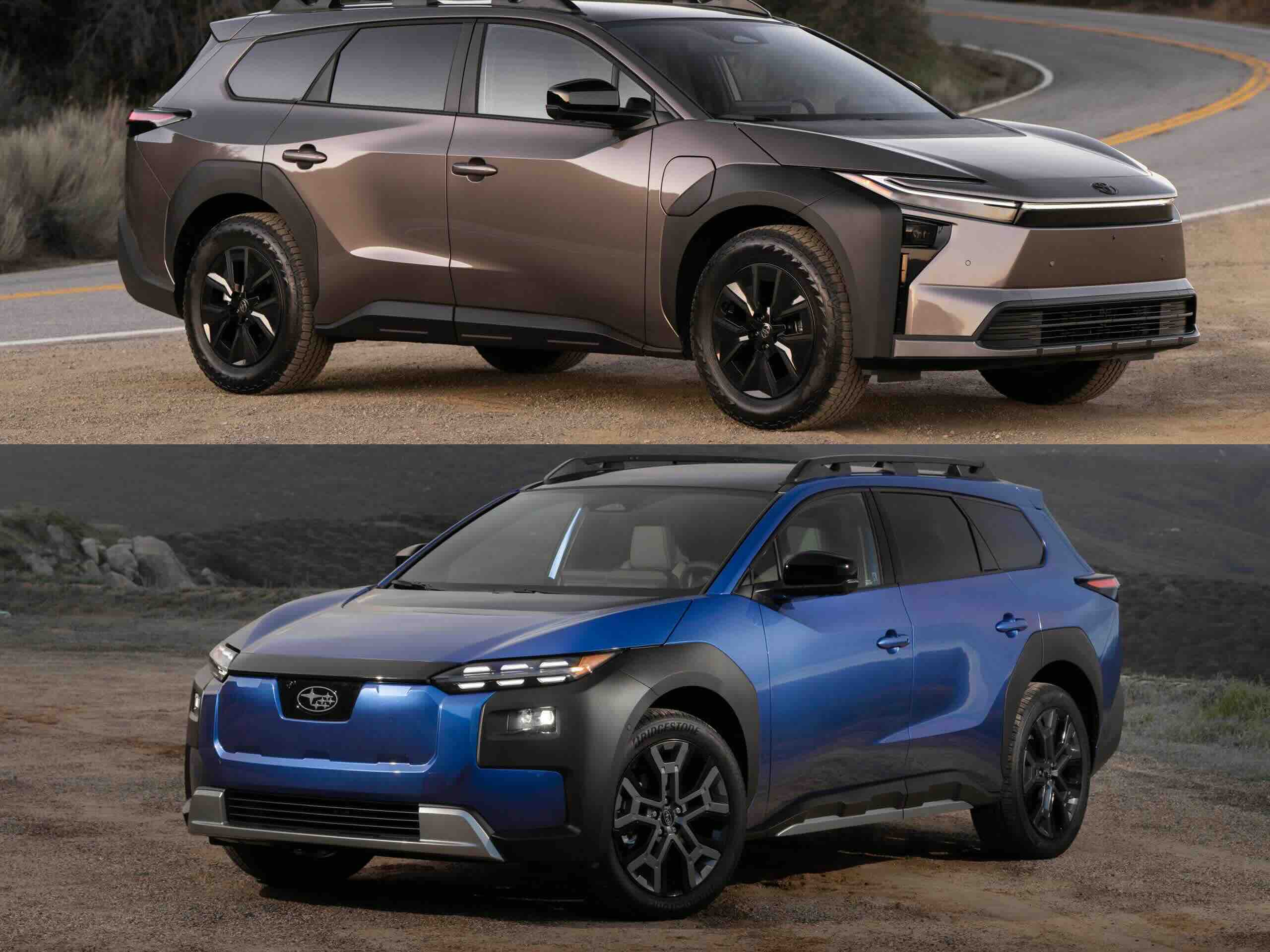

A couple of weeks ago, they sent me a new Toyota Bz to test drive; in a few weeks, they’re going to send me a Subaru Trailseeker to test drive. It’ll be easy to write the Trailseeker review because I’ve already written the Bz review (it’s here, if you’re interested) and they’re both basically the same thing – other than their badges and some minor styling differences.
It begs some questions: What is a Subaru? What is a Toyota? Is it the badge – and the styling? Is it enough when everything else is the same? This sameness is inherent with EVs. The Bz and Trailseeker are literally the same – in terms of their electric drivetrains, which are identical – but sameness is the defining attribute of EVs because they all have basically the same battery packs and electric motors. Some are higher-capacity or more (or less) powerful but there’s not much difference in that.
Certainly not the sort of difference that once defined a Subaru vs. a Toyota.
The Trailseeker is the first Subaru that hasn’t got a boxer (or horizontally opposed) engine. The italics to emphasize the difference between a boxer engine and an inline or “v” engine. It’s not just the layout that’s different. You can hear the difference – and feel it. A boxer engine doesn’t sound the same as an inline four or a V6 (much less a V8). It is these differences that not only define the brand but also conjure affection. It is hard to feel much of anything about a battery pack – or electric motors – for basically the same reason that it is hard to feel much of anything about a cinder block. If you’ve seen one, you’ve seen them all. Cinder blocks don’t have a sound, either. They are useful, of course – but one is pretty much like any other and they’re interchangeable and (ultimately) disposable.
Why do people like Subarus? Well, because they are Subarus – and a big part (arguably, the essential part) is the boxer engine they all have (until now) which is not the same as the engines that Toyotas have (which have their own, different attraction). When you could still get a Subaru boxer engine and a manual transmission, the differences were even greater. You can still get a manual in two Subarus – the WRX and the BRZ – but these are high-performance models rather than the mass-market models like the Impreza that you used to be able to get with a manual but can’t anymore. It is likely you won’t be able ot get a manual in the WRX and BRZ soon, either – not because people don’t like them but because the government doesn’t like them. These manual-equipped models don’t do as well on government fuel efficiency tests and the government punishes manufacturers that make models that don’t do well on government fuel efficiency tests via fines that are of course passed along to buyers in the form of higher sticker prices. Since higher sticker prices make a vehicle less attractive to buyers, the manufacturer is incentivized to stop offering models – and transmissions – that incur the fines.
That’s why all of not-just-Subaru’s mass-market vehicles are automatic only now. And it is also why Subaru and Toyota (and pretty much every other vehicle manufacturer) are shying away from engines and transmissions altogether. EVs have neither – and they do very well on government fuel efficiency tests.
Another question arises that’s related to the ones already asked: Can brands like Subaru – and Toyota – continue to make a case for themselves when they’re all selling basically the same thing? If the past is prologue, the answer is probably no. Do you remember Plymouth? How about Mercury? And Pontiac and Oldsmobile?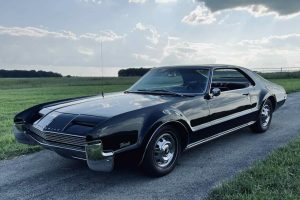
At one time, these brands had an identity because there were differences – meaningful ones – between an Oldsmobile and a Pontiac and a Ford and a Mercury. The same government pressure eliminated those meaningful differences by – effectively – forcing the parent company to turn the brands into marketing arms that resold the same things offered by other brands. At one time, an Oldsmobile had an Oldsmobile engine and a Pontiac had a Pontiac engine. Then things changed. Oldsmobiles and Pontiac got the same (Chevy) engines. There were some minor styling and branding differences, but these same-engined Oldsmobiles and Pontiacs were basically the same as the Chevys that they shared their mechanicals with.
Today, only Chevy remains. Plymouth is gone, too. And Mercury.
How long will Subaru – or Toyota – last once they, too, are selling the same thing, with only minor styling differences and a badge to set them apart?
. . .
If you like what you’ve found here please consider supporting EPautos.
We depend on you to keep the wheels turning!
Our donate button is here.
If you prefer not to use PayPal, our mailing address is: EPautos 721 Hummingbird Lane SE Copper Hill, VA 24079






All the car makers have been committing suicide for some time, at the behest of the Psychopaths In Charge.
There’s an argument made that engine design is “settled science,” in that German researchers showed that 500cc per cylinder is the “ideal” displacement. Of course that’s in a marketplace that’s regulated.
https://www.caranddriver.com/news/a15358174/why-0-5-liter-cylinders-will-soon-dominate-automotive-engine-design/
Another interesting thing is that BMW decided that the turbo 4 was better than a V6 because there’s less friction???? Sounds like someone justifying their decision after the fact. And of course there’s European countries taxing displacement and banning cars in cities.
But then again, Ferrari had a 1500cc V12 in the 1940s.
Which would you rather drive? A 2.0L turbo 4 with “ideal” 500cc/cylinder displacement, or a 125cc/cylinder V12 that could spin the driveshaft at 6800 RPM?
“What is a Subaru? What is a Toyota? Is it the badge – and the styling?”
Like Humpty Dumpty said ““When I name a car ,” “The car is what I choose it to be more or less.””
Okay he didn’t really exactly say that.
I will soon be re-badging my 2026 Dodge Durango Hemi 5.7 as a Dodge Maserati HEMI. I already bought a Maserati name plate on EBAY for $25. That and the Borla cat back exhaust qualifies as a Maserati.
If Dodge/Chrysler can do it so can I. The 1989 Chrysler TC by Maserati is a rare two-seat luxury convertible born from a collaboration between Chrysler and Maserati, hand-assembled in Milan, Italy.
Both Dodge and Maserati are owned by Stellantis, a global automotive conglomerate formed by the merger of Fiat Chrysler Automobiles (FCA) and the PSA Group. Because they sit under the same corporate umbrella, high-end engineering from Maserati often trickles down to American performance vehicles, and vice versa
It’s funny you mention that, Euro…
The other day, I rolled up behind a Smart car. Remember them? This one had a “V12” chrome emblem on the back. I gave the guy a thumbs up when I passed him!
Buick also remains in the lineup at GM. Most brands have lost their personality although a few remnants survive. The answer to your question is yes. I would take a Subaru built by Toyota, but not a Toyota built by Subaru.
Morning, Auto!
I think Buick remains chiefly because for some reason Buick is very popular in China. I think it’s a cultural-legacy thing.