

The current Dodge Charger is the closest thing that’s new to a muscle car there is – but it isn’t, really. Even if they do put a V8 into it, which is supposed to happen sometime next year. Then they’ll have a supercar.
It is not the same thing as a muscle car.
Here’s the problem: The current Charger isn’t based on an inexpensive, mass-produced platform – which is what made it feasible, in the Before Time, to build a muscle car almost anyone who wanted one could afford. This was what made the muscle car explosion of the ’60s that lasted into the ’70s possible.
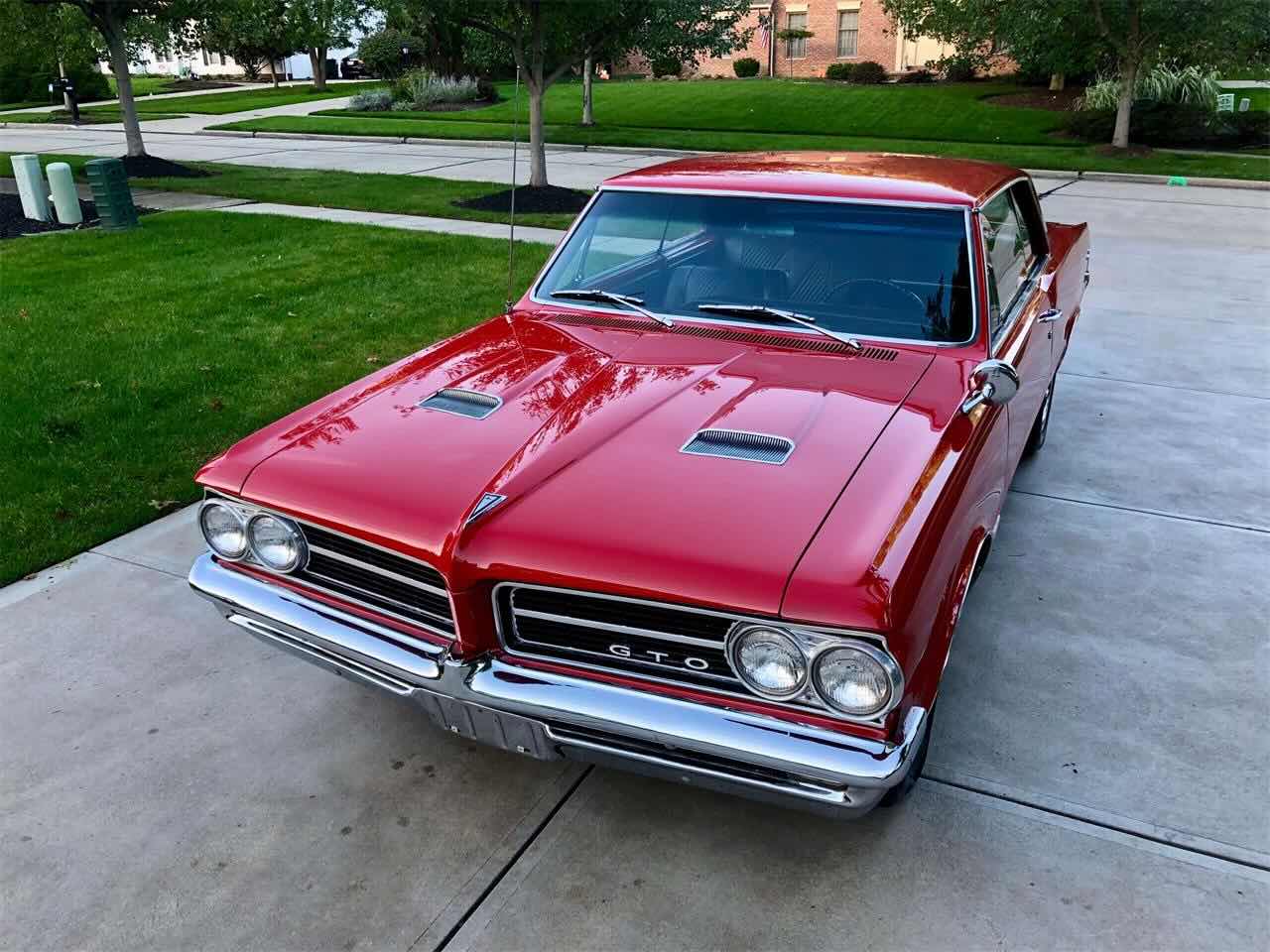
The first mass-market muscle car was the 1964 Pontiac GTO. It became a mass-market car for two reasons. The first was that lots of people – most of them young guys under 30 years old – lusted for one and could you blame them? The early GTOs were the car equivalent of women men can’t help lusting for. They had magnetic good looks and it made you feel great knowing one was yours.
But what good is all that if it’s beyond your means?
What made the original GTO – and all the others that followed – so successful was that young guys under 30 could afford them.
The base price of a ’64 GTO when it was brand new was $2,776. More finely, the GTO package was a $295 option that could be added to the base price of a ’64 Tempest.
Initially, the GTO was not a separate model, in other words. It was based on the Tempest, which was an example of a ’60s-era economy car. Non-GTO Tempests came standard with a non-high-performance six cylinder engine and not much else. You got the shell and the exterior glass and the tires. For many, this was enough. The relevant point is that Pontiac sold many more non-GTO Tempests than Tempest GTOs. Total production for 1964 was about 235,126 cars and of that number, only about 32,450 were ordered with the optional GTO package, which got you the equipment – 389 V8, heavy duty manual transmission and suspension, plus some trim to sex it up – that transformed Pontiac’s economy car into a muscle car.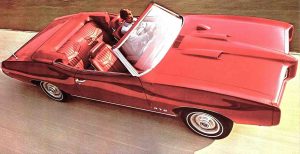
In other words, Tempest sales carried GTO sales. More finely, the money Pontiac (GM) made selling lots of Tempests made it possible to offer the GTOs at a price not too far off what it cost to buy a Tempest, which meant that almost anyone who could afford a base Tempest could swing a Tempest GTO, if they really wanted one. The ’64 GTO’s base price when new ($2,776) is equivalent to about $30,321 today, according to the government’s CPI inflation calculator. That’s still expensive, but not impossibly expensive. Many young guys under 30 today could probably swing that – at least if everything else didn’t cost so much. Back in ’64, gas cost about 30 cents per gallon and almost everyone who had a job could afford a place to live that wasn’t their parents’ house. Also, back in ’64, the insurance mafia was not yet as predatory and not yet in cahoots with the government, as now.
How many young guys can swing the $50k (ok, $49,995) base price of a new Charger coupe in addition to the cost of everything else?
This car is $20,000 more expensive to buy in inflation-adjusted money than a ’64 GTO. Yes, of course – the new Charger is a much more formidable car, even with its little (3.0 liter) six cylinder engine, which is much more powerful than the ’64 GTO’s big (6.5 liter) V8. The new Charger is also more luxurious than Cadillacs were back in the ’60s. Most ’60s-era GTOs did not have AC or power windows and locks or a Bluetoof playing stereo. None had digital display instrument clusters. But what good is all of that to the young guy who can’t afford it?
The original GTO was a young man’s car; see the ads. Check the buyer demographics. The current Charger is a graying man’s car, which is an incongruence to begin with. Young guys like fast cars but more important, they align with young guys. Seeing a guy in his 50s or 60s in a $50,000 performance car is something like seeing the same guy walking around with his college-aged girlfriend. That’s great for him, of course – but not so much for the younger guys who can’t afford it. And the thing is, neither can most middle-aged guys, which is why Dodge has only sold about 8,000 Chargers so far this year.
Dodge would probably sell many more if there was a base version available – as there was, back in ’23 and before. It didn’t comes standard with a V8, either. But it did have a base price around $30k. Dodge sold about 70,000 Chargers that year – and most of them were not Charger R/Ts, which was the performance version, similar to the GTO back in the ’60s.
So why is the current Charger a $50k car? Well, because Dodge didn’t design the current car to be a mass market car, as was the case with prior (2023 and before) Chargers. It was supposed to be an electric car and when that didn’t exactly work out, they rushed to put an engine in a car that wasn’t originally designed to have one. This engine – the 3.0 liter twin-turbo Hurricane six – is an expensive engine. The result is an expensive performance car that is almost inevitably a middle-aged man’s car. The V8-powered version that’s coming next year will be an even more expensive – around $70k to start – supercar.
At least Dodge is trying. The rest can’t even do that – because none of them have a suitable (RWD) mass-market car platform that could serve as the basis for a new muscle car. Almost everything mass market is FWD/AWD and designed for sideways-mounted turbo fours. Certainly, you can get a lot of performance out of those turbo fours – and a lot of grip out of FWD/AWD – but that’s a recipe for a performance car, not a muscle car.
Dodge could try harder, though.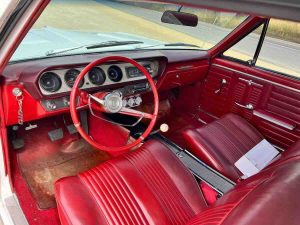
Maybe take the shell of the current Charger and use it as the basis for something akin to the ’64 Tempest GTO. Strip it of luxuries that aren’t required and maybe install the 3.6 V6 (no turbos) in it, along with a six speed manual. Make the 5.7 liter Hemi (no supercharger) available optionally. Maybe go crazy and get rid of the LCD display in favor a set of necessary analog gauges and skip the stereo altogether (offer a pre-wiring package as an option). Nix the expensive LED headlights and replace them with lights that work fine but cost a third as much. Install the bare minimum of federally required “safety” stuff. People who buy these kinds of cars would be glad not to have to pay for it.
And so on. Muscle cars are not supposed to be luxury cars. They are supposed to be an inexpensive way for a young man to go fast. Everything else – besides the good looks – is beside the point and contrary to it, too.
Get the base price down to $35k and it’d be a young man’s car – like the ’64 GTO was. Like all the original muscle cars were.
Instead of a middle-age-man’s car that probably won’t be around for very long, for exactly that reason.
. . .
If you like what you’ve found here please consider supporting EPautos.
We depend on you to keep the wheels turning!
Our donate button is here.
If you prefer not to use PayPal, our mailing address is: EPautos 721 Hummingbird Lane SE Copper Hill, VA 24079









Yes, Eric, I see your point. When I was 32, I bought what I’d always lusted for: a ’63 Stingray 327 Fuelie 4 speed. At 80, I’d look like a rolling joke in it today. I’d say that today’s Charger is Dodge’s “Halo” car. Those that can afford it are close to getting their own halo, assuming they’ve been good. LOL!
Amen, Marty –
I may look a little silly in my Trans-Am, but I have had it since I was 26! So we’ve aged together (though it has aged better than I have).
Sorry to hear you haven’t got your ‘Vette anymore…
The last/closest thing to an affordable “muscle car” (low price/big engine) was probably when you could still buy work truck, reg cab/2WD pickups – but that’s 20 years ago now.
All you needed was to pick a V8, heavy duty suspension and posi, and you had a great affordable platform.
Even on a tighter budget, a compact Ranger or S-10s with a 170-200hp V6 and a manual was a decent deal.
Not only is affordable performance becoming hard to find, go see what GM is selling today. Once all the Caddy V cars are gone, your sole performance “OPTION” will be a Corvette.
The GTO in your pic is a pretty car, but the one in the commercial looks a little ugly to me.
The “Hi-po” option, that was available on almost every car from the 50’s thru the 70’s, and most prominently in the 60’s, made for bargain basement beginnings to create a hot-rodded homebuilt muscle car.
The days of just adding bigger carbs, hotter plugs, maybe a more free breathing intakes, headers and exhaust, with cragar or mag wheels, and advancing the distributor, and perhaps gutting the muffler-exhaust, are long gone for performance gains.
Today’s hi-po options are bigger superchargers and turbos, and a software tune, and lots more shekels are being burned to generate minimal gains. Auto & safety engineers have been working overtime, to eke out performance that the owner could choose to add whenever finances allowed, burdened by onerous and hugely expensive regulations that price vehicles out of the range of Goyims everywhere….
Oy Vey!!!
YMMV…..
From the very beginning of the automotive revolution, there were people trying to make cars and driving a privilege of the rich and connected.
The Selden patent was an attempt to patent the automobile and keep prices high, sort of like IP today. They hated Henry Ford for making the model T, for paying a good wage to men and a fair wage to young single women, and for beating the Selden patent.
Hot rodding became popular as young guys took discarded cheap cars and made them faster, better looking, and better handling without taking the yoke of a career or a corporate job. The muscle car was Detroit marketing’s noticing and jumping on to the hot rodding culture.
Now, with 100 years of communist strangulation and marching tyranny, there is almost no freedom anywhere. How could there be cheap performance cars, when the intent is to put young men in debt and bury them in obligations?
Muscle cars and men born from the mid 60s to the mid 80s are now relics of “a better, vanished time.”
I am very surprised Dodge hasn’t even announced that the 3.6 V6 is going in that car.
There may be some parts sourcing issues we don’t know bout, but IDK.
Agree 100% on doing a sort of stripper. My daughter owned one and it was a great car, even though she really wanted the v8.
You raise some noteworthy points about muscle cars: First, that many muscle cars were basically option packages as opposed to separate models. Pontiac wasn’t the only one: Over at Oldsmobile, they took the B07 “Apprehender” package for police cars and repurposed it as the 4-4-2 option for its F85 compact: 4 speed stick, 4 barrel carburetor, and dual exhausts. Supposedly the 4-4-2 option was available on sedans and wagons. Plymouth and Dodge’s Road Runner, GTX, and Super Bee were option packages for Satellites and Coronets.
This was possible at a time when economy cars were essentially scaled-down full-size cars. And the “pony cars” like the Mustang, Camaro, Challenger/Cuda, and Javelin were based on the Falcon, Nova, Dart/Valiant, and Rambler.
Next, muscle cars were not luxury cars, or luxurious cars. They came with power nothing, spartan interiors, and few creature comforts. There were luxurious, high-performance cars like the Pontiac Grand Prix, Mercury Marauder, Buick Riviera Gran Sport, and Chrysler 300. But they were for an older, more affluent crowd who still liked driving fast, and who wanted more in the way of refinement, comfort, and convenience.
Today, that’s not possible, because the basic platforms of economy cars and luxury/performance cars are radically different from each other, and because even economy cars are more luxurious in terms of equipment and even performance than the luxury cars of even a few years ago.
There are exceptions, notably the Volkswagen GTI and Subaru WRX. But they’re exceptions.
That can strip it down, or they can just stretch the financing out to 10 years.
Which is easier for the marketing team?
Charger Scat Pack (3.0L Twin-Turbo SIXPACK): 4,865 lbs
Gaahhhhh! It may look svelte. But like a 160-lb woman in a muumuu, it’s a porker beneath the exterior wrap.
Whereas the base 1969 Charger with a bigger 3.7-liter six weighed but 3,100 lbs.
Mazda engineers worked hard to prevent the Miata from getting fat as it aged. Meanwhile, Dodge engineers swilled Cheetohs, beer, pizza and Little Debbie cakes. Guess what happened! 🙁
I take back what I said. I wouldn’t buy this 2-1/2 ton lump even with a manual trans. It’s approaching the weight of a freaking box truck. And, since all materials have a cost per pound, that’s an important reason why it costs so damned much.
Hi Jim,
Yeah, it’s startling. Almost 5,000 pounds and it’s not even an EeeeeeeeVeeee!
If my ’76 TA had an aluminum LS instead of a cast iron 455, it would weigh around 3,500 pounds and it’d still have stamped steel suspension parts, steel wheels and heavy gauge steel body panels.
Even with the cast iron 455, the TA weighs 1,000 pounds less than a new Charger.
Eric, another good example is the Buick Grand National. The curb weight was around 3,400 pounds. The 442’s and the Monte Carlo SS’s were about the same. About anyone in the 80’s could afford the base models of these cars when we had a decent economy and government agencies that weren’t as tyrannical as they are today.
Lest I forget, our dollar back then wasn’t debased as it is today thanks to the government and the bank mafia Federal Reserve.
Because of those assholes, the American dream has become the American fantasy.
Very well-said, Allen!
The Olds Cutlass (basis for the 442) was the best-selling American car circa 1979. More than 518,000 of them sold. That’s on par with F-150 sales today and more than that when you consider that the US population was much less in ’79 than today. It was cost-effective for GM to put a hotted up 307 in the 442 (and Hurst Olds) because after all, both were just hotted-up Cultasses.
You can’t hate the state enough.
Only an 8-speed automatic transmission is offered with the Charger — no manual option.
It comes so close to being a car I’d actually buy. But no manual is a deal-killer, as is telematics spyware.