

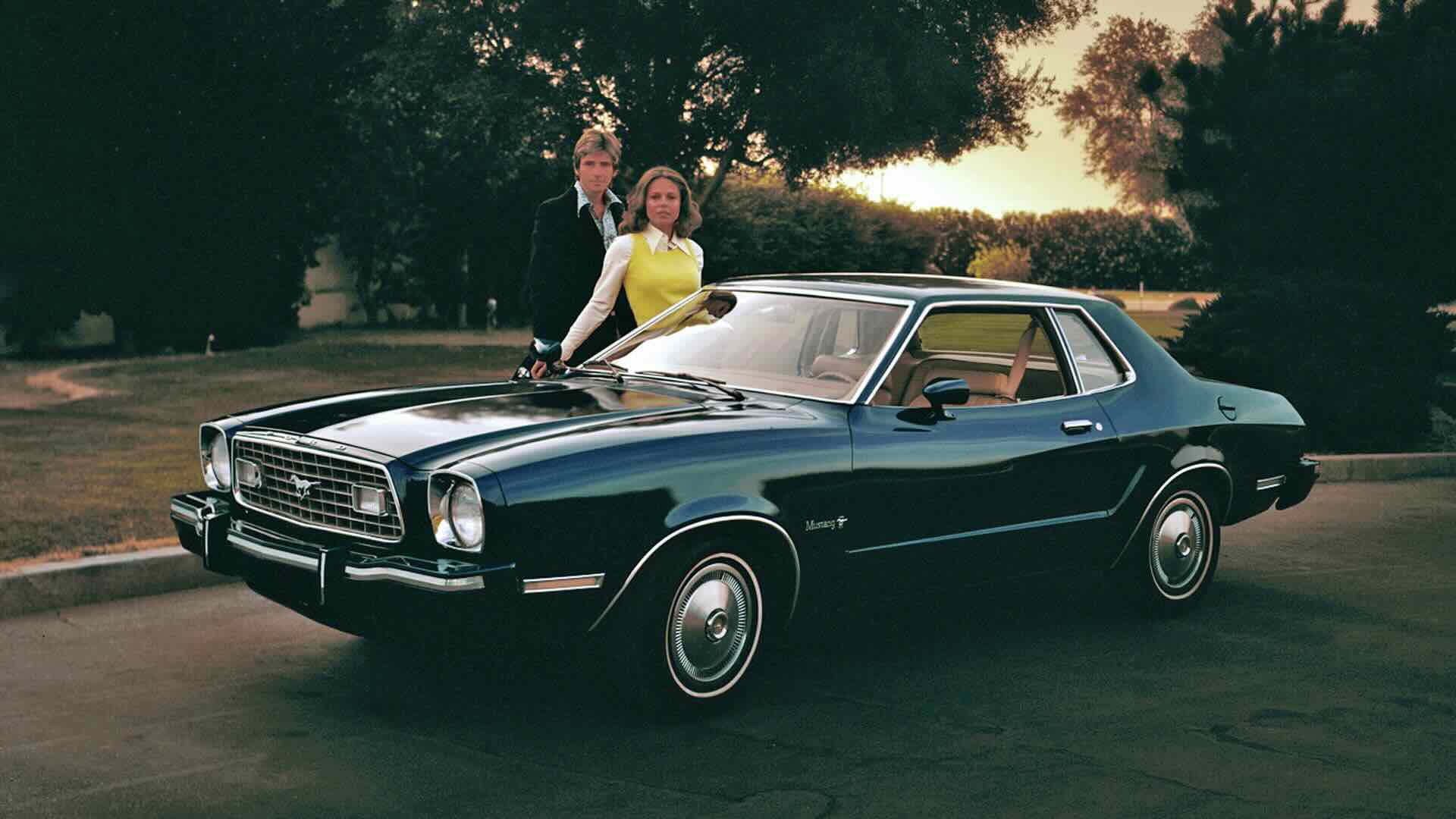

When Ford introduced the all-new 1974 Mustang II, it was something like the introduction of New Coke back in the ’80s in that lots of people thought it wasn’t the real thing.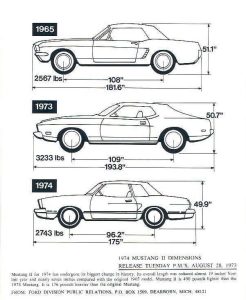
It was for openers a much smaller car than the 1973 Mustang – and much less powerful, too. At first, the biggest engine that you could get was a small V6 and the standard engine was a four. Even the wheels only had four lug nuts – which at the time was the sure mark of an economy car (no need for five lug nuts when there’s very little twist being made under the hood). In 1975, the second year, Ford put a small V8 (the 302) back into the lineup. But only with a two barrel carb, single exhaust and 140 horsepower.
As a point of reference, the 1973 Mustang was a available with a 351 cubic inch V8 and a four barrel carburetor and dual exhaust that touted 266 horsepower. It had five-lugs wheels. It was also about 500 pounds heaver and about 19 inches longer.
For a long time – for decades, in fact – the Mustang II (which was made for four years, from 1974-1978) was regarded by car guys with either pity or contempt. They mocked its kinship with the Pinto. There were very few car guys who were willing to drive one. Maybe their sister or girlfriend had one they’d ride in. But that was as far as it went – for decades.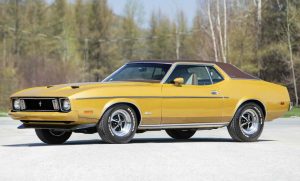
But in retrospect, it was very much a Mustang in keeping with the original (1964) Mustang idea. That idea was a compact-sized, affordable car that had general appeal. Like the Mustang II, the original Mustang shared kinship with a little economy car – the Falcon – which is how Ford was able to make it affordable. Development and manufacturing costs were lower; many mechanical parts interchanged. Interestingly, the first Mustang did not come with a rumpety-rump V8, either. The standard engine was a mild in-line six and the available V8 was a lot like the V8 that became available in the Mustang II in 1975 in that it wasn’t hot-cammed or especially powerful. It was designed to produce smooth power enough – a different kind of power. Ford did put a rumpety-rump, hot-cammed V8 into the lineup (the famous 289 Hi Po) shortly after the 1964 Mustang was introduced, but even then, the first-generation Mustang was still a pretty small, pretty light car and it had general appeal. 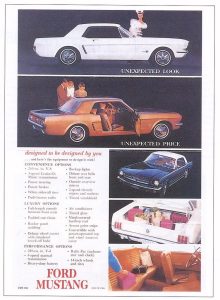
Young buyers loved it, but so did older buyers. Men and women loved it. It was not a polarizing car. By 1973, that was no longer true. The last big Mustang was a car that young guys loved – and that was about the only demographic that did. It had become more muscle car than pony car by then. The original Mustang was the first pony car – the car that created the type (and segment). A pony car is smaller and lighter than a muscle car, which is a category of car that is generally agreed to have been created by Pontiac in 1964 – same year as the Mustang’s debut – with the debut of the first GTO. The GTO was a hotted-up version of the Pontiac Tempest coupe, which was a larger car than the Falcon or the Mustang. But the important point of difference is there was no iteration of the GTO that wasn’t hotted up. Pontiac never offered anything less than a big V8 in the GTO and the car was designed specifically to appeal to young guys. It’s true some older guys and some women bought GTOs – but probably not one out of ten were older guys or women.
The ’64 Mustang, on the other hand, was bought by everyone – just about. While the GTO sold well, the first Mustang sold really well. We’re talking more than a half a million annually by the end of 1965. That same year, Pontiac sold 75,352 GTOs. It is not a small difference and it comes down to demographics. Pony cars had – and still have – more general appeal while muscle cars have a more limited, specific appeal. It’s why the Mustang and other pony cars outlasted the muscle cars, which were all gone after 1974 – which was the last year for the GTO (technically, there have been “GTOs” made since then, briefly, but not really since they weren’t really Pontiacs because they were rebadged Australian Holdens – a down under subsidiary of GM – and were powered by Chevy engines).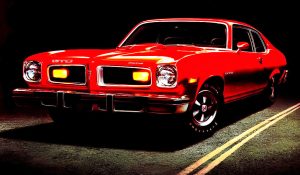
But by 1973, the Mustang had become as big and heavy as a GTO. It was a de facto muscle car – and had an appetite for gas like one, too. That was a problem, because by 1973, gas had gotten both expensive and scarce (there were episodic shortages and gas lines). Muscle cars were no longer selling hardly at all – and that’s why Ford remade the Mustang as a pony car, again. And it sold really well – again. The first year for the Mustang II was a much better year than the final year for the last big Mustang. Ford sold 385,993 Mustang IIs in ’74 – nearly triple the number of ’73 Mustangs sold. Mark Twain might have called that a sockdolager.
Why did it sell so well? Because it had general appeal, again – not just the limited/specific appeal that a muscle car has, chiefly to young guys. Women loved the Mustang II. The ’73 pretty much ignored half the potential market. Then another third again (older guys who had matured out of muscle cars) as well as older people generally and also people who just wanted a sporty small car.
Not a hulking muscle car.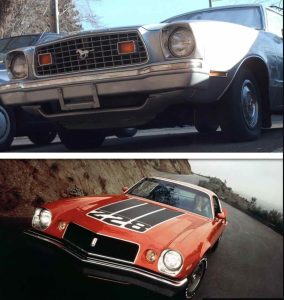
It is not going too far to say the Mustang II saved the Mustang. The other pony cars – Camaro, its Pontiac Firebird sibling and the Dodge Challenger – are gone (and have been gone before, having been cancelled and then resurrected – only to get cancelled yet again). The Mustang carries on.
The Mustang II was only made for four years – from ’74 through ’78 – and that is sometimes used as evidence against it. But the production/sales numbers tell a different story. And for those who are fans of muscle cars, the Mustang II presents an interesting opportunity today. Because even though it wasn’t much of a performance car when it was new, it can easily be made into one today and – unlike the ’73 and older Mustangs, which are now chiefly cars for rich old guys due to their “classic” (and so expensive) status, it is still easy to find a nice Mustang II for under $10,000 – one that can be turned into an impressively powerful muscle car.
Just for a lot less than it costs to buy a “classic “muscle car.
. . .
If you like what you’ve found here please consider supporting EPautos.
We depend on you to keep the wheels turning!
Our donate button is here.
If you prefer not to use PayPal, our mailing address is:
EPautos
721 Hummingbird Lane SE
Copper Hill, VA 24079
PS: Get an EPautos magnet or sticker or coaster in return for a $25 or more one-time donation or a $10 or more monthly recurring donation. (Please be sure to tell us you want a magnet or sticker or coaster – and also, provide an address, so we know where to mail the thing!)
If you’d like a Baaaaa hat or other EPautos gear, see here!








There are so many cars I used to think sucked that in retrospect or compared to today’s vehicles are actually cool. Like big old station wagons, the hallmark of a boring slow vehicle. Now, well it seats 9 and many have a big block
In the early 70’s a friend had that second gen Mustang fastback. It was HUGE. However, it had less usable trunk space and a back “seat” that was far more cramped than my 69 Bug.
Contrast that with the 64 Tempest (straight 6/3 on the tree) my Dad had. Lots of room for a family of six and a trunk that could hold all our “stuff”.
Car design is an art, and few are good at it. The great ones make it look easy.
Morning Eric.I’ve got a old school 302(carb) just waiting for the right car. A Mustang ll would be just about perfect. Hell, I’d use a pinto,like my cousin did in the early ’80’s.Don’t know how much power it had, but it was a lot more then 140 hp. Just ask the ’84 Corvette pilot he torched.
Morning, Not a Number!
Yup. And here’s a sad story. The people who own the land adjacent to my place had have a Mustang II (orange) sitting in the woods as long as I have lived here, which is more than 20 years. I ought to have tried to buy (and save) that car years ago. It is probably too late now. I doubt there’s a solid panel left.
It’s worth a look.
Sure, but then you’d not only have to drive a Mustang, but the ugliest of them.
Morning, James!
Well, beauty is in the eye of the beholder, right? The Mustang II has grown on me over the years. Maybe I’m just getting old! On the other hand, it is one of the few fun cars of the past that is still affordable, which means not only that it can be bought by people like us – but also modified into something really fun by people like us. The stock 302 is pathetic, it’s true. But then so were the same-era Camaro and Firebird’s V8s. My ’76 TA’s 455 made all of 200 hp back in the day, had 7.6:1 compression and had barely enough grunt to heave a ’76 TA to 60 in about eight seconds. It was slower than a current RAV4, in other words.
Perspective changes a lot!
Huh — the wheelbase is just over 96 inches on the Mustang II … a little less than my first-gen RAV4. And it weighed a svelte 2,743 lbs, also just a little less than the first-gen RAV4.
It sold by the hundreds of thousands. Yet no one makes such a car anymore — or even CAN make such a car, owing to Govco ukases.
File this story under ‘creeping enshitification.’