

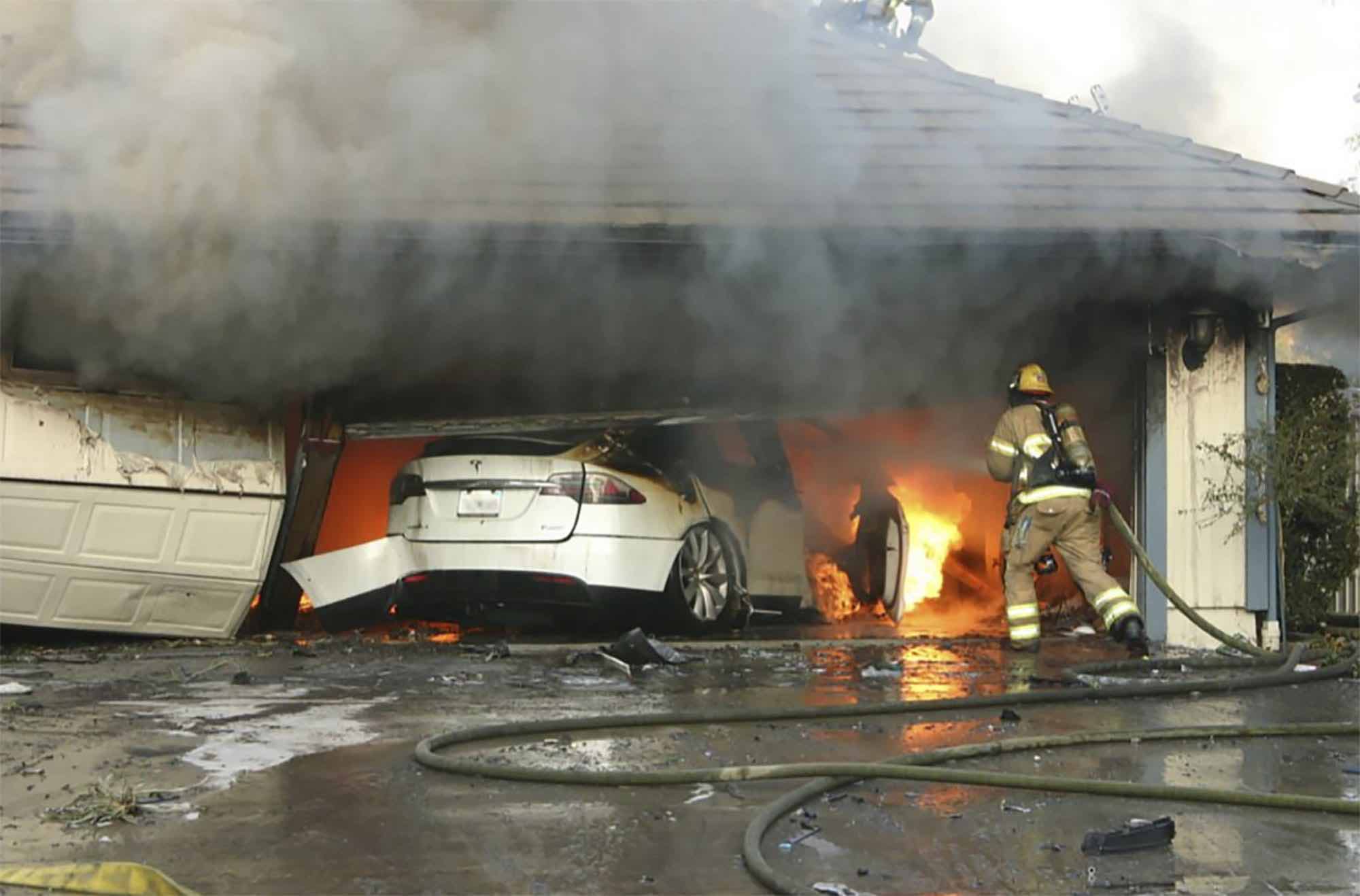

I have a story for you, about something that happened to me the other day, that I think really makes the point about the relative danger of owning and EV that carries around 800-1,000 pounds of battery pack vs. a car that carries around about 130 pounds of gasoline.
You’ve undoubtedly heard about EVs going up in smoke – spontaneously combusting – sometimes when they’re not even moving. Or had something moving run into them (a la the Pintos that sometimes caught fire back in the ’70s, when they were rear ended by another car). This can happen at any time and without the owner having done (or not done) something that turned out later to have been the thing that triggered the fire. The fire just happens. No warning. And when it happens, it happens fast – and furious. The chemical fire burns viciously hot and is very hard to put out without specialized equipment, such as a bag big enough to put the burning EV in to snuff it out or a dumpster filled with sand, to contain it. EV fires have taken down two cargo ship and several buildings/parking garages.
This sets the stage for what happened to me the other day. What didn’t happen, to put it more accurately.
I fired up (ha!) the Trans-Am, to take a joy ride and to fill the gas tank while gas is still under $4 per gallon (by next week, it might be over $4 again, depending on how the war with Iran that never ends goes). I caught a whiff of gas while still in the garage, but since my garage is a place of many spills, I didn’t pay much attention to it. I ought to have.
I stabbed the gas pedal to relax the choke – this is part of the warm-up process with a carbureted (pre-fuel-injection) old car. The choke mechanically richens up (more gas) the air/fuel ratio when the engine is cold, which helps get it started. Once it warms up, the choke – which is just a door on top of the carburetor that restricts how much air can get into the engine – is released by stabbing the gas pedal quickly; the engine then settles down into a normal idle and you’re all set to go.
I backed out of the garage, headed down the driveway and began my roundabout drive to the Marathon gas station where I usually fill up. The TA was running great and I was feeling good. I rolled up to the pumps, got out and got the pump going. I left the engine running, which I chiefly do because sometimes the old 455 is hard to start after it’s been running hot for awhile. The RA III exhaust manifolds, which are basically cast iron headers, are heat soaks and big and thick ones, too. The one on the driver’s side is pretty close to the starter motor and that heat transfer sometimes causes the starter motor to bind up. So I just leave the engine running when I know I’m only stopping for a couple of minutes.
After I had pumped in about half a tankful, I walked in to pay for the gas. This is a local joint and I know the owner and always like to stop in and say hello. Well, when I walked back out to the car, I smelled gas again – but didn’t dwell on the smell since I was at a gas station and sometimes there is spillage. I got back in the car and headed back home, about seven miles distant. I rolled into the garage and shut the engine off and now the gas smell was enough to make me think. And look. I got out and saw a puddle of liquid expanding from under the front end to adjacent the driver’s side tire. I popped the hood and saw where it was coming from. The rubber fuel line that connects the metal return line that runs back to the gas tank to the fuel pump had failed. Pressurized gasoline had been arterially spurting all over the subframe and also the lower part of the engine, very close to the piping hot driver’s side exhaust manifold.
Yet no fire.
Think about that. Highly combustible gasoline, spraying almost directly on a very hot engine and it didn’t combust. Because – thank the Motor Gods – there was no spark. The Trans-Am did not burn to the ground. Neither did most Pintos that were slammed in the rear end by another car – unless the impact was severe enough to sever the fuel filler neck that connected to the gas tank and in the process of shearing off, a spark was created. Absent that, what you had was a spill – not a catastrophe.
With EVs, you do not need a spark to have a fire. Lithium-ion batteries can just catch fire.
So which would you rather drive – given how difficult it is, relatively speaking, to get a gas-engined car to burn vs. how easy it is for a battery-powered vehicle to burn itself to the ground?
. . .
If you like what you’ve found here please consider supporting EPautos.
We depend on you to keep the wheels turning!
Our donate button is here.
If you prefer not to use PayPal, our mailing address is:
EPautos
721 Hummingbird Lane SE
Copper Hill, VA 24079
PS: Get an EPautos magnet or sticker or coaster in return for a $25 or more one-time donation or a $10 or more monthly recurring donation. (Please be sure to tell us you want a magnet or sticker or coaster – and also, provide an address, so we know where to mail the thing!)
If you’d like a Baaaaa hat or other EPautos gear, see here!








My blood ran cold at first, Eric…I saw that one burned out care and thought your Great Pumpkin T/A got smoked. Thank Goodness no fire.
burned out car
Amen, Bill!
My TA loves me – and I love it back!
Hopefully you carry a small or big fire extinguisher close by in the passenger compartment, if the fuel had ignited.
My 1998 Durango wasn’t so lucky, the master brake cylinder had developed a pinhole leak due to rust on the line and in sprayed hot brake fluid directly onto the headers, which did ignite, ironically, at the mechanics, as i was pulling into the shop after driving there. Total loss, but it still started and ran, despite the damage.
Oy Vey!! Almost like “Jewish lightening”, but i really enjoyed that ride and had wanted to keep it.
I’m glad your chariot stayed safe!!
But not as glad as I’m sure you are, LOL!!!
Joking and politics aside, you were kinda luck because spraying gas on hot headers is a pretty fair way to catch your car on fire.
You had a Beetle. I don’t know how long you owned it or if you had done much maintenance. Dad’s ’67 Type 3 squareback caught on fire once due to the Americanization of things. He thought he was being proactive and replaced the fuel lines shortly after getting it. The originals were 5mm and the fit was so snug VW didn’t need hose clamps. He used 1/4″ because in 1977 that was what parts store had spools of on the rack. The fit is loose (1/4″ being closer to 6mm), you have to use clamps and even then it’s not absolutely guaranteed never to leak or slip off. It wasn’t a total loss. Serious upside to simple cars, replace a soft parts, get 100 feet of wire and a pair of crimpers. We got it running again and he drove it for a while with just what we left of the interior and threw big ass blankets over the slightly melted front seats, until he replaced it with a fastback for his commute. He parked it saying “one day the boy and me will fix it up” but mom eventually said “it’s been 10 years, just let it go.” I really wish we still had that squareback, it would be a cool sleeper I think for Home Depot runs.
I used to buy VW 411’s and 412’s back in the early 1980’s because nobody wanted them and they were cheap. First thing first was to replace EVERY fuel line. Those early injected models including your Squareback were notorious for spraying onto the engine and turning into a melted magnesium alloy fireball. Oh, I got the vehicles cheap because those injection systems had a common ground bus in the middle of the engine underneath the intake manifolds. The wiring was always bad and greasy. Clean up the grounds and a dead 411/412 would fire right up.
Gas has to be aerosoled, (sorry I don’t know the word for it) to blow up or go Whoooof.
Why a carburetor or fuel injectors spray it. The finer the better.
Maybe called vaporized?
Gas in a coffee can, if lighted, just burns like a candle. No whooof, etc…
Try diesel in the can and you can’t even light it, or I can’t.
While I never did this, I’m theorizing that if you created a spark submerged in gas, it wouldn’t blow? But not 100% sure. I’m pretty sure it needs O2 to light off?
I just looked this up: autoignition temperature ranges from 470-530F. So guessing your exhaust temps were under this?
Gas and diesel remain one of the greatest and relative safest methods of transporting energy and currently have no equal in BTU per volume, that I am aware of. It transformed the world, and it’s only been commercially avail. for around 125yrs ago.
My story will help: I used to keep a small amount of gas-oil mix in a 1.5L wine bottle. I used it for my 2cycle lawn stuff. Anyway, I was burning some bug-infested green wood by drizzling gas on it from this bottle. The flame travelled up the stream, Yosemite Sam style, into the bottle. Fearing a kaboom, I threw the bottle. It sat on the ground, but only a little puff of flame coming from the neck! I extinguished the fire by draping it with a wet towel to cut off the air. Then I remembered fire needs 3 things: fuel, air, and ignition source. Remove any one of those, and the fire goes out.
But remember…TWA flight 800 blew up because a missile, uh, I mean a SPARK happened inside a full fuel jet plane tank with overly saturated air. I know it’s the truth because of the CIA propa, uh, I mean ANIMATION that showed how the nose blew off, while the body of the plane kept climbing for a while…which always happens in mid-air explosions. /total sarc (Side note on TWA 800, it’s the only time in my memory that a “defect” in a plane didn’t lead to a design change. Hmmm.)
Or grounding of the entire fleet until the “fix” could be implemented.
We all need to get a EV and park them around DC
Yep, I had an ancient fuel hose crack on my Chevy that dripped gas on the suction side and it would stop once a bit of gas had dripped out. I only figured it out when the crack got to large. The supply hose was hard as a rock, the return line was still flexible. Funny considering they were put on at the same time in the same factory.
Out of curiosity, am I the only one noticing more condensation dripping from the drain hole in my muffler now that we are at 15% ethanol?
In our engineering school study of the Pinto debacle, we were told it was the positioning of mounting bolts allowing them to puncture the gas tank subsequent to a severe rear end collision. And that it was remedied by padding and protecting said bolts for pennies per car.
What i took away was how every trivial decision can ruin you.
Glad you caught the rotted hose, that’s an awful way ti lose a valuable old car.
Had similar experiences with some older diesel equipment that we have. Now if I smell fuel where I normally don’t I know to stop and look.
Just about everything people “know” about the Pinto is a lie. A media/government lie. There is a legal journal paper that goes into all the details. “The Myth of the Ford Pinto Case”.
Yes there were some minor oversights that could contribute to a leak or fire, but the Pinto was no worse than average for a car of its era and class.
Part of the improvements that would have turned the performance of the pinto in rear end collisions into class leading or whatever would have been to go to a no bolt or smooth bolt design for the differential. The total for all improvements was ~$10 per car. This was at a time where people would buy a different car to save $10 and that these improvements were figured out after the fact to meet regulations imposed in later model years.
Interesting. How would a no bolt or smooth bolt design for the differential have reduced the risk or severity of fire in a rear-end collision?
As an aside, in 1979 I bought a decrepit Pinto for $35. Sold it for $50 three days later after doing some off-roading in it down by the river.
I remember it being bumper bolts or the Feds’ 5mph bumper being able to puncture the tank if hit directly from behind hard enough, but it’s been a very long time since I studied it and memory is quite fallible. But it was fasteners being able to puncture the tank under some conditions.
A HS girlfriend had a pinto wagon, when I was with her it was a woody inside and out… nice little car and good memories…
Got it. Thanks.