

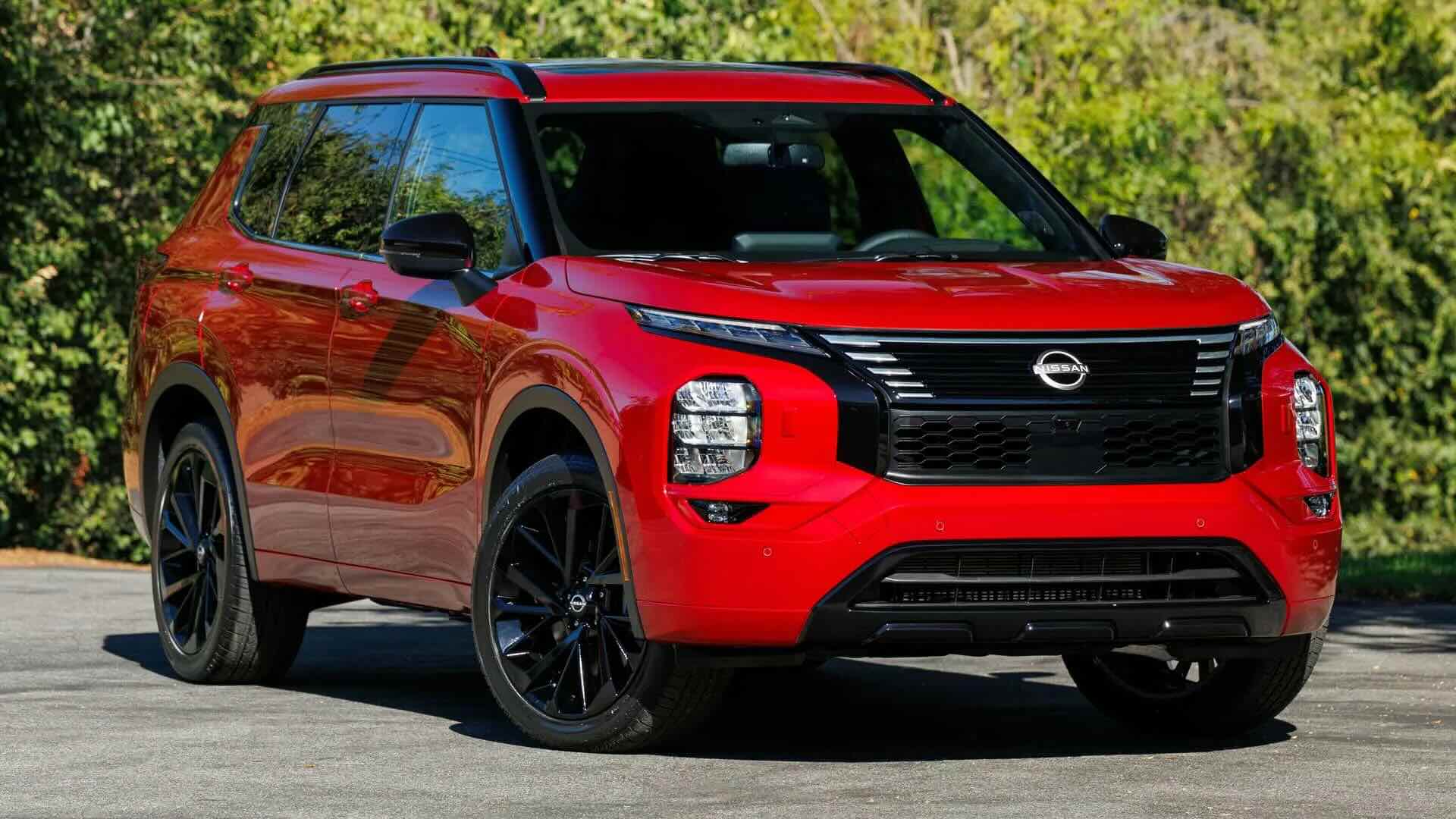

Nissan’s Rogue has sold very well – notwithstanding that it’s not especially roguish. It’s a competent, attractively priced compact-sized crossover – and that’s been enough.
Now Nissan’s offering something more that’s also different – and even a little bit actually roguish: A plug-in hybrid drivetrain without a transmission – it’s got direct drive instead, very much like a full-time EV – that can be driven just shy of 40 miles when the battery pack is fully charged but doesn’t force you to stop for a charge when it’s out of charge. There’s also a lot more power and snappier acceleration.
But it’s not really a Nissan. And it’s only going to be sold for this one model year.
That’s pretty roguish, in a way.
What It Is
The Nissan Rogue plug-in hybrid is actually a Mitsubishi Outlander plug-in hybrid that identifies as a Nissan. Its mechanicals are Mitsubishi but it gets some Nissan styling cues. It also comes standard with a third row, which is not available with the actually Nissan Rogue.
Prices start at $45,990 for the base SL trim – which comes with 20 inch wheels, synthetic leather seat covers, heated front seats, a wireless charging pad, a heads-up display (HUD) and a digital/LCD instrument cluster.
The $49,990 Platinum adds three zone climate control, a panorama sunroof, real leather seat covers, heated rear seats, heated steering wheel and an upgraded nine speaker Bose stereo.
Both trims come standard with the same plug-in hybrid drivetrain, which consists of a 2.4 liter four cylinder engine and a battery pack that can be recharged while driving – using the engine as a generator – or by plugging it in to an external source of electricity.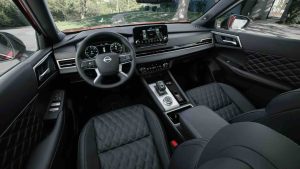
What’s New For 2026
The Rogue plug-in is a one-year-only badge-engineered stopgap. Next year, Nissan will be offering its own, in-house-designed plug-in hybrid.
What’s Good
One of the few compact crossovers (besides the Outlander) that comes with a third row.
It’s an EV that doesn’t make you wait around for a charge.
Much stronger-feeling (and quicker) than the non-hybrid Rogue
What’s Not So Good
Much more expensive than the non-hybrid Rogue (which lists for $29,490 to start).
More expensive than the Outlander plug-in hybrid ($43,245 to start) and the Mitsu’s got more power and a third row, too.
If you run low on charge, you’ll burn a fair amount of gas.
Under The Hood
Both the “Nissan” Rogue plug-in hybrid and the Mitsubishi Outlander plug-in hybrid are propelled by the closest thing extant to a series hybrid drivetrain. This type of drivetrain is very different from the typical hybrid drivetrain, which relies chiefly on the gas engine to turn the wheels that move the car, with the hybrid side providing additional/supplementary power on demand (when maximum acceleration is wanted) and also to power accessories when the engine is cycled off – as when the vehicle isn’t moving (or decelerating/coasting).
That’s a parallel hybrid set up. Almost all currently available hybrids are set up this way.
The Rogue/Outlander combines both ways.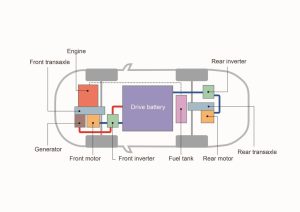
Both the Rogue and the Outlander have a 2.4 liter gas engine but it does not usually turn the wheels. In Pure EV mode (this assumes a fully charged battery pack) the electric motors (front and rear) are what turn the wheels – directly, just like the way it works in most EVs. Ypu can drive this way for about 38 miles – again, assuming a fully charged battery pack. In Series mode, the gas engine serves as a carry-it-with-you generator, making electricity to charge the battery, which powers the electric motors (it works similarly to the old Chevy Volt, for those who remember). In Parallel hybrid mode, a clutch system connects the engine directly to the front axle, to provide motive power to the front wheels (along with the electric motors).
There is no transmission acting as an intermediary between the engine and the wheels. This is a huge efficiency gain and also a simplicity gain in that it eliminates a major driveline component (the transmission) and along with it, a potential down-the-road failure point. Most conventional hybrids have CVT transmissions and these haven’t got the best track record for long-term (post warranty) durability.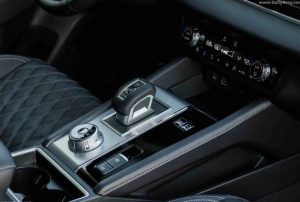
There are some differences, though, between these two Mitsubishis.
The “Nissan” version is less powerful – 248 horsepower vs. 297 for the Mitsubishi – and the “Nissan” goes slightly less far (38 miles) on a fully charged battery, without the gas engine coming online – vs. 40 for the Mitsubishi. Regardless the take-home point here is that either of these two are capable of doing daily short-hop driving without burning a drop of gas, if you start out with a fully charged battery pack. Since this a hybrid, the battery pack isn’t as huge as the one in an EV, so it’s feasible to fully charge it overnight using a common household (120v) power outlet; it can also be charged faster using a Level II (240v) outlet. However – unlike the Mitsubishi version – the “Nissan” cannot use commercial high-voltage DC “fast” chargers.
That’s too bad, because you could get a full charge in about 10 minutes.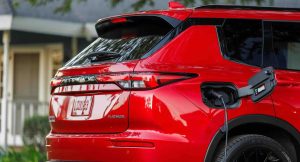
Obviously, 38-40 miles of fully charged, electric-only range isn’t very far but the thing, is you can go much farther than an EV can in a given amount of time because even if you exceed the 38-40 miles of EV-only range, the vehicle keeps on going for several hundred more miles, until you run low on gas. When you do, it only takes a few minutes to fill the tank and off you go. An EV will force you to stop for a charge sooner – and wait much longer, to recover a charge.
The main “problem” here is burning through the gas you pumped into the tank before it starts going bad. The Chevy Volt had a similar problem, if you want to call it that. When used for short hops and kept charged up at night, the gas in the tank sometimes lasted for months. It became a thing to pour some StaBil fuel stabilizer in the tank to keep the gas fresh.
And easier way is to just take a longer drive once a month.
You can pull a small trailer up to about 1,500 lbs. with this rig.
On The Road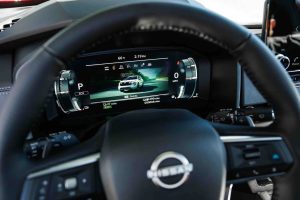
It’s much more relaxing driving an EV when you don’t have to worry about how much range you’ve got left. Or whether you’ll be late to work (or getting home) because you had to stop to wait for 20 minutes to recover some charge.
I use the word – well, the acronym – deliberately. This “Nissan” is technically a hybrid, but it is also functionally an EV. There are other other plug-in hybrids that can be driven 20-30-ish miles without burning gas, but only if you drive with a very light foot; push down forcefully and the gas engine comes on. They also have transmissions that you can feel (and hear). The Rogue plug-in hybrid operates like an EV. It has the same right-now/instant torque (332 ft-lbs) and linear forward thrust that is one of the things EVs have that most gan engines vehicles lack. Though not ludicrously quick, the Rogue can get to 60 in about six seconds – which is about two seconds sooner than the non-hybrid Rogue. The Mitsubishi-skinned (and badged) version of this vehicle is quicker as you’d expect given it has 49 more horsepower. Probably the deal between Nissan and Mitsubishi was that the “Nissan” version of this little crossover was going to offer more power/better performance – to give the Mitsubishi and advantage over the “Nissan.”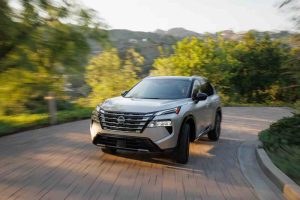
When the engine does come on, it’s much less noticeable than it is when a conventional hybrid’s engine comes on because you feel it as well as hear it – because the engine isn’t connected to a transmission and isn’t connected to the wheels. There is some running engine noise in the background and that’s about it.
On the downside, this little “Nissan” isn’t especially fuel efficient. Once the gas engine is running, you’re looking at about 25 MPG on average (25 city, 27 highway) which is initially startling given just 2.4 liters of engine. But when you find out that the Rogue plug-in weighs 4,674 pounds before anyone gets in, it all makes sense. It takes energy to move a thing and heavy things take more energy to move. This little crossover weighs nearly as much as a mid-1970s Cadillac Sedan de Ville, which was a massive land yacht with a full-perimeter bolt-on steel frame that was powered by a massive cast iron V8.
To make this thing work – from a gas-savings point-of-view – it’s necessary to keep the gas engine from coming on to the extent possible. If most of your daily driving is no more than about 40 miles, this is doable and – given how expensive gas has gotten – it could possibly end up saving you a lot of money. But if you regularly drive longer distances, you may be disappointed by what you end up having to spend on gas.
At The Curb
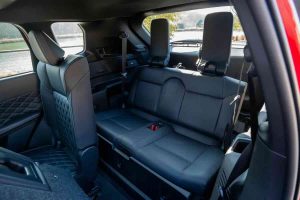
It looks like an extended Rogue but it’s really a reskinned Mitsubishi. Not – as Seinfeld used to say – that there’s anything wrong with that. There are very few small crossovers that offer a standard (or even optional) third row and none that are plug-in-hybrids like these two hybrids. The third row is a squeeze for anyone but kids but that’s just the point. This is a vehicle for families that need the extra seats for kids but maybe don’t want the extra size (most crossovers with three rows are mid-sized or larger). It’s also a way – as regards the Nissan-badged version of this vehicle – to get a three row “Rogue” and stay within the Nissan family, even if this three-row “Rogue” is something like an adopted kid who isn’t biologically related to the rest of the family.
It’s also an easier way to get into a Mitsubishi – and easier to get it serviced, too – because there are many more Nissan dealers than there are Mitsubishi dealers.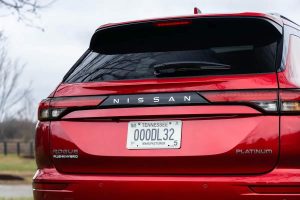
There is a downside to having a third row in a compact-sized crossover. Just open the rear liftgate to see for yourself. The third row takes away a lot of room for cargo. There’s only 12.8 cubic feet left behind the third row – vs. 31.6 cubic feet behind the second row in the actually Nissan Rogue. You can, of course, fold forward the third (and second) row to make more space but it’s not the same as having the completely open space you get when there’s no seat in the way.
While Mitsubishi offers its version of this vehicle in five different trims, the “Nissan” is available in just two, the SL and Platinum. The base SL lists for more than the base ES trim of the Mitsubishi – which stickers for $43,245. The latter also comes standard with a larger (12.3 inch vs. 9 inch) secondary touchscreen as well as a nicer, eight speaker Yamaha-sourced audio system.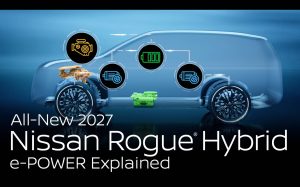
The Rest
Next year – which is just six months away – Nissan will have a full series hybrid iteration of the Rogue on offer. It is likely that it will be more efficient than the current rebadged Mitsubishi and it may be able to go farther on electric power alone. But it’s also likely to be more expensive, since it’ll be “all new.” Meanwhile, you may be able to wrangle a great deal on the current model as Nissan dealers are probably wanting to clear out the inventory they have to make space for the new model (and to avoid having to try to sell the old model side-by-side the new model).
The Bottom Line
If you need a three-row Rogue – and can’t wait until next year – you could buy one this year. But only for about six months longer.
. . .
If you like what you’ve found here please consider supporting EPautos.
We depend on you to keep the wheels turning!
Our donate button is here.
If you prefer not to use PayPal, our mailing address is:
EPautos
721 Hummingbird Lane SE
Copper Hill, VA 24079
PS: Get an EPautos magnet or sticker or coaster in return for a $25 or more one-time donation or a $10 or more monthly recurring donation. (Please be sure to tell us you want a magnet or sticker or coaster – and also, provide an address, so we know where to mail the thing!)
If you’d like a Baaaaa hat or other EPautos gear, see here!








How China’s Geely gets to 48% thermal efficiency
https://www.youtube.com/watch?v=2SyONV_EruQ
“The 2026 Nissan Rogue Plug-in Hybrid achieves approximately 64 MPGe combined when using both electric and gasoline power, and about 26 MPG when operating on gasoline alone. It also offers an all-electric driving range of up to 38 miles.”
https://evcube.net/20260618-every-hybrid-powertrain-explained-mild-hybrid-phev-erev-super-hybrid/
I’ve wondered many times why straight up electric EVs shouldn’t have a small generator range extender built onboard which charges the battery all the time – thus extending the range.
An ICE motor disconnected from the drive can run efficiently at constant rpm.
Apparently this is already being built.
What is an EREV and is it better than a regular hybrid?
An Extended Range Electric Vehicle is a full EV with a backup generator engine. The wheels are always driven by electric motors; the engine only runs when the battery is low. It eliminates range anxiety entirely while providing a pure EV driving experience. Li Auto has proven this formula commercially.
Extended Range Electric Vehicle (EREV)
Li Auto has found remarkable commercial success with the EREV formula: a full electric driving experience with a generator that eliminates range anxiety entirely.
How it works: Built from the ground up as an electric car. Large battery. Electric motors are the primary propulsion. The combustion engine exists solely as a backup generator that activates only when the battery runs low. It runs at a fixed speed optimized for generation efficiency.
Key advantage: Completely eliminates range anxiety. Most drivers can complete their daily commute on electricity alone, while retaining the freedom to drive across the country without planning around charging stops.
Who it is for: Buyers who want a pure EV driving experience but need absolute flexibility for long-distance travel. The GM Chevrolet Volt (2010) first proved the concept; Li Auto has since perfected it.
Hi Jack,
Carrying a generator does solve the range/recharge wait problems – but it addresses a problem that does not exist; i.e., the “problem” with using an engine to turn the wheels.
Every Hybrid Powertrain EXPLAINED in under 9 Minutes
https://www.youtube.com/watch?v=Aq757W93dUs
Plug-in series hybrid vehicles like this actually, on some level, make sense.
You get the best of both worlds while end running the worst of both worlds. As such, plug-in series hybrids actually do help you Burn Less Fuel.
You have electric power from the batteries for short trips around town, and when that runs low, or you’re taking a longer trip, you have the gasoline engine which powers a generator that recharges the battery and provides power to the electric motors that drive the wheels—like a diesel locomotive, which is one of the most efficient transportation machines out there. Plus, you can plug in with standard 110 volt or 220 volt dryer plugs. No range worries there.
I know someone who had the Chevy Volt. He had to add Sta-Bil to the gas tank because of how little gas he used.
Question is, why aren’t more vehicles like this? Maybe they make TOO much sense and work TOO well?
The Volt was an electric car I might actually buy (if I had to). It was actually practical.
GM has a longstanding & exasperating tendency to come out with stuff that is actually good, only to kill it off after only a few years for unclear reasons.
My “review”:
Thumbs down.
Much too expensive versus the ICE version and I don’t like the name rogue. The word rogue primarily refers to a dishonest, unprincipled, or mischievous person, or something that acts independently and unpredictably outside of established rules
“can be driven just shy of 40 miles when the battery pack is fully charged”
EP
Were you able to check this claim?
Car and Driver Testing: In real-world 75-mph highway range tests of this shared powertrain, the vehicle typically delivers around 24 to 26 miles of pure electric range. This drops because highway speeds drain EV batteries significantly faster.
Independent reviews from outlets like Cars.com and automotive journalists indicate that in stop-and-go city driving, the regenerative braking system successfully extends the battery life, making the 38-mile target achievable
PHEV Rogue: When the dashboard says 100% charge: The battery is physically only filled to roughly 80%–85% of its absolute engineering limit. When the dashboard says 0%: The car automatically switches to hybrid mode, leaving roughly 15%–20% of the energy reserved so the battery never truly bottoms out
Mitsubishi Outlander plug-in hybrid
The 2023 through 2025 model years of the Mitsubishi Outlander PHEV feature an EPA-estimated 38 miles of all-electric range. However, the 2026 model year refresh introduces a larger battery that increases this range to an EPA-estimated 45 miles.
PHEV Rogue prices start at $45,990 for the base SL trim
The non-hybrid Rogue (which lists for $29,490 to start)
$16,500 more seems ridiculous to me
PHEV Rogue tire size: 255/45ZR20
ICE Rouge:
235/65R17 – Standard on the S AWD trim in North America
which suggests a smoother ride vs. the PHEV Rogue with a 45 aspect ratio
If you want a rounder, more comfortable ride that absorbs bumps better, a 60 aspect ratio will feel softer than a 45 aspect ratio. If you prefer firmer handling, sharper steering, and less road feedback, a 45 aspect ratio will feel stiffer and more direct.