

GM used to have more than one luxury division and one of them was Oldsmobile. It was a kind of stepping stone to Cadillac – or a step back away from Cadillac, which was (and still is) a little too visually much for some buyers who want the luxury but not necessarily the flash (GMC fills the step-back role in today’s GM hierarchy of brands).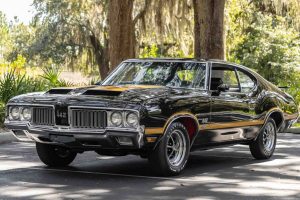
Oldsmobiles could also be a little rowdier, but in a subtler way. Models like the Cutlass-based 442 were basically Pontiac GTOs for the man (it was usually a man) who wanted to go fast but look more mature when he pulled into the parking lot at work. Like Pontiac – and Buick – Oldsmobile produced its own line of V8 engines, all the way into the 1980s, when the last iteration – the 307 – was finally cancelled as part of GM’s “corporatization” of its engine offerings, which ended the separate engine-designing and producing operations of most of its various divisions. It was around the time of the snuffing of the Oldsmobile V8 that GM also snuffed the rear-wheel-drive platforms that used to be the homes for the Oldsmobile V8.
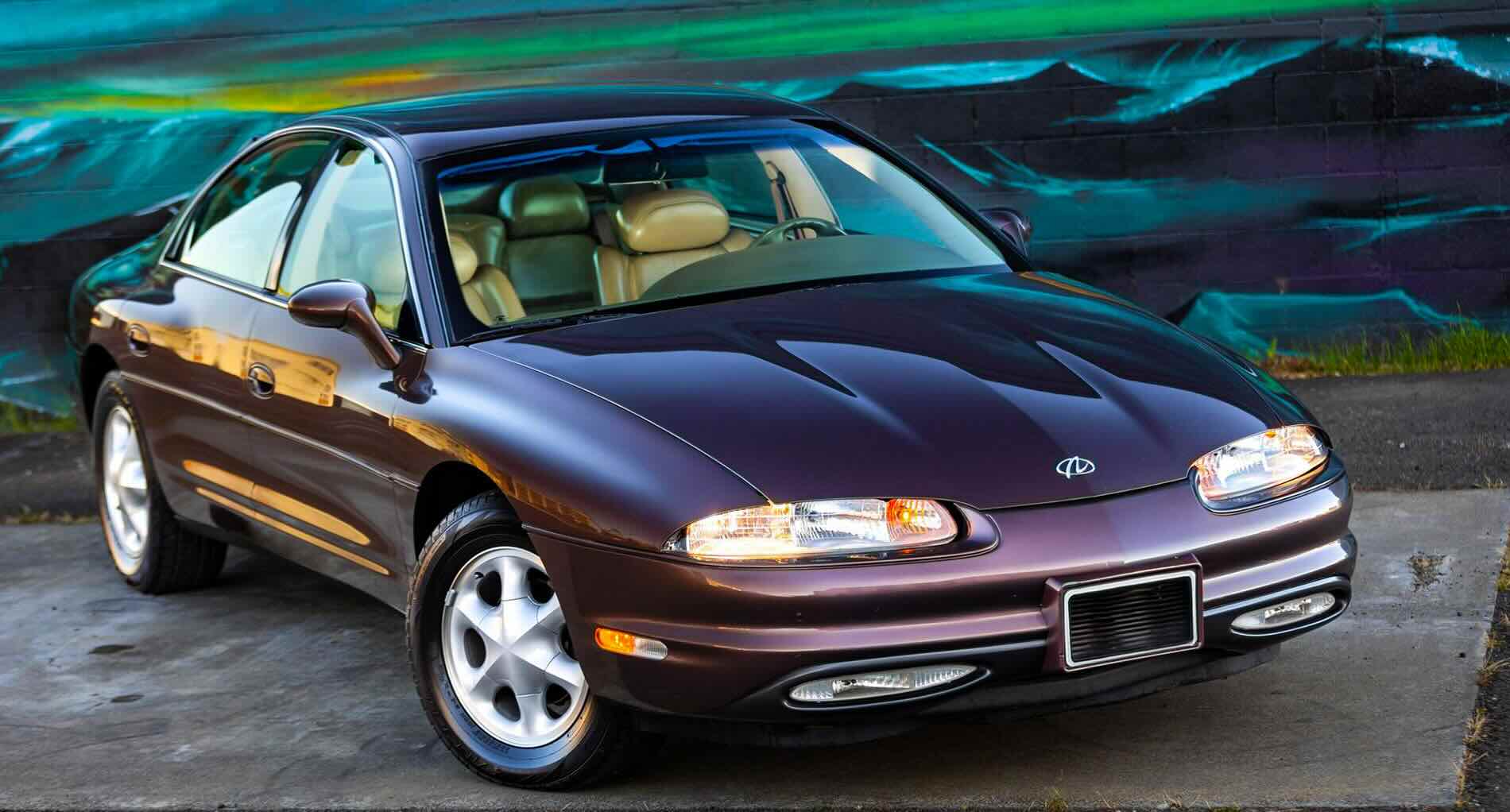
But there was one last hurrah for V8-powered Oldsmobiles – even if the V8 wasn’t Oldsmobile’s and even if the car it was used in wasn’t rear-wheel-drive. That car was the Aurora, which was introduced 1993 for the 1994 model year. It would prove to be one of the last Oldsmobiles and also the last Olds that was V8-powered. It was also supposed to save Oldsmobile, which it didn’t do. The brand was cancelled back in 2004, after 107 years of continuous production and more than 35 million vehicles sold, including some best-sellers like the Cutlass.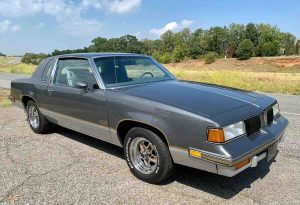
The car only made it to 2003, when the “Final 500” were made.
Interestingly, Oldsmobile – like Pontiac – was very successful while it was still designing and producing its own V8s and putting these into rear-drive models like the Cutlass, which was the best-selling car in America back in 1979. More than half a million were sold back then, when America’s population was about 225 million, or about 100 million less than it is today. Today, the best-selling vehicle in America is the Ford F-150, which Ford sells about the same number of in proportion to today’s population of roughly 320 million.
Olds only manages to sell 213,799 Auroras over a nine-year production run. So how come it failed?
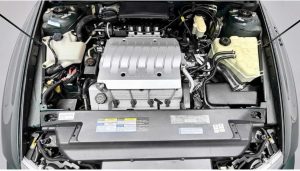
GM’s decision to cut the beating heart out of Olds (and Pontiac) was probably the main reason why. This was done as a compliance measure. Every different engine had to be run through the compliance rigamarole required by the federal government. Each had to be individually “certified” as compliant with federal emissions standards and this cost money. GM had to spend it on engineering resources for each of its division’s separate engine lines. So – to save money – GM made the understandable but fatal (to Oldsmobile and Pontiac) decision to stop making Oldsmobile and Pontiac V8s and put Chevy V8s in Oldsmobiles and Pontiacs. Of course, even that stopped after awhile, because why buy an Oldsmobile or Pontiac with a Chevy V8?
Or a Cadillac V8?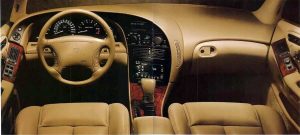
That’s what was under the hood of the last Oldsmobile to come with a V8 engine. The Aurora’s V8 was a slightly smaller, slightly less powerful iteration of the Northstar V8 that GM used in various Cadillacs of the era, including the STS – which at the time was the division’s flagship model. Unlike the old-school Olds V8 – which was a single cam, overhead valve design made out of cast iron – the Aurora’s Cadillac- sourced 4.0 liter V8 was DOHC and aluminum. It produced a claimed output of 250 horsepower and 260 ft-lbs. of torque, which were impressive numbers back in 1994.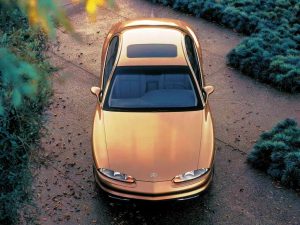
I thought so, at any rate.
In ’94, I had just begun writing car reviews and the Aurora was one of the first new cars I got to test drive – in an official capacity. I remember running it up to about 120 MPH on New York Avenue in DC at around 3 in the morning, on my way to work at The Washington Times. The thing had ass, people say out in the country. It felt quicker and was definitely faster than the Olds 403-powered ’79 Trans-Ams I’d test-driven unofficially before I got the Times gig. It was also much smoother and far quieter and definitely got much better gas mileage.
And yet, there was something lacking. An Oldsmobile badge, for openers. GM did this weird thing of disparaging the brand it was trying to use to sell a car. The Aurora was just “Aurora” – and the ad copy said it wasn’t “your father’s Oldsmobile,” implying the Olds brand was for old people. How do you get people to buy a car under a brand label you’re embarrassed by? 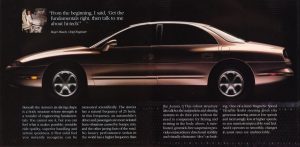
There was a deeper problem.
The Cadillac Northstar V8 was a fine engine – once they got the teething problems sorted out – but it wasn’t an Oldsmobile engine, without which the Aurora was something less than an Oldsmobile, for the same reason a Big Mac wouldn’t be that if instead of two all-beef patties it had two sausage patties. Not that there’s anything wrong with sausage.
The point is it’s not beef – and without that, you haven’t got a Big Mac.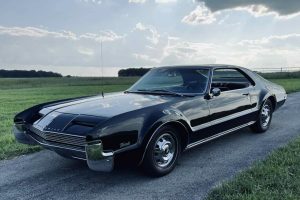
It didn’t help, either, that the Oldsmobile brand had been losing altitude fast for years before the ’94 Aurora got to dealers. The record high of 1,066,122 Oldsmobiles sold in 1985 had piddled down to just 402,936 by 1993. Probably not coincidentally, back in ’85, Olds was still selling Oldsmobiles such as the Cutlass and Delta 88 and 98 equipped with Olds V8s.
But it wasn’t the FWD that doomed Aurora.
Oldsmobile had a big hit on its hands back in 1966, when it introduced the visually arresting – and FWD – Toronado, which was the first FWD American car made since the coffin-nosed Cord 810 of the 1930s. In addition to being drop-dead gorgeous, the ’66 Toro also came with an Oldsmobile 425 V8, which of course no other-brand GM car had.
This is what made it uniquely Oldsmobile.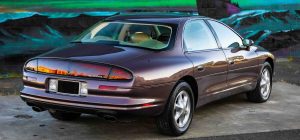
The Aurora was something less than that. Also, its styling – while “futuristic” – was not stunning. The distinction matters. Most people under 30 today think of cosmological phenomena when they hear Aurora. Not the car. But everyone who has eyes to see turns to look when a ’66 Toronado passes by. You can’t help but look at it. The thing is that beautiful.
Still, it is sad that the Aurora wasn’t able to staunch the bleed. Oldsmobile itself was put to sleep one year after the Aurora. Both had to fight with one arm tied behind their back – and with the parent company not really in their corner.
The outcome was inevitable.
. . .
If you like what you’ve found here please consider supporting EPautos.
We depend on you to keep the wheels turning!
Our donate button is here.
If you prefer not to use PayPal, our mailing address is: EPautos 721 Hummingbird Lane SE Copper Hill, VA 24079