

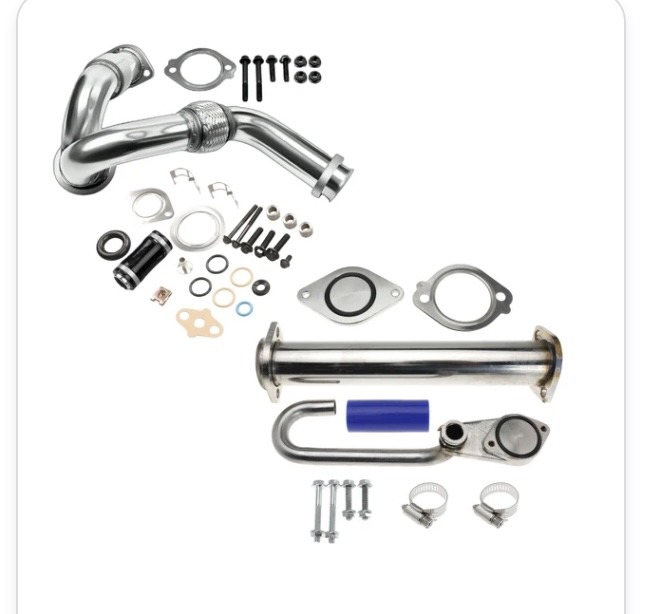

Owners of diesel engines are well familiar with the fine line between high performance, reliability, and meeting emissions standards. The engines now have an impressive ability to deliver power and efficiency, but the systems put in place to achieve these results while complying with environmental regulations can create a lot of restrictions that can impact the health and usability of the engine.
Of all these systems, Exhaust Gas Recirculation is one of the most troublesome and can lead to a multitude of repair costs and component failure. Here we focus on specific engines, such as the Ford 6.0 Powerstroke, and on off-road or competition use, where EGR delete kits are intended to be applied.
This article delves into the principles behind EGR systems and their inherent weaknesses, before explaining how delete kits can aid the restoration of any diesel engine to its optimum performance by removing the sources of carbon contamination and thermal stress from factory configurations.
Understanding Diesel Exhaust Gas Recirculation (EGR)
What is an EGR System and What is Its Primary Purpose?
The EGR system was designed to help minimize Nitrogen Oxide emissions by recirculating some exhaust gas back to the intake manifold. Incorporation of inert exhaust gases reduces the maximum combustion temperatures, thereby reducing the formation of NOx. This method meets NOx standards, but it does so at the cost of continuously exposing the intake tract to carbon particles.
How Recirculated Exhaust Gases Impact Combustion Temperatures and Emissions Compliance
Recirculated exhaust gas will replace fresh oxygen with exhaust gas, which will decrease combustion efficiency while decreasing NOx. Under certain operating conditions, replacing fresh charge with inert gas can reduce combustion efficiency and require more fuel to deliver the same power; exhaust temperatures may also shift depending on load and calibration.
The trade-off between compliance with emissions standards and engine efficiency is the inherent weakness of EGR design.
Why Factory EGR Systems Cause Engine Problems
Carbon Buildup and Soot Accumulation in the Intake Manifold
Exhaust gas carries soot particles that, combined with oil vapor from the PCV system, deposit throughout the intake system. This carbon builds up on intake valves, manifold runners, and intercooler passages over time and can gradually decrease the amount of air that flows through them. The accumulation forms hot spots, causing high thermal stress and low combustion efficiency.
The Vulnerability of the 6.0 Powerstroke Engine
Common Factory Failure Points in the Ford 6.0 Powerstroke EGR Cooler
The Ford 6.0 Powerstroke earned an infamous reputation, and one major contributor was its EGR cooler design. The factory cooler’s inadequate construction cannot withstand the thermal cycling and pressure demands of heavy-duty use, leading to premature failures that often strand owners on the roadside.
The Risk of Coolant Boiling, Oil Cooler Failure, and Head Gasket Damage
When the EGR cooler fails, coolant enters the exhaust stream, causing white smoke and rapid coolant loss. The resulting low coolant level and elevated temperatures, combined with an already restrictive oil cooler positioned beneath the EGR cooler, raise oil temperatures and increase the risk of head gasket failure. These cascading failures make heavy-duty 6.0 Powerstroke EGR delete systems an essential upgrade for reliable operation in off-road and competition applications.
How EGR Delete Kits Restore Engine Efficiency
Complete Removal of Soot-Filled Exhaust Gas Recirculation
Soot is mixed with oil vapor from the PCV system and forms a dense sludge that causes turbochargers and piston rings to wear out. This dirt decreases the economy of the vehicle’s fuel consumption, affects throttle response, and causes a substantial decrease in the lifespan of the components.
Left unaddressed, this cumulative effect can turn a good diesel engine into a poor one that needs lots of maintenance and care; an EGR delete prevents further degradation rather than restoring lost efficiency. Actual efficiency gains depend on baseline condition and tuning.
Cleaner Intake Air Flow and Lower Operating Temperatures
With EGR flow removed and the ECU recalibrated, many owners report cleaner intake airflow and lower operating temperatures. After appropriate tuning, reported improvements include crisper throttle response, power delivery, and fuel economy, while thermal stress on critical components is reduced.
Key Benefits of Upgrading Your Diesel Engine
The engines have been improved to run more efficiently and at lower exhaust gas temperatures with only fresh, cool air in their combustion chambers. Proven EGR delete kits provide instant throttle response, power output, and fuel economy benefits after tuning, and minimize thermal stress on important parts.
Improved Fuel Economy and Throttle Response
Once EGR restrictions are removed, clean power is delivered throughout the RPM range, resulting in crisp throttle response and making for better fuel economy – which builds up over thousands of miles. With EGR flow removed and the ECU recalibrated, many owners report crisper throttle response and modest fuel-economy gains over time; it also eliminates the EGR cooler as a failure point.
Enhanced Long-Term Engine Reliability and Reduced Maintenance Costs
Using an EGR delete kit can address one common failure path (EGR cooler and intake carbon) and help to prevent the root cause of many diesel engine failures, increases the lifespan of the components, while also decreasing maintenance costs. Owners save on the costly repairs that can be required if the coolers fail, the carbon needs to be cleaned, or—in severe cases—the turbocharger must be replaced.
Important Considerations Before Installation
Owners are strongly advised to check local emissions legislation, as EGR deletes are designed for off-road use and competition only. The check engine light may be on after installation, and performance will be suboptimal until custom-tuned.
Leak-free operation and long life depend on professional installation and correct bleeding of the coolant system. On-road use may violate emissions laws and fail emissions testing.
Conclusion
For off-road/competition diesel owners, particularly those running 6.0 Powerstroke engines with a history of EGR cooler failure, an EGR delete, properly installed and tuned, can remove a known failure path and reduce intake carbon. It is not a universal efficiency fix, and on-road use may violate emissions laws.
For serious dieselers, these changes can offer better performance, increased efficiency, and a longer service life, provided the compliance and tuning requirements above are met.