


Orwell was on to something when he examined the mentality of certain kinds of people in a scene in his novel, 1984 wherein the character Parsons – who is described as one of those people who will eagerly swallow the most outrageous absurdity, expresses exultant happiness about Big Brother having increased the chocolate ration. In fact – as the novel’s hero Winston Smith understands perfectly well – the chocolate ration had just recently been reduced.
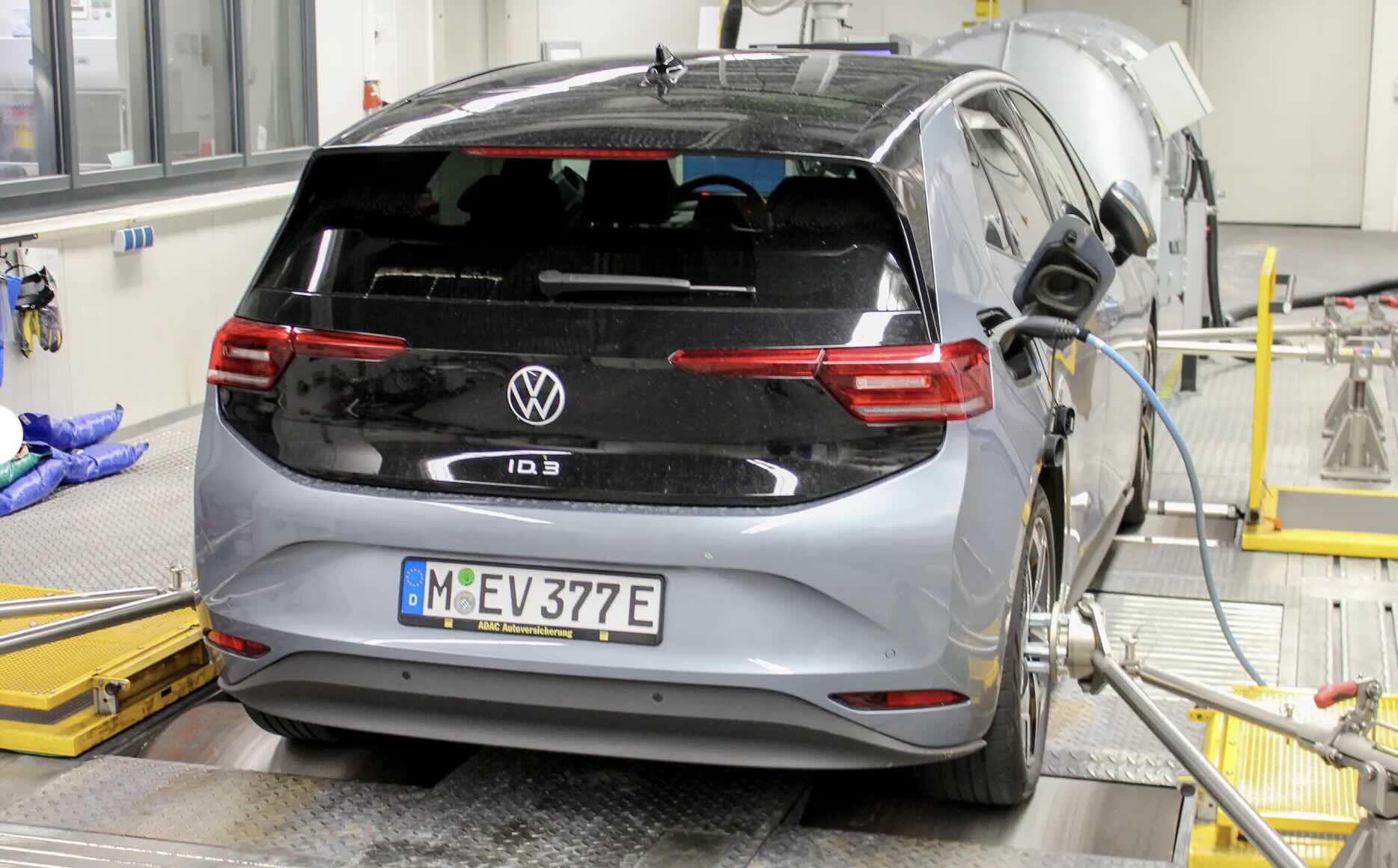
Maybe Parsons is working for ADC, which is a German roadside assistance company. Kind of like AAA. Anyhow, the company says it tested the battery pack in VW’s ID3 device and found that after 100,000 miles of driving, it only lost just shy of 10 percent of its capacity to hold a charge.
Italics added.
The ID3 is basically an “electrified” version of the Golf. VW does not sell this device in North America; it is a Euro-market only device. Now, a couple of interesting things about this device. The first being that it has only been available on the retail market since 2020 – and as everyone knows, that was the high-tide year of the (cough) “pandemic.” This is relevant because most people weren’t allowed to drive much that year. So, in real-world terms, the ID has only been on the road for about four years. Most people drive their vehicles around 12,000 miles annually but devices get used much less regularly – because they are devices. More particularly, because they are hard to drive long distances regularly on account of their synergistically compounding short range/long recharge times. Most device owners use their devices irregularly and for mostly local, short-distance driving. So their devices tend to accumulate fewer miles each year than most vehicles do.
This means there’s not yet sufficient real-world driving data to establish the rate at which (and the extent to which) the ID3’s batteries lose charge capacity. But let’s look at what ADC discovered after driving an ID3 around for about four years.
The report says the device had only lost just shy of 10 percent of its original charge capacity. This was touted in much the same way that Parsons touted Big Brother’s increase (decrease, actually) of the chocolate ration. It is astounding in its insolent absurdity. Would anyone abide the loss of nearly 10 percent of the originally touted city/highway mileage of a vehicle after as little as four years of driving and just 100,000 miles (the latter figure being about middle-aged for almost any vehicle, which typically will run without suffering a major mechanical failure for at least 200,000 miles and 15-plus years.
No, they would not abide it. The government would certainly not abide it. There would be recalls and lawsuits. Not just over the loss of nearly 10 percent, either but also because of what that loss portends.
Well, as regards devices.
Asl anyone who owns a device – a laptop or smartphone, for instance. What typically happens is the device accepts and holds charge for a time. Then the time comes when it begin to lose charge. Once this starts, it always gets worse. In no time at all the device no longer holds any charge at all and is only usable if it is kept plugged in. That can work – for a device that does not have to move. That can be kept plugged in while it is used. But it does not work for a four-wheeled-device. When it is plugged in, it cannot be used for its (putative) principal purpose; i.e., to transport people from one place to another place. At that point, the device is useless, in other words.
So, when ADC exults that only about 10 percent of the ID3’s original capacity to hold charge has been lost, it is not letting the marks know that only about 10 percent is just the beginning of the loss. What will it be after another year – or four? Let’s say it’s only 20 percent. That would amount to a loss of about 54 miles of driving range off the ID3’s new-device 272 miles of fully charged range, leaving 218 miles of driving range. And since the actual driving range you will typically get out of a device is often 10-20 percent less than indicated (sometimes even more than that) it isn’t really even 218 miles. Not 218 miles you can count on, at any rate. When driving an EV, it is always prudent to assume you have less range than indicated; otherwise, you may not make it to where you were wanting to go.
Or where you can get more charge. Assuming you can get it there. 
Back to the just-shy of 10 percent thing. Even if it’s only that much – and even if it isn’t the beginning of more – it’s still a loss and so a gyp, just the same as Big Brother’s cutting down the chocolate ration. But – like Parson’s – we’re supposed to regard this as good news and smile with vapid enthusiasm.
It’s a measure of the extent to which what was once regarded in the West as a brilliant work of cautionary fiction has become a kind of literary documentary about what has become of the West.
. . .
If you like what you’ve found here please consider supporting EPautos.
We depend on you to keep the wheels turning!
Our donate button is here.
If you prefer not to use PayPal, our mailing address is:
EPautos
721 Hummingbird Lane SE
Copper Hill, VA 24079
PS: Get an EPautos magnet or sticker or coaster in return for a $25 or more one-time donation or a $10 or more monthly recurring donation. (Please be sure to tell us you want a magnet or sticker or coaster – and also, provide an address, so we know where to mail the thing!)
If you’d like a Baaaaa hat or other EPautos gear, see here!









Democrats’ all-electric USPS fleet sees each truck come with a $6.8 million price tag
https://www.americanthinker.com/blog/2025/07/democrats_all_electric_usps_fleet_sees_each_truck_come_with_a_6_8_million_price_tag.html
Matson Suspends Shipping EVs Citing Hazards of Lithium-ion Batteries
https://maritime-executive.com/article/matson-suspends-shipping-evs-citing-hazards-of-lithium-ion-batteries
There exists a solution to this problem, as demonstrated by bumper cars and electric trains. It would also produce ozone.
Well, they solved one of the charging problems.
https://www.youtube.com/watch?v=i30DGB82A5o
I want to be trendy like EV owners! I’m making some minor modifications to my 1979 Firebird in order to fit in.
I punched a pinhole in my gas tank in order to drip gasoline out of the tank at a loss of about 10-20% per tank, depending on how fast I drive. An additional pinhole in the tank is actuated any time the AC or heat is activated.
I then installed a restriction in the fuel filler neck to only accept gasoline from the pump at a rate of 1/2 gallon per minute.
Next, I installed an app on my phone that directs me to boarded up old stations with no gasoline 50% of the time while on long trips.
I installed a sand injector into the oiling system of the V8 engine in order to require an engine replacement every few years.
I installed a kill switch into the ignition that allows remote shut-off at any time by our savior Elon Musk.
Finally, I attached 1,000 pounds of weight lifting plates to the underside of the car. I won’t be needing them anymore, now that I have switched to a high soy diet.
You’re almost there. You just need to upgrade so that your 1979 Firebird has a much higher risk of uncontrolled burning if it gets wet.
ROTFL – great post Philo!
1/2 gallon per minute, SMMFH. Please don’t give the Lilliputians any ideas.
You just know they will try something like that. Make car owning so annoying you quit.
‘I won’t be needing [weights] anymore, now that I have switched to a high soy diet.’ — Philo Beddoe
You’ll be wanting the custom front plate I spotted this morning on the plug-ugly schnoz of an F-350:
https://postimg.cc/qg7MpwMd
I bawled with laughter. Either this dude actually answers spam emails headlined ‘Increase your length and girth’ … or else the owner is a dyke. 🙂
Ha. If you got to say it, you ain’t.
EVs are a great example of trying to market a bad product. Emphasis on the positives and ignore the negatives. Well, what are the positives?
You can charge it in your garage. OK, fine. If there was a big demand for being able to refuel at home there are plenty of storage tank solutions for gasoline that are probably about as safe as lithium batteries, and plenty of companies that will keep it refilled for you too.
Nearly silent and vibration free. An inline six is an extremely well balanced engine. You can’t really feel it at idle. Adding proper mufflers can deaden engine noise, as if you’d want that. Most of the noise in a modern automobile comes from the road surface and wind, not the drivetrain. Given the weight of the EV road noise will still be a problem if not worse.
“Saving” the environment. Of course, because there’s no tailpipe, right?
The ability to charge at home was a huge selling point here in Central Texas, where memories still linger from the Labor Day weekend 2017 “gas shortage” which I Heart Radio created after one storm event caused a refinery explosion in Houston.
Never let a crisis go to waste, and I Heart had a new ad deal with GasBuddy.com.
Displacing emissions from dense urban areas to a rural generating station has some traction. No one wants air pollution and even though they’ve come a long way in cleaning up exhaust an EV is truly zero emissions.
But yes, they’re lying, greedy and not being honest. EVs requiring mining and manufacturing. We know that but most people assume an EV was conjured into existence by a genie wearing Birkenstocks.
It’s also not honest to say where we stand today is necessarily sustainable since it’s probably true that coal and oil will become less easy to get. We’ve built a world that assumes oil just bubbles out of the ground forever.
Will that always be true? We’ve already gotten much of the close to surface stuff so mines and wells have to be deeper and we have to go to under sea sources. At some point the economics might favor nuclear and electric cars for routine travel, saving ICE for long trips where it still clearly is better. Nothing wrong in that and if they’d have sold it like that maybe it would be different. You can’t separate the political nudges here either. The subsidies, the regulations, the taxes have distorted the market for everything. Maybe oil should cost more, maybe less. Cars themselves maybe should cost more, maybe less. We’ll never know since real market discovery is impossible when they’re writing thousands of pages of new distortions annually on top of millions of existing ones.
Yet, a change in energy balance is a legitimate question. Maybe in our generation, it might be 100 years in the future. Only mother nature knows. I figure we might just have to ease up to let the oil pools refill since peak oil scares from 40 years ago have proven to be incorrect.
It’s about trade-offs in how we use resources and the end result. They’ve sold “green” on pixie dust promises and absurd negatives (climate change as a political tool).
I’ll say this, if you ignore the quicksand foundation they used to build the EV market more development in batteries has occurred in the past decade than the previous century. So it’s not without some upside. It’s a chicken-and-egg question. Maybe an EV is viable if there’s a 4th or 5th generation to lithium or a step function in finding other types of batteries.
Until the EV market there’s never been anything that really pushes battery technology as hard. Prior to EVs the only significant reason to improve batteries was aerospace and we found what we needed in lithium types in the 1960s. The industry is in actuality very risk averse so it wasn’t going to test novel ideas, no one wants to be the first to test a new thing on orbit using their dime. None of their ideas was likely to get out of a lab if it was just spacecraft and airplanes as applications.
Who is the “we” you speak of? “Until the EV market there’s never been anything that really pushes battery technology as hard. Prior to EVs the only significant reason to improve batteries was aerospace and we found what we needed in lithium types in the 1960s. The industry is in actuality very risk averse so it wasn’t going to test novel ideas, no one wants to be the first to test a new thing on orbit using their dime. None of their ideas was likely to get out of a lab if it was just spacecraft and airplanes as applications.” -Peter Parker
Maybe steam technology should be pushed harder; maybe a combination of lead acid with a backup motor, maybe compressed air, etc. That’s not for “us” to determine and fund (subsidize). Rather, that’s the job of the entrepreneurs in society to ponder and risk their fortunes on. If a free market existed, the most viable technology would rise to the top. This is generally what happened during the mid-20th century. By the late 1990’s combustion engine technology was virtually perfected. What’s wrong with the automobiles that were produced in 1999? Why do “we” need to “improve” them with EVs?
“We” is my co-workers and me. I work in aerospace, my job is the spacecraft C&DH. Specifically in context one thing I do is design battery chargers and power supplies for satellites. I’ve seen lithium cells blow up, we do first article testing in bunkers at the far end of the campus.
My point is that batteries haven’t really progressed for a long time. Better ones are of interest to me, call it professional curiosity. I’m at the end of my career and they’ve been pretty much the same thing for 30 years.
Whether EVs improve or not, I don’t care that much. I have no need for an EV, steam car or to replace my ICE at all really. I’m also about proven things we have at hand, one of which is mature nuclear power,. In world that wasn’t so twisted by bias and politics that could give us exceptionally cheap electricity, which could tilt scales towards electrical devices, too.
But that’s not reality.
“peak oil scares from 40 years ago have proven to be incorrect” – Peter Parker
ALL the scares from 40 years ago have proven to be incorrect.
It boils down to this, if someone is trying to scare you into getting what they want, they’re full of crap. And fear mongering is what powers GovCo
The push for EV’s came from the (((governments))), not private industry.
That, and the increase in government mandated safety requirements for vehicles. The (((governments))) tax breaks, government incentives, inc, were such to the point that vehicle manufacturers were deluded, due to (((government influences))), to produce devices, which no one, but a small portion of the public was interested in buying.
And here we are today…..YMMV….
Perhaps the math isn’t realistic in other ways too…. Do EV owners actually drive their devices 25,000 miles per year (100,000 divided by 4 since 2021) or even 20,000 per year (divided by 5 since 2020). Like you said, Eric, most would drive them less not more. I live in the boondocks and easily drive that much in a year which is another good reason for me to never own a device
I had this conversation with my insurance agent recently. Seems the average car in Colorado moves between 15K and 20K annually, so with two cars and two drivers that probably works out to 40-50K per household, assuming one car travels much further than the other. That’s the whole state, so the front range figures into that number significantly. Out in the Wild West where I live we drive 20 miles to Walmart and 30 for dinner (that’s one way). So 25K is probably about right for a suburban Deutschlander.
I’m not sure that’s true. The typical SLC I-15 or Denver I-25 urban corridor dweller is likely doing 100 miles every day shuffling across town. They then tack on a couple to few hundred on weekends escaping the pressure cooker.
I think rural people tend to fall into two more extremes. People like you (I assume) who are all over a wide geographic area really rack them up or others (like me) who have exceptionally short commutes (about 3 miles) and only do a long trip maybe once or twice a week. I put less than average annual miles on my truck but it comes in big chunks when I do. It’s why I have a 7.3L with only 230,000 miles (about 10K/year) on it.
Good point. There are plenty of Aspenites who never past the airport or Independence Pass except for the rare trip to Rudi for the yacht races. And there were the locals up in Grand County that would make the annual trip to the doctors’ office in Denver and that’s about it.
I’m far too interested in looking around this amazing world, and really start feeling tied down when I don’t have a long weekend or road trip out to the desert. One reason why I’m building a camper van is so I can look at all the places between cities and maybe find some hidden gems.
The gas tank only shrank 10% after 100,000 miles!
People aren’t supposed to ask how much capacity the battery will lose over any number of years. The plan was simple, people would trade these devices in every 3-4 years. Perpetual payments for the renter class. The system was perfected with smart phones. Where people trade them in and the cost of the device is wrapped into the monthly bill. The ones pushing this pap didn’t count on the plebs ever coming to their senses. buyers remorse is a helluva thing. Even the most ardent climate alarmists are stepping away from EVs. And to think, VW caved when it came to a fraction of a fraction emission error, Now a 1O% miss is no big deal.
That’s the entire goal—to make you always have a car payment.
You see, starting in the late 1990s, thanks to, of all things, increased emissions, safety, and fuel economy regulations, cars got to be TOO well designed and built. Gone were the days of engines and transmissions conking out and bodies and frames rusting through in as little as five years. It became feasible to drive a car for more than 10 years and 100,000 miles.
That was a great thing for car buyers—not so much for car makers. They built their business model around trading in vehicles every 3-4 years. That model was upended.
That’s why so many car makers hopped on the EV bandwagon. People would once again be trading in their cars every 3-4 years—because their EVs are unusable by that point.
At least under the old model, you could choose not to trade in your car every 3-4 years by maintaining it properly and treating it well. With EVs, that’s not an option.
“ That’s the entire goal—to make you always have a car payment “
I’ve been thinking this recently as well. Frankly, gas or electric it’s the same goal. The computer riddled gas car with sketchy electronics system – the battery car with a failing battery pack. Five years in, what to do when the magic touchscreen goes dark and/or that expensive battery gets weak? Well just trade ‘er in on the next financial time bomb!
Then the leasing scam for cars. Remember the goal of a lease was to allow companies to preserve capital but get the equipment needed for the business. I had a coworker who used to work automotive leasing, his point was a consumer vehicle lease isn’t really a lease – when you have to drop 3k to 5k upfront that’s not a true lease. What a windfall for the car companies! Grab the cash while convincing the public what a deal! New rig for way less payment than actually buying the car. Not mentioned the ugly end after 3 to 5 years the easy out grab a new rig another lease & permanent payment merry go round.
The prevailing complaint is how cheaply built and nanny-laden EVs are but all new cars are the same. Plastic suspension parts and even some engine critical like water and oil pumps. The design life for a new gasoline car is probably no significantly longer than an EV.
My 2018 Grand Cherokee has a mechanical issue and now an electronic issue. Left rear “oil can” combined with what may be a loose spring “twang” over large bumps although the trusted shop did my alignment didn’t see anything wrong.
The electronics – handy dandy door unlocker via hand entering the outside door handle is now part time. Sometimes it works, and then other times 3 to 5 hand motions to wake it up.
Meanwhile the not handy but reliable mechanical keys for the ‘91 Silverado truck still functioning like they did 34 years ago.
As does everything mechanical and electrical in that truck!
“You see, starting in the late 1990s, thanks to, of all things, increased emissions, safety, and fuel economy regulations, cars got to be TOO well designed and built. ”
These are all requirements that had to be met by the engineers but they had absolutely nothing to do with how cars are designed and built.
Similar to my comment yesterday, these sorts of comments only serve to show that people are commenting about manufacturing and engineering as if they know with certainty what was going on within the industry. Yet, the commentary only serves to show that the average Mericun knows nothing about engineering and manufacturing an automobile specifically but almost anything in general.
USSA has become a consumer culture with almost zero knowledge of what it actually takes to produce anything.
Not intended as a personal attack on Bryce or anyone else. Until the average person has some understanding of what it takes to produce products we are doomed to consumerism.
Of course it’s only 10% in Germany. It makes you wonder what the range loss would be in Alaska or Texas where much hotter or colder temperatures prevail. EV lovers would be driving with the windows down in Texas and wearing a parka in Alaska to maximize range. Sadly the real loss occurs in around 8 years which they don’t talk about.
Florida, where a lot of the EV battery horror stories seem to originate, would be a better test.
Anything south of Gainesville is a swamp and a harsh marine environment most of the year.
But, if shouting from the rooftops the Good News that the VW loses ONLY 10% in 100k miles, doesn’t that imply that other battery powered devices lose MORE than 10% over the same period?
It’s sad to watch people push the rope of progress. As Oat Willie said, “Onward through the fog!”
Thanks for mentioning who came up with, “Onward through the fog!”
It led to an interesting read:
‘Oat Willie on the cover of the Rag – December 6, 1976’
“… What’s that you say? Oat Willie isn’t a real person? Nonsense!!! Let me tell you about him.
Quoting now from the December 1987 issue of Texas Monthly an article titled ONE MAN, ONE OAT:”…
https://www.reddit.com/r/Austin/comments/105poow/oat_willie_on_the_cover_of_the_rag_december_6_1976/
Also, RE: “push the rope of progress” – I like that one.
Glad you like it, helot. It was inspired by Bob Hope when, at 90-ish, he was asked about having sex. His reply, “It’s like shooting pool with a rope.”
Another Bob Hope joke:
I’ve just flown in from California, where they’ve made homosexuality legal. I thought I’d get out before they make it compulsory.