


An interesting and creepy thing about using EV fast chargers is that it’s difficult (if not impossible) to use them if you have not joined the collective. The latter is a reference to the Hive Mind beings called the Borg in Star Trek: The Next Generation.
You cannot use cash to pay for a charge, which is interesting all by itself. There is no technical reason why not. You can use cash to buy all kinds of things from vending machines, which is essentially what EV fast charging kiosks are. They could have been designed to accept bills and coins to pay for a charge, just the same as a kiosk that accepts bills and coins for so many other things.
Well, why not?
Probably because if they did then they’d have to periodically send someone to collect the coins and bills and then theyd have to be counted and taken to a bank and that costs money. The idea here is to extract money, electronically.
Cash is also anonymous – and that is anathema to those who want to know. Everything. As in every detail about every transaction – with the end goal being not just to know but to control.
So they made the kiosks electronic payment only. But not just that. Your credit card isn’t enough (as it is at gas pumps). You must also download the app, which connects the kiosk directly to your wallet, so to speak – and more than just that, too.
Then you can just scan the code and – voila – the kiosk will dispense electricity.
This isn’t just a nudge toward cashless. It’s a push. Why do they want you to download the app? Because they want to get you used to paying for things this way. So that you get used to being (initially) monitored this way, so you will sigh and accept being controlled this way, when the time comes to meter how much electricity you’re allowed to have and when – based on how far you’ve driven (you’re “carbon footprint”) and also whether you’ve been properly compliant. If not, they’ll deny your readily revocable privilege to buy charge.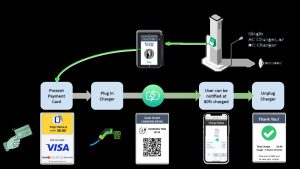
Cash can’t be controlled – at least not without exerting physical control over it. If you have $20 in cash and the guy running the gas pumps wants to sell you twenty dollars’ worth of gas, it’s a matter between you and him. A fast charger kiosk that is controlled by God-knows-what that only accepts electronic payment renders you utterly at the mercy of whatever controls it, such as an a AI enforcing a social credit regime.
There is no haggling with a machine.
Thank God, the EV push has lost momentum, chiefly because EVs are a pain-in-the-ass as well as expensive pains-in-the-ass. Most people can’t afford them and even affluent people are shying away from them because no one likes having to plan their lives around how long it takes to get a charge. This has thrown a shoe in the machinery of cashless energy dispensing, which is the leading edge of imposing cashless everything. They want to rearrange things such that no one can buy a cup of coffee without having downloaded the app. 
If they can push you into having to do that in order to drive . . . .
We are now at another teaching moment, similar to the one that arose in early 2020 when “masks” were pushed on people. Most just sighed – and wore. If more hadn’t, “masking” would have never had a chance to gain a foothold and that would have ended it before it became a kind of national humiliation ritual. Similarly, if more of us insist on using cash, it will be harder for them to push us into a cashless future and the fact that they want to do just that ought to motivate us to use cash as often as possible.
Unless of course you are ok with just downloading the app. If so, then you were probably ok with wearing a “mask,” too.
. . .
If you like what you’ve found here please consider supporting EPautos.
We depend on you to keep the wheels turning!
Our donate button is here.
If you prefer not to use PayPal, our mailing address is:
EPautos
721 Hummingbird Lane SE
Copper Hill, VA 24079
PS: Get an EPautos magnet or sticker or coaster in return for a $25 or more one-time donation or a $10 or more monthly recurring donation. (Please be sure to tell us you want a magnet or sticker or coaster – and also, provide an address, so we know where to mail the thing!)
If you’d like a Baaaaa hat or other EPautos gear, see here!










Paying by ‘app’ also hides charges, such as per/minute fees that are in addition to the KW/HR price. I saw one video where a man payed over $600.00 for a 30 minute charge, but couldn’t see the $5.00/minute fees on his pay screen. He only found out after getting the bill.
It’s a con, scam, ripoff, racketeering, whatever you want to call it along those lines.
It’s not like you can just breeze on down to the next ‘station’ if you don’t like the price, especially when you aren’t going to know until you get hooked up.
The true purpose is to kill individual mobility, just like all the commie-states that are trying to kill legal self-defense.
“EVs are a pain-in-the-ass as well as expensive pains-in-the-ass. Most people can’t afford them and even affluent people are shying away from them because no one likes having to plan their lives around how long it takes to get a charge. ”
People in other countries are building electric cars that make a little more sense. Here is one that has a top speed of 56 MPH and a supposed range of 110 miles. It only takes 4 hours to charge on a *standard* outlet:
https://www.topgear.com/car-news/electric/microlino-spiaggina-a-windowless-drop-top-quadricycle-costs-ps21k
The problem being, the damn thing still costs ~$28k American. WHY? A 10.5 kWh LiFePO4 battery pack only costs about $1,260 on eBay. You could double that and make it $2,520 and double (or nearly the double) the range. The rest of this car shouldn’t even cost $2,000 to build. That would make the total production cost for an extended range version $4,520. You could add $4,000 for profit and other expenses and it would still be $8520. It would sell like crazy for that. SO where in the fuck do they justify the additional $20k?!
The most reasonable explanations I can figure are 1. Greed. 2. Powerful people don’t want the poor to have cars. Not even tiny electric ones.
“ The rest of this car shouldn’t even cost $2,000 to build.“
That’s a seriously misinformed guesstimate and is part of what’s hurting America. No one understands manufacturing costs anymore.
Go price the materials and tooling for the tires, rims, windshield wiper arm, glass, etc. Especially so as a low volume project.
I don’t mean to pick on you as a personal attack. It’s just that this mindset is so pervasive in our culture.
People say they want to buy American and are willing to pay extra for it but every indication in their lives and purchasing decisions says otherwise.
Morning, BID –
I take your point; but that said, were it not for government “safety” compliance costs, it ought to be cheaper to manufacture a basic vehicle today due to lower manufacturing costs and economies of scale. VW of course probably no longer has the tooling to stamp out new Old Beetles. But if it did, I am certain such a car could be made and sold at a profit for around $12,000. The genius of those old VWs was that multiple configurations were easily made, including the Microbus. It was just a mini-bus shell over a Beetle drivetrain.
I think your closest comparison would be a Mahindra Roxor. Because of the laws this vehicle can only be sold in the U.S. as a side-by-side utility vehicle and not as road legal. But due to long standing licensing agreement between Jeep and Mahindra dating back to just after WWII practically speaking it’s just a Jeep CJ2A they’re stamping out.
The chassis was essentially last engineered during the Eisenhower administration. The engine they use is a turbo diesel they use in other machinery and tractors. The R&D and tooling was paid for long ago. Mahindra is globally a fairly large company that rivals VWAG in scope, so I think a fine comparison in terms of design, labor and materials.
It costs $30,598 as a base price. No way to know from the outside the margins but surely Mahindra has low input cost making things in India (no doubt as would VW making the Beetle in Mexico as they did for decades). This vehicle does not comply with FMVSS, so no costs there. It would be subject to tariffs and other government tinkering, though.
Hi Tony,
Well, as a counterpoint, there is the Toyota HuiLux Champ pickup $13k base price.
Toyota hasn’t actually started selling them anywhere in great volumes so we don’t know for a fact that they can meet this price. And where they are starting to show up their price is more like $18K to $19K.
https://www.beforward.jp/stocklist/make=1/model=17117
I suspect the real price of a Hilux Champ in America would be like the Roxor. It goes to your point on cost of regulation and inflation. Just in the couple of years from announcement the Champ has gone up $5K in street price.
The rise of the robots will drive production costs down further. Whether or not that’s passed on to consumers (or is permitted to be passed on through new entrepreneurs starting competitive companies) will be the big driver of US manufacturing.
I have a feeling either one of two things will happen: The establishment will see sky-high profits, protected by government. Or we’ll see another round of artificially low interest rates and over the top government spending in another attempt to prevent deflation caused by new competitors.
Now that a skilled worker going vertical at dawn typically costs manufacturers way over $35 an hour, $28k is lookin about right.
Hey Burn It,
It looks like Tony gave a comparison in the Roxor and Eric gave the Toyota Hilux Champ as a counterpoint. $13k for the Champ, which is, I would argue, much larger, more robust and more complex than the Microlino Spiaggina.
I would agree that you’d need sufficient production volume to pay for all the tooling, etc. I just don’t see this little clown car uses all that much glass, steel, aluminum, plastic and rubber for it to cost many thousands of dollars for its manufacture. Yes you have to pay people, and should pay them well enough.
So, you tell me. You seem to have some fervor when it comes to vehicular manufacturing. How many man-hours are required to build that little car when much is done with machines these days? What do you think is fair? $3k? $4k? Meaning my final cost would be ~$9.5k/$10.5k…
“So, you tell me. You seem to have some fervor when it comes to vehicular manufacturing. How many man-hours are required to build that little car when much is done with machines these days?”
Let’s start with this fact: it takes 20-30 hours to assemble a vehicle in a modern assembly plant. That’s not inclusive of man hours to produce the parts to feed into the assembly plant. That is final assembly only.
Those hours are only that low due to the capital intensive investment in the plant (which is in Billion of $). You cannot hand assemble more efficiently than in a volume assembly plant, Agreed?
Let’s call it 30 hours to assembly by hand. Likely much more hours than that for the clown car but I’ll go with 30.
What is labor (inclusive of overhead) cost? In USSA it’s about $60 – $80.
So 30 hours x $60/hr = $1800 on the low end.
Recall, this is assembly cost only. You haven’t even begun to account for the parts costs themselves.
But you say – do the production somewhere else – Mexico, China, maybe India? Sure, you can reduce the labor but you haven’t even addressed the materials (copper, glass, steel, rubber, etc) costs which are commodity prices and are pretty consistent world wide. Even more costly when you can’t purchase in massive volume.
You haven’t accounted for any of that.
How much does it cost to manufacture an aluminum rim? Don’t forget to include amortization of the tooling for each component in the clown car.
You say just buy the wheels on Amazon. ok – but do you think that the tooling wasn’t still amortized into the piece price? And let’s not forget that Amazon isn’t a reliable supply chain for vehicle production.
So who’s going to manage supply chain to feed this hand assembly process? That person will need to be paid – agreed? Engineering? Facilities management? Heating, electricity, etc. All this needs to be included in the overhead to “assemble” the car.
It’s a case of Leonard Read’s I, Pencil essay x 1000.
Let’s think about it slightly differently. If I delivered all the parts to your house, one car’s worth per week would you be able to assemble 1 per week, reliably, consistently to some set quality standard each week for $2000? You may say yeah of course off the cuff. Think about that hard & carefully – as a lawful binding contract.
If you think carefully about that you’ll acknowledge that you’ll eventually fail to keep up with the schedule and would default on the contract or you would need to bring in more labor or buy tooling to increase your efficiency and that would further increase your costs.
I’m only scratching the surface of what you haven’t included in your costs.
Morning, BaDnOn!
I agree with your conclusion; by now I think it is obvious that the intention is to push most of us out of owning our own car, electric or otherwise. I have an article on deck that will get into one of the ways they plan (I believe) to do this.
Can’t wait to read it, Eric.
I read your remarks and don’t think I’m being unreasonable. One of the supposed advantages of an EV is that there should be much reduced complexity. Unlike the $13k Hilux Champ, the Microlino Spiaggina or similar EVs only need batteries, control electronics and motors, and sometimes hub-motors at that, to make them go, eliminating the transmission, possibly the differentials, the complex moving parts and assembly of the the engine, etc. So I don’t think this tiny device really needs to go north of $10k. Maybe I’m crazy.
“So I don’t think this tiny device really needs to go north of $10k.”
Go do it. Seriously. Build them. Prove the world wrong. And I’m not being sarcastic. I would love to see it done. Make me eat crow!!
And just for clarity, I’m not saying $24k is a reasonable price for the electric clown car. The truth is likely somewhere in between.
Also might want to look at GEM cars as a benchmark that starts around $15k.
I would love to see them undercut with a good $10k product offering.
Hey Burn It,
I hear all you say and believe you have some insight into the inner workings of the automobile industry. But, as you may have guessed, that doesn’t mean that I believe it can’t be improved upon while still making it worthwhile for the people involved.
I’d love to build my own prototype, if only for the satisfaction of making incarnate the possibilities I imagine. But I’d also love to show that an inexpensive but effective vehicle is possible, as I believe it should be.
I will further check out this GEM company you speak of. Also, however, there was the Tata Nano and there is the Wuling Mini EV:
https://is.gd/SIbc9X
$5k. Now maybe that’s subsidized in some way, but it’s pretty similar to the Microlino offering otherwise. Were I in the market for such a thing, I’d be happy to pay a couple grand more to not use slave labor, though I know some would not.
RE: “I’d love to build my own prototype,”
…Do it while you still have vitality.
The energy, the drive, it can fade.
…It will fade.
[Lights fire underneath]
Comparing the Wuling to the Microlino is comparing apples to oranges.
Wuling is making something on the order of 1.5M vehicles in 2024. It is taking full advantage of assembly plant volumes and Chinese labor throughout the supply chain.
The Microlino is promoting a dream of 10k units annually. To be built in Italy (ie at European wage rates) and I would assume European and East Bloc supply chains.
Again I don’t think you have any appreciation for what it costs to do injection molding of something like a door interior trim panel and how large that cost difference is amortizing between hundreds of thousands of units vs amortizing across 7-10k units.
Add those cost differences up across the entire bill of material for the vehicle and you’re adding thousands and thousands of dollars to the cost of the Microlino. Well beyond the $2000 that started this discussion.
My end point being it’s more than Greed that is forcing the pricing or some elite plan to keep us out of cheap transportation.
In either case, neither of these cars will serve the US market very well. Are there niche urban use cases where they could make sense? Sure. But you’ll never find enough volume for them in the US to come close to making Wuling volumes feasible here.
Now do I wish you could buy a Wuling if you wanted one. Sure do.
But also having been exposed to Chinese mini cars, GEM’s etc., you’ll quickly find that you probably don’t want one either as they really suck outside very specific use cases.
BaDnOn
Let’s close this out with a discussion of the 1958 BMW Isetta since that is one the original microcars and the basis of the Microlino’s design.
Pricing in 1958 was about $1050 dollars. This was at a time when the average full-size US car was about $1500 – $2300. Why would anyone buy such a car in the US? Niche use cases and novelty were pretty much the reason.
Adjusting for inflation – always under predicted by the lying BLS inflation calculator – $1050 in 1958 dollars = $11,842 in 2025. Sound about right? Curious eh?
The Isetta only sold about 160,000 units before the German economy improved and more people were able to afford full size transportation.
Bottom line – unless people are economically distressed and resources limited, few actually want a clown car like the Microlino and production volumes are going to be low.
History rhymes
Morning, BID!
Here’s what I think is a more relevant case in point: My ’02 Nissan Frontier pickup. It’s not a clown car. It has a six foot bed and is useful for both work and transportation. It has AC, the main necessity. When new, it stickered for about $12k. That’s about $22k in today’s dollars. My point being that it proves a pick-up could be built for that sum today and for less were it not required to have air bags. That alone would shave off at least $1,000 from the sticker price.
I suspect there are a lot of Americans who would love ot be able to be buy a compact-sized pickup for about $20k. But they are only allowed to buy pickups that cost more than $30k.
Fully agree Eric. However, your discussion of pickup truck prices now brings all US safety and emissions regs into the equation. It’s unavoidable.
As you’ve written about many times, these compliance costs are now part of modern pickups and why you can no longer buy the EXACT same spec Nissan truck today.
One thing of note is that when you start getting close to the $20k price point, all OEM’s begin having a very hard time actually making money due to all the embedded overhead across the organization.
Unless the production volumes are huge, there just isn’t much money to be made at the $20k price point.
The average OEM profit margin is about 6%. On $20k, 6% is $1200 per vehicle so not exactly making a killing at that price point.
Consumers are no longer willing to accept NVH, large panel and trim gaps, and inexpensive trim (ie vinyl vs cloth & leather). These “upgrades” also drive up the cost vs what your old Nissan represents.
I have a 1992 Mazda B2600 without AC , and it has roll up windows. Most people would not be willing to drive that type of vehicle anymore. Especially when they can finance “more truck” when they can easily finance $30k for 6-7 years.
We aren’t going to change human behavior and their willingness to finance stupid . . . Well until things . . . . Change.
> It only takes 4 hours to charge on a *standard* outlet:
Considering the source, that’s most likely a BS1363 outlet, which delivers 13A at 240V. You’d need to double the charging time here, unless you put in some sort of 240V outlet. That’d be at least NEMA 6-15 or 6-20, though if you’re going to go to the trouble, a 14-30 or 14-50 would handle larger loads you might throw at it.
Hey Scott,
Perhaps you are an electrician? My math is that the battery at 10.5 kWh would need >2,625 watts to fully recharge in 4 hours. 120V x 20A is only 2,400 watts, so yes, it would take a bit longer than 4 hours with a standard US circuit. Maybe 4 1/2 hours, though I don’t know how safe that would be. Guess if the breaker doesn’t pop, you’re okay, huh? 😉 Good to be informed about the differences in European electrical standards, though, so thanks for that.
I remember seeing one lady in front of me in Wal Mart trying to pay for her scanned and bagged groceries with an app on her phone. The app apparently was not working-either properly, or at all-and she had to leave her bagged items. Just one more reason to use cash for everything, including gasoline, even if it means being inconvenienced.
Another point I would like to make about access to electric.
There is NO electric distribution company anywhere (worldwide) upgrading residential neighborhoods for higher capacity use. That means that level 2 electric car charging is as good as it going to get.
There will not even be the lame level 3 or 4 “fast” chargers (which are not fast, fast chargers haven’t been invented yet, and may never be either) available for residential neighborhoods. They just don’t have the capacity and never will (both distribution and generation).
People don’t realize how close we are to brownouts and blackouts on hot summer days when everyone has the air conditioning on. There is NO extra on those days.
IMHO people should be looking to replace electric powered things in their homes with alternatives like natural gas. At minimum if you have natural gas in your residence you should at minimum be powering your clothes dryer, water heater, stove and oven and furnace with it. For most of those things natural gas is cheaper than electric to boot (it is for me).
Absolutely richb, all my appliances and furnace run on natural gas despite the efforts of the greenie climate scammers to demonize it. Good luck keeping the grid up during a heat wave if they continue to build the power sucking AI Big Brother centers everywhere.
A Midwest City Oklahoma Walmart has cameras pointed at your face at the self-checkouts. You can see yourself on a screen. Data mining, I suppose. I renewed my drivers license last week and it would not surprise me if Oklahoma sold my DL pic to data miners. None of Walmart’s business if I buy Twinkies. I place a plastic grocery bag over the camera when I check out. I’d use the lane with cashiers, but the one or two open ones are always mobbed. And, of course, I always pay with cash. Walmart says the cameras are for my safety.
This afternoon I went into a Race Trac convenience store and their is a big sign on the front doors (and on the beer cooler) “YES we ID Everyone” as if they want you think that is a WONDERFUL thing. Not “We ID under 30” which would have at least a little logic, but EVERYONE. Welcome to your Social Credit Score bitches, you encouraged this in the names of “responsiblility”, “safety” and “the children “ (and that means you “conservatives’” just as much as the Karens).
So choke on it when soon you need “show ID” and “prove who you are” to purchase ANYTHING. It’s been coming for years and most of you have done NOTHING to stop it.
Is that you Lee Aaron? LoL!!
Several years ago I went to buy some beer at a convenience store. Not only did they want to see my “ID”, they wanted to scan the code on the back. I objected and the pimply faced kid said, “We have to do it. It’s the law”. Which I knew was BS.
I left the beer on the counter and walked out.
I do the same, Mark –
I particularly despise the way they use low-wage cashiers (often teens) to harass customers who are obviously decades beyond the age threshold to legally buy alcohol. I despise these laws in the first place as the government has no legitimate business involving itself in such things; but I get “carding” someone in their 20s and 30s who might conceivably be in their late teens. There are sometimes very young looking people. But it is just absurd to subject anyone clearly over 40 to this idiocy – let alone over 60. But I take that back. It is not actually idiotic. It is purposely designed to establish arbitrary rules that require mindless obedience.
I encounter this more & more these days: “It is purposely designed to establish arbitrary rules that require mindless obedience.”
…I did get an opportunity to use the line someone here used when an ID was demanded by an attractive looking teenaged/20-something year old cashier: I responded by saying, “If you think I am under 21, can I have your phone number, so we can go out on a date?”
While she blushed, she didn’t/couldn’t/wasn’t able to make the connection about how my request for her # was just as absurd as her asking for my ID. The conditioning was too strong in that one. Sigh.
Same here. I do not abide by obvious idiocy. I certainly don’t look anywhere near under 21, so asking for my ID is pure idiocy. If everybody under 30 would just leave the beer on the counter and walk away, their “policy” would change overnight. I guaranty it.
Hi Mr. Liberty, your comment reminds me of this one that someone had posted here. I saved many of the ones I really liked over the years for when I need a chuckle, and this one certainly fit the bill, for the idiocy is, and was thick with this one, as well:
Some years back – when I could still tolerate commercial air travel I attended a Toyota long lead in California. I was waiting at LAX to catch my flight home and decided to sit at one of those bars they have inside some terminals. I just wanted coffee and a place to sit. An older guy – long gray hair, appeared to be at least 60 – sat down and asked for a drink. The bartender demanded ID from this guy, who got really angry – understandably – and sarcastically asked this guy (who appeared to be maybe 25) whether he thought there was even a slight chance he was under 40. “It’s policy,” the young bartender said. The older guy said – thusly: Fuck you, twerp. I was in Vietnam before you first crapped your pants.” And he got up and left.
Morning, Shadow!
That comment was mine. True story, too.
Ha ha! I did not realize! It is a hilarious comment but sad that it is true as it is an indication of where society is headed.
You would think that rockets are being launched at the charging stations.
It will be easier to fly to the moon on gossamer wings.
Today is National Moon Landing Day!
That makes yesterday the Mary Jo Kopechne Day of Remembrance.
If Ted Kennedy drove a Volkswagen he’d be president today…
https://encrypted-tbn0.gstatic.com/images?q=tbn:ANd9GcQwHX4J69PDeiMMuu9tYeXDVzuasrflP6RJQw&s
Drumpf
When I was seven in 69 I took the bait, watched the whole show on “tv”. Nixon talking to the actornauts(nots) on the telephone as fucking if. Never happened…all fiction … bullshit to the third power.
The lunar module looked like a grade six science project. Where was all the air stored in the contraption?
Let’s review the tapes….. wait for it NASA lost the recordings.
Never A Straight Answer.
That’s an interesting question, Nova. Where did they store all the air (nitrogen, oxygen, etc.)? If it was stored and carried in a compressed state, how much volume would that have taken up. Could they have stored enough in tanks? Also, wouldn’t they have to re-compress what was exhaled as well? otherwise, the LM would explode, right? According to the internet, the 2 Apollo 11 astronauts spent 21.5 hours in the LM and on the surface of the moon.
Ok, I get it. Inhaled air is generally Nitrogen – 78%, Oxygen – 21%, Other gases – 1% and Carbon dioxide – 0.04%, and exhaled air is Nitrogen – 78%, Oxygen – 17%, Carbon dioxide – 4% and Other gases – 1%. So as long as you remove the carbon dioxide and then replace it with oxygen, you can theoretically recycle the other constituents, but could that really have been done in the LM? Could it have carried enough oxygen to do this for nearly 24 hours for two men (while physically exerting themselves)?
400/1000000=4/10000=2/5000=1/2500=0.0004
0.0004×100=.04
0.04 percent of the atmosphere is carbon dioxide.
More water vapor in the atmosphere ever since Hunga Tonga.
Cowabunga!
The push into an EV charging app is curious since the car itself is providing more information than any app could about where you’ve gone since the last fill up. Not sure how tying your movements to what someone does on a phone like Amazon purchases is important. They can do that on the back end at the fusion centers. Paying for your electricity via cash is only going to cut out a credit card processor, not the linking of travel data.
Service people like getting cash tips and contractors like getting paid cash for small to medium jobs. It really helps get better service. And young people who live and die by Venmo light up when presented with cash!
You can always pay cash at the gas station, but that doesn’t mean they’re happy about it.
Maverick convenience stores push their Nitro card with a 10¢/gallon savings. It’s a debit card of sorts that will pull money out of a checking account. There’s an app of course and you can load it onto your Apple Wallet. You also get points that can be used for food and drinks. They also have a lessor card that just tracks you for a 2¢/gallon discount. There’s no discount for paying cash like many other gas stations offer.
I think most large chain stations would love to have the power of forcing customers into using an app exclusively, but because of competition cannot.
We’re always told that convenience stores lose money on gas and make it up on junk food, makes you wonder what the margins are on these EV charging stations. I know my retail rate for electricity is $0.11/KWh, “small commercial” is $0.10/KWh. Don’t know what they’re charging customers but I’ll bet it is a lot more than wholesale.
Gas card are about repeat customers. It’s no big secret that loyalty cards are very effective marketing tools. Have been forever, learned about them as an MBA student in the 1990s.
It’s also not difficult to work around them to get the discount without leaking much personal information, although now that most check out kiosks have facial recognition cameras it’s getting tougher to stay anonymous even paying cash anywhere.
BTW, the original idea for loyalty cards mainly was targeted marketing, to build a profile of customers, trying to link demographics to buying preference. It stuck me as creeping even 30 years ago before the cyborg revolution got going. The firms doing the data crunching would be able to tell you’re 45-54, black, female, some college, two kids, your profession and probably even your ZIP code just from your buying habits at the Walmart based on the data most brain-dead consumers will happily hand over to save $0.30 on hotdogs. The stores would benefit knowing what to stock keeping inventory lean and best pricing.
Hi Toby.
How about linking multiple cards to one account and having a larger group of people using that account. They would all get the discount and would be a sort of super shopper that purchases everything from freedom seeds to feminine hygiene products.
If their going to get the data in the end your goal should be to make it as valueless as possible.
Jenny, I got your number. I need to make you mine. Jenny, don’t change your number
You’ve got it about right, overwhelm the algos under massive meaningless information.
Hi Tom.
Remember when the UK GovCo told people they must register all birds and they responded by registering chicken Mc Nuggets, rubber chickens, etc?
Back in the day many cashiers would keep a loyalty card at the register and scan it if you “forgot” your card so you got the discounts. Most of the stores clamped down on the practice, and of course there’s no fooling the self-checkout scanner.
Hi Ready
As long as the scanner doesn’t use facial recognition software my idea should work. I’m sure someone could read the magnetic strip on the card and transfer it to a different card. However I’m not sure if newer cars have some sort of RFID chips in them.
The RFID chip isn’t necessarily harder to spoof than the strip. I’ve used it, you can put as much or as little as you want on them, there are serial numbers but it’s all ones and zeros on there.
See my above comment about the Race Trac convenience store. This “your papers please” crap is getting totally INSANE and the Orange Clown administration is hard at work tightening the noose NOT making it go away.
We are all Palestinians now.
Check the charging app’s permissions, particularly on Android. Most people aren’t aware of what they agree to when the install permissions screen appears and just click “Accept”.
Your charging app does not need to access your photos.
A conversation on Reddit about EeeVee charging apps:
Q: When I re-fuel my ICE car, I tap my credit card to the pump, press some buttons, and am getting gas in less than a minute.
When I re-charge my EV, I need my phone, an Internet connection, the specific app for the charger network company, a log-in, and a nuisance process of steps to “activate” the charger. A problem in any of those requirements will prevent me from charging.
What is with the obsession with needing an app and a live Internet connection for charging?
A: There are several reasons why charging networks insist on apps:
An app solution is much cheaper to install and maintain than a card terminal.
Apps will usually have their own internal pre-paid account that you top up with larger amounts of money less often. This results in smaller credit card fees – though those fees are relevant mostly in countries that allow predatory practices (i.e. US).
Apps can very strongly try to upsell you on various subscriptions. This allows their owners to both extract more money out of individual customers as well as keeping them using their own system more often.
Apps can sell your data. This might seem like just a chump change, but consider that they are selling data of a person that almost by definition is also rich enough to own an EV today.
As far as benefits for end users – there are basically none, but there is also not enough competitive pressure for a new player not reliant on apps to have an obvious advantage.
https://www.reddit.com/r/electricvehicles/comments/172y13t/explain_the_obsession_with_needing_an_app_for/
Apps are a plague on society. Like deer ticks that carry Lyme disease, apps are a parasitic infestation of smart phones. *sprays phone with insecticide, then hurls it into boiling water*
FYI to Eric, the following headline was seen in today’s RT.com: “EU hatching secret electric car plan.” The draft legislation could force rental and corporate fleets to switch to EVs by 2030, according to Bild as reported by RT. “The regulation is seen as a backdoor to accelerate the green transition and enforce the bloc’s combustion-engine ban, which mandates a 100% cut in CO2 emissions from new cars by 2035, effectively outlawing gasoline and diesel vehicles.”
https://www.rt.com/news/621716-eu-hatching-secret-electric-car/
As if that’s not enough, the EU’s busybody technocrats are also working to ban state interference in their attempt at consolidating Europe’s banks. (“EU cracks down on state meddling in bank M&A” via Ft.com).
So, not only are the EU communists trying to ban gas vehicles, they’re trying to merge all banks into a single unit to further increase their draconian control over the continent. “What a time to be alive!” as the lemmings like to say.
Meanwhile the heathen Chinese smile inscrutably…
Yesterday a major payment network in Europe went down. Cash was needed to buy groceries, pay restaurant bill, and road tolls.
What happens when you can’t pay, app or no? You sit.
What if you were to lose you phone and need a charge to go get a new one?
Technology is great where it makes life better, but tech for the sake of tech is a hinderance at best and a tool for spying and control at worst.
Good point, Dan. I’ve experienced two instances this year where payment processing systems crashed in a certain area of my city (a fairly big one), forcing customers at grocery stores, restaurants, etc. in that area to pay cash until the problem was resolved. Always carry cash.
Hi Dan,
I have no issue with alternatives. My issue is with denying them. It’s fine to have the option of using an app or a credit card, provided there is also the option to use cash. When alternatives are taken way there is a reason why.
If you can pay for gas at a gas station with cash you should be able to pay for electricity with cash. Perhaps it’s because “filling” an EV takes a lot longer and that’s why they went with the no cash payment approach but not allowing credit cards or a prepaid charger card shows that they want an app that does a lot more than their claiming.
I’m curious if any one has looked at what the charging app demands for permissions; could it be web browsing data, call history, location, contact lists, etc?
The next step will be requiring an app to buy gas.
The federal reserve notes in my wallet say (in all caps) “THIS NOTE IS LEGAL TENDER FOR ALL DEBTS, PUBLIC AND PRIVATE”
So they have to accept cash as per the law. Yet somehow they don’t have to accept cash.
RKW
During the early stages of the scamdemic (2 weeks to flatten your spirits) I stopped for a drive thru coffee and tried to pay with cash, this send the fags working there into a state of all out panic which looking back was priceless. I was informed of misdeed and would have to pay in cards . Nay nay was my reply and the said coffee was on the house.
Ps: Eric the driving was great all the clovers were off the roads sitting home or taking an idiot pcr test.
Always a silver lining in all clouds!
Apps and QR codes are a two way street. Sure, you get a morsel of info when you download or click one of these things but, whomever is on the other end also gets access to your phone and all its contents.
All apps are controlled by Google and Apple. Who controls them? The restaurant that wants you to take a picture of the QR code to read their beer menu doesn’t control the QR code, the company that they’ve contracted with does. When that 3rd party gets hacked ALL the people that have snapped a QR code have their phone accessible to the hacker.
But, good news! All the problems about your phone and info being compromised will be gone…just as soon as you get Your subcutaneous RFID chip.
Hi Mark. What would happen if you installed the app on a burner phone you bought at a yard sale and set up the app over WiFi, turned off and in a Faraday bag when not needed?
Landru, you sound like a guy that sell hoops through which people can jump. That’s very creative.
;^)
Hi Mark.
I like my privacy and the use grey man approach to problems. The more people who follow that approach the safer we are from GovCo.
If only one person embraces privacy they are easy to find in a group; if at least 25% embrace privacy it gets harder to identify those who seek privacy.
One way is do some things online without using VPN’s and Tor and others with it. That way you look like a sheep when your outlook is different and it hopefully will give you a little more lead time in a bad situation.