



The ’26 Ioniq 5 EV goes back today.
Yesterday, I spent another half-hour of my life waiting to get a partial charge at a commercial “fast” charger. I spent a total of about an hour (two roughly 30 minute sessions) waiting to get some charge back into the EV during the week I had it to test drive.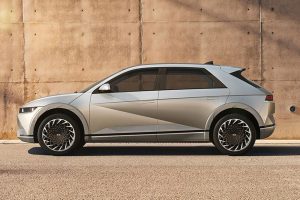
If I owned this EV – which ostensibly accepts charge more quickly than some other-brand EVs – I’d be spending about four hours each month, probably, waiting for it to recover some charge. An EV takes much longer to recover a full charge – even at a “fast” charger. If you want a full charge, the wait will be much longer than half an hour, which is the time it took to recover enough charge to drive the Hyundai another 50-70 miles or so.
This is not usually explained to people by the people trying to sell people on EVs.
Another thing is that even if an EV is capable of being recharged faster, the rate at which it actually recharges is also dependent on the fast charger. These fast chargers are not all the same.
Tesla “superchargers” – the word is bracketed in air-fingers quote marks to point out the interesting way combustion engine terminology is used to make EVs and EV paraphernalia sound exciting, as when supercharged – are capable of faster-charging than some of the other not-as-fast chargers. What about those others?
Think about that. Have you ever encountered a gas pump that takes much longer to fill your tank? Very occasionally you may have to deal with one. Ninety-nine percent of the time, when you pull up to any gas pump, it will pump gas into your car’s tank very fast. It typically – it routinely- takes less than five minutes at pretty much any gas pump you pull up to, anywhere in the country.
It is not like that with EV fast chargers because they are not all Tesla-style superchargers. In fact, most are not – in most parts of the country. At least they are not in my part of the country. In my area – SW VA – the only convenient fast chargers are EV Go fast chargers, which are hilariously named in that you generally do not go very far until after you wait, unless you are willing to wait comparatively forever. Having to wait about half an hour to get charged up enough to go another 50-70 miles being a long time to wait when I could have put 15 gallons of gas – a full tank andenough to drive it about 300 miles – into my old truck in less than five minutes.
Of course, I could have waited at home.
Note that the wait still applies – and it’s also much longer; it takes (best case) about six hours or so to fully recharge an EV at home using the fastest-possible type of charging you can do at home, which is using a 240V Level II charger. That requires an electrical panel that can support an additional 240V circuit, which also requires a 40-50 amp breaker. If you have that, great – but it still means the wait. Some will argue that the wait is irrelevant because after all you are home and so presumably do not need to drive anywhere. But what if something comes up and you do? Regardless, even if you are sleeping, it’s inarguable you’re still waiting. I have used JB Weld epoxy to fix various things; it takes several hours for the JB Weld to set and overnight for it to set up enough to return the fixed thing back to service. The fact that I am home and able to do other things – including sleep – does not change the fact that I have to wait for the JB Weld to set.
It is the same with charging an EV at home. Being able to do other things while you wait is great. But let’s be honest about the wait.
I do not think EVs will ever become more than a specialty/niche segment of the market on account of the wait. Even if that “breakthrough” in battery technology we have been hearing about for tghe past decade ever happens that makes it feasible to fully recharge a battery in “only” ten minutes. That’s still twice as long as it takes to fully fill most gas tanks. How is doubling the wait time an improvement? Imagine the continuous parking lot at gas stations if it took every has-engined car ten minutes to fill up. Ten minutes scaled up is not a small thing.
Ay home? Unless every home gets upgraded to commercial high-voltage capacity, ten minute recharges arent going to happen there, either. Never mind where the electricity is going to come from and who’s going to pay for it.
So long as there is an alternative to the wait, most people aren;t going to willingly wait. Even when gas is expensive, it still saves time – which unlike money cannot be recovered. Most people are probably not going to willingly sign up for all the waiting (and the attendant planning) that comes along for the ride with an EV, no matter how quickly it can get to 60 nor how quiet it is. Most people have things they’d rather be doing than waiting. It’s why fast food is still popular, even though it has gotten as or even more expensive than home-cooking a meal.
Because it’s fast, you see.
. . .
If you like what you’ve found here please consider supporting EPautos.
We depend on you to keep the wheels turning!
Our donate button is here.
If you prefer not to use PayPal, our mailing address is:
EPautos
721 Hummingbird Lane SE
Copper Hill, VA 24079
PS: Get an EPautos magnet or sticker or coaster in return for a $25 or more one-time donation or a $10 or more monthly recurring donation. (Please be sure to tell us you want a magnet or sticker or coaster – and also, provide an address, so we know where to mail the thing!)
If you’d like a Baaaaa hat or other EPautos gear, see here!










[…] EV Epitaph — Eric Peters Autos […]
[…] https://www.ericpetersautos.com/2026/06/25/ev-epitaph/ […]
[…] EV Epitaph — Eric Peters Autos […]
Worst business model – building a product so good it never fails
https://www.youtube.com/shorts/iFcQRYFZun4?feature=share
I bought two cast iron skillets. My great great grandchildren can get them if cooking is still a thing by then. I stupidly thre away my mother’s two skillets whic were brown with rust. Sometimes ignorance is not bliss.
They are glorified golfcarts for your 15 city as per jew Ageda 2030. You ain’t voting your way out of this, or talking your way out of this. They put us in the dirt or we put them in the dirt. 1 or the other, the whole world is Palestine now. $ vs people.
EV’s only make sense when they can be garaged every nite after one charge’s worth of usage. (e.g. commuter) Although my golfing buddy took a cross country trip in his Tesla and didn’t complain. To be fair, dunno the details of his route. Although I did specifically ask him if charging was a problem and he said no. YMMV
I say that brand new cars these days are so loaded with nanny-state tech, so you might as well get a damn Tesla: So you’d at least get some giddy-up!
In fact liquid fuel pumps could run even faster than their typical 10 GPM or so. They are slowed to make blending (so you get the right type and octane from one nozzle) and metering more accurate between certifications.
You might remember Donut Labs’ solid state battery that was the darling of CES 2026. Turns out it’s a fake.
https://youtu.be/j5oyVNjrUPI?si=rIQJtid095iS9muU&t=1509
Solid state batteries are like controlled nuclear fusion, always 5 years away. They can make one in a lab, but they can’t get them to scale. Solid Power, inc, a money hole out in Louisville, has been burning cash from Ford and BMW for years. But once they get “the process” right, they’ll make it all back in weeks!
Toyota, Sumitomo and Idemitsu Kosan have what actual engineers and scientists believe is a technically sound plan to manufacture them. Their schedule is to have them to market in 2027. We’ll see of course, but these are not fly-by-night companies and generally very conservative overall. So if they think it’s possible they wouldn’t have dumped $1 billion into the joint endeavor.
solid state batteries
are far too expensive
and not ready for prime time
Nio
The battery developed for NIO
is a semi-solid-state battery,
not a true (or “all-solid-state”) battery
It is extremely expensive to manufacture
—costing nearly as much
as a whole entry-level NIO ET5 sedan
NIO executives revealed that the pack alone
costs about 298,000 RMB
(~$41,000 to $45,000 USD),
which is equivalent to
buying an entire NIO ET5 sedan
NIO leverages their unique
Battery-as-a-Service (BaaS) model
Drivers can pull into any NIO Power Swap Station
and upgrade their vehicle to the 150 kWh pack
in roughly three minutes
Owners can temporarily rent
the ultra-long-range pack
for long road trips, then swap back
to a standard pack for daily commuting
once they return.
The cost to rent NIO’s 150 kWh
semi-solid-state battery pack
for exactly one week
is either 1,050 CNY (~$147 USD)
or 700 CNY (~$98 USD),
depending entirely
on the base battery
your vehicle normally uses
Nio 150 kwh
semi-solid-state battery pack
delivering a range
of over 620 miles (1,000 km)
on a single charge
Show me the yield. I bought into Solid Power as a gamble back in 2016 and watched it become a tax deduction as deadlines passed, production output failed to ramp up and manufacturers went with Panasonic’s batteries instead. Every few months I check in to see how they’re progressing, and still not scaling up to mass production. Even now their web site has the disclaimer “Cell Performance Metrics are initial commercialization design targets.” That’s coming from a legitimate company that’s been trying for almost a decade.
At what point do investors put a stop to the science experiment?
EVs are a solution seeking a problem. Nothing is more efficient than the act of converting gasoline into energy; conversely batteries are an inefficient way of storing energy. Like the B-model F-35, it has to drag around extra weight.
I do not have the time or desire to sit somewhere waiting for a soulless glorified golf cart to recover a partial charge. I live in the South and don’t want to be sweating for 30 minutes or longer waiting for a partial charge.
That doesn’t even cover how these things nearly weigh twice as much as a vehicle their size (a Tesla 3 weigns nearly as much as a van), go half as far (most cars and trucks can go 500 miles or more on a full tank) and can catch on fire in a devastating way that twkes thosands of gallons of water to extinguish.
They’re also plugged into the Matrix, allowing your movements (what little there are) to be tracked and can be shut down via an over the air “update.” If waiting for a stupid Windows computer to “update” is a royal pain in the posterior, why would you want to do it in a car?
EVs also eat tires for breakfast. They also have zero resale value because once batteries go through enough charge/discharge cycles, they degrade chemically and can’t hold as much of a charge.
And your range is degraded by very hot or cold temperatures.
So what if the stupid things can beat a Hellcat in a drag race? You’ll have to sit at a charger on your duff waiting to recover charge so you can get home. These vehicles as Eric shows are useless for rural areas.
The point of these things and their forced adoption is part of the plan, along with deindustrialization, restrictive land use regs (except for water and power-chugging data centers), to corrall the “eaters” into 15 minute open air prisons, leavng the rural areas to the plutocrats while we live in the pod, eat ze bugs and hopefully die since we’re the carbon these evil SOBs want to eliminate.
It’s thoroughly satanic.
They may beat a Hellcat in a drag race, but they’d lose to a 4 cylinder 98 Ranger at LeMans.
I had an acquaintance who had a Tesla Model S. I said I’d race him to Atlanta and back on one full tank of gas or battery charge. He wisely passed on that offer.
1. 75% of the energy is lost, primarily as heat, converting gasoline to motion.
2. My Suburban weighs more than any Tesla Roadster or Model S/X/3/Y.
3. 100% of torque available at zero RPM is what can burn through tires.
Gotta learn to drive different in an EV.
4. Only a hybrid vehicle is going 500 miles w/o an extra fuel tank.
5. Choose a cheaper EV w/ LFP battery pack & never worry about battery fires.
AI killed EVs. The electricity is needed elsewhere because the C-suites finally being able to fire the white collar workforce comes first.
It is the American way.
Ironically, it is the white collar workforce who bought the EVs.
EV Epitaph?
2025 global sales of electric vehicles (EVs)
reached 25% of new global light-duty car sales.
Driven by a 20% year-over-year surge,
annual global EV volumes topped 20.7 million
units for the first time.
Pure internal combustion engine (ICE-only)
light cars and trucks dropped by
3 to 5 percentage points
in global market share
from 2024 to 2025.
Globally, plug-in electric vehicles—
combining Battery Electric Vehicles (BEVs)
and Plug-in Hybrid Electric Vehicles (PHEVs)
—accounted for 25%
of all new light-duty car and truck sales.
Excluding the United States,
28% to 29%
Top Countries by EV Sales Share (2025):
Norway 97%
Denmark: 69% – 71%
Singapore: 47% – 63%
Sweden: 61% – 63%
Iceland: 57% – 62%
Finland: 56%
Netherlands: 56%
China: 53% – 54%
Belgium: 43%
Richard,
All the countries you cite have all-but-outlawed gas-engined cars. This is not market driven. It is government driven. When the government stops pushing EVs, what happens? What happened here? EV market share collapsed. Why? Because while EVs have some pros, the cons outweigh the pros for most people.
His name isn’t Richard. It’s Jim — Jim Farley. And has he got a deal for you!
You can get a good look at Bankruptcy sticking your head up an EV’s tailpipe, but wouldn’t you take the Ford accounting departments word for it?
How can you attack Jim Farley
when ford is setting records?
Last year, Ford Motor Company issued more recalls than any other automaker ever. It surpassed the previous record holder, General Motors, by more than double, with 153 recalls affecting nearly 13 million vehicles.
My irony meter is clicking like a Geiger counter! 🙂
China is heavily dependent on imports for oil, but produces almost all of its electricity domestically, and for city drivers, small cheap electric vehicles (starting at about $6,000 USD) make good sense. ICE vehicles are not outlawed, and as of 2023, only 7.6% of vehicles in use are BEVs, although that’s changing.
https://en.wikipedia.org/wiki/Electric_car_use_by_country
China burns a lot of coal for their electricity (bad, right?) but offers a very good market solution to the problem of urban transport using cheap EVs (good, right?) in a way that makes actual, practical sense. Environmentalist heads would explode at the irony.
EV sales in the US are not dead
without tax credits and
they would not be dead anywhere else
without tax credits
U.S. new electric vehicle (EV) sales
fell by 25% in the first half of 2026
(US EV tax credits end)
compared to the first half of 2025.
If every other country in the world
had a 25% reduction in EV sales,
there still would not be an epitaph for EV’s
Global EV sales outside US
would still be over 20%,
and that’s not an epitaph
In business and marketing,
“epitaph” can be used
to describe a product
that has become a symbol of failure
Tesla, BYD, Li Auto & Seres Group
are all earning profits
Other companies may become profitable,
although not in the US
Amazon took seven years
from its launch in 1994
to report its first quarterly profit
You seem biased to declare
EV’s are dead, just like
many conservatives
are biased to declare
climate change is a hoax
Amazon is not a good example as they were financed intentionally for years with the expectation they’d lose money by undercutting competition to build market share. Musk’s companies operate in the same way. It’s a great business plan to make a small fortune but you have to start with a large fortune. If you can outlast the flushing money like crazy period and literally drive all your competition out of business then you’re left with the market to yourself and then you can build that small fortune back into a much larger one.
Richard,
I said market share has collapsed. It is now around 5-6 percent (and most of that is concentrated in urban hives such as the LA/SF area and DC and its suburbs). It was more than 8 percent. I never said “EVs are dead.” I said they are an artificially-induced, government-pushed thing and once the pushing goes way, so does much of the “market” for them.
On “climate change”:
First the term is am imbecility. Because the climate is not and never has been static; it changes. Whether it is changing in an abnormal way – and due to us driving cars – is the proper way to begin any discussion.
Also: Is there any way you could post your comments in non-Haiku style?
For May 2026, combined sales of battery electric vehicles (BEVs) and plug-in hybrid electric vehicles (PHEVs) captured exactly 7.09% of total new light-duty vehicle (LDV) sales in the United States
In May 2025, the combined sales of battery electric vehicles (BEVs) and plug-in hybrid electric vehicles (PHEVs) captured exactly 8.65% of total new light-duty vehicle (LDV) sales in the United States.
Down 18% without tax credits is not dead
V8 engines power roughly 10% to 12% of new US light vehicles.
Manual transmissions account for 0.8% of new light vehicle sales in the United States.
V8 engines are not dead, but manual transmissions are close to dead
Tesla took 17 years from its founding in 2003 to achieve its first full-year profit in 2020. No U.S. automaker other than Tesla has ever earned an overall profit on electric vehicles (EVs). But they keep selling EV’s anyway.
Richard,
You keep repeating that I said “dead.” I did say collapsed. The words mean different things.
The Epitaph: This is a text, phrase, or commentary written about a failed product after its demise (AKA dead)
EV sales have not failed, even in the united states … There can be an epitaph for the Edsel, but not for EVs.
i didn’t see the word collapsed in the article but you could say EV sales in the US collapsed in 2026.
Richard,
You are just about the most pedantic person I have ever interacted with. EVs sales in this country have collapsed over the past year; multiple manufacturers have pulled EVs from the market and/or decided not to bring out models they had said were coming (eg., the Honda “zero” series; the VW IDs). Even Tesla sales are down. But you parse the meaning of “epitaph” in a headline.
“Also: Is there any way you could post your comments in non-Haiku style?”
*snickers*
Eric, I believe he said his eyesight is failing and he often “types” through a speech-to-text interface which is responsible for the unique style, misspellings etc.
It’s true my eyesight is failing, but i will try to reformat the typing to fit this website. The speech-to-text interface creates a weird format with no punctuation
STFU
Dear Dickhead Green
Just so so you know there are a lot of dummies on planet Earth, I will cite the Covid scam as proof. The motherfucking climate is always changing regardless what Joe public does.
Please stay on your meds.
I seem to recall, 4 or 5 years ago, ole Dick telling us how he took the shit shot for the sake of domestic tranquility on the home front. Haven’t listened to him much since then.
There has to be “free” in a free market. Compulsion by banning the sale of ICE vehicles makes EVs the only choice.
It’s interesting how even with the transfer of our tax dollars to EV owners, these glorified golf carts were still a rounding error. Notice how when the tax credit went away, sales tanked.
It rather reminds one of how contributions to the Clinton Global Initiative fell by 90 percent, the year after Hitlary lost the presidential election.
Suuuuure, it wasn’t about influence buying! 🙂
Look on the bright side when the parking garage full of EVs collapses due to weight or burns to the ground from a damaged battery you get to buy a new one.
A win for the economy or maybe not (broken window fallacy)!
‘Ten minutes scaled up is not a small thing’ — eric
Even setting that issue aside, there is still the weight [as opposed to wait] bloat.
Vehicles already were packing on hundreds of pounds due to saaaaaafety mandates, despite weight saving technologies such as aluminum engine blocks and even aluminum body panels for the F-150. Cars are not ‘GLP-1 friendly’ — science offers no help for these unfortunate obese creatures.
EeeVees gratuitously pack on another thousand pounds of baaaattery, exacerbating the bloat. The late Paul Fussell claimed that old-school rich folks, who didn’t care about the vagaries of automotive fashion, purchased their rides based on lowest cost per pound. Almost inevitably, they would up in an Electra 225 land yacht, or one of its peers.
The point remains that an extra thousand pounds of material has both an up-front cost and an ongoing maintenance cost for brake pads, tires and even the electrical power needed to propel the great gross honker around. This is technological regression: more weight, more cost for zero benefit other than quick 0-60 times.
In real life, technological regression doesn’t occur except under deleterious interventions, such as Govco. Wait, let me amend that claim: the NYT just published a story on how higher hood lines, such as the 47-inch hood height on a Silverado, probably are killing several hundred pedestrians a year. The market did that: punter/poseurs need the ego boost of drivin’ a big-ass truck. Yet outlawing this silly styling fad for safety’s sake doesn’t even occur to purblind regulators.
Go figure!
Well, I gotta keep rockin’ while I still can
Got a two-pack habit and a motel tan
When my boots hit the boards I’m a brand new man
With muh back to the riser, I make mah stand
— Steve Earle, Guitar Town (1986)
erratum para 3: ‘would up’ –> ‘wound up’
Jim, I drive an almost 30 year old small car in the summer and looking out the windows all you see is the door handles of the trucks around you. If it wasn’t for my antenna ball finding my car in a parking lot would be a lot harder.
Hot rodders of the 1950s ‘chopped tops’ because the ponderous old sedans of the late Thirties to mid Fifties looked too top-heavy to them. This chopped-top Buick with a six-inch slit windshield prowls the streets of my little burg, scaring children and puppies:
https://ibb.co/W4mKrPpK
Little did ancient hot-rodders suspect that insecure Americlowns of the 2020s would want to ‘sit tall,’ since they are in fact impotent to command anything else besides their giant truck in an impersonal algorithmic world.
Maybe you could get a six-inch roof lift …
Jim: “Maybe you could get a six-inch roof lift …”
Jim, back in the 60’s John Wayne had that done to one his cars, a wagon if I remember correctly. Being tall and having money means you can make the car fit you better.