
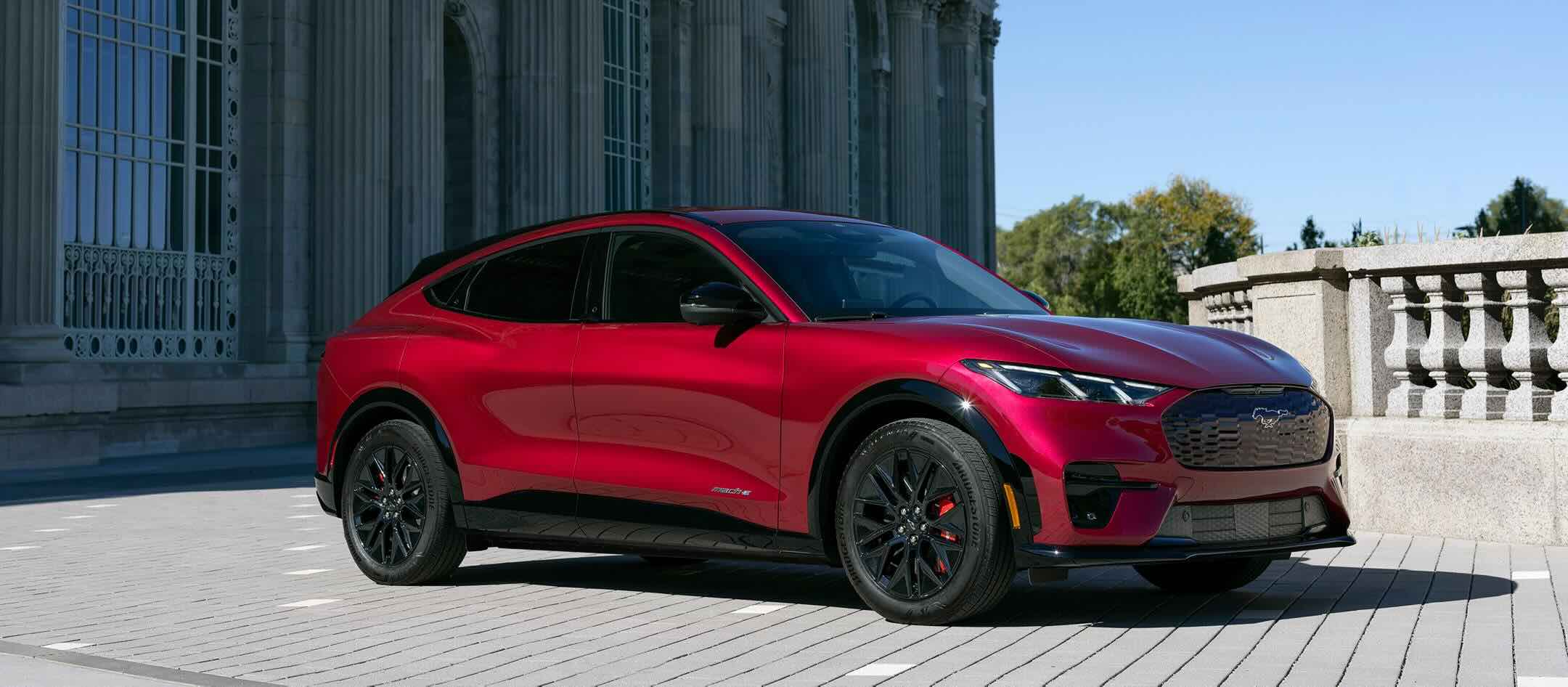

Ford invited comparisons of the electric Mach-E crossover with the engine-powered Mustang by badging the former as a “Mustang” – so let’s do that.
These two Fords are closer together than you might expect – as well as farther apart, too.
What It is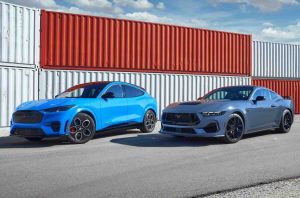
The Mach-E is a compact-sized electric crossover – which on the face of it is as far from being a Mustang as day is the same as night. And yet – like day and night – there is overlap. Both of these two “Mustangs” are about the same size and both are styled to look like they’re related, even though they are functionally unrelated.
The Mustang is powered by gas, the Mach-E by electricity. The Mustang is a four seater with room for two – and very little room in its trunk. The Mach-E is a four door with room for five and much more room for cargo.
Interestingly, the Mach-E can be driven farther on a full charge – 260 miles – than a Mustang GT can be driven (in the city) on a full tank of gas (just 240 miles). Of course, the Mustang can be refueled faster – but you can’t refuel it at home.
So, horses for courses!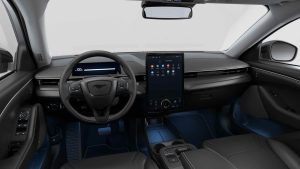
The Mach-E’s base price is $37,995 for the Select trim, which is rear wheel drive (like the Mustang). Unlike the Mustang, which is rear-drive only, the Mach-E is available with AWD. The dual motor setup bumps the Mach E Select’s trim to $40,795. Both RWD (single motor) and AWD (dual motor) Selects come standard with synthetic leather upholstery, LED headlights and 19 inch wheels, as well as a dual LCD main and secondary display.
The next-up Premium trim lists for $40,595 to start and adds heated/ventilated front seats, a heated steering wheel and an upgraded 10 speaker Bang & Olufsen audio system. AWD (dual motors) is available as a stand alone option; so equipped, the price rises to $43,595.
At the apex is the GT which – like the Mustang GT – is the highest-performance version of the Mach-E. It comes standard with a high-performance dual motor (AWD) drivetrain that makes more horsepower (and much more torque) than the GT’s standard and optional 5.0 liter V8. The GT Mach-E also comes standard with sport bucket seats, high performance Brembo brakes, 20 inch wheels with thin-sidewall sport tires and all the luxury upgrades that come with the Premium.
Base price for the GT is $53,395.
These prices track pretty closely with the Mustang’s prices, too. The latter stickers for $32,995 to start and runs to $51,080 for a Premium GT.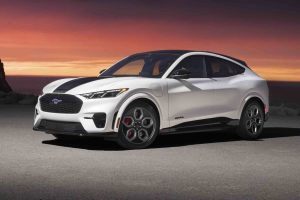
What’s New For 2026
A new California Special appearance package (for the GT) is available. It resurrects the California Special package that was offered with the first-generation Mustang back in the ’60s. California Specials get white paint with Rave Blue blue exterior accents, GT/CS badging, 20 inch carbonized gray wheels and a blue-gray interior that’s unique to this trim.
What’s Good
More practical in many ways than a Mustang with just two doors (and an engine).
More city driving range than Mustang GT.
GT with performance upgrades matches performance of 795 horsepower Mustang Dark Horse (with supercharged 6.2 V8) for about half the price.
What’s Not So Good
Though powerful and quick, it’s like other EVs – none of which are like a Mustang.
Standard range is only 260 miles (240 if you opt for AWD but don’t spend extra for the optional 88 kWh battery pack, which gives you 300 miles of range).
As is true of all EVs, if you don’t drive to (and wait at) a “fast” charger, you’ll have to wait at home – and if you don’t have a single family home/townhouse with a 240V Level II charger, you’ll probably have to spend time driving to and waiting at “fast” chargers.
Under The Hood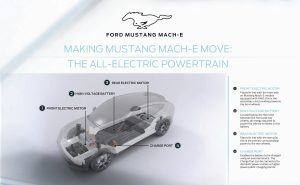
The Mach-E is available with one – or two – electric motors and three different battery packs.
Standard in the Select is a singe motor driving the rear wheels; it’s fed by a 73 kWh battery pack. This set up gives you 264 horsepower and 387 ft.-lbs. of torque; fully charged driving range is 260 miles. The optional 88 kWh battery pack increases the driving range to 300 miles and if you buy the dual motor (AWD) set up, power increases to 325 horsepower and 500 ft.-lbs. of torque.
The GT – uniquely – comes standard with 91 kWh battery as well as dual motors, the combo generating 480 horsepower and 600 ft.-lbs. of torque. The latter can be pumped up to 700 ft.-lbs. if you buy the optional Performance Upgrade. 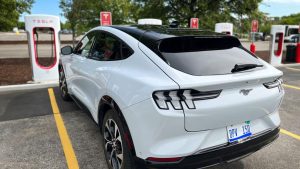
Equipped with the single motor/RWD and the standard 73 kWh battery, the Mach-E can accelerate to 60 in about 5.6 seconds; the GT can cut that down to just 3.3 seconds.
It takes about 40 minutes to recover 80 percent charge at most “fast” chargers – and Ford provides an adapter to allow the Mach-E to use Tesla superchargers, which may be a bit faster. You can also charge the Mach-E at home, using either a Level II (240V) outlet or a standard 120V household outlet. Ford provides a power cord that works with either; some other-brand EVs do not include a standard home-charge cord. You have to pay extra for it. And some cannot be charged at home using a standard 120V outlet, which effectively forces you to have a 240V circuit wired up, if you want to charge at home. Be aware that either way, you have to have a place to plug in and that pretty much means a single family home or a townhouse. You cannot use a common extension cord to reach because they’re not rated for the amperage and the charge box won’t work with it.
The Mach-E’s charge door is located up front – on the driver’s side – which means you don’t have to back into a spot at fast charging stations.
On The Road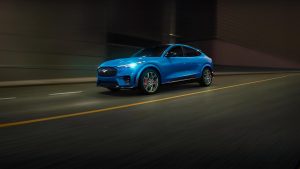
The standard-issue Mach-E is quicker-accelerating than most of the V8 Mustangs made from 1964 through the mid-1990s. To really hammer the point home, back in ’95 I got to test drive the then-new Cobra R, which was the highest performance Mustang you could buy that year (and you could only buy one of these very limited production, competition-intended Mustangs if you had an SCCA road racing license). With its 300 horsepower 351 (5.8 liter) V8 and five speed manual, you could get to 60 just about as as quickly as you can today in this Mach-E.
It also has about the same driving range, though the difference is you could pump the Cobra R’s fuel cell full of gas in just a few minutes. It takes longer to recharge the Mach-E but I found it charged much faster at home – using a standard 120V household outlet – than any other EV I have tested out so far. On two separate occasions, it recovered about 60-70 miles of driving range after leaving it plugged in overnight. This will matter a great deal to potential buyers who do not have a 240 V (Level II) charging hook-up at home, perhaps because they do not have a single family home or townhouse – or don’t want to pay to have one installed. The cost to get this done can be as much as a couple thousand dollars if your home’s panel needs to be upgraded to accommodate a dedicated 240V (30-50 amp) circuit.
It’s also like traditional Mustangs in that it’s rear-drive (unless you opt for AWD) and so you can squeal the tires. This is pretty much the only noise you’ll hear, though – because electric drivetrains are rigged for silent running.
This is a little weird – at first – because of the disconnect between sudden thrust and the absence of any engine roar (or neck-snap at each upshift; there are no shifts – just linear forward motion). But it has its virtues in that going fast silently is smart if you want to go unnoticed going fast. The Mach-E’s crossover shape helps here, too. It has Mustang styling elements, but that is not the same thing as looking like a Mustang. That’s also a good thing, if you like the idea of not being looked at by cops.
Ford does provide propulsion sound as an option. You’ll find it in the tap-swipe menus built into the huge, tablet-style display off to your right. In the GT, the sound replicates what a V8 sounds like. A different sound might be less confessional. Playing the sounds of combustion is a nostalgic nod to the emotional appeal off combustion.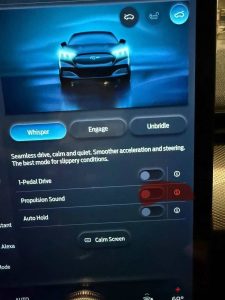
The car feels both hunky and agile, because it is. The electric-assist steering is pinpoint precise but you also feel the weight in ways both good and bad.
Just driving – in a straight line – it feels hefty and planted; same during moderate cornering – which is (to be fair) all the cornering the typical buyer will ever do. On the other hand, if you drive it like a Mustang, the 4,318 lbs. (for the RWD model; dual motor models weigh just shy of 5,000 lbs.) makes itself felt; the tires begin to squeal to let you know they’re feeling it, too. On the other hand, this can also be a lot of fun. The Mustang – which weighs just 3,588 lbs. – has much higher cornering limits, which means you have to corner much more aggressively to really feel like you’re testing yourself. This of course being both risky on public roads as well as illegal.
The Mach-E has another thing going for it, too. Once the corner straightens out, it rockets forward like nothing shy of a Dark Horse Mustang can do. Immediately, too – because there’s no time lost on a downshift or for the engine that isn’t there to gather itself and belt you forward.
Is it as fun to drive as a Mustang? In some ways, no. There’s no animality. There’s also not much difference – vs. other EVs. This is a problem that’s inherent with EVs, since it’s hard to imbue a motor with personality. But it’s also fun to be able to take more than one other person (realistically) along for the ride and the silent explosion of acceleration can be fun also.
At The Curb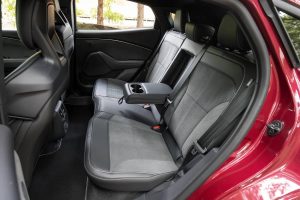
It isn’t a Mustang, of course – but there are some resemblances. It’s the differences that matter more.
The Mach-E is a little smaller than the Mustang, for openers. The latter is 189.4 inches long vs. 186.7 inches for the Mach-E. But the Mach-E makes much more practical use of its size. In the Mustang, you effectively have a two-person sporty car. Plenty of room up front but very little in the rear – and no access, either. Not unless the people up front get out first (or let the people who are going to try to sit back there get in first). There’s almost a foot more legroom in the backseat area of the Mach-E vs. the Mustang (38.2 inches vs. 29 inches) and about five inches more headroom (38.2 inches vs. 34.8 in the Mustang).
Plus, people can get into the Mach-E’s backseat area without the people up front having to get out first.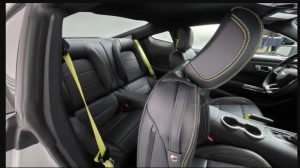
There’s also room for stuff, which the Mustang has very little room for in its 13.5 cubic foot trunk. This is actually a pretty roomy trunk for such as small/specialty car but the access is limited due to the small size of the trunk lid. The Mach-E has more than twice as much room for stuff in its cargo area – 34.4 cubic feet behind the second row, expandable to 64.4 cubic feet with the second row folded – and far better access, because of the wide-opening liftgate.
The long and short being that the Mach-E is a far more practical Mustang. It could plausibly serve as a primary family car – a role for which the Mustang is as suited as beachwear is for Minneapolis in December.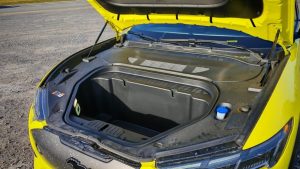
The Rest
A slight obnoxiousness is that Ford charges extra now for the Frunk – the storage area under the hood, up front. The Frunk is there, of course. But you’re locked out unless you pony up $495 extra to unlock it. This is chintzy, almost the same thing as charging extra for the air in the tires. It might save Ford some money but it’s going to annoy a lot of potential buyers.
There’s also the creepy eye-movement monitor, which Ford has installed (it’s that thing on top of the steering column) in anticipation of the requirement that goes into effect next year.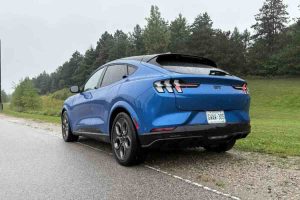
The Bottom Line
The Mach-E is a different kind of Mustang, obviously. That’s not necessarily a bad thing, either. The fact is Ford has sold almost as many this year so far (18,445 as of late November) as it has Mustangs (about 24,030 so far).
Maybe the Mach-E is the right Mustang for you. If it’s not, there’s always the other Mustang.
. . .
If you like what you’ve found here please consider supporting EPautos.
We depend on you to keep the wheels turning!
Our donate button is here.
If you prefer not to use PayPal, our mailing address is: EPautos 721 Hummingbird Lane SE Copper Hill, VA 24079









Wow, Eric is softening toward eeeveees! I never thought I’d see the day.
And frankly, I’m disappointed. Especially after just finishing this morning’s other article where he recommends refusal to comply with the pressure to condition ourselves to the future “they” want for us.
I suppose he doesn’t want to be in the same position with Ford as he is with Mercedes. At least, that’s the cynical view. I hope it’s not that, but everyone has to make a living.
Slightly off topic… I wonder if the Rivian electric cargo vans from the nearby Amazon distribution center will hazard (and havoc!) the 60-year-old wooden bridge on my road when it re-opens soon? (It’s been closed for the last 10 years.) The old signs, still up, warn that the bridge has a 3-ton weight limit, and as far as I can tell, the county boys aren’t doing anything to upgrade that. It’s still going to be and old wooden bridge, albeit with some of the more rotten pieces of lumber replaced.
The large and small versions of those EV vans reportedly weigh 7000 and 8677 lbs respectively — empty. New-to-the-route Amazon drivers want and try to use the bridge already, but they find that they have to turn around and re-route. I’ve had packages delayed for 40 minutes or sometimes until the next day because of this.
I wonder if the increase in range from the 120V outlet was because November in Virginia is probably at a sweet spot for charging temperature? No need to heat or cool the battery pack means more angry pixies into the battery.
Hi RK,
It’s actually been chilly here – 40s at night – for the past several days. I have been impressed by the Ford’s ability to recover usable charge/range overnight on 120V. (I’m sure the resident troll will chide me for not having spent the money to wire up a 240V charge point.)
And a battery for the Mach E is about 20 thousand dollars. Ford wants 15 grand cash up front to even look at it.
Badging two entirely different vehicles, that don’t share a single part in common, as ‘Mustangs’ strikes me as a gross error in branding. Making a ‘GT’ package available for both of them (if I’m understanding correctly) just deepens the blurring of lines.
Offering a California Special paint job on the EeeVee in a nostalgic nod to mid-1960s Mustangs is a case of defiantly doubling down. Only us 105-year-olds even remember those white-and-blue beauties. *taps cane excitedly*
YTD sales totals of 18,445 and 24,030 respectively would have led to instant cancellation in the Before Times, when every successful mainstream model sold in the hundreds of thousands — or else!
You’re blowing it, Lightning Jim Farley. Your mythical $30k EeeVee pickup is the millstone that’s gonna sink your ass to the bottom of the sea.
I been all around the world
Don’t no pickup bother me
I been all around the world
Don’t no pickup bother me
You know I’ve seen everything baby
Everything but the bottom of the sea
— George Thorogood & the Destroyers, Bottom of the Sea