


When Toyota created Lexus, it did so not because people weren’t buying Toyotas. It was done to get people who had more money to spend it on Toyotas.
Not that there is anything wrong with Toyotas. Far from it. But – in America, at least – many buyers expect the prestige of a luxury-brand when they spend Lexus money on a vehicle.
Even if it is still a Toyota.
So Toyota created Lexus – the brand, for America.
But what will happen when Toyota-badged vehicles cost as nearly as much as a Lexus-badged vehicle?
Will Toyota buyers pay Lexus money for them?
The success (or not) of the new Crown and Crown Signia will answer that question.
What It Is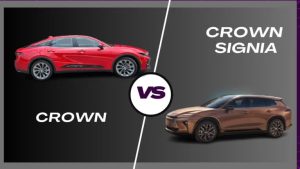
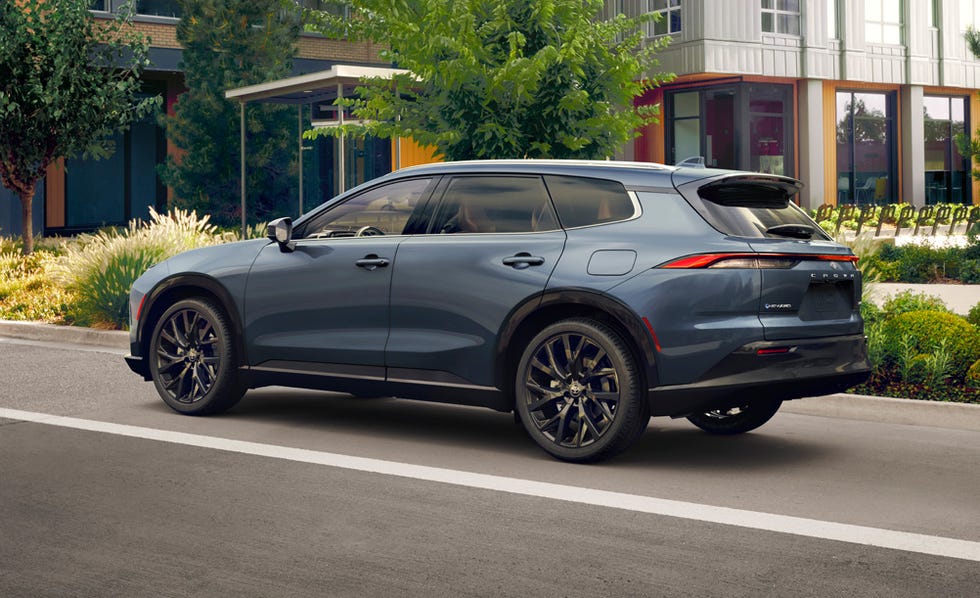
The Crown sedan – and Signia – are the two-fer replacements in Toyota’s lineup for the discontinued Avalon sedan. The Signia is basically a crossover wagon similar to the recently cancelled Venza in terms of its overall shape and utility but more luxurious – and priced more like a Lexus.
Both Crowns come standard with four cylinder/hybrid (and AWD) drivetrains rather than the V6 FWD drivetrain that used to come standard in the Avalon. The Crown sedan is available with a hotted-up version of this drivetrain that may and hopefully will become available in the Signia wagon – focus of this review – in 2026. For now, the Crown Signia comes only with the same basic standard drivetrain as in the Crown sedan – along with the much greater cargo capacity and versatility of the wagon vs. sedan layout.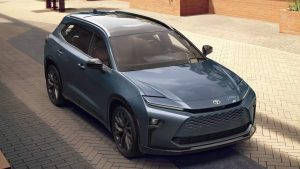
Prices start at $43,590 for the XLE trim, which comes standard with heated and cooled front seats, leather upholstery, a heated steering wheel a digital main gauge cluster and a 12.3 inch secondary LCD touchscreen. Cat’s eye LED headlights are standard, too.
The top-of-the-line Limited – $47,990 – adds a panorama sunroof with retractable shade, an upgraded 11 speaker JBL audio system and 21 (vs. 19 inch) wheels and tires plus rain-sensing wipers and digital key capability that enables the owner to access/operate various vehicle functions (such as lock/unlock) remotely via their smartphone.
The Crown sedan stickers for $41,440 to start and tops out at $54,990 for the Turbo trim, which features the more powerful hybrid/four cylinder drivetrain that may become available in the Crown Signia next year.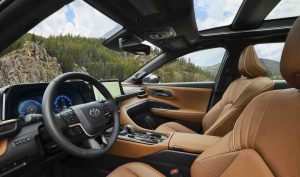
What’s New For 2025
The Crown Signia is a new variant of the Crown sedan that replaced the Avalon sedan in 2023 that also takes the place of the Venza crossover that Toyota retired last year.
What’s Good
For just a little bit more money than it takes to buy the Crown sedan, you could get the Crown Signia and have much more space for things you need to carry.
Averages close to 40 MPG.
Lexus-level luxury on the inside.
What’s Not So Good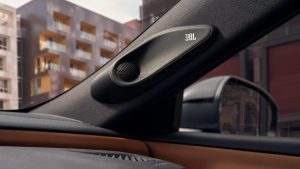
Costs near-Lexus money.
Sluggish performance from the one and only available drivetrain.
“Drowsy driver” eye movement monitor is arguably both creepy and (ironically) distracting.
Under The Hood
Both Crown Signia trims come with the same drivetrain, consisting of a 2.5 liter four cylinder engine paired with three electric motors and a battery pack to power them (the gas engine powering up the battery pack as well as providing most of the propulsive force). Total combined output is 240 horsepower, which is about 60 down from the 3.5 liter V6 that was standard in the Avalon. The weight is also up – by about 800 pounds.
The Signia weighs a hefty 4,210 lbs. vs. 3,570 lbs. for the old Avalon sedan and this explains why the Signia’s mileage, though good for a two-ton-plus crossover wagon, isn’t dramatically better than the mileage touted by the V6-powered Avalon: 22 city, 32 highway vs. 39 city, 37 highway.
The overall difference is 11 MPG.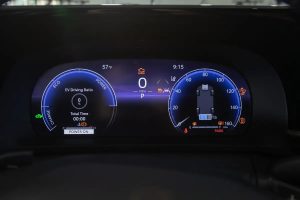
Arguably, the bigger difference is that the Avalon – when it was last available in 2022 – sticked for $36,825. That’s about $6,765 less than what the Crown Signia lists for in 2025 and even if you lop off say $2k to account for three years of inflation, the difference is still nearly $5k more to buy the Signia Crown. That it is more fuel-sippy is great.
Whether you end up saving any money is another matter.
But you will save time – in between fill-ups – because of the Signia’s much longer range, especially in city driving, where the hybrid drivetrain is most efficient. This Toyota can go about 565 miles in stop-and-go city driving on the same 14.5 gallons of gas that the Avalon consumed to go just 319 miles. On the highway, the Avalon could go 464 miles but the Signia can keep on going another 72 miles (536) before the little dash light comes on telling you it’s time to gas up.
That’s a savings arguably worth more than the dubious savings on fuel costs – in part because you can’t get back time.
On the other hand, there is a cost – in terms of performance
Because it’s so heavy relative to how much power it has on tap, it takes the Signia about 7 seconds to get to 60 MPH. To be fair, this time is on par with other mid-sized hybrid crossovers and it’s only “slow” relative to how much quicker late-model vehicles as a whole have become over the past 25 years.
Toyota says the Signia can pull a small trailer that weighs up to 2,700 lbs.
On The Road
The Signia’s hybrid-drive system is unusual but you can’t really tell that it is – except by watching the power-flow display in the main gauge cluster. It shows the application of power to each wheel by the three electric motors, one of them independently applying power to the rear wheels as the system deems warranted. The other two work the front wheels. This layout serves as a form of traction/stability control as well as propulsion in that each motor can adjust how much power is fed to each wheel and this can be used to control both wheel-slip in low traction situations as well a to correct the vehicle’s directional line during cornering.
That said, it’s not something you’d even be aware of unless you watch the display in the dash. The Signia drives pretty much the same as other hybrids, as far as the driver can tell.
There’s an “EV” mode you can engage to allow for short-distance, low-speed driving on battery/motor power alone – until the charge depletes or the speed increases beyond a fast walk and at that point the gas engine automatically restarts, as in other hybrids.
The system also cycles off the gas engine automatically whenever it’s not needed to propel the car and these transitions are quiet and seamless.
However, when you need to accelerate, it’s not as quiet as this Lexus-in-all-but-name ought to be. The four cylinder/hybrid drivetrain doesn’t make enough power to propel the 4,210 Toyota at anything faster than a tepid pace without sounding like she’s given’ her all she’s got, cap’n – in the words of Scotty from the original Star Trek series. The 3.5 liter V6 that used to come standard in the Avalon – and which made 301 horsepower (61 more than the Signia’s four cylinder/hybrid drivetrain) would have been the perfect powerplant for this Toyota-badged Lexus. That V6 was not just powerful enough to move this much weight; it was also smooth and when you needed acceleration, the sounds it made were the right sounds. The sounds of struggle emanating from the Signia’s overtaxed four cylinder/hybrid drivetrain aren’t.
This raises an obvious question: Why doesn’t the Signia – and for that matter, the Crown – come standard with a V6, as every vehicle this size and with a base price well over $40k to start used to come standard with?
The answer is simple and it isn’t better gas mileage. Certainly, the Signia’s mileage is better than the old Avalon’s. But it’s risible to suggest that people who spend well over $40k for a Lexus in everything but name care about gas mileage so much they’re willing to spend a small fortune to get it. If they wanted to save money, they’d be shopping a Prius.
The real answer is that the V6’s mileage isn’t compliant – with federal fuel efficiency regs – and (not being a hybrid) the V6 stays running all the time and that results in higher “emissions” of carbon dioxide, the gas that isn’t a pollutant. The four cylinder/hybrid drivetrain is more compliant – and that’s the answer to the question.
As already mentioned, the Crown sedan is available with a turbocharged iteration of the four cylinder/hybrid drivetrain and that would cure the problem of their being insufficient power to easily (and quietly) get the Signia moving – but it pushes the price of the Crown sedan to nearly $55k and no doubt the Signia would cost at least that much if equipped with the same drivetrain.
That’s literally Lexus money – and that might make it harder to sell this Toyota.
One other driving-related point is the “drowsy” driver monitor that’s built into the steering column. If you don’t continuously stare straight ahead, you’ll get pestered to do just that. The good news here is that a piece of black electrical tape solves that problem.
At The Curb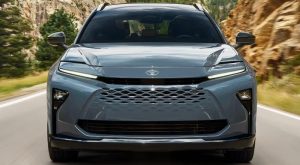
The Signia is about two inches shorter overall than the Crown sedan – 194.1 inches vs. 196.1 – but it has much more space inside due to its wagon-crossover shape. Its roofline is lower than that of the typical crossover, which makes it look sleeker than the typical crossover and this does result in the Signia having a little less room for cargo inside than the typical (taller) crossover of the same size. But there’s still a lot more room for cargo inside the Signia than there is in the Crown’s 15.2 cubic foot trunk.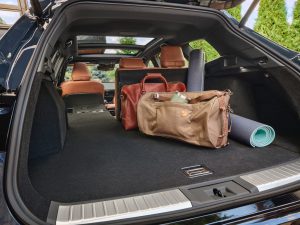
To be specific, there’s almost twice as much space (25.8 cubic feet) for whatever you need to carry around behind Signia’s rear seats and as in every other crossover, you can fold the rear seats down to expand the available space to 68.8 cubic feet, which if you’re doing the math in your head comes out to about 4-5 times as much total available space for stuff than you could stuff inside the Crown’s 15.2 cubic foot trunk.
That’s not the main draw, though – because you can get the same versatility in literally every other crossover and there are literally a dozen or more of them in this general class that also have rear seats that fold down and lots space behind them, too.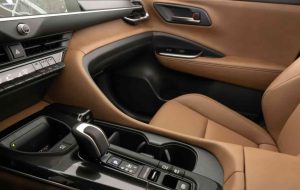
What Toyota is aiming for here is to tempt Toyota buyers with a Lexus in almost every way except for the price. If it sounds as if I’m contradicting what I wrote about above, let me explain. While the Signia is pricey for a Toyota, relative to what anything with a Lexus badge costs now, it’s a bargain.
As a point of comparison, a 2025 Lexus RX350 – which is slightly smaller and similarly equipped in terms of its amenities – lists for $49,125 to start. That’s for the version with just the four cylinder engine. The hybrid version, which comes standard with essentially the same drivetrain that comes in the Signia, lists for $51,425.
And the RX has significantly less total cargo capacity – just 46.2 cubic feet – as the Signia’s got.
The Signia has many of the Toyota-usual thoughtful design touches, too – including a cell phone cubby that holds the phone in place while it charges and redundant/manual control knobs for everyday-use functions such as adjusting the volume of the audio system.
The Rest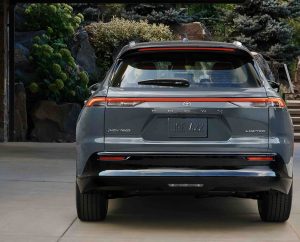
In keeping with the near-Lexus (for less) idea, the Signia comes standard with pretty much everything. There are only the two trims and they’re both loaded.
The main available option is an Advanced Technology Package ($1,865) for the Limited that bundles a 360 degree Panoramic View camera system, power-folding outside rearview mirrors (with puddle lamps) and several additional driver assistance systems, including semi-self-driving features such as Lane Change Assist, which only requires the driver to signal a lane change.
The Signia then changes lanes on its own.
The Bottom Line
The only thing this near-lexus lacks is an engine befitting a Lexus. But then, such engines are lacking in most new Lexus models, too,
. . .
If you like what you’ve found here please consider supporting EPautos.
We depend on you to keep the wheels turning!
Our donate button is here.
If you prefer not to use PayPal, our mailing address is:
EPautos
721 Hummingbird Lane SE
Copper Hill, VA 24079
PS: Get an EPautos magnet or sticker or coaster in return for a $25 or more one-time donation or a $10 or more monthly recurring donation. (Please be sure to tell us you want a magnet or sticker or coaster – and also, provide an address, so we know where to mail the thing!)
If you’d like a Baaaaa hat or other EPautos gear, see here!









“Prices start at $43,590 for the XLE trim, which comes standard with heated and cooled front seats….” In other words, it comes with a butt-cooler? I must be further out of the loop than I thought, but this is the first time I’ve heard of a butt-cooler in a car. I can imagine some prospective buyer deciding this was the feature that sealed their deal — “I can’t survive without a butt-cooler!” Otherwise, this peculiar new vehicle may be remembered someday for marking one of the high points of compliance madness — just as the CAFE and emission rules, mercifully, may be disappearing for good.
It’s amazing that car companies still expect us to drop 50 large on yet another underpowered, pregnant road slug.
I agree, Tony –
$50k for a crossover with a four cylinder engine? Really? Yep. Really.
Seems expensive for what it is.
Morning, Rich!
Absolutely. And it is getting worse…
I’ve got an issue with the 39mpg City rating for the hybrid. While the std. v6 was 22.
This has to mean it’s on battery.
So are they cheating the numbers? Are they assuming you recharge it at home?
Why isn’t that cost/time in the numbers?
What happens when it’s out of charge and the engine has to do both, charge the battery and propel the car. No way it’s 39 then.
I smell smoke and mirrors which our epa is allowing to promote this stuff.
Just like the mpge thing is a energy lie.
There’s likely a fair amount of smoke and mirrors to game the EPA numbers, but a hybrid system could do some of this by recovering energy normally lost to heat when you brake or gravity is pulling you downhill. This energy stored could be used to help you accelerate from the stop. That’s not magical hand waving, necessarily. Getting your car up to speed, climbing a hill or accelerating to over take uses a disproportionate amount of energy compared to what it take just to stay in motion. So measuring the amount of fuel burned would give a fairly large advantage to a hybrid filling in the MPG valleys. There is no big conspiracy in that and given a true free market it’s completely possible hybrids would have gained share just based on economics of fuel consumption. The most efficient way to do it is run an electric drivetrain with an engine acting as an on-board generator, as in the diesel electric trains. They generate the most propulsion with the least amount of fuel possible. The downside is complexity, so repair and maintenance has to offset fuel saving, which has been a hurdle for consumer hybrids. Trains are constantly moving and generally do so without stopping or changing speed much over uniformly level tracks, so each saved penny is easily and quickly justified.
Hi Clapper!
That’s true. The main thing here, though, is that this is a compliance drivetrain. The Signia is gorssly overweight and pricey on top of that. If it weighed 1,000 pounds less and had a V6, it’d be nearly as fuel efficient and much less expensive. Can’t have that.
So was the Prius a forced model or a response to a market demand? Of course we haven’t had a free market for anything for a long time, so nothing is truly free will. But it’s seemed to me Toyota recognized a niche and filled it. Could have just been recognizing the regulatory writing on the wall, hard to say. But back in 1997 I don’t remember anyone really talking about EVs or carbon credits or any of that, although the global warming, peak oil chatter was of course ever present. Nothing happens in a vacuum. Still, the few people I know who drove a Prius were mostly frugal, just wanted the fuel economy for commuting, more than virtue signaling.
Hi Clapper,
In re the Prius: CAFE (federal fuel economy requirements) have been in force since the mid-1970s and they have exerted pressure ever since on manufacturers to bring forth high-MPG vehicles to improve their CAFE scores (and avoid fines). So – yes – I think it’s fair to say the Prius came forth as a compliance car. Keep in mind that it is essentially impossible to legally build an economical car that isn’t a hybrid due to federal “safety” regs, which have made cars much heavier than they once were. A Geo Metro got mileage as good or better than a Prius – but it is no longer possible to make such a car. So they make cars like the Prius instead.
Eric,
How intrusive was the Toyota “drowsy driver” system vs. the Ford Explorer?
We were constantly being pestered by the Crown we rented to “sit up” and it also got mad at me for scanning my mirrors and not keeping my eyes in the little box.
Most of the cars owned by my family, parents and in-laws are Toyotas, but with them all going hybrid/turbo or both and added to that all of the safety nanny garbage, I think I’m done with the brand and most new cars period.
I really don’t like digital readouts, the constantly changing numbers for the speedo are distracting and annoying. Can that be turned off and just display the emulated speedo gauge instead? Nice easy sweep of a needle on a dial, thanks!
And of course, how are the seats? Kiddie size with thigh eating decorative seams or do they fit American adults?
The 2000 Lexus RX300 originally BASED for around $33k – 25 years ago. Today that would be over $62k TO BEGIN. And the Avalon from that same year started just under $30K – which would be about $55k today.
You’re witnessing a dying currency – and absurdly stagnant wages – more than overpriced vehicles.
(*But I still agree/wish that the 2GR V6 was available in the Crown/CS.)
I’m an expat in Japan. They’ve sold Lexus here since 2019. Lexus is a brand in at least 70 countries. Once significant distinction is that nearly all Lexus models are actually still made in Japan rather than in other global factories. There are exceptions, mainly for North America, the ES and RX are made in the U.S. or Canada along side their Toyota equivalents.
The eighties through the early 2000’s had to be a boom time for automotive journalists. There were autos that were being built that were different and desirable to fit anyone’s lifestyle and taste. These days, it’s difficult to distinguish one from another. We can thank the feds for killing off a once great and exciting industry!
Preach it, Allen!
God almighty. When I think about the new cars I got to test drive in the late ’90s through the early 2000s… and then I think about what its come to today. Well, it makes me want to have a drink.
Is the Signia Made in Japan?
Maybe – the plan is that this will look cheap in a couple years 🤪🤪
Morning, Nasir!
It’s getting depressing. I just did some background research on the Mazda CX50 they’re sending me soon. The turbo-equipped version stickers for $40,800. For a nothing-special crossover. Who is buying these things?
The CX-50 rolls off the same assembly line in Alabama as the Toyota Cross.