
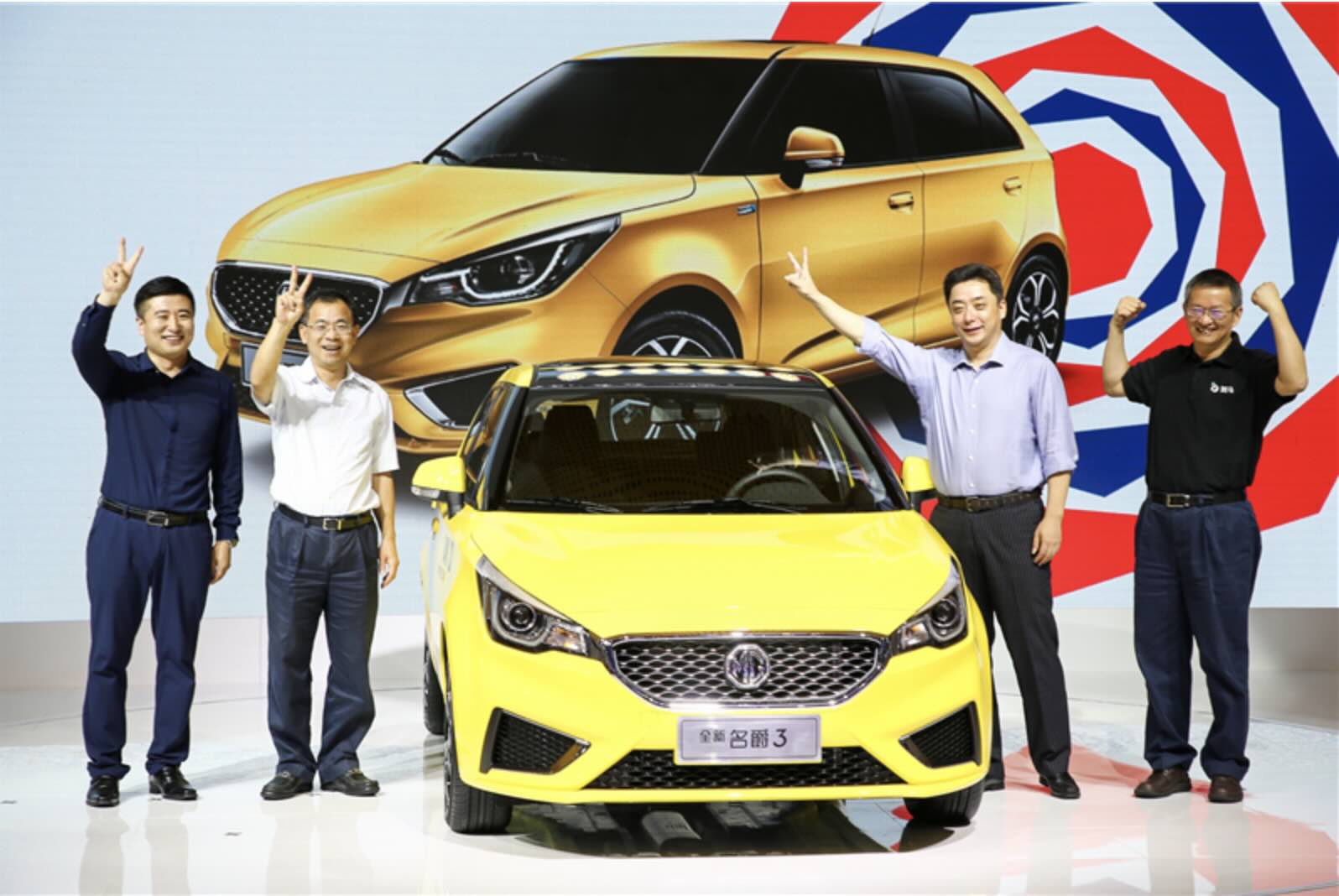

There are people who insist that it’s just not possible for a car company to sell a new car that isn’t a useless car like the Fiat Topolino (top speed 25 MPH; not legal for use on most roads in the United States) that Transportation Secretary Sean Duffy recently so generously decided to permit Americans to buy.
Well, how do they account for the MG3, which is available in Australia, Mexico, Britain and other countries for about $13k?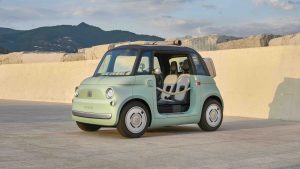
It isn’t an electric golf cart, for openers.
Under the hood of this small sedan – which has four doors rather than two openings and two pieces of rope, like the Topolino – there’s a 109 horsepower four cylinder engine paired with a CVT automatic. it’s capable of reaching and hold highway speeds. It does take about 12 seconds to get to 60, which is about as long as it took for the typical economy car Americans used to be able to buy until the early 2000s to get to 60. It’s nice to get to 60 more quickly. But it’s also nice to not have to pay a minimum of about $22k – which is what the least expensive new car Americans are allowed to buy (the Hyundai Venue) costs – to have that capability. 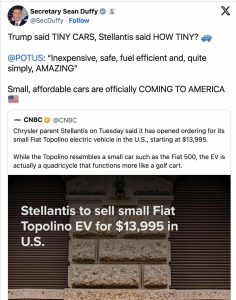
Some say Americans would never buy a car that takes 12 seconds to get to 60, even if it does only cost $13k. How would these solons know, since Americans aren’t allowed to buy cars like the $13k MG3? How about we open up the market and let’s see? Of course, it isn’t up to we. It is up to people like Duffy and Trump, who could at least make the case for setting aside the regulations that prevent cars like the MG3 (and many others) from being legal to sell here.
But why did they disappear from here to begin with? Go back to the early 2000s and American were able to select from among a plethora of small, inexpensive cars very much the MG3. One after another, they vanished from the market.
They’re all gone now.
This happened for a number of reasons, two of them related. Inexpensive cars are not high-profit-margin cars. Put another way, the car companies wanted to make more money on each sale and so they had an incentive to replace the low-profit-margin cars in their lineups with more expensive models that have higher profit margins. That worked for awhile, because there were lots of buyers who were willing and able to assume the financial burden of higher (and longer) monthly payments.
Americans were able to afford this, is another way to put it.
It isn’t working anymore – because more and more Americans can no longer afford a six-year indenture at $757 per month (the current average monthly payment on a six-year car loan) on top of everything else.
What happens then? A decline in volume; i.e., the number of vehicles sold. This – in turn – has caused the car companies to focus their efforts on even higher-profit-margin vehicles, such as huge SUVs and pick-ups. The catch is that even fewer people can afford the average $1,000 per month, six-year indenture it takes to get into one of them. The cycle is now set up to deliver ever-fewer, ever-more-expensive vehicles to ever-fewer people – until buying a new car becomes something like buying a new airplane; i.e., it is something only very affluent people are in a position to do.
If that’s the desired outcome, that’s what’s going to happen. If it does happen, there are necessarily going to be many fewer car companies because there is an inherently limited market for Lexus/Mercedes/BMW-priced cars.
If, on the other hand, it isn’t the desired outcome – if the non-luxury-priced car companies wish to remain in the business of selling cars, then they’ll need to get more people buying cars and a fine way to make that happen would be to put on offer cars almost anyone can afford to buy, like this MG3. It’s a lot like the cars Americans used to be able to buy – just a lot nicer. Back in the early 2000s, $13k cars generally did not come standard with AC or power windows and alloy wheels; these were extra-cost options. They were considered luxury options. The $13k today MG3 comes standard with them – plus AppleCarPlay and Android Auto, a decent stereo and a digital main gauge cluster.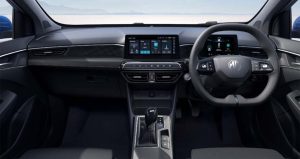
How is possible? (Use Russian accent.) Simple. The MG3 is made in China, by SAIC – as if there were something wrong with that. SAIC owns the MG brand, which of course was once a British brand. SAIV bought the rights back in ’07 after the collapse of the MG Rover Group.
There, are, of course, people who think there is something wrong with that. They are the same people – or at least, have the same mindset – as people who bemoaned “Jap crap” back in the ’70s and ’80s. That “crap” was often superior to the stuff made in the USA and it definitely cost less. Some will remember super little first-generation Japanese cars such as the original Honda Civic of the ’70s and also various Datsuns and Toyotas, too.
Yes, it’s true that the Japanese government assisted the Japanese car companies – but the sore truth that many Americans do not want to hear (then and now) is that the underlying problem isn’t the “Japs” or the “chinks” but rather their own Red, White and Blue government, which has made it much more expensive to make anything in the USA that isn’t expensive. The “Japs” back then and the “chinks” today make things the way we used to make ’em in the USA. That is to say, inexpensively – and often, without it being cheap crap.
It speaks bigly to the problem that the “chinks” can make a $13k car today with AC and other features that would have been considered luxury features the last time an American car company offered a $13k car for sale, which was about 25 years ago – and sell it in places like Britain and make a profit on the transaction.
The point being it is possible to make a $13k car that isn’t a useless car like the rope-door’d Topolino and sell it for a profit in countries like Britain and Australia and Mexico, too.
Just not here.
. . .
If you like what you’ve found here please consider supporting EPautos.
We depend on you to keep the wheels turning!
Our donate button is here.
If you prefer not to use PayPal, our mailing address is: EPautos 721 Hummingbird Lane SE Copper Hill, VA 24079