
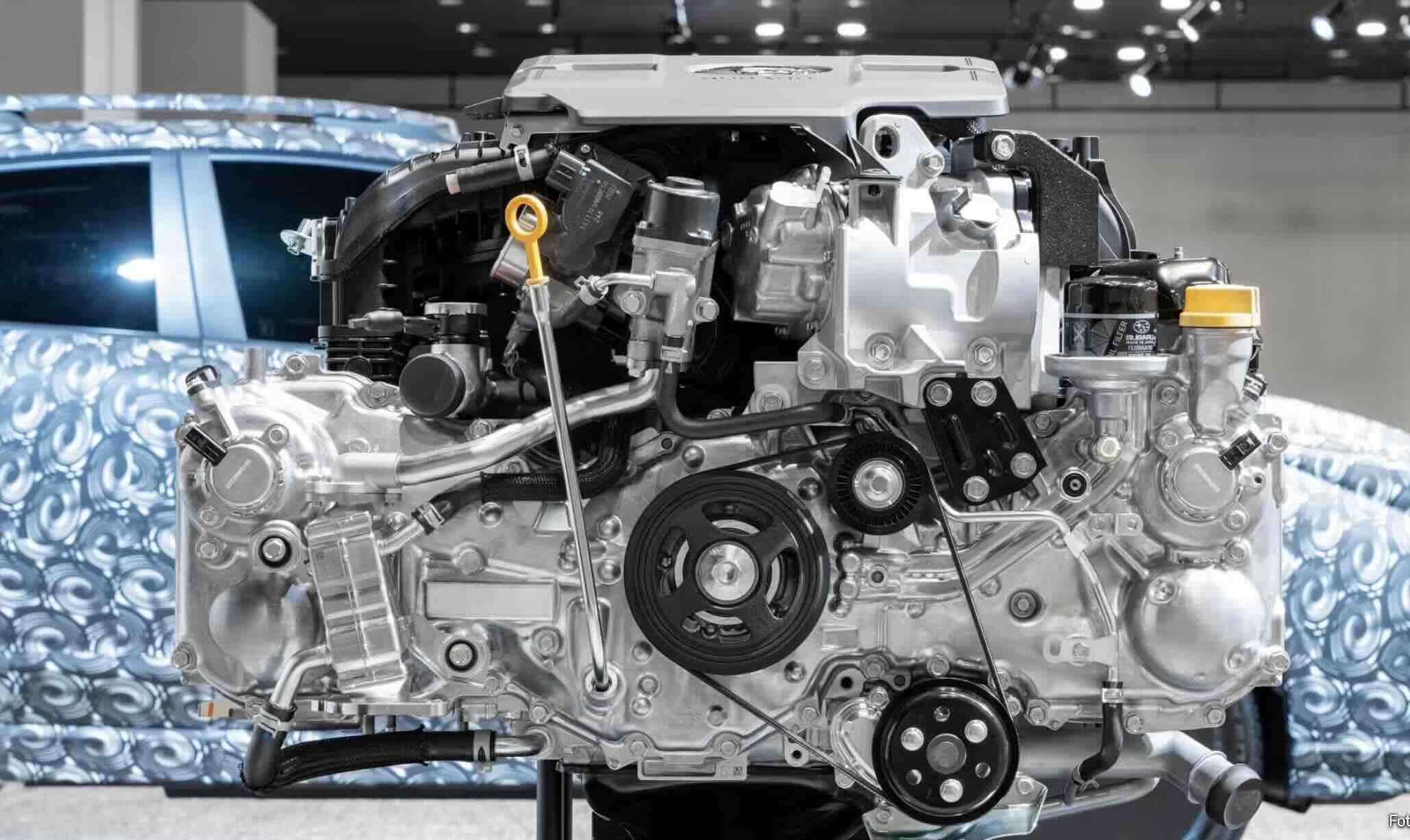

The great sci-fi writer H.G. Wells wrote about Things to Come. How about things that are going away? Subaru’s boxer engine, for instance. It is going away – in Europe – after the end of the 2027 model year. Beginning with the 2028 model year, Subaru will only be selling devices powered by electric motors, apparently because its trademark horizontally opposed engines can no longer be made compliant with EU “emissions” regs.
This implies Subaru’s boxer engines are somehow unclean – the same slander hurled at VW’s TDI diesel engines here in the U.S. about a decade ago. These engines are “unclean,” in a kind of religious sense. Burning fuel being something like eating pork is to orthodox Muslims in the eyes of orthodox believers in the man-mad cult of The Changing Climate. Like other religions, it is both ominous and vague, with its own end times eschatology. The antagonist is a gas you cannot see or smell (because it constitutes 0.04 percent of the air) that is said to be an existential threat that must be vigilantly guarded against at all times, lest it ruin creation. You must believe and you must be prepared to sacrifice in order to remain in good standing with the cult.
In the case of Subaru, the sacrifice amounts to about 80 percent of its current European sales – which very probably means the end of Subaru in Europe.
The good news is that while people in Europe won’t be able able to buy Subarus anymore after the end of the 2027 model year – except in name – Subaru isn’t giving up on the boxer engine in the home market or (at least for now) the North American market. That, however, is likely to change on account of the change that is likely coming.
Subaru – and every other car company not yet selling devices exclusively – got a brief dispensation when the apostate Trump was re-elected in 2024. He prevented federal “fleet average” MPG mandatory minimums from going up to 50 from about 35, which served as a de facto EV mandate, since the only realistic way to bump up the “fleet average” MPG number is to bring forth lots of EVs that are credited with averaging 120 MPG”e” or even higher than that. These CAFE standards, as they are styled, also served as a kind of death warrant for engine’d vehicles that drag down the “fleet” average. This is why a large percentage of the engine’d vehicles still around have very small and hybrid-augmented four (or even three) cylinder engines.
Expect more- or rather – less – now that the political winds have shifted. The Climate Cult is apt to have a revival, a real bring-down-the-house, tongue-talkin’ hootnanny, full of fire and brimstone.
Meanwhile, Subaru will try to sell “Subaru” badged devices in Europe, going up against other devices with other badges, some of them literally the same thing aside from the badge, such as the Trailblazer device – which is also the Toyota Bz device. These devices were jointly developed and share identical battery-powered drivetrains marketed differently as “Subarus” and “Toyotas.”
Expect more of the same – literally.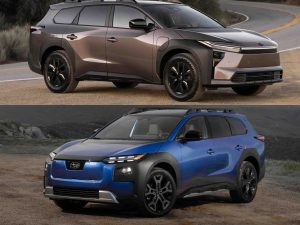
Where does this leave Subaru (and Toyota) and all the others? Well, in the case of Subaru, it certainly leaves the brand without the thing that brand was built on, that being its boxer engines. A Subaru without one s something like Elvis without his voice.
In this vein it’s worth bringing up the case of Volvo, which hardly exists as a brand anymore for both the same as well as similar reason. It also has largely switched over to making devices badged as “Volvos” and they aren’t selling very well, since these devices lack the Volvo-ness that once made a Volvo different than, say, a Subaru. Volvo also lost the other part of its identity as something other than the same thing everyone else sells when everyone else began selling “safety,” too – in part because the government forces everyone to but also because of me too.
At one time, dimly remembered, “safety” was not the mass-inculcated (and enforced) obsession it is now. No one wanted to drive an unsafe car, of course – but that is not the same thing as wanting to drive a fun car or a good-looking car or a high-mileage car that maybe would not hold up as well in a crash, if that were to happen. Since most people reasoned that crashes are unlikely things – especially the really bad ones that might end up with someone dead or badly injured as opposed to just scraped up a little bit – but fun (and good-looks and high-mileage) are everyday things, many went with the car that wasn’t as “safe.”
This meant Volvo – which catered to the “safety” minded – had a corner on that market. The government effectively took that market away from Volvo by ending the free market; i.e., by eliminating people’s freedom to choose the maybe not as as “safe” if you crashed it (but more fun, or good-looking or higher-mileage) vehicle over the “safe” (but granny panties-looking and not-much-fun) Volvo by making every car a Volvo.
So why buy a “Volvo”?
Why buy a “Subaru”? Or a “Toyota,” for that matter?
Everything’s being made into a device – and they’re all very safe (assuming they don’t catch fire or fail to stop because their drive-by-wire brakes decided not to). It’s the vehicular expression of Soviet Prole apartment complexes, only more expensive and not everyone can afford one.
. . .
If you like what you’ve found here please consider supporting EPautos.
We depend on you to keep the wheels turning!
Our donate button is here.
If you prefer not to use PayPal, our mailing address is: EPautos 721 Hummingbird Lane SE Copper Hill, VA 24079