


One of the things vehicle manufacturers have done to discourage the average person from attempting even basic service – such as changing the oil/filter – is fitting an underbelly pan to new vehicles. If you have been underneath a vehicle made during roughly the past decade or so, you already know about it but for those who haven’t, the deal is this:
Underneath the engine (and also the transaxle, if it’s a front-drive/AWD vehicle) there is a plastic pan that denies access to the underside of the engine. In order to be able to see and get at the underside of the engine – and to get at and remove the oil drain plug and filter – you must first remove this pan, which is typically held in place by a number of small plastic screws around the perimeter. The pan supposedly is there to shield the underside of the engine from water-splash and so on but what it certainly does is make it more difficult to get at or even see the underside of the engine.
Or to notice when something’s leaking.
Someone I know owns a two-year-old Subaru Crosstrek; it only has about 24,000 miles on it and ought not to be leaking anything. But it has been leaking oil – because one of the valve cover gaskets is either defective or perhaps the valve cover itself was over-tightened during assembly, which might have crushed the gasket, causing the leak. The point is there’s a leak. But – thanks to the pan – the leak went unnoticed for quite some time, because there was no evidence of a leak, such as oil drip spots under the car that would have been visible when the car was moved – because the pan caught all the drips. When the car was taken in to a shop for an oil change, the mechanic found the oil that had escaped the engine. It had accumulated in the pan.
Brilliant!
The pan makes it appear there are no leaks. This causes people who own the car to believe their car isn’t leaking. Look! No spots on the garage floor! My car is so well-made!
So, that’s part of the problem with the pan – in that it hides problems, causing people to believe there aren’t any. This can, of course, lead to bigger and worse problems as well as expenses that the vehicle’s owner might otherwise not have had to pay. Such as engine damage resulting from loss of oil.
In the case of this leaky Subaru, the car is still covered by its factory powertrain warranty and so the cost of parts and labor to replace the leaky valve cover gasket will hopefully be zero. But what if the leak went unnoticed for just long enough for the powertrain to be out-of-warranty? Usually, that means the owner is on the hook for the cost of the repair, which can be considerable (in some cases, replacing something as seemingly simple as a leaking valve cover gasket can entail disassembling most of the topside of the engine, in order to be able to get at/remove the valve cover, to replace the leaking gasket).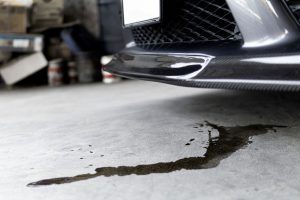
The other problem with the pan is the one mentioned earlier, above. The presence of the pan serves as an impediment to even basic service work such as changing the engine’s oil and filter, because before you can do that you must first remove the pan. This is very awkward to do if you don’t have a lift because it’s hard to get at the several small plastic screws that hold the pan in position. To avoid the pan coming partially down before the last few plastic screws are out, you either have to hold the thing up with one hand or use something else to hold it up.
But that’s not the hardest part.
Getting the pan off is relatively easy. It is getting it back on that’s a challenge, especially if you haven’t got a lift – because you’ll be trying to do this on your back, while lying on the ground. It is necessary to maneuver the pan into position, aligning the mounting holes in the pan with their mounting points on the vehicle’s underside – and then screw it all back together.
If you do have a lift and the tools a professional mechanic has, it’s not a big deal. But if you’re just an average DIY-type with a floor jack and a set of basic hand tools, it’s an additional hassle that serves as a deterrent to the doing-of-it-yourself. That appears to be the point of the thing. Along with giving people the false impression that their vehicle isn’t leaking anything, even when it is.
You can, per usual, thank the government for this. The pans help manage airflow underneath the vehicle, which makes it more aerodynamically “slippery” and that provides a slight but important fuel economy benefit. Not one that matters to the individual vehicle owner but in terms of “fleet averages” and compliance.
. . .
If you like what you’ve found here please consider supporting EPautos.
We depend on you to keep the wheels turning!
Our donate button is here.
If you prefer not to use PayPal, our mailing address is:
EPautos
721 Hummingbird Lane SE
Copper Hill, VA 24079
PS: Get an EPautos magnet or sticker or coaster in return for a $25 or more one-time donation or a $10 or more monthly recurring donation. (Please be sure to tell us you want a magnet or sticker or coaster – and also, provide an address, so we know where to mail the thing!)
If you’d like a Baaaaa hat or other EPautos gear, see here!










On the subject of “CAFE”, auto manufacturers should delete the hood, doors, and anything else that creates a panel gap, because said gaps can trap small amounts of air, creating draaaaaaaaaaaaaaaaag. Also tires, because of rolling resistance. And don’t forget the seats, dashboard, and steering wheel, because “Weight reduction, bro!”. Hell, just delete the whole damn car! Then there won’t be any issues with “fuel economy”!
RE: “Hell, just delete the whole damn car! ”
…That, is the goal.
Some of the underbody covers have curved ducting to direct air flow onto alternators or turbo-manifolds tucked behind the motor. All of them end up as nasty oil-soaked crap that is a PIA even on my car lift at the shop. The dealerships even leave out half of the fasteners after just one oil change. The quickee-lubes are even worse about tearing the things to pieces.
Some of the pans hold the bottom of the front bumper cover in place along with the bottom of the front fenders and wheel wells.
It has all become a plastic mess from knee-height down.
Not to mention these plastic covers are also a potential liability. Say one of your customers leaves your shop, hits a rut, bump, etc. Or one of the plastic clips/bolts/whatever just breaks off from wear and tear. Either way, the cover detaches. Now that customer is likely going to assume that you didn’t reattach it properly, and might even demand compensation.
You know, this will go nowhere: “Now that customer is likely going to assume that you didn’t reattach it properly, and might even demand compensation.”
…Not happening.
Any more “words of encouragement”, ‘ol wise one?
Yes. Cherish those you love & tell them so.
Morning, blue!
As it happens, we were coming yesterday from the store when we rolled up behind a late-model Tahoe that had a pan that was partially falling off – you could see it scraping the ground on the driver’s side. I kept back just in case it came off entirely. My bet is that big piece of plastic could do a lot of damage if it hit you in the face at 60 MPH.
[…] This article was originally published on Eric Peters Autos. […]
[…] This article was originally published on Eric Peters Autos. […]
While reading this article, I thought of this other thing:
“”Mayday” is used in the most urgent life-threatening situations, while “pan-pan” is for urgent situations that are serious but not life-threatening.”
https://simpleflying.com/pan-pan-mayday-distress-calls-differences-guide/
I guess, YMMV? Running the engine out of oil – could be – life threatening. Depends, I guess?
Just changed the oil in my Audi. I didn’t use the ramps this time, there is enough room. The three most aft screws are slightly annoying, but not a big deal.
On of the things I’ve noticed about all the covers/pans is that the fucking mechanics have no problem busting them and not replacing them. It aggravates me.
We’re never gonna be free of this shit.
Hi Yeti,
These plastic pans do not appear to have any necessary functional purpose that would matter to the owner. If my vehicle had one, I’d probably just remove it. However, it may be that they keep water splash away from sensitive electronics and such, so I’d also look into it carefully before doing so.
It’s one thing to have skid plates on a 4WD. It’s another to put these pans under a racecar, but if they’re too slick, you get lift and like Mercedes on the Circuit de Sarthe, an expensive racer becomes a giant, terrifying frisbee.
I wonder if the pan can make the car too slick at high speeds and possibly result in the same calamity? Saving a few MPG isn’t worth your car going end over end because you got some dirty air from the vehicle in front of you.
Real world solutions?
1.Take off pan,
2.place in trunk on floor to in act as a barrier to save the trunk interior, with a baggie holding all the screws, and ….
3.drive like normal,
4. replace the pan before sale.or trade in
I have a GTO with such a stock pan, but it has an almost 4×4 body armor skidplate thickness, since the cars is very low slung, for protection from speed bumps and road debris.
YMMV….
RE: “I have a GTO with such a stock pan”
I’m guessing it’s one of the newer versions, the super-plastic kind?
My several 1st Gen S-10 4×4’s have had them, but they all were nothing like in the photos in the article.
I figure the usefulness of a plate or pan is proportional to it’s rigidity. A flimsy plastic thing held on with quick snap plastic fasteners isn’t there for protection. If it’s thick plastic or metal that doesn’t deform easily and is held on with bolts then it probably is for some protection.
I could be misremembering, but I think the S-10 skid plates had holes in them so oil could drain out & you would know you had a leak. Eventually?
The plastic pans seem like part of the reason they are there is to conceal leaks. I would not be surprised if this were so.
The Pan, at least for VAG Products, is for aerodynamics. The manufacturers would not spend the extra money for them if they didn’t have a use. On my Audi A1 it is a Full Pan. On my S1 which has different shaped front bumper, the Pan is about half the size. Granted, the Pans cause more work when servicing the cars but knowing they serve a purpose, it doesn’t bother me.
Doug: “but knowing they serve a purpose, it doesn’t bother me.”
Even if the cost of manufacture added more to the purchase price than the cost of the fuel you would save in a lifetime of driving?
Upside: I have 66000 miles on my Fusion. My mileage, every gallon entered in a spreadsheet at purchase, is 26.6 mpg. I figure if that pan saves 0.1 mpg (probably wildly optimistic) it saved me 19 gallons, or $57 with gas at $3/gallon.
What do you suspect adding that pan cost?
Downside: To do my own oil change, I have to remove and replace it. If I have a dealer do the change, it is inevitable that some of the screws, at $3 each, will not be replaced. I know that his labor cost includes the time to remove and replace the pan in the cost of the oil change. Most important: I cannot verify that the drain plug has been tightened or if the oil filter really was replaced unless…. yep….. I remove and replace the pan (and buy more screws).
As you might hear in the NY garment district: “Such a deal I can live without!”
Damn! I just checked the invoice for the 3 screws I bought about a year ago. $6.50 each! They are steel, with a captive washer, but $6.50 each? I rarely let others do routine service on our cars, but occasionally “It happens”. I almost always regret letting anyone near them.
Hi ARYLIOA.
Check to see if there is an U-Pull It type wrecking yard in your area and grab an assortment of clips and screws for your car. Some people just stick screws or bulbs in their pockets and walk out or just buy them there; either way those yards seldom charge you for a few screws.
The purpose for me is aerodynamics. I drive well over 100MPH in Germany and 80 – 110MPH on Mexican Autopistas. If you’re driving a Fusion, I doubt wind flow/resistance is an issue but for me it is.
RE: “110MPH on Mexican Autopistas”
I’ve not heard of that before. On the border areas it was all bump & grind traffic. I’m trying to imagine 110MPH on Mexican ‘Autopistas’. Seems, nice. I wonder where they are & what it’s like.
The manufacturer isn’t trying to make it difficult to service intentionally. If they are willing to use glue to save $0.0001 per fastener they sure as heck won’t put on a big piece of plastic without some reason.
They are interested in eeking out 0.2 MPG because of CAFE b.s. In another article Eric posted this is the sort of extra weight and cost that EPA and FMVSS add.
And as mentioned, for some cars the aerodynamics aren’t just MPG but handling. That’s probably not the case with your average road car like a Crosstrek but would be with sports cars and higher performance sedans and hot hatches.
Exactly, Hanta –
This belly pan thing is just another manifestation of Compliance Costs.
My wife had a VW Passat that had one of these. I got the oil changed at an oil change shop and we took off for our cabin in Wisconsin’s north woods. While driving up in the lovely nothing anywhere wilderness the pan bolts loosened and it started dragging the front on the pavement. I had to crawl under and rip it off ( thankfully the bolts were plastic) and throw it in the trunk. Just another solution to a problem that needed to be created. After having the dealer replace a fender blinker bulb to the tune of $75 I decided to not get work like oil changes done at the dealer anymore. I also decided to not buy another VW or any German car, due to the fact of my daughter’s costly repairs on her BMW 7 series.
HA! I can relate: “I had to crawl under and rip it off ( thankfully the bolts were plastic) and throw it in the trunk.”
My daughter had an 07 Audi roadster which I bought at auction and had to do a little work on. That damned plastic pan was part of what held the whole front end together. Nice car, after the top stuck halfway down and it had to go to the dealer computer, I made her get rid of it.
My 2010 Mazda has a cutout for the oil filter but it’s a really tight space and impossible to see, plus the pan has gotten floppy over the years. Probably going to just remove it for good next time I do an oil change.
There was a car about 90 years ago that had a pan, but it was chrome and sealed up from the bottom to keep all dirt out of the engine bay and give you a nice reflective view of the probably V12 or whatever it had, I forgot, but it was a beautiful engine. I think it may have been on Jay leno’s garage. Maintenance was still easy because of the cowling lifted from the side. What they do now is nothing but annoyance and some alleged fuel savings. Doesn’t keep the engine clean, hinders maintenance.
As an owner of a 2004 Forester, I can tell you Subarus have been leaking fluids for over twenty years now. They had head gasket failures for over 10 years and did nothing about it. The reason for the leak was a weak gasket. The turbo engine of that era never had the problem because it was fitted with a stronger gasket. Subarus answer at the time was to use a coolant conditioner, basically stop leak. This was done to get the cars out of warranty, so you’d be on the hook for the repair which is quite expensive. Eventually they fixed that issue but now they leak from the valve covers and cam carriers. Why? Because they are glued together and tend to leak because the sealant fails often well before 100K miles. And it is expensive. It’s an engine out repair.
I mentioned Subaru’s peculiar (bizarre?) decision to use sealants instead of physical gaskets in some of their engines in a comment to Eric’s review of a 2024 Crosstrek. https://www.ericpetersautos.com/2023/08/18/2024-subaru-crosstrek/ Ever since learning of that characteristic, I have — with regret — put Subarus into that growing category of vehicles that I would never want to own without having a comprehensive warranty. It seems like a new kind of planned premature obsolescence.
Yup. I’m of the same view. Our Forester has been a bit of a maintenance queen. They are in general to be honest just following the regular schedule, but the unexpected things are crazy expensive. Too many vertical seams that are glued along with the delicate CVTs have completely turned me off. It’s a shame really.
Wow. Good to know. Thanks for those bits, guys.
Addendum: For those interested in this Subaru oil-leak problem, I came across a more recent video by “Mr. Subaru” on YouTube, from a month ago, in which he addresses the RTV sealant problem in yet more detail. Basically, he confirms that all new Subarus will eventually have an oil leak problem based on the use of the RTV sealant and that the fix requires the engine to be removed. Worth reviewing: https://www.youtube.com/watch?v=tfxdA44VaGY&ab_channel=MrSubaru1387
No valve cover leaks on a flathead. No rubber band cam belts, electronic injectors, or computers either. No plastic and no belly pans either unless you’re trying to eke out the last 0.5 mph on a dry lake bed somewhere! Just saying.
A guy took me out to his field and showed me this old rusty relic of a truck that had not moved in many decades. Said he’d been out tinkering, wanted to see if he could get the old flat-head to run ‘just for fun’.
He reached in touched the key and it was purring!
I swear one of the smoothest running engines I’ve ever seen.
Yep and the power is quite adequate for modern driving. Mpg can still be in the 20s. The 51 Ford F6 that I bought a few weeks ago I had to spend a pleasant half hour rebuilding the carb, 10 minutes running a piece of 600 grit between the old points, and an hour bleeding the brakes (I’ve never done a Hydra vac before so it took longer). Smooth running, easy pleasant maintenance, and they will usually crank up after sitting in a field somewhere for 40 years. Nothing made since the 60s has these virtues.
I disagree with Eric, I think the 50s and 60s was the peak of cars. They had what you needed, nothing more. The 80s/90s Japanese cars added complexity and not all of it was just for compliance. You didn’t have to do quite as much maintenance on weekends but when you did you needed a NASA flow chart to troubleshoot. The cars in the 50s/60s were more like tractors, you could get them running with a few tools and some brains. They didn’t go 100K just doing oil changes and adding gas like the Toyotas and Hondas, though.
Just imagine the ‘bullet-proof’ super basic- maintenance friendly super efficient flat-head engine that could be built today!
Small start-up could manufacture these engines with a basic 5 speed transmission for universal fit into anything one decided to bolt it in to.
Great business idea?
Another, WOW. “and they will usually crank up after sitting in a field somewhere for 40 years”.
Never touched one. I think I’ve missed out.
Obviously, like in International law, mankind has made some serious leaps backwards.
In high school early 70s my buddy drove a 50 Ford two door with a flat head V eight – the smoothest running motor I’d ever seen. His was a three speed manual with an overdrive unit hitched on the end of the transmission, engaged by a chrome pull handle under the dash.
My 2000 Nissan Frontier has a skid-plate/splash pan to remove everytime before I can get to the oil filter. Has 6 bolts and is made of steel. Looks pretty sharp under there and serves an actual meaningful purpose.
I don’t mind too bad because the truck is so tall..
no lift, Jack or ramps required for servicing..
People keep paying for these modern plastic POS ninnymobiles.. otherwise they would go away.
Convenience, stupidity or just have WAY too much fiat currency.
Probably all the above.
My 2 cents.
I battled that awful thing on my Mazda 3 a couple of times when I was trying to do a drain and fill of the “lifetime” fluid in the transmission. Fortunately, I’ve found a good mechanic shop that has the proper adapters to do a transmission flush.
Are the covers needed? Why not just leave them off. Problem solved. I have a 2023 Crostrek. It does not have a plastic pan. I change the oil. It has the manual transmission. I like that part of the car. I hate the nanny crap.
On trucks and some AWD cars the pan may be for physical protection. If that’s the case then it’ll also probably be stamped steel or maybe aluminum.
On most cars the main function of the plastic plates is aerodynamic, it helps clean up air flow under the car to eek out MPG. They do the same thing on race cars, putting flat plates on the belly. They’re doing it to control down force but it’s also to help fuel economy.
It may also serve secondary functions like light duty debris and splash protection. Might help reduce wind noise or control cooling of the drivetrain. It’s not the worst idea to watch coolant and transmission temperatures initially if you do leave it off, just to make sure. Chances are very small it will have that much impact but you never can say for sure without the wind tunnel testing the manufacturer did.
‘vehicle manufacturers have [fitting] an underbelly pan to new vehicles.’ — eric
So now they put a pan — a bedpan, if you will — under the engine, as well as a pizza-box (or larger) sized cover on top of it. Your Sitzpinklermobile doesn’t need a mechanic. It needs a nurse.
How would an Old World, Freudian-trained psychiatrist diagnose this bizarre behavior? It is the opposite of the codpiece phenomenon of five centuries ago. The modesty pans serve to conceal an embarrassingly tiny engine, which in a car translates to a lack of virility. Turbochargers and sound effects (Vroom! Vroom!) can’t conceal the fact that under the hood, almost nothing is there.
Such effeminate vehicles flee in terror before well-endowed machines like this one, which proudly ‘let it all hang out’:
https://tinyurl.com/y4n7rpwa
Don’t like modesty pans? They’ve got an EeeVee just for you …
That is very astute, Jim – post o’ the day!
Bwahaha! ” — a bedpan, if you will — ”
…I’ll never look at ’em the same from here on out.
At least skid plates are reasonably functional. Judging by the scratches on the Cheorkee’s plates they might have saved the oil pan and gas tank a few times. But a real PITA for simple work underneath the vehicle.
A lot of the newer cars have their oil filter on the top of the engine and sometimes there is a smaller removable door panel that can be removed for draining the oil.
Our Forester is exactly this. Filter on top (they even put a catch basin around it so when you take off the filter oil is not spilled) and there’s a hatch in the belly pan to access the drain plug.
And, you can be pretty much assured that those multiple plastic screws will get stripped and/or lost after several removals. Thus, you will have a droopy pan or one held in place by zip ties.
Sure, you can get generic replacements at AdvanceAutoZoneReilly’s but, they won’t be a perfect fit…usually by a long shot. And they won’t be cheap in price despite the low quality.
Our 2016 Jetta has a foam “pan” protecting access to the underside of the dash and serving as part of the design to suppress engine noise in the cabin. Two easily-lost plastic screws secure the piece in place, and cost $20 to replace at the dealer.
Third party replacements are probably available, but VW hides the specs on the screws.
The questoin is, how much does the pan actually help reduce noise?
Yeah. I think that going OEM in that case is probably a good idea. I visit owner forums where people state that they only use OEM parts. I think that’s crazy as OEM costs 3x as much as aftermarket in many cases. In the cases of these @#$# fasteners, that may be the way to go. Riht to the dealer