


Mr. T used to say, I pity the fool. Let’s add to that the one who must – somehow – design their crossover to stand out from all the other crossovers.
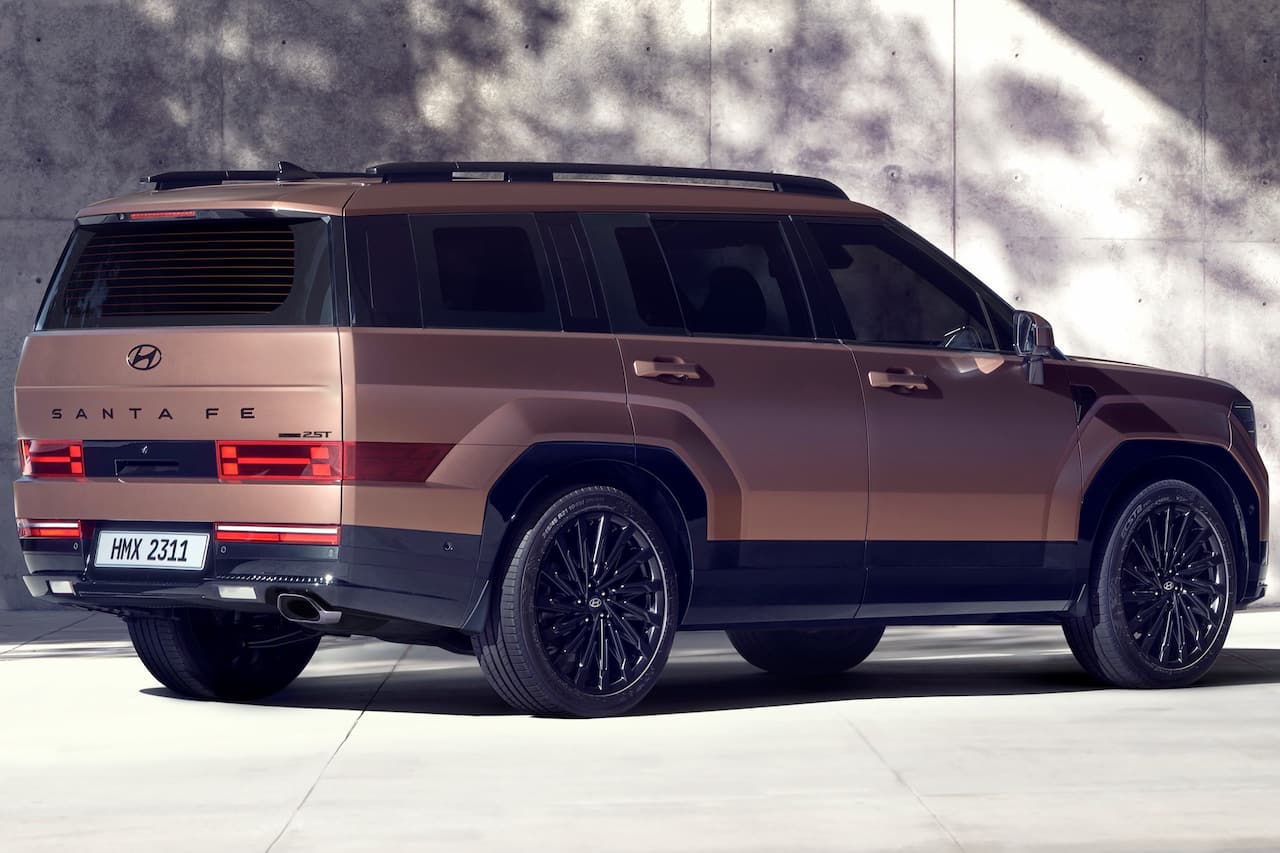
Well, one way to do that is to design it differently – at least visually – and that’s what Hyundai did with the Santa Fe. It looks very much unlike all the other crossovers.
And more like a futuristic Range Rover.
What It Is
The Santa Fe is a mid-sized crossover with three rows and rooms for 6-7, depending on the configuration. It is available with either a convention gas-engined drivetrain or a hybrid drivetrain, which can save you about 16 MPG in city driving. It is also available in a more SUV-ish XRT trim that has more ground clearance and towing capacity than the other trims. But it’s how the Santa Fe looks that makes it stand out. The sleek, slab-sided exterior is strikingly distinctive, which will appeal to people who want a mid-sized, three-row crossover – just not one that looks like every other crossover.
Prices start at $34,300 for the base trim SE, which comes standard with a turbocharged 2.5 liter engine paired up with an eight speed automatic and front-wheel-drive. Adding the optional AWD bumps the MSRP up to $36,100. A hands-free liftgate, LED headlights and a 12.3 inch touchscreen are standard.
The $36,800 SEL adds a single sheet, panorama display that integrates the main instrument cluster with the interface for the secondary systems and apps, synthetic leather seats with heaters for the driver and front seat passenger and a digital key that lets you use your phone to access the vehicle and control certain functions. AWD bumps the price up to $38,600.
The XRT ($40,950) comes standard with AWD and 1.3 inches more ground clearance as well as a set of 18 inch whees with all-terrain tires. A sunroof and GPS navigation are also included.
The Limited ($43,700) gets a larger, panorama sunroof, real leather, heated rear seats (and steering wheel plus an upgraded 12 speaker Bose audio system. AWD bumps the price of this trim to $45,500.
The Caligraphy trim ($46,850) is the most luxirous version of the Santa Fe. It comes with everything that’s standard in the lower trims, plus quilted leather seats, suede headliner, power folding second row captain’s chairs, dual wireless phone chargers and 21 inch wheels.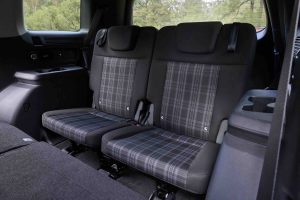
There is also a hybrid version of the Santa Fe, which will be the focus of this review. It is offered in SEL ($37,800), Limited ($44,700) and top-of-the-line Caligraphy trims ($47,850) all of which are available with AWD but come standard with FWD. In these models, the 2.5 liter gas engine is replaced by a 1.6 liter gas engine paired with a hybrid system that keeps the gas engine off as often as possible to boost gas mileage.
A six speed automatic is standard with the hybrid SF.
What’s New For 2025
The restyled SF made it debut last year (2024) so the changes for this year are few beyond the addition of a new color – Atlantis Blue.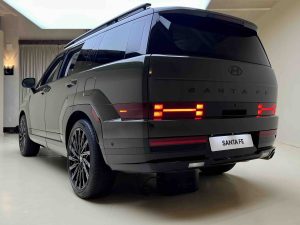
What’s Good
Striking looks assure this crossover stands out from the crowd.
Excellent fuel economy from the hybrid, which also isn’t extravagantly expensive to buy.
Hybrid’s standard transmission is not a CVT automatic transmission.
What’s Not So Good
The hybrid would be less expensive to buy if Hyundai offered it in the base SE trim.
Hybrid’s max tow rating is just 2,000 lbs. Significantly below the 3,500 lb. rating of the non-hybrid models and less than half the 4,500 lb. max tow rating of the XRT trim.
All-LCD panel doesn’t look distinctive because everything else has one of those, too.
Under The Hood
The non-hybrid Santa Fe comes standard with a turbocharged 2.5 liter four cylinder engine that touts 277 horsepower and 311 ft.-lbs. of torque. This is only slightly less horsepower (and more torque) than the 290 horsepower (and 252 ft.-lbs. of torque) produced by 3.3 liter V6 that used to be standard in the Santa Fe circa 2018 – which was back when V6 engines were still commonly standard in mid-sized crossovers.
Interestingly, the gas mileage touted by current SF’s 2.5 liter turbo four – 20 city, 29 highway – is only slightly better than the 18 city, 25 highway touted by the old V6. The V6 also enabled the Sante Fe to come standard with a 5,000 lb. max tow rating. The current SF is only rated to pull a maximum of 4,500 and that’s exclusively the XRT trim. All other non-hybrid trim are rated to pull a maximum of 3,500 lbs.
The long and short of it is that Hyundai – like every other vehicle manufacturer – has had to replace the six cylinder engines that used to commonly be available (and even standard) in vehicles like the SF for reasons of compliance. Turbo fours move less air – when not under boost – and so “emit” less of the dread trace gas (C02) that forms 0.04 percent of the air. The government demands ever-lower C02 “emissions” and small, turbocharged fours help comply with those demands. The turbo helps meet buyer demands – for six cylinder power/acceleration. Speaking of which: The SF equipped with the 2.5 turbo engine can get to 60 in about 6.2 seconds. AWD-equipped models are a tenth or so less quick because of the slightly heavier curb weight.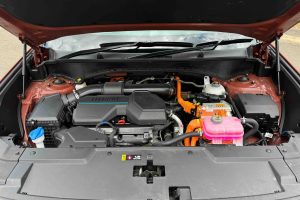
Hyundai also offers a hybrid drivetrain that replaces the 2.5 liter four with an even smaller 1.6 liter four, supplemented by an electric motor for on-demand power and a battery pack that powers accessories when the engine isn’t running. The engine also powers up the battery, completing the circle. Total maximum output of this drivetrain is 231 horsepower and 271 ft.-lbs. of torque, which is sufficient to get this version of the SF to 60 in about 7.8 seconds.
That’s obviously a couple steps behind the non-hybrid SF but what you get in exchange is much better gas mileage – and driving range. The hybrid SF touts 36 MPG in city driving and 35 on the highway. That works out to about 35 MPG overall vs. about 25 overall for the non-hybrid SF, which is a big difference in everyday cost-to-drive savings.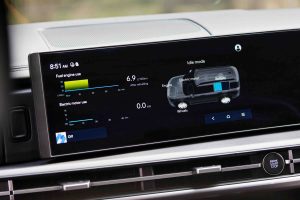
It is also a huge difference in driving range. On the same roughly17 gallons, fully fueled, the hybrid SF can be driven about 637 in city driving and about 619 miles on the highway, vs. 354 miles in city driving and 513 miles on the highway for the non-hybrid SF.
Another difference – vs. most other hybrids – is that the SF hybrid does not use a continuously variable (CVT) automatic. A six speed automatic is standard. The non-hybrid comes standard with an eight speed automatic.
There is one other difference that must be mentioned. The hybrid’s max towing rating drops to just 2,000 lbs. from the otherwise standard (in the non-hybrids) 3,500 lb. rating.
On The Road
The tested Sante Fe hybrid’s man selling point – other than its different-than-other-crossover looks – is gas mileage but Hyundai also ought to make more noise about the driving range, as mentioned above.
Especially in stop-and-go city driving.
Being able to drive more than 600 miles in between stops isn’t just about saving gas money; it is about saving time. EVs waste it, no matter how you look at it. Yes, you can charge at home. But you’re still having to spend time there, right? Maybe you are able to do something else – such as sleep. But the fact remains: You’re spending time waiting to be able to drive again.
The hybrid drivetrain is especially good at buying you time in stop-and-go “city” driving because when you’re not moving (or moving slowly) the engine usually isn’t running and so it isn’t using any gas – and the less you use, the more time you have before the next fill-up. Even in mixed-use driving, the hybrid SF’s real-world mileage is spectacular. Normally, when I get a mid-sized crossover to test drive for a week, the tank is near-empty before the end of the week. As I type this sentence, I’ve been driving the SF hybrid daily for five days – nearly a week – and the tank is still half-full, with more than 300 miles of indicated driving range remaining.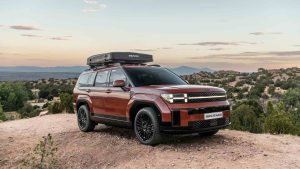
There is another thing to like about this particular hybrid. Unlike the majority of them, the SF hybrid has a six speed automatic transmission; i.e., it does not have a continuously variable (CVT) automatic transmission. That means it shifts up and down through gears, which feels (and sounds) more normal than the sensation-free (but often not sound-free) surging up and down you get with a CVT, unless it has been programmed to mimic the shifting characteristics of an automatic. But that’s fake and gay. And it’s still a CVT, which isn’t good because CVTs are by the nature of their design not as long-term durable. A CVT failure is very expensive – and there goes whatever you saved on gas money.
Hyundai tuned the SF’s suspension for a pleasantly soft and so very comfortable ride. It excellently copes with America’s increasingly Third World, pothole’d and badly patched roads. The only driving downside is the truly obnoxious Lane Keep Assist “technology” – which of course is standard, even though probably no one would pay extra for it were it optional. In addition to trying to correct your steering, it also turns down the volume of the stereo when you steer too – in its opinion – close to either the painted yellow center line or the white-painted shoulder line. The problem here (one of them) is that painted lines are often painted skewed and so rigid adherence to avoiding the lines – so as to avoid the obnoxious countersteering and radio-volume-adjustment – is unnatural as well as silly.
Arguably, the vehicle manufacturers have gone overboard with tech for tech’s sake. It doesn’t make the vehicle “safer.”
It makes it more annoying.
At The Curb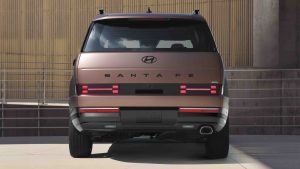
The SF – standard and hybrid – is mid-sized and comes standard with a third row. What that means is that while it does have more room for passengers than a two-row crossover, there’s not much room in the third row. That’s kind of the bargain or – more precisely – the compromise. A mid-sized crossover like the SF is made to appeal to people who need a third row but don’t want a full-size crossover.
The SF’s third row is fine for kids, who can easily crawl back there and it’s a fine place to toss a gym bag or other such things when you’ve got passengers in the second row. With the third row in use, there’s still just shy of 15 cubic feet of cargo capacity behind the third row, which is comparable to the trunk space you’d have available in a current mid-sized sedan. Fold the third and second rows down and the available cargo-carrying space opens up to 79.9 cubic feet.
Of course, other mid-sized/three-row crossovers tout very similar versatility. What they lack is the visibility the SF comes standard with. It does not look like all the rest of them and that is what really sells this crossover. The view from the rear is particularly striking, in that is so unlike the view you see when you roll up behind just about anything else. Whether one likes how it looks is of course a matter of opinion but there is no denying it does not look the same.
Inside, there’s the now-usual rectangular slab of LCD touchscreen, which can be configured to display various things. But there are still rotary knobs you can use be feel to adjust the cabin temperature as well as smaller knobs to control the volume of the stereo and make tuning adjustments.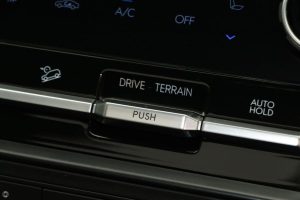
A notable feature is the dual, side-by-side wireless phone chargers (plural) on the center console. Just be aware that they are mounted close to the cupholders; try not to spill your coffee.
The range selector for the automatic transmission is a stalk-mounted, turn-the-widget thing. Push the button for Park. It’s sensible to do it this way because all modern cars have drive-by-wire transmission controls now and so having a “shifter” on the center console is purely for looks sake and takes up space that could be used for such things as a pair of smartphone chargers.
The Rest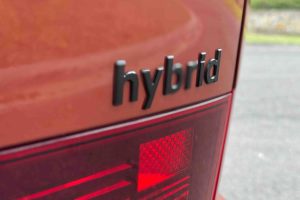
On of the odd things about many hybrids – and this one is no exception – is that in order to get it, you have to step up a trim. You can get into a non-hybrid SF for $34,300 but to get into a hybrid SF, you must step up to the SEL trim, which is already $2,500 more expensive (in non-hybrid form) than the the SE non-hybrid. The hybrid SEL stickers fort $37,800 – which means it costs $3,500 more vs. the non-hybrid SE. You do get the larger LCD display, synthetic leather upholstery and heated seats, all of which are nice to have. But the cost-bump eats away at the gas savings of the hybrid drivetrain.
It’s possible Hyundai would be able to sell more hybrid SFs if they only cost $1,000 more (to start) than the non-hybrid base trim SF.
The Bottom Line
It’s not so much whether looks can kill – but whether they’ll sell.
. . .
If you like what you’ve found here please consider supporting EPautos.
We depend on you to keep the wheels turning!
Our donate button is here.
If you prefer not to use PayPal, our mailing address is:
EPautos
721 Hummingbird Lane SE
Copper Hill, VA 24079
PS: Get an EPautos magnet or sticker or coaster in return for a $25 or more one-time donation or a $10 or more monthly recurring donation. (Please be sure to tell us you want a magnet or sticker or coaster – and also, provide an address, so we know where to mail the thing!)
If you’d like a Baaaaa hat or other EPautos gear, see here!









To me, it looks like a Spanish galleon, especially from the back. I think it’s the fact that it’s flat on top and in the back and bulges in the middle. Reminds me of the backside of a pirate ship. Just me?
That’s a great one, Junker!
Spot on. It’s be hilarious to carve out some baroque figures on the stern.
What’s the owners manual say about recommended octane fuel for the turbo 4?
Don’t most of these hairdryer equipped engines require “premium” fuel to experience the maximum advertised HP?
Those old V6s were typically good to run on 87.
Any fuel savings is likely lost on the 91 octane up-charge.
Good news, Flip! The Hyundai’s turbo engine is a regular unleaded engine.
Flip,
I have a hybrid which demands premium. I’ve been using E30 for years whenever I can find it as it’s cheaper than regular and has the same octane rating as premium (supposedly modern cars are safe anyways). Zero issues for about 5 years now.
Just imagine what a hit Jeep would have had on their hands, had they designed the new Grand Wagoneer with an eye towards the past lineage of Wagoneers. Instead, they opted for the “safe” committee choice, and produced yet another box shaped, large size, people pod, indistinguishable at 50 feet from a Tahoe, or Navigator or this Hyundai.
All, watch this video, please. It doesn’t pass the smell test, especially “weight has no impact on range”. Perhaps the smart double-E’s, the mech-E’s, and those with common sense here can weigh in.
https://www.youtube.com/watch?v=UmKf8smvGsA
You don’t need an appeal to authority to validate your own common sense.
To say weight doesn’t affect range would display an enormous lack of appreciation for physics and the concept of work.
Apologize – I’m not watching a 25 minute video. I can tell within the first minute this guy is only producing click bait.
Hi MH,
That guy is a tool. I personally tested out what happens when you tow with an EV, which is what you’d expect. What happens to gas mileage when your truck is dragging along 8,000 lbs?
My mileage drops by 1/2 when I tow with my 2012 Tahoe or 2000 Silverado. I just don’t have to wait 30+ minutes to refill.
I read some of the comments on the video (like BID not wasting a 1/2 hour watching it). My thought is only an AI could write some of that fanboy shit.
Someone wearing a rivian tshirt isn’t making many good life choices.
The irony of the bleak sameness of all cars today is how it encourages drivers to look for older cars and basically “resto-mod” them to what similarly priced new cars are capable of, but which have a distinctive style that new cars do not. The huge plus is it will stimulate small business to perform these customizations. Money that would go toarge corporations & manufacturers will go to little shops, who specialize in painting, upholstery, and suspension work, just to name a few.
They might be ugly but they will have real engines again.
https://issuesinsights.com/2025/07/25/car-lovers-rejoice-after-50-miserable-years-cafe-standards-are-dead/
Why is every OEM hellbent on ugly designs?
Federal Motor Vehicle Safety Standards. Especially since 2007.
Morning, BID!
Ugly is, of course, a matter of opinion. But its a fact that federal “safety” regs impose a very real template on car design that trends toward homogeneity. NASCAR cars all look the same for the same basic reason.
Although the regs impose constraints on belt line height, A pillar strength as it relates to rollover, etc. it is a fallacy to say that FMVSS is responsible for ugly angular designs. Same for gaping angular grille designs. Slab sided panels, squared off two box designs, etc.
There is nothing about FMVSS that dictates a Cyber Truck an outcome.
This Hyundai is a blatant rip off of the Rover Evoque, and Cyber Truck elements.
This uglification of auto design has been going on for over a decade.
Place blame where blame is due. Modern designers aesthetic sucks. They produce ugly for the sake of ugly. It says something about the current hopeless state of western culture. Similar trends are going on in architecture and consumer product design.
Look at a lamp post from the Victorian era with its elegant design vs what we settle for today as but one example of what I’m talking about.
‘This Hyundai is a blatant rip off of the Rover Evoque, and Cyber Truck elements.’ — Burn It Down
Agreed. I gag at the sight of a Rover Evoque. And a Cybertruck. And a Lincoln Navigator, for that matter.
Big, blocky, slab-sided hunks of steel indicate low effort on the designer’s part. Jony Ive, the former Apple designer who was all about tastefully radiused corners, wouldn’t sign his name to this uncouth p.o.s.
But I would — with a hammer and impact chisel. 🙂