


You’ve probably seen off-roading LandRovers and Jeeps with Jerry cans of gas strapped to their sides. The reason for that being there aren’t many gas stations around off-road. So it’s interesting to see Hyundai offer an off-road version of the Ioniq 5, which is compact-sized electric crossover.
It does come standard with a larger/stronger battery pack and more advertised driving range on a full charge.
But what happens if you run low when you’re far from a paved road?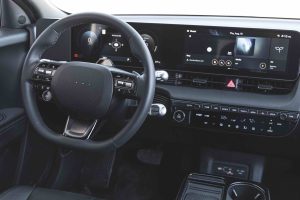
What It Is
The Ioniq5 is a small electric crossover that competes with similar battery-powered models in the same size/price range such as the Ford Mustang Mach-E as well as its in-house cousin, the Kia EV6. It’s also a less expensive alternative to the Tesla Model Y.
Two main things distinguish this battery-powered Hyundai from the others. The first is that it’s available in a version that does not focus on “ludicrous” acceleration. Quickness takes a back seat to a lower price tag – and more driving range.
If you want more range – and quicker acceleration – it’s available.
So also the unique (among battery powered vehicles) XRT trim, which offers off-road upgrades such as increased ground clearance, a set of all-terrain tires, tow hooks, front and rear clips designed to increase angles of approach and departure and a two-way charging system that can be used to power small appliances when you’re nowhere near another place to plug those in.
Prices start at $42,600 for the base SE Standard Range, which comes with a smaller/less powerful battery pack, 168 horsepower and a fully charged driving range of 245 miles. This version of the Ioniq 5 is also rear-wheel-drive, which is a big difference vs. other non-EV small crossovers – all of which are front-wheel-drive-based.
The $46,650 SE is comes with a larger/stronger battery pack, 225 advertised horsepower and up to 318 miles of driving range if you stick with RWD. You can also opt for a dual motor/AWD set-up that bumps the power up to 320 – at the cost of about 30 miles of advertised driving range. This version of the Ioniq 5 also comes standard with a heat-pump type cabin heating system that draw less energy from the battery.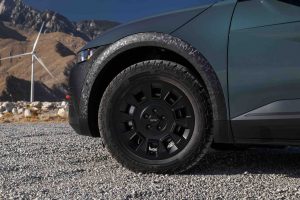
The $49,600 SEL is also available with the same drivetrain options but adds some features such as power folding side mirrors, synthetic leather seat covers, a heated steering wheel and rear seat heat ducts.
The $54,300 Limited comes with 20 inch wheels, a panorama sunroof, nicer seats (driver’s seat has extendable thigh cushion) and rear sunshades.
What’s New For 2025
The off-road themed XRT version of the Ioniq 5 has been addition to the lineup; all trims get an updated interior and a Tesla-style charge plug. 
What’s Good
Home charge cord is included (it’s extra-charge in some models, such as the VW ID Buzz).
Off-road XRT equipment is unusual to find in an EV.
Indicated driving range jibes with how far you can actually drive.
What’s Not So Good
Rising cost of electricity has pretty much eliminated any “fuel cost” savings.
Now that the federal $7,500 tax rebate has expired, buyers will have to pay full price for this (and every other) EV.
Charge (range) leakage overnight if you haven’t got a place to plug this (or any other) EV in overnight.
Under the Hood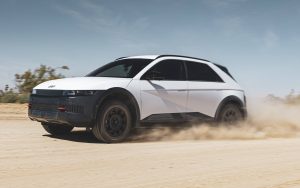
Like most (but not all) EVs, there’s a trunk under the hood; this EV’s electric powertrain is hidden underneath the floorpans.
The standard drivetrain consists of a single motor driving the rear wheels, powered by a 63 kWh battery pack; this battery pack can store more electricity than the previously standard 58 kWh battery pack and Hyundai says it can be “fast” charged . . . faster (from 10 percent to 80 percent in about 20 minutes).
The standard drivetrain advertises 168 horsepower and a maximum fully charged driving range of 245 miles.
The optional long range drivetrain consists of an 84 kWh battery (replacing last year’s 77 kWh battery pack) and this increases the Hyundai’s advertised driving range to 318 miles for single motor (RWD) models. If you opt for the available dual motor set-up (which makes this EV AWD) the advertised driving range decreases to 290 miles, but you get 320 horsepower and 446 ft.-lbs. of torque.
All versions of the Ioniq5 come standard with a home-charge power cord – which (believe it or not) is actually an expensive option in some other EVs, such as the VW ID Buzz mentioned above. This is not a small omission, because without that home-charge cord, you are effectively forced to rely on public “fast” charging kiosks – and that means having to drive to one and wait there while your EV’s battery pack charges. That will take at least 15-20 minutes out of your day, just for the wait – plus the time spent driving to and from the “fast” charging kiosk. It is much more convenient – and much more reliable – to be able to plug in at home, where (assuming there’s no blackout) you can count on the power being on and where you can do something else – like sleep in your own bed – while you wait for your EV to recover charge.
“Fast” charging kiosks are often not conveniently located – and it is not uncommon for them to not be working. Depending on them exclusively can mean running out of charge and will always mean having to plan around the trip to and from as well as the wait time.
Electricity also costs more at “fast” chargers than it does at home.
Another nice thing about the Ioniq 5 is that it comes standard with an external display that tells you at a glance how much charge you’ve got while you’re waiting for one. A series of little boxes in three rows intuitively shows how much charge you have – or have left to charge. The little door for the charge port opens electrically, too.
On The Road
Before I test drove the Ioniq 5, I tested what would result from leaving it to sit unplugged overnight.
Next morning, the range-remaining indicator indicated a loss of about six miles of driving range – even though I had not driven anywhere yet. Why? Because it costs electricity – and so, charge/range – to power the EV’s thermal management system. This is the thing that keeps the battery pack from getting too cold or hot, which is necessary to maintain its “health” as well as its ability to accept a charge. This is why if you do not plug an EV in – to compensate for the power draw – you’ll have less charge/range when you go to drive the vehicle the next day.
It is also another reason why a charge cord is such a necessary accessory – as well as something to think about if you do not have a place to plug in overnight, such as a garage. If you don’t, compensating for the loss sapped by the thermal management system – by “filling up” prior to parking unplugged overnight – is more of a must.
Driving the Ioniq 5 was a pleasant surprise because the range indicated turned to be an under-estimate – for once. I have test-driven many EVs over the past several years – most of the models that are available – and all of them did not go as far as indicated. The difference between actual and indicated was typically 10-20 percent and when it was very cold out, as much as 30-40 percent. It was not very cold (early October) when I test drove the Ioniq5 , but it did go farther (in actual miles) than the miles-available indicator indicated, by about 5 percent on the positive side of the ledger. That really matters with an EV – especially when it’s one like the standard-range Ioniq5 that has a maximum-advertised range of 245 miles.
With its standard (168 hp) single motor/RWD drivetrain, the Ionique5 doesn’t have the “ludicrous” acceleration capability of a Tesla but it still responds to your right foot impressively because of the immediacy of the power delivery. It feels quicker from a dead stop than many non-EVs that actually are quicker. That goes for passing power also – because in an EV, there’s no momentary turbo lag and there’s no wait for the transmission to downshift (because there is no transmission; in an EV, the electric motors directly drive the wheels).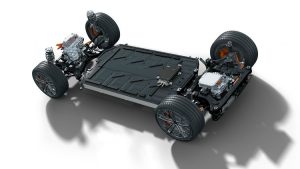
With the dual motor set-up, “ludicrous” acceleration (0-60 in just over 4 seconds, which would keep pace with most V12 supercars made as recently as the late ’90s) is at your beck and call – though remember that using this performance capability will drain the battery pack just as quickly as making use of a V12 supercar’s capability would drain its tank.
Whether you go with the single motor/RWD set-up or the dual motor/AWD set-up, the Ioniq 5 is a pleasant vehicle to drive because it’s not saddled with clumsy “tech” for the sake of “tech” – in terms of most of its controls and how they work. There’s a simple, old school knob to turn the stereo’s volume up or down, the touchscreen’s interface isn’t overdone (no multiple menus or “categories” to sift through in order to change the station) and the turning on/off of the drivetrain doesn’t leave you wondering whether you actually did turn it off.
The right-now power delivery is ideal for Froggering through traffic; but the initial power delivery could be smoother. EVs have a tendency to jump forward from a dead stop if you push down too much on the accelerator pedal and not move much at all if you don’t push down enough. It takes a little while to get used to the different power delivery.
There’s a rotate forward/back toggle stalk on the steering column, which is how you engage Drive and Reverse. Park is a button at the top of the stalk.
At The Curb
The Ioniq 5 is 183.3 inches long, so it’s just a little bit smaller overall than its main rival, the Ford Mustang Mach-E (which is 185.6 inches long) so it’s not surprising it has less room inside – for cargo. The Hyundai’s got 26.3 cubic feet behind its back seats and the total available with the back seats folded down is 59.4 cubic feet. The Ford has 34.4 cubic feet behind its back seats and a total of 64.4 cubic feet. The Ford also has more front seat legroom (43.3 inches vs. 41.7) though about an inch-and-a-half less backseat legroom (38.1 inches vs. 39.4).
The Ford’s base price ($37,995) is also lower and its standard power (268) is higher. However, the Ford is not available with anything like the XRT equipment that Hyundai offers with the Ioniq 5. This includes the raised suspension mentioned earlier – plus the knobby tires, tow hooks and a two-way charging system that allows you to power other devices (such as a TV or crock pot or electric lights) to make off-road camping more like off-road glamping.
But be careful about venturing too far off-road (or using too much of the battery’s remaining charge to power up your camping accessories) for the obvious reason: There aren’t many places to get a charge when you’re off-road. LandRovers and Jeeps can carry Jerry cans of gas. It is not easy to carry extra electricity with you.
It does look rugged, though.
And in an interesting (because unusual) way. The protective body cladding has a kind of carbon-fiber sheen that looks really sharp with the available color-shifting metallic blue-green paint.
And the high torque of electric motors driving all four wheels (all of which is available at zero RPM, meaning as soon as you touch the accelerator) is a definite advantage. It is effectively like having a 4WD system with the leverage of a 4WD system’s Low Range gearing.
All trims come with heated front seats, a leather-wrapped steering wheel and a 12.3 inch center touchscreen (in addition to an LCD main gauge cluster) and six speaker stereo system. The XRT upgrades to a premium eight speaker Bose system. This trim’s center console tray also slides forward and back, which is handy.
As is the phone charge pad that’s right there on top, where your right hand naturally falls.
The Rest
Every Ioniq 5 trim comes standard with a plethora of “assistance” tech that is capable of more than just the usual “assisting.”
If the car thinks you’re not paying full attention – or are in full control of the vehicle – which it determines via an eye-movement monitor system and pressure sensors in the steering wheel, among other things – it may tell you to pay attention/regain control immediately and if you don’t, it will slow down and stop automatically.
You can prevent this – for now – by pushing down on the accelerator.
The Bottom Line
The Ioniq 5 is an interesting alternative (in XRT trim) to the Mustang Mach-E. It’s also thousands less expensive than a Tesla Model Y ($44,990 to start) and can go places the latter can’t.
Put another way, it’s different – and for an EV, that’s no small praise.
. . .
If you like what you’ve found here please consider supporting EPautos.
We depend on you to keep the wheels turning!
Our donate button is here.
If you prefer not to use PayPal, our mailing address is:
EPautos
721 Hummingbird Lane SE
Copper Hill, VA 24079
PS: Get an EPautos magnet or sticker or coaster in return for a $25 or more one-time donation or a $10 or more monthly recurring donation. (Please be sure to tell us you want a magnet or sticker or coaster – and also, provide an address, so we know where to mail the thing!)
If you’d like a Baaaaa hat or other EPautos gear, see here!










Need to see if you can get a i5 N to test.
Wonder if the fake engine sounds and fake shifting can temporarily fool you while pulling some major Gs.
The Willys Jeep was so good in offroad conditions because it was rugged and lightweight.
Ionic 5 xrt looks to be 5831 lbs. I would think this is too much mass in too small a footprint to take on anything other than dry mild trails.
Battery at the bottom of what is still not great ground clearance would keep me off anything that I would consider an actual off road trail.
Of interest is that it doesn’t appear to come with a spare tire.
While they can market it as off road, I think it is better kept to possibly being better in snow.
Also see there is a class action lawsuit on these for level 2 overheating charging ports.
Shouldn’t that be 4,731 lbs, or thereabouts? Even so, an ICE compact car of thirty years ago, with the same wheelbase and body envelope, would weigh about 60% as much.
It’s appalling when tiny little cars outweigh the land yachts of yore. There is nothing economical about massively heavy cars, when we have the technology to make lightweight vehicles that require less energy to accelerate and decelerate.
An example is set at the top: the military’s Joint Light Tactical Vehicle weighs 14,000 lbs. The previous generation Humvee weighed 8,000 lbs. All materials that go into vehicles have a cost per pound. So the price tag goes up too. But BigGov just prints (or borrows) the dollars to pay.
Yes, I looked it up again today and see
Ioniq 5 XRT: 4,673 pounds
Ioniq 5 SEL (AWD): 4,547 pounds
So I didn’t pay attention to something yesterday
‘The standard drivetrain … powered by a 58 kWh battery pack … can store more electricity than the previously standard 63 kWh battery pack’ — eric
The values ’58’ and ’63’ appear to be transposed.
Thanks for the catch, Jim – just fixed!