


Should EV owners have to pay a surcharge – an annual fee – to make up for the fact that EV owners don’t pay a charge at the pump? Meaning, gas taxes – which are really more like user fees that are used to build and maintain the roads – because of course EVs don’t use gas.
Well, not directly. They do use natural gas (indirectly) via the utility plants that burn natural gas to generate electricity that is pumped (so to speak) into EVs. That also causes C02 “emissions,” which they say is causing the “climate” to “change.”
Anyhow, the argument for levying a separate surcharge on EV owners is that they are getting a free ride, using roads that are paid for and kept up by the people who buy gas (and diesel) and so pay motor fuels taxes every time they buy fuel.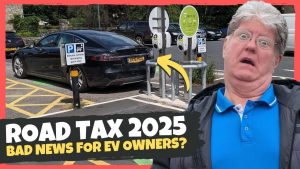
It’s hard to see how one could argue that EV owners ought to not be expected to pay – as the saying goes – their fair share. Especially when it’s less than that.
A lot less.
In Michigan – to cite one example – EV owners currently pay an annual surcharge of $160 per year. How much – in motor fuels taxes – do people who don’t own EVs pay annually? The answer is interesting.
In Michigan, the total tax paid per gallon is about 50 cents (this encompasses the federal tax of 18.4 cents, plus a state tax of 31 cents, plus a sales tax on to of that and a separate 1 percent “environmental tax”). A current-year compact-sized crossover SUV such as a Toyota RAV4 has a roughly 15 gallon gas tank. That works out to roughly $8 in just the gas tax (not counting the added sales taxes) paid at every fill-up. It’s typical for most people to fill up once a week, which amounts to four fill-ups monthly and about 48 fill-ups annually. Which would come to about $380 annually in just the gas taxes paid by the owner of a compact-sized crossover such as a RAV4 in Michigan. A full-size truck or SUV typically has a 20-or-so gallon capacity fuel tank and its owner would pay considerably more in gas taxes, about $500 per year.
Contrast this cost with what EV owners are charged in Michigan in lieu of paying gas taxes to help pay for the building and upkeep of the roads they use. Ready?
$160.
But EV People in Michigan are upset about this. They’re even more upset about the charge “skyrocketing” by $100 more if legislation – SB 593 – is passed by the state legislature. If it does, owners of EVs would be facing having to pay about half what the owner of a compact-sized crossover such as the RAV4 pays annually in motor fuels taxes.
Oh, the humanity!
The legislation would also impose an additional $100 surcharge on EVs that weigh more than 8,000 lbs. – which is (surprisingly) lots of them. It’s surprising because four tons is almost unbelievably heavy for a non-commercial vehicle, such as a garbage truck or tractor trailer. A Ford F-150 Lightning might look like a half-ton truck. But it’s an asphalt-crushing behemoth that does precisely that – hence the added surcharge. Electric vehicles are hard on the roads for essentially the same reason that a 400 pound passenger is hard on your car’s seats (and suspension).
A RAV4 weighs 3,370 lbs. – less than half the weight of an F-150 Lightning. A Cadillac Escalade IQ – which is the battery-powered version of the full-sized Cadillac Escalade SUV – weighs a staggering 9,120 lbs., the equivalent of three RAV4s stacked on top of one another. Is it unreasonable to expect the people who buy these monstrously heavy things to pay for the damage they cause?
Let’s not forget that the EV push – which is just the right word, because that’s what it is, a push – is premised on the claim that vehicles with engines are causing “climate change” or at least, making it worse. The italics are used to make an important point; that being a claim is something other than a fact. It is a fact that EVs are much heavier than their analogs with engines, because EVs have battery packs that weigh exponentially more than gas tanks. The latter – which are mostly made of plastic these days – weigh next to nothing, in fact. When it is empty, the gas tank in a current-year small crossover such as the RAV4 can be easily picked up by almost anyone because it weighs maybe 30 pounds.
Pump 15 gallons of gas in that tank and the total weight is about 120 pounds (a gallon of gas weighs about 6 pounds, so about 90 pounds for the gas plus the weight of the tank). A strong man could pick that up. The battery in a Ford Lightning weighs a ton (2,000 lbs.) all by itself. It doesn’t get lighter as it discharges, either. It is just as heavy when empty (of electricity) as when it is full.
To put that in some context, a ’70s-era VW Beetle – the whole car – weighed several hundred pounds less than that.
Someone’s got to pay for all that. Shouldn’t it be the people who signed up for that?
A Defender of the (EV) Faith says au contraire! ” . . . raising fees for PHEV and EV registrations discourages EV adoption and signals to the automakers that are based in the state that Michigan is not serious about electrification efforts.”
Italics added. Are we talking about vehicles or Ukrainian orphans? The question begged is: Why is the government encouraging or discouraging anything with regard to who buys what kind of vehicle? Michigan is “not serious about electrification efforts”? The writer (if you want to use that word) confuses force-feeding with “efforts,” the latter implying something organic and voluntary.
But Michigan does appear to be serious about making EV owners pay for the damages caused by their voluntary chosen “electrified” behemoths.
At least kinda-sorta. If the full cost were to be levied, it’d really “discourage” the “adoption” of these devices.
. . .
If you like what you’ve found here please consider supporting EPautos.
We depend on you to keep the wheels turning!
Our donate button is here.
If you prefer not to use PayPal, our mailing address is:
EPautos
721 Hummingbird Lane SE
Copper Hill, VA 24079
PS: Get an EPautos magnet or sticker or coaster in return for a $25 or more one-time donation or a $10 or more monthly recurring donation. (Please be sure to tell us you want a magnet or sticker or coaster – and also, provide an address, so we know where to mail the thing!)
If you’d like a Baaaaa hat or other EPautos gear, see here!










Michigan also has the worst roads and the highest car insurance. When the ‘big 3’ laid off approximately 15K power train engineers in 2022 on account of ‘electrification ‘, nobody heard a peep from politicians about all the good jobs lost. They were busy bragging about the alleged battery jobs they secured that never arrived. Anyone with half a brain could see what was happening and why it wouldn’t work but not the ceo’s Of f, gm, and crisisler.
Amen, Auto-outsider!
It’s sad to witness what’s become of America’s Big Three. It especially irritates me that the decline has been presided over by CEOs who are rewarded to the tune of double-digit millions annually in compensation. GM today – all its remaining divisions – has less market share than Chevy had by itself in 1970.
Eh, there’s a lite version of this in Virginia with your car registration. You get a surcharge applied based on your car’s MPG rating, with EV’s paying the max. I think the EV portion is $200 or $300. Hell, I paid $40 for my Volkswagen! (32 MPG)
This is a great excuse for our Overlords to implement a tax-by-the-mile scheme.
“discourages EV adoption”
Why does truth always foil their plans??
Remember when the truth about Ivermectin was said to discourage vaccination?
I’d like to meet these societal planners and do some discouraging of my own.
If the plans are worth doing, the truth will reinforce them.
Ev should pay a high speed charge tax at pos. Like gas
Best way
The fuel tax comes closer to being a “fair” tax than any tax I can think of, at least in theory. It is based somewhat on usage of the usage of the roads. I am in more inclined toward privatization of all roads and let the free market work things out. If the government is involved at all things will be f*cked up, as all monopolies are.
In other news…why you avoid the Cloud.
https://www.zerohedge.com/technology/major-disruptions-reported-across-key-internet-services-downdetector
Is Loudoun County in free fall or is The Rockefeller Foundation prophecy coming true?
Here in the PNW Alaska Airlines was a jewel in the crown years ago. This is their third outage this year. Close friend a pilot with them for years, now retired, he’s royally pissed about how it’s evolved recently.
West coast point to point none better in the ‘80s.
I refuse to “cloud”, old school on my machine software only. Clouds evaporate, no thanks.
Scout Motors desperately pivots to survive:
‘As Volkswagen Group is again in rough waters, with net cash flow reportedly at alarmingly low levels, battery-electric variants of the Scout Traveler SUV and Scout Terra pickup have been put on the back burner. According to a report from the German publication Manager Magazin, Scout Motors will start sales with EREV [Extended Range Electric Vehicle] variants.
‘Starting sales with EREVs allows Scout Motors to use smaller batteries, lowering the manufacturing costs. The company also believes that the range extender will convince more [buyers] in the US.
‘While a range extender offers flexibility, it also adds complexity and weight to a vehicle. Its main goal is to provide peace of mind, and history has taught us that this is not enough. Indeed, BMW launched the i3 with a range extender option in 2014, which proved far less popular than the BEV models. The range extender was discontinued in Europe with the 2019 model, although it was still offered in the US.’
https://www.autoevolution.com/news/scout-motors-expected-to-start-erev-sales-first-as-parent-volkswagen-runs-low-on-cash-259626.html
No one could possibly have foreseen his coming! /sarc
Given the 3 to 5 year lead time for new vehicles, what do you think auto makers are designing right now for 2030? My bet: all hybrids, all the time.
A libertarian NEVER entertains any idea of new taxes. Fail.
Oh the irony! If they offered an updated version of the old Scout – ie a modern Bronco-style 4×4 w a V8 and manual trans – it would sell like hotcakes, guaranteed
“No taxation without representation” is most closely associated with James Otis Jr., a Massachusetts lawyer who popularized it in the early 1760s. in 1761 and, after the Stamp Act in 1765, famously stated that “taxation without representation is tyranny”
Or apropos of today…representation without taxation is corruption. In other words, the government gives favoritism to those they favor and tax (punish) they ones they don’t.
EV’s get a free (or reduced rent) because they are favored loyalist to the King (not Trump but Marxist-Democrat government state/federal).
When are we going to dump the tea? Mr. Zeldin we are waiting.
Am I reading this right? A Libertarian is advocating a levy/tax on free will? Can we confirm that Eric wrote this article?
No one could confuse me with a lover of EVs, but a tax is a tax and I hate all of them. Maybe EV owners are not paying gasoline taxes, but they are paying an arm and a leg to continuously charge them through their electricity bill. Dominion Electric and FPL are not giving discounts for EV charging on their monthly utility bills.
What’s next implementation of a fee for those with wood stoves because they are not using enough propane and natural gas to subsidize the industry? How about a tax on vegetarians because broccoli doesn’t cost as much as a steak?
A tax on EVs will only allow the authoritarians to then consider taxes on hybrids and this will trickle down to ICE engines as they become more fuel efficient. Did we learn nothing from the implementation of the income tax? Eventually, everybody pays it.
Well said. First Principles matter.
‘How about a tax on vegetarians because broccoli doesn’t cost as much as steak?- — Raider Girl
Since I happen to like broccoli, I advocate for it to remain tax free. A light tax on Brussels sprouts, which I find only borderline edible, seems sensible. And a punishing levy on kale — which offends every taste bud I’ve got — is just common sense! 🙂
Do you like broccoli?
Yes I do, yes I do
Do you like ice cream?
Yes I do, yes I do
Do you like broccoli ice cream?
No I don’t, YUCKY!
— Devon Thagard & Troy McDonald, Do You Like Broccoli Ice Cream?
A Tuscan soup with chicken and kale is absolutely delicious. 😁
You can add all of the bacon, candied pecans, and vinegar in the world and it still wouldn’t make Brussel sprouts tasty. 🤮 I am still against taxing them.
Au contraire! Brussel sprouts are tasty, very cool little miniature cabbages. Broccoli, on the other hand is a nasty, unnatural little tree, akin to poison oak, and edible only when drowned thoroughly in cheese sauce.
As to kale, I suppose it’s something OK for food (like cattle) to eat.
Another B Sprouts upvote. I’m playing both sides on this, I’m a broccoli fiend as well. Here you can get Brussels Sprouts on the vine/stalk, grab a big ‘ol mess of fresh sprouts right out of the bin, yum! Thanks Fred Meyer (Kroger).
Now the issue is Boomer (The Mighty Sparkey) vs Gen X (daughter, AKA “The Barracuda”). I’m a veggie steamer, drown it in butter, salt and Parmesan cheese when just fork tender. She is mortified, bake and broil till well browned and crunchy is the Gen X way.
PS: big NO on kale. Eck.
Hi RG,
I don’t object to the motor fuels tax, because it isn’t one. It is a road-use fee – and I have no problem paying for what I use. If I do not use the roads then I don’t pay the tax. EeeeeeeeeeeeVeeeeee owners use the roads but do not pay to maintain/build them. I think they ought to, because there’s no such thing as a free lunch . . . unless someone else is forced to pay for it!
For crying out loud.
The roads are government owned. Roads were established constitutionally via power to establish “Post Offices and post Roads.
No mention of road tax. No mention of gas tax. No mention of the public paying a road use fee to travel the Post Roads.
There is nothing Libertarian about accepting a gas tax as a road use fee!
Indeed, if I have a heavy vehicle like one of my old 2 ton trucks, which I very seldom use, the gas tax is a very fair way for me to pay for my roads. If I’m driving a 80000 lb tractor trailer for business it’s also fair that I pay for that load and the huge number of miles I put on them. Likewise, my motorcycles put no measurable load on the road, and pay very little fuel tax. And something in between like the Great Pumpkin, pays for what it uses.
How can you put a reasonable charge on a BEV for it’s road use? As noted, it weighs as much as one of my IH Loadstar 2 ton trucks (at least unloaded), but is presumably used many miles per day. Without an intrusive mileage tax?
Now if we could eliminate the property tax that is vehicle registration for naturally fueled vehicles.
And so what is to be done with heavy industrial equipment like loaders or farm tractors that use the roads? These vehicles typically use off-road (ie untaxed) diesel.
Maybe we need a farmer tax? (Sarcasm)
When those vehicles make up 1/10 percent of road miles traveled, let’s worry about it. Until then how about we use judgement and sense?
Hi Eric,
I hardly believe EVs are getting a free lunch, especially when we add in the additional kW/h that they use to charge.
We are arguing over pennies here. How much is the federal gas tax? I think it is about $.19 per gallon. If someone drives a Toyota Corolla and drives 12k miles per year and averages 34 mpg the Corolla owner pays about $67 a year in federal gasoline taxes. My Suburban at 12k per year and 15 mpg averages around $152 in federal gasoline taxes. Small numbers to quiver over.
There is no such thing as fairness…only loopholes. We will bang our heads all day long if we try to justify equal outcomes, because they don’t exist.
Agreed.
One of the biggest purveyors of cliiiiiiiiiiiiiiiiiiimate change hysteria, Bill Gates, has mysteriously changed his tune on the topic. Is the truth about cliiiiiiiiiiiiiiiiiiimate change finally reaching the masses, or is the globalist elite not making as much money off of this scam as they hoped and thinking they can make MORE money off of hysteria over diseases?
https://www.armstrongeconomics.com/world-news/climate/gates-climate-change-crisis-averted/
What happens when the EV batteries start to reach the end of their service lives in large numbers.
I’m sure every single cell will be disposed of properly and done in a facility designed to prevent and contain any spontaneous combustion, with owners gladly paying their “fair share” to mitigate impact of their choice on the environment.
Yeah, right.
Sure. Just like the Mercury filled fluorescent bulbs. Nobody dumps those in the trash or a landfill. And the ones responsibly collected are properly decontaminated, right?
I’m sure it won’t become a “superfund” project.
The EV pundit sees the current battery technology as a bridge device, necessary until the magic sauce battery tech of tomorrow is ready for mass consumption. What they don’t realize is we’re already there. Lithium is the most electrochemically energetic of metals, the lightest of metals. If you’re going to build a chemical battery, Li is probably the best stuff.
So then it comes down to incremental improvements that might raise the energy density by a few percent. This isn’t the exponential gains we’re used to with silicon and electronics (which is pretty much played out too). But the true believers aren’t willing to accept that battery design is pretty much done, at least at scale. The boys in the lab might be able to produce some really cool examples of something incrementally better, but then the factory can’t build it.
If they really want electric transportation, accept the limitations on the vehicles and deal with the fact that they aren’t made for interstate driving. Once you commit to a city car concept it totally changes the power to weight equation. Slower speeds mean you can run a smaller battery pack, might not need airbags and all the impact/rollover protection, and won’t need all the space for luggage and the whole family for hours of driving.
Or just keep gasoline and put this foolish experiment to rest.
It’s almost as if there are certain laws that the universe has, which constrain us from doing whatever the hell we want.
You know, the underlying premise of all of science.
(Computer science is not really science, it’s mislabeled. At its best & most fundamental it’s a type of applied mathematics…but it’s still not subject to the same kinds of constraints that, say, chemistry or physics is. But hey, what do I know?).
I would even go so far as to suggest that there are certain branches of theoretical physics (string theory, for example) that engage in flights of conceptual fantasy that really strain the definition of science, because they are impossible or effectively impossible to test via experiment.
Indeed, when Alfred and the boys came up with the “gedanken experiment” the crossed out of the realm of science into the realm of the opium den. The whole point of real science is to be able to rest and falsify the “gedanken”.
All of the chemical elements in the periodic table have been thoroughly researched (many for centuries) along with many thousands of chemical compounds of which they are a part. Ready Kw is absolutely correct in that we are already nearing the natural limits of electro-chemistry with current lithium technologies.
Great point Ready. Chemistyand physics are the real laws which must be obeyed.
“ Or just keep gasoline and put this foolish experiment to rest.” – RK
Exactly the right solution.
The more pedestrian of the EV pushers believe the lie that an inevitable battery breakthrough — always just around the corner — will solve all of EVs’ shortcomings: excess weight, high cost (to buy and to maintain), limited range, long time-to-charge, etc.
But the mandarins who are trying to force EVs on us know that’s a lie. Even a battery 10 times better in every way — say, 1/10 the cost, 1/10 as likely to spontaneously conflagrate, 10x the energy density, 10x the max charge rate, 10x the max discharge current, and 10x the life — wouldn’t change the fundamental physics of the issue: the US electrical grid cannot supply enough power to replace the billions of gallons of gasoline used by automobiles in this country every week. The electrical grid would have to be upgraded to supply about 50% more power than it currently does.
To generate and distribute that much more power would require a lot of copper and other metals. And the energy (and its attendant pollution) required over many years (this would be a megaproject!) to mine these metals, process them, and build the electrical generating plants and distribution systems would negate any imagined benefit of widespread EV adoption.
Any engineer or physicist with access to readily available data could tell you that. Ergo, as Eric has long and well said, state and federal govs’ zeal to eliminate ICE vehicles is not to save the planet; it is to limit citizens’ mobility.
Indeed, StraightGate –
I figure maybe if I and others who get it keep saying it, maybe – eventually – others will also! This worked with the maaaaaaaaaaaasks – and the “safe and effective” drugs they tried to persuade people were “vaccines,” too.
The hated $7,500 EeeVee tax credit is gone. And gone from the Senate is its author, the West Virginia clown ‘Joe Manchin,’ who thought it would be a great idea for working folks to subsidize EeeVee-driving toffs.
Accordingly, a new $750 annual tax on EeeVees, to repay these larcenous withdrawals from the Treasury over ten years, is now appropriate.
Visualize a million EeeVees at the bottom of the sea, providing safe homes for deserving, brightly-colored marine creatures. 🙂
“ Accordingly, a new $750 annual tax on EeeVees, to repay these larcenous withdrawals from the Treasury over ten years, is now appropriate.”
Excellent idea!
‘Are we talking about vehicles or Ukrainian orphans?’ — eric
Naw, we’re talkin’ about gay, coprophagic stenographers at Jalopnik — mwa ha ha ha! That’s first-class snark, Eric.
Here, the wayward steno applies his three primitive brain cells to the knotty problem of fairness:
‘A Miata weighs over 3,000-pounds [sic] less than a Chevrolet Suburban and yet they pay the same proportion in gas tax. What do you think, is it fair to charge EV owners significantly more money than owners of gas-powered cars?’
The weasel word here is ‘proportion.’ A Miata consumes about half the gas of a Suburban, roughly approximating the wear each causes on the roads.
Leftist scribblers are really into hyphens these days. Used as an adjective, ‘3,000-pound’ is appropriate. But as a noun, ‘3,000 pounds’ needs no hyphen. How aggravating it is, when ostensibly educated progressives are only semi-literate. [The Jalopnik wretch would hyphenate ‘ostensibly-educated’ too, further inflaming my righteous wrath.]
Effectively all of the wear & tear on the roads comes from semi trucks, which also burn an absolutely enormous amount of diesel fuel.
If you want to go that road, scrap the entire system & charge by mileage (which has its own set of problems) and weight on each axle.
And then small trucking companies will go out of business because it will no longer be viable to do long distance hauls. A monopoly will reign forth and the costs of goods will far surpass anything we can imagine, because when there is no competition the sky is the limit.
Only if you f$@k it up by adding carrots for the big boys.
Which, face it, they probably would.
*carveouts
No, autocorrect had it right, more carrots for the nomenklatura, more sticks for the Kulaks.
License plate registration cost is usually based on GVWR, so there’s no need for a road use tax as an additional consumption fee. If the principle of a government postal road is a public good (for the sake of argument) then charging directly for the relevant wear and tear done then vehicle weight is pretty much the only direct way to do that. You could do a calculation of annual miles done to give a quantifiable damage number. That is literally weight times distance.
Using a derived value based on gallons sort of does this but it has no correction for weight directly. You could argue that gallons used is probably proportional to size but a I6 F150 does just as much damage as a big block while likely using less fuel, so it’s imperfect.
The whole mess could be simplified by just using tolls or privatizing the roads, where presumably the owner would sell subscriptions or charge essentially a toll to use the road. They would very likely arrive at the solution of having a vehicle drive over a scale and charging by the lbs, much like the ferries and bridge owners did way, way back before government usurped authority over all modes and means of travel.