

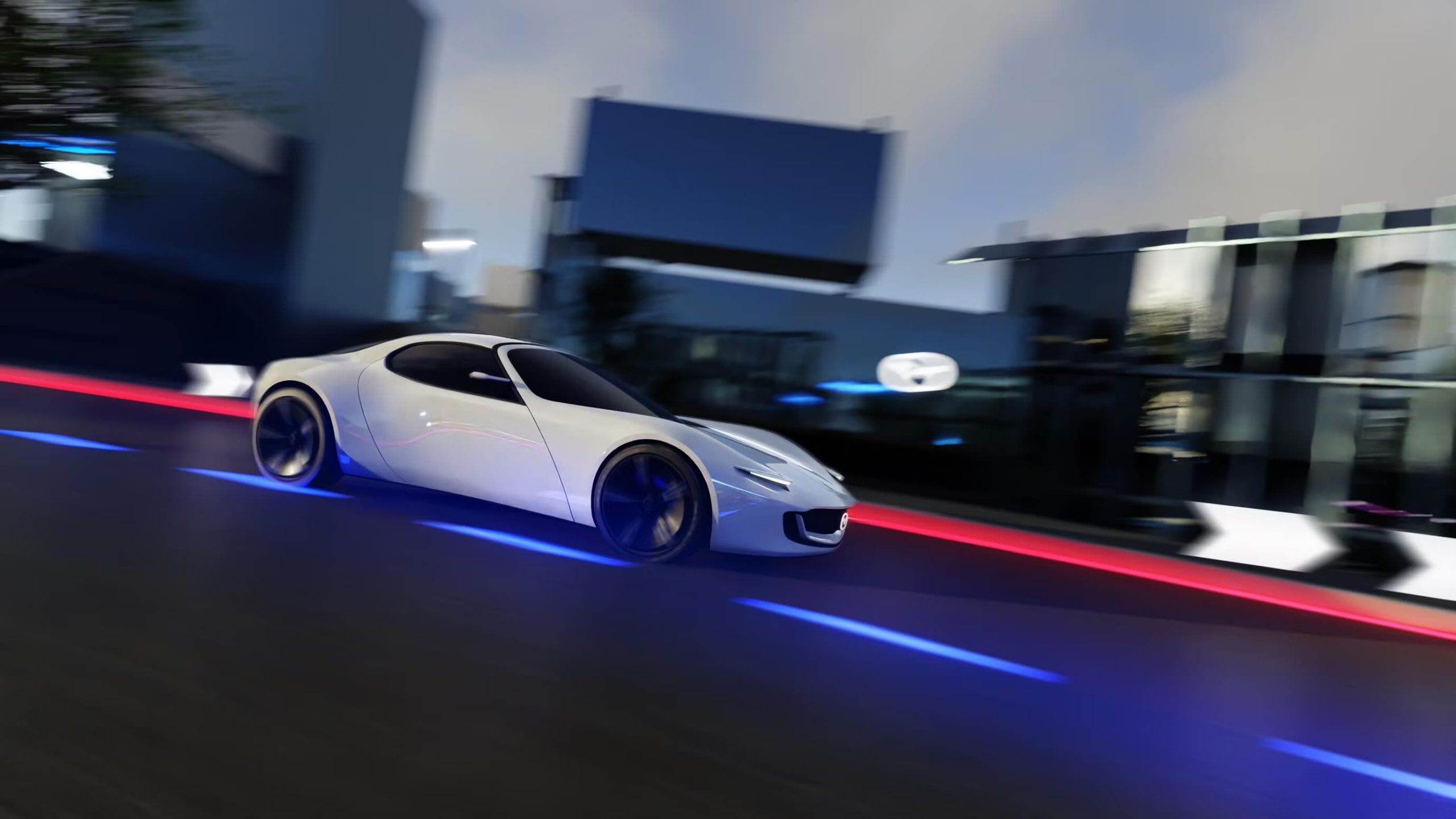

There is a rumor going around that Mazda may retire the Miata – or alter it in a way that would arguably ruin it.
The reason why Mazda may be about to retire – or ruin – the Miata probably has to do with wilting sales, which is arguably a consequence of the Miata having become expensive in congruence with the majority of Americans no longer being able to afford expensive things, especially when they are impractical things.
As the Miata is. This isn’t a slam. It is – it was – part of the attraction, once.
The Miata is a small sports car with a soft top and room for just two. There is not much room in the Miata’s 4.6 cubic foot (not a typo) trunk. The Miata is as close as you can get to a motorcycle on four wheels, insofar as anything new – and that is why it is such a fun car to drive. But it is as practical as swim trunks in Minnesota – in December. That didn’t matter, for years – because many Americans could afford to buy an impractical (but extremely fun) car such as the Miata – because they could afford to also have another, more practical car. 
In 1989, the Miata’s first year, you could have bought a brand-new one for $13,800 – which is less than half the base price ($29,530) of the 2025 Miata. It is true, of course, that $13,800 represented more money (in terms of buying power) then than the same sum does today – but the point being missed is that people today are, in the main, not making more money to offset the greater amount of money it takes to buy a new Miata (or just about anything else). Put another way, it is not “inflation. It is deflation – of most people’s earnings relative to the cost of fun things like Miatas.
Back in ’89, many people who could afford a Miata – the fun car – could also afford the practical car they needed to have because they needed a vehicle with room for more than just two people (and not much else). Proof of this assertion can be adduced via mention of the fact that Mazda sold lots of Miatas, back in the 1990s – and most of them were bought by people who also had another car. Today, most people can only afford one car – and not just because cars have become so expensive. Everything else has, too. There is less discretionary money left over for anything – especially a just-shy-of-$30,000 (before taxes, tags and insurance) new sports car.
So most people who need a practical buy just that – and nothing else.
There is no other reasonable explanation for the Miata’s waning sales stats. The current model is as fun any other prior model and in some ways, more so. The engine is stronger and you get six speeds now instead of just five. While there is a touchscreen, it’s not huge and you can just ignore it – because all of the Miata’s key controls are still manual (i.e., switches and knobs) and the gauges are still analog rather than digital. The Miata is probably the only new car that still has a pull-up emergency brake lever rather than an electric parking brake button – so you can still do jacknife turns (and full 180 degree rotations) using the brake lever. 
In other words, the Miata’s appeal hasn’t changed. But its affordability has.
This is why Mazda is – apparently – contemplating cancelling it. You cannot make money selling something not enough people can afford, no matter how much they might want to buy it.
The obvious solution is to make the Miata more affordable – perhaps even more so than it was back in ’89 – to compensate for the diminished purchasing power that besets most Americans today. But is it feasible?
Could it be done?
Probably. Even certainly. It used to be done. Why not do it again?
For openers, Mazda could probably eliminate two of the four air bags the current Miata comes standard with. The original Miata had none – or just one (for the driver). New vehicles must have at least two – because federal “safety” requirements require that. But more than that could be made optional or even deleted. It’s a safe bet that people who love the Miata don’t care about air bags and would be ecstatic if they didn’t have to pay more for them.
The same as regards power windows and even AC, which is not an essential item in a small roadster such as the Miata that could be kept cool effectively via ventilation – and wing vent windows, which sports cars used to come standard with. 
There are things that could be done to bring the Miata’s price down, is the point.
Adding things – such as hybrid-augmented drivetrain – would only increase the cost of the Miata and also make it less appealing to the people who like Miatas. Selling them a hybrid Miata would probably work out as well as trying to sell an electric Charger to people who liked Chargers with an engine worked out.
It’s telling that popular, successful car models are being shivved by their own manufacturers. It’s a vehicular version of the scene at Jonestown, where everyone drank the Kool Aid, thinking they were going to a better place.
. . .
If you like what you’ve found here please consider supporting EPautos.
We depend on you to keep the wheels turning!
Our donate button is here.
If you prefer not to use PayPal, our mailing address is:
EPautos
721 Hummingbird Lane SE
Copper Hill, VA 24079
PS: Get an EPautos magnet or sticker or coaster in return for a $25 or more one-time donation or a $10 or more monthly recurring donation. (Please be sure to tell us you want a magnet or sticker or coaster – and also, provide an address, so we know where to mail the thing!)
If you’d like a Baaaaa hat or other EPautos gear, see here!










They may as well cancel it if they can’t make it more affordable.
I remember back in 1989 they couldn’t keep them in stock. Make them 13k and the would be like 1989 all over again. Another thought, make the 1989 version again.
Our Economy is tanking. The message is that (the middle class) can no longer afford a relatively cheap toy. You did not mention how much Car Ins has gone up, which absolutely is a huge factor to owning a ‘fun’ 2nd car. I had a NA Miata (bought new in my early 20’s) and a NB. I am a Miata fan. More importantly if they kill the MX5 then they kill MX-5 Cup racing. Which Imho (and I’ve been an avid race fan since the 80’s) is the best racing series I’ve ever watched. Simply fantastic racing. Check it out at https://www.imsa.com/tv/
A hybrid Miata or a Manual Transmission only Miata is the death of the Miata.
Thanks Mazda. The Miata put many a smile on my face!!!
“”A hybrid Miata or a Manual Transmission only Miata is the death of the Miata.””
$#*!@… I meant Automatic Transmission only…
I agree, Kong –
I could have bought a new Miata 20 years ago – because everything cost less 20 years ago. I am making about the same money mnow as I was then and it is not enough to make up for the rising cost of everything. I think most of us are in the same boat.
Mend, not end:
‘Trump is proposing a reset to vehicle fuel efficiency standards. The proposal by NHTSA will lower the fuel economy requirements from model years 2022 through 2031, requiring 34.5 miles per gallon on average by 2031 instead of the current 50.4 miles per gallon.
‘NHTSA also revises down the 2022 fuel economy standards and then hikes them between 0.25% and 0.5% annually through 2031. In 2022, NHTSA increased fuel efficiency by 8% annually for model years 2024-2025 and 10% for 2026 under the Biden administration.’ — Detroit Free Press
https://archive.ph/2KeNj#selection-509.18-509.270
It’s the old three-card monte game, ain’t it? Tinker with the numbers, but keep the endless escalation of CAFE in place. Listen to these co-opted clowns:
‘The National Auto Dealers Association said that it has advocated for regulations that protect consumer choice and vehicle affordability for decades. It said car dealers support CAFE standards that are feasible and in line with customer demand for affordable, fuel-efficient cars.’
Another reason to put stealerships out of business: they play on Big Gov’s team, while cynically claiming (like the big, bad wolf to Little Red Riding Hood) to be our dear old grandma, wanting nothing but the best for us as they pick our pockets. Away with them, and their plaid-suited, gold-toothed, fake-smile chiselers!
What would the market choose if there were no government regulations hindering automotive designers? Imagine an acceleration of innovation congruent with unregulated markets such as computing. Not only the auto market, but all markets which get stifled by the heavy hand of government. You think taxes are bad. Imagine what they’ve stolen from us through interference in markets alone.
“you can still do jacknife turns (and full 180 degree rotations) using the brake lever”
This is the least important function of a real hand brake.
What is important is:
Smoothly starting off on a hill. I’ve never driven a car with the Hill Hold feature which worked as well as a manual start-off.
Sitting at a traffic light and using the hand brake instead of keeping one’s foot on the brake.
Being able to work on the rear brakes without needing a computer.
I always liked the miata, but never bought one. I had more fun for less money with MGBs and Fiat 124s. They’re better cars, made with steel and natural materials.
Faster, better sealed, safer are all unimportant metrics to me. Hands on repairability and fun are more important.
Maybe they can do what Ford did with the Mustang. Make an electric SUV and call it a Miata.
I’m sure the Mazda 3 is on borrowed time too.
“For openers, Mazda could probably eliminate two of the four air bags the current Miata comes standard with. The original Miata had none – or just one (for the driver). New vehicles must have at least two – because federal “safety” requirements require that. But more than that could be made optional or even deleted.”
FMVSS 214 side pole impact. If anyone can invent a solution that passes the test and doesn’t involve side airbags and is a cheaper solution to the problem, they will become rich and will be able to afford as many Miatas or any other car of their choosing as they want.
“The same as regards power windows and even AC, which is not an essential item in a small roadster such as the Miata that could be kept cool effectively via ventilation – and wing vent windows, which sports cars used to come standard with.”
Vent windows cost more to design, manufacture, and assemble than fixed glass.
Simply asserting that something is, or can be done cheaper doesn’t make it so.
Hi BID,
Well, sports cars such as the old MGs and so on had wing vent windows – and those cars were not expensive. My old VW had wing vent windows, too. Somehow, it wasn’t expensive to make or sell those cars.
Again these are assertions based on feelings and simply stating them doesn’t make it so.
A 1970 MGB MSRP was $3260 which is $28,011 per BLS inflation calculator which by design underestimates inflation but is the standard measure of inflation that even you have used before.
Average household income in 1970 was $9,870 per Census.gov which is $84,808 per BLS calculator.
So a MGB cost 33% of average annual household income.
You are complaining $29,530 is too expensive for a 2025 Miata?
$83,730 is average household income in 2024 per FRED and Census.gov (arguably it is lower closer to $70k by other non-government sources).
$29,530 is 35% of the current average annual household income.
And for that extra 2% you’re getting a vehicle that outperforms a 1970 MGB in almost every metric.
Adding vent windows adds weight. Adding vent windows increases potential water leak paths. Adding vent windows adds cost. Arguably vent windows on a convertible makes little sense and is virtually redundant to opening a fixed glass window or dropping the top.
If you want to make the case that wages haven’t kept up with inflation that would be a thesis that could be argued.
If you want to discuss how adding a 15% tariff to imported Japanese vehicles (ie Miata) isn’t making things cheaper we would be in agreement.
Perhaps we could agree that the Miata could be lightened or that it could have less HP like the original version (I put 220,000+ miles on my 1991 Miata). We could probably agree that EPAS isn’t necessary and degrades steering feel.
I’m not saying there are minor cost savings. However the reality is that consumers want AC. Americans always think they need massive horsepower.
But to simply assert that the Miata is too expensive or more expensive as a percentage of household income is demonstrably incorrect.
So salty.
What a dick.
Is BID’s analysis wrong? Not using the “feels wrong” measure but in measurable ways?
People sit around wallowing in doom and gloom but everything wasn’t perfect in the 90s or 60s or ever.
There’s lot to get depressed over but that’s always been true. Mortgage on our first house was 9.5% in 1992. Bush’s recession and off shoring killed a lot of jobs. My first one out of engineering school went to India after about a year and I ended up at a retail job making ends meet for a couple of years. It wasn’t all rainbows and unicorns.
What will really irk them is to go outside and enjoy a happy and content life despite of it all. Misery feeds them.
Tha analysis is absolutely right if you’re looking at the forest but wrong if you’re looking at the trees.
I have no problem with BID’s analysis at all. In fact, I appreciate the perspective he offers. It’s the argumentative tone that’s the problem.
Hi Ralph,
It doesn’t matter if one is a dick (although I don’t think BID is being one). The question is he right?
BID is backing up his points with facts. His numbers are right on.
Maybe not a dick, but tiresome and pedantic. Numbers are important, but they’re not everything. Wing windows do add weight and complexity. Neither matters if you value wing windows. 30 grand IS excessive for a mass market car when real income has been sinking for decades.
There are cases where they were offered in parallel. The 1989 to 1995 Toyota pickup had both wing windows and full sheet door windows. The market decided.
If you bought the truck with air conditioning the doors did would not have wing windows. The 1991 I bought did not get factory A/C and had wing windows, although I had the dealer install A/C when I took delivery so I ended up with both.
Another difference in the trucks was wing windows got different door mirrors, larger folders like traditional mirrors to clear the tipped out wings where the non-wing door mirrors were lower profile mirrors that tucked in the front corner of the window frame, I guess to suit U.S. appearance tastes.
If you do an informal survey you’d see the majority of truck owners of those generation either found acceptable or actually preferred the truck in the other configuration, then and especially now wing window 1989-1995 trucks are unicorns and I’ve never seen one that’s 1992 or newer, when they all were built domestically in Fremont, CA, instead of Japan (like mine).
Toyota got the message, the Tacoma in 1995.5 lacked wing windows in all configurations and while A/C was still technically an option it is very nearly impossible to find one without it installed either at the factory or at the port. The Hilux after 1995 continued globally and retained wing windows for at least one more generation. Now even the Hilux has moved from having wing windows at all.
To me it seems that like automatics the wing window was not something people in the US really wanted or were at least indifferent at a time when a preference to buy them could have changed what was offered.
I won’t argue with BIT’s numbers, but the problem is that he’s viewing them in a vacuum. Eric’s point, which is well taken, is that most people today are less likely to afford “fun” cars, such as the Miata, due to the cost of the vehicle and the higher costs of living expenses. In order to make a fair assessment of the situation, you would need to look at the relationship between vehicle price and a family’s disposable income. That’s the relevant metric.
For example, if in 1970, living expenses consumed 50% of the family income, then the vehicle would have cost $3,260/$4,935 or 66% of disposable income.
Since most would agree that living expenses in 2025 consume a larger percentage of gross income, possibly as high as 70-80%, this leaves a much smaller amount for “fun” items like the Miata. If we deem living expenses today at only 65%, the Miata would consume a full 100% of disposable income. A rather significant increase.
Those higher living expenses are most clearly reflected in the cost of owning and maintaining housing, health insurance, food, and, ironically, transportation. It’s unfair and disingenuous to look only at one metric.
Average-average, or median-average?
What do you mean, household? 1 or 2 earners?
Mean average, median average? Are we comparing apples to apples?
What about the cost of literally everything else?
I’d bet that in 2025, on average 2 earners pull in somewhat less than 1 earner did in 1970. It’s a well-known fact that wages have not kept pace with income since about 1971. Speaking of wages…in this “average income” of which you speak, does that include non-wage income? Because that’s going to skew the numbers way high, given that essentially all of that goes to the top 10% of the country…statistically everyone else owns no income-producing assets…that mostly trickles down in the form of high prices, ahem, I mean , they told me it’s raining.
Hey, Burn it Down – since you are apparently the smartest person here: Where in the Constitution are the feds permitted to have ANY kind of motor vehicle standard?
Answer: NOWHERE
The automakers should have told the feds to pound sand decades ago.
Ah yes – in the spirt of a good debate never miss a chance for ad hominem attacks.
If you want to argue that the feds should not be involved in vehicle regulation, you’ll find no disagreement from me.
When FMVSS, CAFE, etc., are all repealed, then it would be appropriate to say that the Miata can eliminate air bags.
Simply stating side airbags can be eliminated from the 2025 Miata done today while FMVSS 214 is in effect doesn’t make it so.
What then about the SAE? If it weren’t for government imposed rules we’d be complaining about standards and codes.
Houses cost is driven by NFPA/NEC/IBC/IRC/UL as much as anything. Municipal building codes are 99% industry written and adopted with few exceptions.
Humans seem to have a fundamental bias against individual thought and self sufficiency no matter how you look at it.
You know Milgram proved in his experiments that Hitler wasn’t an outlier but that almost all of us have in our lizard brains the tools to become anti-social psychopaths but are prevented 99.99999999999% of the time by the thin veneer of higher reason and logic, which are the first thing to go when stressed by fear, uncertainty and doubt.
“What then about the SAE? If it weren’t for government imposed rules we’d be complaining about standards and codes.”
Correct Anon.
SAE standards are far better to have than FMVSS, CAFE, etc. Ideally, compliance to industry standards would be voluntary.
But what end up happening in practice is that automotive still generally complies with SAE in addition to the Fed Reg’s. Same for ISO standards. Same for IIHS.
What ends up happening in practice is that non-compliance to industry standards opens up the OEM to litigation.
It’s the same in building standards as you noted. Building to code doesn’t ensure a quality build, it just helps the builder avoid litigation by building to the bare minimum. In some cases – building quality actually is at odds with code and what some grifting state inspector will approve.
This country is in a world of hurt and for a multitude of reasons. I wish I could see a way out of this but I’m afraid the rot is too deep.
Having said that, your advice to avoid the doom loop is something I try to do. I think it’s sort of funny how many truly enjoy wallowing there and I’m guilty of it at times too.
Eric — is this a big deal, or a nothing-burger?
‘The White House will announce new fuel economy standards on Wednesday, according to administration sources.
‘The Trump administration will propose rolling back the standards implemented by former President Joe Biden last year, sources told Reuters. Biden required passenger cars and light trucks to have a fuel efficiency of about 50 miles per gallon by 2031.
‘President Donald Trump is scheduled to make an announcement at 2:30 p.m. ET from the Oval Office. Executives from Ford, General Motors and Stellantis are expected to attend the announcement.’
https://www.cnbc.com/2025/12/03/trump-fuel-economy-standards.html
Merely rolling back “Biden’s” indirect EeeVee mandate won’t stop the hybridization train, as long as CAFE penalties apply based on an arbitrary MPG threshold.
‘Mend not end’ is the time-honored Republican way, it is not? Now let us turn our efforts to saving Obamacare … 🙂
Hi Jim,
It’s more like Big Brother’s “increasing” the choco ration in 1984. All Trump is doing is keeping the standards where they were back in 2020. Which – as you note – is why all of a sudden everything (just about) is hybrid today. That’s the best we’ll get, unfortunately.
Supposedly the new CAFE mandate will be 34.5 MPG. I had a 2012 Focus and still have a 2016 with a stick that meets that number easily. So we don’t have to be stuck with hybrids. FWIW, though, I like my hybrid Maverick.
Farley from Ford said he is committed to building more “affordable” cars. We’ll see if he is full of shit or not. Trump says the CAFE rollback could save consumers $1000. Big whoop. So the average new car price will be $49,000 instead of $50,000?
Call me when it hits $20,000, maybe we can do business then.
Morning, X!
The 34.5 MPG standard is basically what it’s been since 2020. And it’s an average – not just highway. So models like the current RAV4 – which averages 30 MPG – are in fact not quite “compliant.” To make them “compliant,” they get hybridized, as Toyota has done to the RAV4 for 2026.
This is the kind of crap you get when you have executive government.
You get one thing for four years (or maybe eight), and then when the other party regains the White House, you get something different. Back and forth, back and forth.
It’s all bull crap. All of it.
Jim, you hit the nail on the head: One of the reasons for the checks and balances in our government is to reduce the wild swings back and forth in governance. The resulting instability means that businesses, families, and individuals can’t really do any longer range planning, because a wild swing in either direction will wipe out their plans.
The cars of 1996-2010 are probably the best in terms of overall performance, reliability, durability, economy, and emissions control. We’d probably be fine if we stopped there.
But no…
Regarding the possible demise of the Miata; it could always be worse. Someone in marketing could say that since the Miata has good name recognition that they should put it on an EV 4 door SUV like Ford did with the Mustang. Other options might be like Porsche did with the Panamera which was built because Porsche noticed that rich Chinese were being chauffeured around in a two door sports car and decided they could make money on a 4 door luxury sporty type car.
Sadly the Miata’s clientele is on the more affordable side of opulence such that price reduction will have to be done through decontenting. Unfortunately GovCo will make it very difficult to cut costs through what they might consider reduced safety and just cutting out AC won’t save much money. Other things like ABS, power door locks, cameras, electric power steering are all tied in with mandatory GovCo regulations; so hard to delete.
Apparently the high cost of contemporary vehicles is systemic. It’s driven by oppressive regulations, CAFE pressure to hybridize, and the fact that it’s hard to build an ‘outlier’ simple vehicle, when all other models in the lineup (and all the suppliers) have gone the CANBUS/ douchescreen route to glorified, soulless appliances.
Maybe we shouldn’t be so distressed as the auto industry visibly turns to shit. Its corporate life cycle is over. This chart titled Technological Revolutions shows that the auto industry’s share of patents peaked in … 1928.
https://postimg.cc/xX14Lj51
In human terms, the auto industry is like the centenarians featured in a Nov. 1 NYT article titled Working Past 100? In Japan, Some People Never Quit. One of them is Seiichi Ishii, a 103-year-old bicycle repairman, quoted as saying “If I die here in my workshop, I will be happy.”
Now the decrepit, superannuated auto industry is just free-riding on the cool kids’ advances in chips and electronic gimcrackery. It’s overdue for a respectful compost burial.
Meanwhile, cumulative production of the Mazda MX-5 Miata since its 1989 debut stands at 1,256,158 units from Mazda’s Hiroshima plant. So used ones should be around for another generation. Too bad about the children, though. With the US fedgov drowning in $38 trillion of debt, they’ll have other issues to deal with besides driving a nice sports car — such as finding roots, grubs and berries to eat in the forest.