

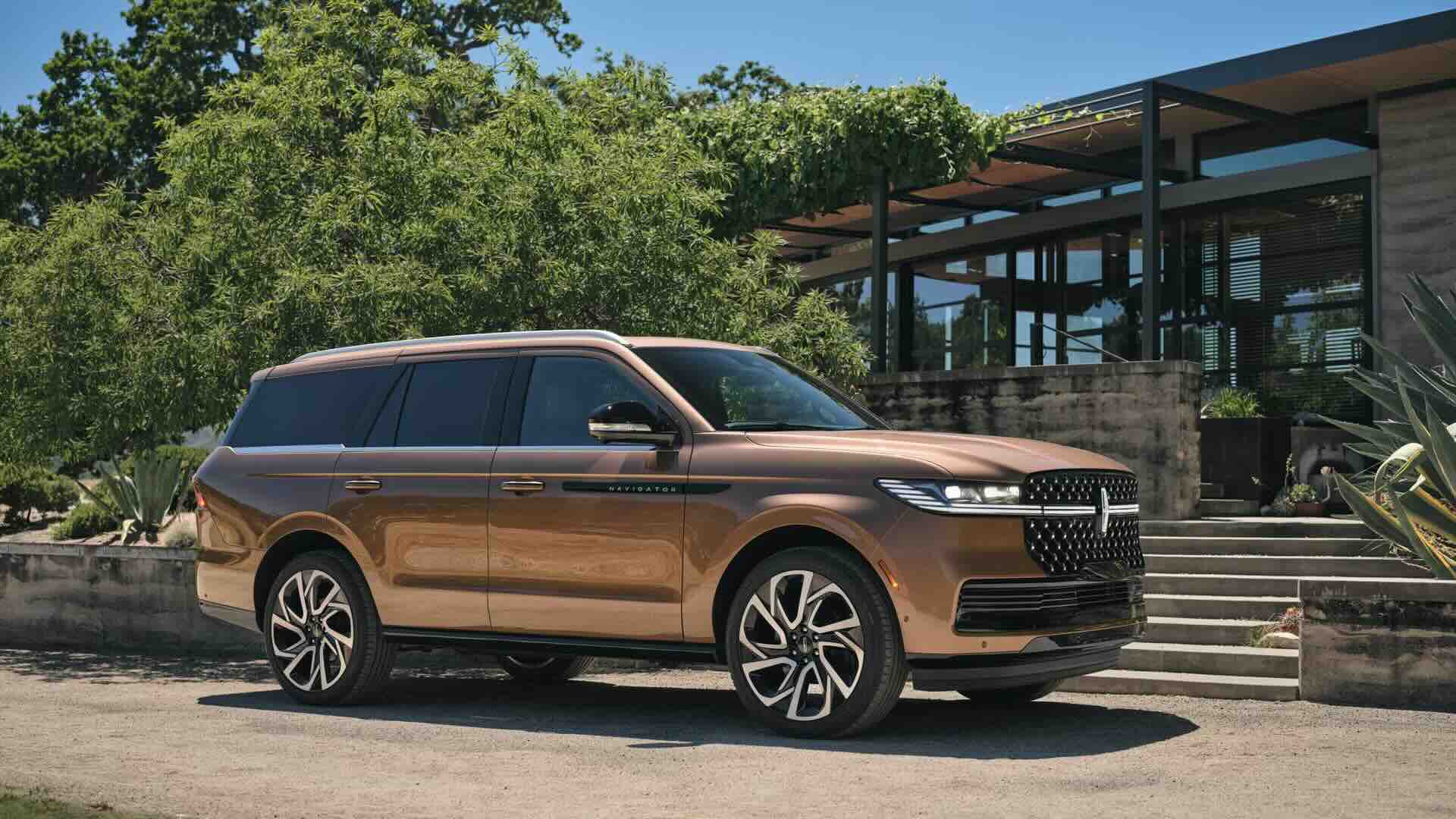

Lincoln no longer sells a full-size luxury sedan – the kind of car that could carry 5-6 people in ultra-quiet comfort. That was – for decades – the Town Car, which Lincoln stopped selling after 2011 – which was also the last year the Ford it was based on (the Crown Vic) was available.
Both of these full-size sedans were replaced by full-size SUVs that seat 7-8. The Ford being the Expedition and the Lincoln being the Navigator, which is based on the Expedition.
Only more luxurious, offering unique features such as a massive (48 inch) LCD display that sweeps from one end of the dash to the other and a 28 speaker Revel Ultima 3D audio system, available massaging second row seats and heated third row seats and 24 inch wheels – that aren’t available with the Expedition. Navigators also come standard with the higher-output version of the twin-turbo V6 that’s optional in the Expedition.
Plus BlueCruise self driving capability.
What It Is
The Navigator is Lincoln’s full-size (and even fuller-size) luxury SUV. Like the Ford Expedition it’s based on, the Navigator is available in standard-length and extra-length versions, denoted by the L after the trim designation.
Prices start at $91,995 for the standard length Premiere trim; the same trim in longer L form lists for $94,995. A full-time 4WD system is standard.
The Reserve trim ($101,995 for the standard length; $104,995 for the extra-length) comes with power deploying running boards, 22 inch wheels, three-zone climate control, fragrance dispenser, panorama sunroof and the 28 speaker Revel Ultima audio system. You can also pipe YouTube videos through the secondary 11.1 inch LCD touchscreen. A Heavy Duty Trailer-Tow package can be added ($750) that bundles trailer sway control/damping, Smart Trailer Tow remote camera view system, heavy duty-cooling, a Class IV hitch and seven pin connector and a two-speed transfer case with Low range gearing.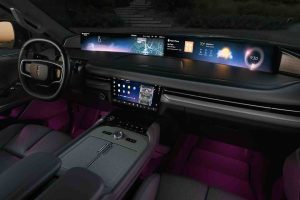
The top-of-the-line Black Label ($118,995 for the standard length; $121,995 for the extra-length) comes with everything you get with the other trims, plus the following upgrades: 30 way power front seats with massagers, a rearseat entertainment system, seat heaters for the third row, premium leather upholstery, suede headliner and all the equipment that comes with the Heavy Duty Trailer-Tow package.
Black Label Navigators are also eligible for 24 inch wheels, available as a stand alone option ($2,995).
Every Navigator comes standard with the same 3.5 liter, twin-turbo V6 (440 horsepower, 510 ft.-lbs. of torque) and ten speed automatic transmission.
What’s New For 2026
Lincoln has brought back the lower-entry-price-point Premiere trim – which had been dropped. This means it’s possible to get a new 2026 Navigator for less than the base price of a 2025 Navigator.
What’s Good
A Town Car that can pull almost 9,000 lbs. and carry 7-8 even more comfortably.
The power of the V6 will make you think it’s a V8.
Not as un-subtle as the Cadillac Escalade.
What’s Not So Good
Even the standard-length Navigator is a kind of streetbound ocean liner; it’s wonderful once you’re out on the open ocean – so to speak – but squeezing it in between the lines of parking spots can be a challenge.
Touchscreen tap/swipe controls for the stereo and seat heaters aren’t as easy to use – especially when the vehicle is moving – as “old fashioned” knobs, buttons and switches.
Though it costs less for 2026 than 2025, it still costs nearly six figures to start.
Under The Hood
Like just about every other full-size SUV on the market, the Navigator no longer comes standard with a V8 engine. But its standard twin-turbo 3.5 liter V6 touts more horsepower – and torque – than any of the V8s that still come standard in competitors like the Cadillac Escalade, which comes standard with a 6.2 liter V8. It is nearly twice the size of the Lincoln’s V6 but touts 420 horsepower – and 460 ft.-lbs. of torque – vs. the Navigator’s 440 horsepower and 510 ft.-lbs. of torque.
The Lincoln’s 8,700 lb. max tow rating is also higher than the Cadillac’s 8,100 lb. max tow rating.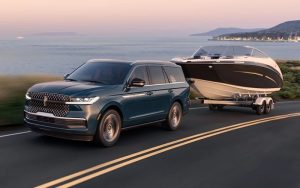
Both, however, are second and third place – respectively – vs. the Infiniti QX80, which comes standard with a 3.5 liter twin turbo V6 that touts a class-best 450 horsepower and 516 ft.-lbs. of torque. The Infiniti’s 8,500 max tow rating falls in the middle. But it is also – by a wide margin – the most affordable of the three, with a much lower base price of $83,750 to start.
Another rival in the class – the Lexus LX600 – comes standard with a 3.4 liter V6 that touts 409 horsepower and 479 ft.-lbs. of torque. The Lexus – which starts at $106,00 is also the most expensive vehicle in the full-sized luxury SUV segment.
The Lincoln gas mileage – 15 city, 22 highway – is not bad given how powerful (and heavy) this full-size SUV is. It can travel about 350 miles in city driving on a full tank (24 gallons) and more than 500 miles on the highway. The electric version of the Cadillac Escalade can supposedly go as far as 460 miles on a full charge but even if it can, it still takes at least half an hour to recover a partial charge. A full-charge takes at least an hour – at a commercial fast charger.
You can fully refuel the Navigator in less than five minutes.
The electric Escalade also stickers for about $20,000 more to start than the Navigator.
On The Road
The Navigator is a liner. As in a huge, ocean-going vessel. You hardly notice the swells because the beam and displacement tame them. When the BlueCruise self-driving system activates – which it does automatically, on roads (highways) that are “mapped” for it – it’s like sitting on the deck in a super-comfortable lounge chair, enjoying the view as the scenery changes. The effect is especially pleasant if your Navigator is equipped with the optional massaging seats – and not just because they massage. The massage is easy to turn on – because the On button is just that – a button (on the lower seat cushion, easily turned on) rather than a tap/swipe icon that you have to dig through menus to find before you can tap/swipe.
This is one of those small things that’s a big thing, in that a function you’d like to use that’s a pain to use is a pain to use. Another small big thing is that once you turn the massage function on, it stays on. It does not turn itself off just as you were getting comfortable – forcing you to dig through the menus again and tap/swipe again. The Navigator is pretty much the only big SUV with massaging seats that has a button to turn them on – and that do not turn themselves off (other than the Expedition).
Power – limitless-feeling, almost – is not a problem. Zero to 60 in 5 seconds is astonishing performance when you reflect that this SUV weighs almost three tons and carries 7-8. There were only a few V8 muscle cars, back in the day, that were as quick, even though they weighed a ton less and only had room for four or five.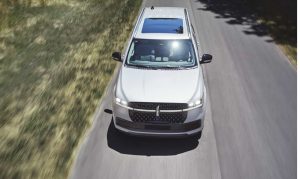
The small V6 makes big power whenever you need it, because the two turbos deliver it as soon as you ask for it. The sound of the engine is muted – as it ought to be in a Lincoln – but authoritative when you need flank speed. The ten speed automatic shifts imperceptibly and accurately. You hardly notice it, which is the point when it comes to a road-going vessel such as the Navigator.
There are just two things that detract from the serenity of the experience. The first is the lozenge-shaped (rather than round) steering wheel, which feels weird in your hand when the road curves such that you have to turn it more than just a little to the left or the right. The design does increase your view ahead – of both the road and the huge curved glass main instrument panel – but it doesn’t improve the feel when you have to steer more than just slightly to the left or the right.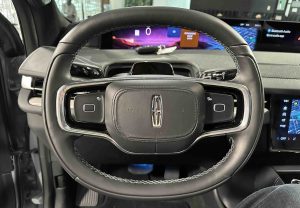
The other thing is the sheer size of this liner. Like the ocean-going ones, it is completely at home away from shore, with the whole ocean to maneuver in. In port – parking lots, in this case – it isn’t easy to maneuver this giant into a spot – or back out. You have to be very careful not to back into things or scrape the side of things. This is not a problem unique to the Navigator. All of these liners have the same problem, which is a function of length and width – and the width of tight spaces designed to accommodate a crossover or car several feet less long and not nearly as wide.
This Lincoln has the tech – cameras and warning beeps to let you know before you do scrape or bump into something. But even so, it is still a challenge to line her up straight in a parking spot and then back her out again.
At The Curb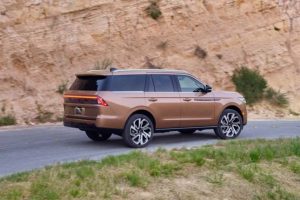
The Navigator is available in standard and extra-length versions, as mentioned earlier. The standard-length version is 210 inches long; the extra-length version increases that to 221.9 inches. This is actually not all that long, by the standards established by American land yacht sedans made back in the ’60s and ’70s – some of which were longer than the extra-length Navigator. Perhaps the most famous example being the Buick Electra 225 – which was as long as its name. The Chrysler Imperial of the same era was even longer.
They had much longer hoods – and trunks – and that’s why they only had room for six in between.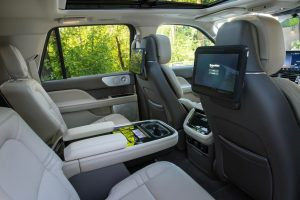
The Navigator’s three rows have plenty of room for more than six. The third row isn’t just-for-kids, either. The main difference between the standard-length Navigator and the extended length version is room for stuff behind the third row, which increases to 37.4 cubic feet from 22.9 cubic feet. The total available space – with the third and second rows folded – is 121.6 cubic feet in the extended-length version (vs. 107 cubic feet for the standard length version).
These specs are in line with those of the Cadillac Escalade – which is also available in standard and extended length (ESV) versions. Neither the Infiniti QX nor the Lexus LX 600 are available in extended length versions and both have significantly less room for cargo behind their third rows and with their second and third rows folded for that reason – vs. the extended length version of the Lincoln and the Cadillac.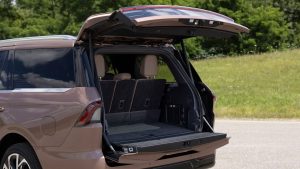
But it’s not so much the space that beckons – or even the opulence. All of the SUVs in this class are opulent. There are some fine difference, here and there, as regards amenities and trim but the overall difference – in this regard – is like the difference between two five-star hotels.
The meaningful difference is the demeanor, which is to a great extent a function of the styling. The Lincoln’s is quieter; the Cadillac’s is louder. It is the difference between Sinatra and Elvis – for those who remember. Neither is better. But they are very different. The Navigator is, arguably, designed to not flash how much it costs.
The Escalade likes to flash it.
The Navigator is quieter on the inside, too. It has one of the largest – the widest – LCD main instrument panels available. But it has a more laid-back look and feel – perhaps because it’s set back from the driver and front seat passenger, toward the base of the windshield – with a long and wide dashpad in between them and the display. For this reason, it does not feel as literally in your face as some of the others’ LCD screens do.
Like the Expedition, the Navigator has a very useful split-opening rear liftgate. It can be raised all at once, or just the upper section. You can also lower the bottom section to create a shelf for sitting or to expand the cargo area’s usable floor space.
The Rest
It’s interesting that Lincoln has lowered the Navigator’s base price for 2026. Other luxury brands (such as BMW) have been doing the same. It suggests that – even in this class – it’s getting necessary to charge less rather than more to close a sale.
The Bottom Line
If you are looking for big – but not necessarily brash – this latter-day Town Car might be the right liner for you!
. . .
If you like what you’ve found here please consider supporting EPautos.
We depend on you to keep the wheels turning!
Our donate button is here.
If you prefer not to use PayPal, our mailing address is:
EPautos
721 Hummingbird Lane SE
Copper Hill, VA 24079
PS: Get an EPautos magnet or sticker or coaster in return for a $25 or more one-time donation or a $10 or more monthly recurring donation. (Please be sure to tell us you want a magnet or sticker or coaster – and also, provide an address, so we know where to mail the thing!)
If you’d like a Baaaaa hat or other EPautos gear, see here!









[…] Great conversation on his latest articles including https://www.ericpetersautos.com/2025/12/05/2026-lincoln-navigator/ […]
Until Lincoln brings back the Town Car or something similar, I’m not interested.
There’s rumors of the Chrysler 300 coming back. Of course based of the new Charger platform, which is AWD, with the 3.0TT and the 5.7 V8 coming back,
I would absolutely be interested in this ‘new’ sedan to replace my grand cherokee V8.
The AWD was discontinued on 17+ 300’s, which lost many sales in the colder climates.
While many enthusiasts are mad at the AWD, you can turn it off for burnouts if you so desire.
The fact that it’s a RWD based system is all I care about.
It might gain some cope car sales too?
COOL!
There were many repulsive descriptions in this review. “a massive (48 inch) LCD display that sweeps from one end of the dash to the other” Eeek!
That, & this, just screams, “Non-durable!” …”Touchscreen tap/swipe controls for the stereo and seat heaters”.
I’m reminded of HAL from, ‘2001 Space Odyssey’:
“When the BlueCruise self-driving system activates – which it does automatically”
I don’t know WHY every car company wants to produce a vehicle with features I dislike. Maybe, someday, they’ll wonder WHY I don’t buy their crap?
“This Lincoln has the tech – cameras and warning beeps to let you know before you do scrape or bump into something.”
I. Don’t. Want. That. Crap.
I know how to drive!
Ten years of owning a beep-less 1998 Navigator = I really like it.
I bought it just before the run-up in used car prices for $4900 with less than 50,000 miles.
…At 76,000 miles the tranny self-destructed & a rebulit one cost $3,000.
The rear window motor is out.
The heater/fan has no recall memory & is on defrost at every startup, but it does switch to panel/floor.
…I can’t imagine all the failures in the new digital model,… ~10 yr’s down the line.
Right now, I wouldn’t buy one for $3,100.
Insert G.M.’s latest vid:
‘Chevy Christmas 2025: ‘Memory Lane’ Short Film – Nostalgia Hits Hard!’
https://www.youtube.com/watch?v=VDYXnWeWJJc
…Thanks for the review. Maybe, someday, American car companies can produce something worthwhile again?
Morning, Helot!
These things are so huge that dealing with things like bank drive-thrus can be a real hassle. You’re so high up that you have to reach down to get to the tube and if you have to open the door, it’s already too close to open much. Parking spots are not wide enough. Even if you line up straight, you are likely to be close to the next vehicle such that you can only open the door partially to get out. You have to shimmy out sideways. If you’re not thin or flexible it can be a challenge!
I can imagine. My ’98 does not seem to be quite like that. I can even roll down the window & rest my arm on the sill with my elbow sticking out, like in cars of the Before Times.
Your comment, plus the review, I sure do appreciate my ’98 all the more.
What is the existential meaning of a three-ton SUV that costs $100,000?
In my mind, the Lincoln Navigator is today’s analogue to the Duesenberg Model J, a three-ton luxury barge powered by a 6.9-liter straight eight, introduced in 1928. Wikipedia recounts what ensued:
‘By the time the Great Depression hit in October 1929, Duesenberg had only built some 200 cars. An additional 100 orders were filled in 1930. Thus, the Model J fell short of the original goal to sell 500 cars a year. Most engine and chassis were made in 1929 and 1930, but due to the Depression, high price, etc., ended up being sold and bodied in subsequent years.
‘During the model’s production life, the first major change was to replace the four-speed gearbox, which proved unable to handle the engine’s power, with an unsynchronised three-speed gearbox. Unlike almost all American manufacturers, Duesenberg did not switch to a fully synchronised gearbox in the mid-1930s, which made the Model J difficult to drive and outdated by the latter years of its run. The factory closed in 1937.’
Even expert double-clutching couldn’t save the ponderous Duesenberg land yachts. 🙁
Meanwhile, as the US economy erodes for all but the super-rich, the Navigator appears to be tacking toward an iceberg. What’s Ford doing about it? Lightning Jim Farley still thinks that what this country needs is a good $30,000 EeeVee. :rolls eyes:
Indeed, Jim –
My hypothesis is that car company CEOs such as Farley are so rich they are divorced from the realities faced by normal people. Imagine how warped your view of what things cost – the cost of living – would be if you were paid $30 million in one year. That is what CEOs such as Farley and Barra are paid. They are paid more in one month than most Americans will ever be worth, after a lifetime of working. People such as Farley and Barra associate with others similarly positioned. A $100k SUV for them is what a Snickers bar is for us.
It is truly a situation analogous to the court of Louis XVI. They do not seem to appreciate the danger of this, either.
Let them eat cake! Sorry, I couldn’t resist…
There’s an old analogy that said: A decent State school 4-yr tuition/room-board should approximate what a luxury car costs. Seems about right.
$121k for a fucking Ford SUV with “Lincoln” slapped on the hood? Yeah, fuck that. If I ever decide to spend $121k on a vehicle it will be an airplane.
I hear you, X –
See today’s lead article….
X,
That won’t get you much airplane. It’ll get you a nice bug smasher that’ll do 100 knots or so, but not much more. Used Cessna 172s and 182s in very good or excellent condition with decent avionics will set you back a $150K, easy. We’re not talking fully redone birds with new and updated glass cockpits, either; we’re talking birds with fair to good paint jobs, a decent interior, good vacuum instruments and KX-155 NAV/COMs. The KX-155 is step up from the 175 with analog readouts; the KX-155 came with LEDs and flip-flop display. If you want a 172 with a fresh paint job, interior, and modern avionics, be prepared to pony up at least a quarter mil. Shoot, even 150s and 152s in good shape are fetching high five figure price tags now! A nice 152 with a nice (but not fresh) paint job, a clean interior with no tears and decent avionics (again, nothing modern and no glass cockpit) will set you back $60K-$80K.
Used airplane prices have skyrocketed because few people can afford a new plane. New plane prices are astronomical. If you thought used plane prices were bad, go look at new ones! A new 172 will set you back $400K, minimum; a 182 will set you back at least $700K; a Piper Archer, a low wing contemporary of the 172, will also set you back $400K, minimum. Granted, these planes are brand new, 0 hours, and have glass cockpits, but there’s no way they should cost $400K on up. Beechcraft doesn’t make anything like cheap though; their least expensive single is the A36 Bonanza, which costs $1.1 million on up. Goodness knows what their twins and turboprops go for.
To put things in perspective, a brand new Cessna 172 would cost you $10K back in 1960. In those days, a Caddy cost about $5K. While a 172 was a reach, it was at least an attainable reach if you worked hard and saved your money. Inflation adjusted for today’s money, a new 172 should cost $110K or so; unfortunately, it costs about four times that.
Wow. …Worlds away from the old guy back in the ’80’s who flew his homemade aircraft from his dirt airstrip across the road from the local tiny airport.
Worlds away.
I don’t envision every flying anything other than a 100-kt bug-smasher anyway. But you’re right — airplane prices are up like everything else. Before COVID I saw a few ads for AT-6s and Stearmans in the $100k range. Clapped-out ones, probably, but you’re not going to find that today, as you say a decent 172 is $100k now.
$100K will get you a TIRED 172! That 172, while airworthy, won’t turn heads on the ramp. Its paint job is faded. The interior is worn. If you’re lucky, you have analog KX-170/175 NAV/COMs. It has all its original vacuum instruments. Finally, it’ll have a high time engine nearing TBO. If you want a nice 172, plan on ponying up $200K or more.
That said, you can get an old Aeronca or Ercoupe that are in nice shape though. I’ve seen nice Ercoupes for under $50K; we’re talking fresh paint job, refreshed interior, and an O-200 engine with low time.
Yep, I’ve seen reasonably priced Ercoupes. I’d consider one for sure. Short-wing Pipers seem to be relatively affordable also.
I would need to get my ticket first, though, I only have a handful of student hours and need to get everything else in life squared away to resume lessons.
Good luck to you… 🙂
I’ve had a 2016 Navigator L Select for 7 years and now I own a 2017 Nav L Reserve. I think the previous generation had more comfortable seats and they can carry more. Plus I like the look better. I bought mine with 36k miles for $38k with TT&L and a 6 year 75k mile Ford Warranty with a $50 deductible. Hard to beat that deal. From my perspective the 2017 is much more reliable than the 2016. They are quite nimble for what they are. I average 16-17MPG with regular fuel and it has a 35 gallon tank, which is much better than the new ones. On the highway, I can go 700 miles on a tank.
Morning, Bryan!
I am not a fan of the turbo V6 engines being used in these vehicles because they’re not V8s. I appreciate the power the turbo V6s make, but – fundamentally- they are compliance engines and that is just wrong in a high-end vehicle such as this.