


Electric vehicles have brought something back to the lower end of the new car market that’s been absent from that end of the market for decades:
Rear wheel drive.
It was common – once – for even economy cars to be rear-drive. Examples include the Ford Pinto and Chevy Chevette and the Datsun B210. Front wheel drive became standard in pretty much everything by the ’90s – except for trucks and SUVs and high-end luxury/performance cars.
Electric cars are bringing that back for essentially the same reason FWD replaced RWD in most passenger cars: It’s a way to simplify how a car is built and that helps to lower the cost of the vehicle.
FWD eliminates the need for a separate transmission and rear axle assembly and a drivetrain spread out over the length of the vehicle, from front to rear.
The EV drivetrain does the same – because there is no transmission or axle; the electric motors directly drive the wheels that propel the car. That makes it just as easy (and inexpensive) make an EV rear-drive as FWD.
AWD is easy, too – just add another motor to drive the front or rear wheels.
While FWD has the wet/snow day traction advantage – because you get more traction pulling than pushing – RWD cars usually handle better and that’s why higher-priced cars (with engines) tend to still be RWD.
The Volvo EX30 EV comes standard with RWD – and sub-$40k base price. You’d generally need to spend another $20k or so to get a RWD non-electric car, because the only ones available are sold by Mercedes, BMW, Lexus and other luxury-car brands.
Here’s a Volvo that’s rear-drive for less than $40k.
It is also something else.
What It Is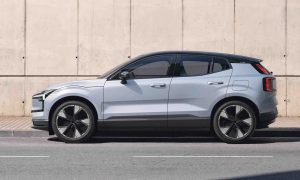
The EX30 is a small electric crossover from Volvo. It’s smaller than the Toyota Bz – and comes standard with a much more powerful electric drivetrain as well as standard RWD. The Toyota EV is FWD. But the Toyota is larger – and has much more space for cargo as well as a roomier back seat. Same pros – and cons – vs. other small EVs in this class such as the Nissan Leaf.
Prices start at $38,950 for the Single Motor Plus trim, which comes standard with a 268 horsepower electric motor driving the rear wheels and 261 miles of advertised fully charged range. This trim also comes standard with a 12.3 inch center touchscreen, a panorama sunroof and a premium Harman Kardon audio system.
The Twin Motor Performance Plus ($44,95) gets a second electric motor (and AWD) as well as a power bump to 422 horsepower. Range goes down slightly to 253 miles.
The Twin Motor Performance Ultra ($46,650) has the same drivetrain (and advertised driving range) as the Performance Plus but adds a bundle of tech features such as automated self-parking, a surround-view exterior camera system and interior/exterior trim differences.
What’s New For 2026
The single motor (RWD) version is new and accounts for a major price cut vs. 2025. Last year’s EX30 came standard with the dual motor/AWD drivetrain – and a base price of $44,900.
What’s Good
Much lower starting price – and standard RWD.
Much stronger standard – and optionally available – drivetrains vs. most other small crossovers in the same general price range.
Comes standard with the high-end audio system.
What’s Not So Good
Significantly smaller and less roomy – especially for backseat passengers – than rivals like the Toyota Bz, Nissan Leaf and Tesla Model Y.
Hyundai Ioniq5 offers similar power/performance – and standard RWD – in a roomier, less expensive package.
Driving range isn’t very far and – like all EVs – it takes comparatively forever to recharge.
Under The Hood
Volvo offers the EX30 in both RWD and AWD configurations, as mentioned. The RWD EX30 has a single motor touting 268 horsepower, driving the rear wheels only. This configuration (one less motor) enabled Volvo to price the 2026 EX30 much more competitively than last year’s dual-motor only EX30 and still offer the most powerful standard drivetrain among EVs in the class, with a similar price.
As a point of comparison, the Toyota Bz comes standard with a 165 horsepower (and FWD) set-up; the Nissan Leaf also comes standard with just 214 horsepower (and FWD). The Hyundai Ioniq5 does come standard with RWD – and it has a lower base price than the Volvo – but its standard single motor drivetrain touts just 168 horsepower.
The downside to the EX’s more powerful standard drivetrain is not very far standard driving range – 261 miles. However, this is more driving range than you get with the standard-issue Toyota Bz (236 miles) and the Hyundai Ioniq5 (245 miles).
Much more power – and performance – is available. The optional Twin Power (dual motor) drivetrain touts 422 horsepower and is capable of getting this small EV to 60 MPH in just over 3 seconds. Range goes down – as you’d expect, given the additional weight of having two motors to carry rather than just the one – but not that much. Volvo says this version of the EX30 can go 253 miles on a fully charged battery.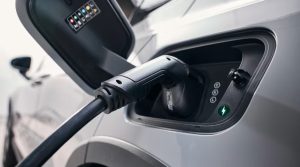
You can also pull a small trailer (up to 2,000 lbs.) which is more than any gas-engined subcompact crossovers in the same price ballpark can handle.
But it’s not as much as the Tesla Model Y – which is rated to pull as much as 3,500 lbs. The Model Y also comes standard with rear-drive, 300 horsepower and a rated driving range on a full charge of just over 300 miles. However, the Model Y’s $44,990 base price is about the same the Volvo’s when the latter is equipped with its optional Twin Motor drivetrain – and $5,040 more than the EX30’s base price with the single motor/RWD drivetrain
On the Road
The problem this Volvo EV’s got is the same problem every other EV’s got in that they all pretty much drive the same. It is hard to impart “Volvo-ness” into a vehicle that – like the EVs made by Toyota and Nissan and Tesla, et al – has the same basic drivetrain as every other EV.
So, the only way to impart meaningful differences is by powering different wheels – and by offering more power for less money. This is the formula here. The EX30 is rear drive in standard drivetrain form, as mentioned already – and that imparts a driving feel that’s more like an expensive vehicle than an entry level vehicle. Especially as regards how it handles in the curves – because there is a big difference in handling feel during cornering between a front-engined and a rear-engined (or front motor’d and rear motor’d) vehicle because the weight of the engine (or motor, in the case of the EV) is in back rather than up front.
You can feel the rear tires applying the power, pushing you (rather than pulling you, as in a FWD vehicle) forward and there is more power than the price-competitive others, such as the Toyota Bz, Nissan Leaf and Hyundai Ioniq5.
The downside is the weight (and rear end) can “come around” on you, if you don’t keep on the gas – the accelerator, in an EV – to keep the rear end planted as you corner. And – of course – the RWD layout is not nearly as grippy in the snow as FWD.
The single-motor Volvo gets to 60 in 5 seconds, which easily beats the other EVs mentioned – and also the single-engine Tesla Y, which takes a second longer to get to 60. With the twin motor drivetrain, the little Violvo crossover is quicker-accelerating than a Ferrari. The catch is the same one that catches you in any high-powered EV. If you make frequent use of the EV’s Ferrari-like acceleration capability, you’ll have to stop for a charge a lot more often than the advertised 253 miles. The same would be true if you were driving a Ferrari, of course – with the key difference being that you can fully refuel a Ferrari in just a few minutes vs. having to wait at least 20-30 minutes to get a partial charge at a commercial fast charging kiosk.
You can charge at home, of course – and wait there instead. But it takes eight hours to fully charge the EX30 using a 240V Level II hook-up and if you haven’t got a house – and a 240V hook-up – you’ll be waiting a day or two to get a charge or find yourself tethered to the commercial fast-charging grid, which isn’t as widely available and conveniently situated as the gas station network.
At The Curb
The EX30 is little – just 166.7 inches long – which has its pros and its cons.
On the pro side, the EX30 is not much longer than some motorcycles. This means you can fit a motorcycle (or two) in your garage, along with an EX30. It also means this little Volvo has a very tight turning circle that makes u-turning a snap and sliding in – and out – of tight curbside parking spots nearly as easy as parking a motorcycle.
On the con side, the EX30 is realistically a two-seater because it has a very tight back seat, just 32.3 inches of legroom back there. To put that in some perspective, the Tesla Model Y has 40.5 inches of rearseat legroom – about eight inches more, in other words. It also has much more room for cargo: 33.1 cubic feet behind its rear seats and 75.5 with the rear seats folded. The little Volvo only has 12.4 cubic feet of cargo space behind its rear seats and even with them folded, the available space only opens up to 27.8 cubic feet – which is less than the Tesla has with its back seats up. 
That said, the space available is still more than twice that available in any mid-sized sedan’s trunk and the wide-opening liftgate provides excellent access to the available space.
This little Volvo makes for a fine commuter vehicle/second vehicle – in part because it is so little but also because of its newly littler base price. Volvo was wise to cut the MSRP down by about $5k vs. last year, especially given the formerly available $7,500 tax rebate is no longer available. A snappy little EV commuter that can be picked up for less than $40k makes a lot more economic sense than one that lists for closer to $45k (Tesla has made the same move, for the same reasons, with the pricing of the 2026 Model Y.)
Outside, the EX30 looks like most of the rest – and inside, too. There isn’t much to see, literally – insofar as the inside. Most of the dash is just that – a dash. Following the design ethic pioneered by Tesla, the centerpiece is a 12.3 inch rectangular touchscreen that looks like a giant smartphone leaning on the dashboard. EV people seem to like this look – and the function (most controls are tap/swipe) but it does look generic, which is arguably a liability when you’re trying to sell something that – putatively – isn’t the same as what everyone else is selling.
Volvo does impart some differences – as regards standard amenities. Even the base trim comes with a very good Harman Kardon audio system, a wireless charger and both Apple CarPlay and Android Auto, as well as a large (panorama glass) sunroof.
In fact, you don’t get much more – in terms of amenities – by going with the twin motor drivetrain, which is a plus if all you want is the amenities and not the extra-cost you have to pay to get the twin motor drivetrain.
The Rest
Volvo now offers the EX with its Cross Country equipment, which includes a suspension lift (by about 3/4 of an inch) plus underbody skid plates, fender flares and a set of 18 inch wheels (19s are otherwise standard) fitted with A/T tires. The idea is to impart more snow-day capability and even some off-road capability, though the latter is limited by the vehicle’s range and the absence of places to get recharged where there are only dirt roads.
The Bottom Line
Volvo took a step in the right direction reducing the EX30’s base price – and by offering more power for less money vs. many rivals in the segment.
. . .
If you like what you’ve found here please consider supporting EPautos.
We depend on you to keep the wheels turning!
Our donate button is here.
If you prefer not to use PayPal, our mailing address is:
EPautos
721 Hummingbird Lane SE
Copper Hill, VA 24079
PS: Get an EPautos magnet or sticker or coaster in return for a $25 or more one-time donation or a $10 or more monthly recurring donation. (Please be sure to tell us you want a magnet or sticker or coaster – and also, provide an address, so we know where to mail the thing!)
If you’d like a Baaaaa hat or other EPautos gear, see here!










What is it with this trend of putting the instruments on a big screen in the center of the console? The instruments should be in front of the driver, not in the center of the console. A quick glance down is a lot easier and safer than turning to look at a giant cluttered screen in the center of the dash.
RE: “What is it with this trend of …”
Contrary to every TeeVee commercial on the idiot box, Car makers, do not give a shit about you, the driver.
Nada. Zero. Zip.
Understand that, and you may begin to see.
Hi Dave!
Well, they do it because it’s cheap. It reduces manufacturing costs – and it increases profits.
[…] https://www.ericpetersautos.com/2026/01/04/2026-volvo-ex30/ […]
‘Following the design ethic pioneered by Tesla, the centerpiece is a 12.3 inch rectangular touchscreen that looks like a giant smartphone leaning on the dashboard.’ — eric
Why beat around the bush? It’s an ALTAR … to the iconic cellphone, the source of all wisdom, all knowledge, all joy … for slaves.
Never have I been a phone person, even in the landline days of prehistory. Neurolinguistic Programming asserts that people have preferred styles of communication: visual; auditory; tactile. Auditory ranks dead last on my list. I despise fucking phones. And accordingly, I adamantly reject the cellphone human interface, with its Fisher-Price toy, cartoon icons (ages 3-5).
EeeVee phone home … before I smash your spyware telemetry to bits. 🙂
– I – was too, “a phone person in the landline days of prehistory.” A.k.a. the 1980’s & 70’s.
I talked to chicks at night, the coiled phone cord tangled around.
It was exciting to talk to the prettiest girl in the world. It was nothing like the world of today. Nothing!
I captivated her. I see that same draw in the, Today World. Only, it’s much weaker, now.
I dunno where I was going with this:
Fak, I could only find it on CIA-Book:
https://www.facebook.com/home2hollywood/videos/its-a-wonderful-life-buffalo-galslasso-the-moon-scene/856504384778176/
Same stuff.
..Imagination, in the world, is being squashed.
“You can also pull a small trailer (up to 2,000 lbs.) which is more than any gas-engined subcompact crossovers in the same price ballpark can handle.”
And how far can you actually pull it, before the EV runs out of juice?
I’d be surprised if the range didn’t drop by at least half, even while driving at a very moderate speed.
Add to that some cold weather and you may as well just buy a real car, if you actually want to get anywhere, let alone with a trailer behind you.
No thanks! Another EV BS device!.. its a Computer on wheels.. for $40k.. Bring Suzuki Jimny to US!!
Sounds like a nice small car, I’d consider buying one if it came with a gas, or better yet, diesel engine.