


How much difference does two years make? About $3,385 is how much. That is how much more Lexus is asking for the 2026 GX550 – which is otherwise identical to the 2024 GX550.
This isn’t Toyota’s fault, by the way. It is a consequence of the tariffs (that is to say the taxes) Toyota is having to pay – which means you’ll be paying for them, if you want to buy a new GX550.
It probably won’t prevent you from buying a 2026 example of this superlatively luxurious and superlatively capable off-roader because if you could afford to pay $62,900 in 2024 for one, you can probably afford $66,285 today.
There are some other sound reasons to consider the GX550, too – especially relative to its Toyota-badged siblings.
What It Is
The GX550 is a mid-sized, three-row SUV that’s related to the Toyota 4Runner and the LandCruiser. All are considered among the most capable SUVs you can buy, in terms of what they are capable of off-road – but the Lexus (being a Lexus) is the more luxurious – and naturally, more expensive – of the three.
There are also some other differences, as you’d expect.
The Lexus comes standard with the turbocharged V6 that’s not available in the LandCruiser or the 4Runner – which comes standard with a much less powerful turbocharged four cylinder engine.
4WD is also standard in the Lexus; it’s optional (again) in the Toyota.
The Lexus also touts much higher standard towing capacity (9,096 lbs.).
Prices – for the Lexus – start ay $66,285 for the GX550 Premium, which comes standard with 20 inch wheels, a power rear liftgate, heated and cooled front seats and synthetic leather seat covers.
The $70,750 Premium + adds a heated steering wheel, second row seat heaters, a power-folding third row and automated self-parking.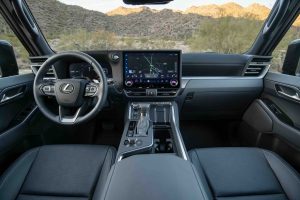
If you want more than the already standard high level of off-road capability, the $73,930 Overtrail adds a locking rear differential, 18-inch wheels with 33 inch all terrain tires, a one inch lift, an upgraded off-road suspension that allows for greater wheel articulation and Off Road driving modes, including Crawl mode. There is also an Overtrail + that adds massaging front seats and heated rear seats, plus a wireless pad ot charge phones. It stickers for $81,395.
These iterations revert to two-row-only.
If you’re wanting even more luxury – including massaging from seats (and 22 inch wheels) the $78,750 Luxury gets all that.
A top-of-the-line Luxury + adds adjustable shocks, an adjustable tint sunroof, plus an ultra premium 21 speaker ultra-premium Mark Levinson audio system, a chiller built into the center console and power deploying running boards.
It stickers for $82,750.
What’s New For 2026
The GX550 carries over unchanged since its 2024 reboot/debut.
What’s Good
Formidable off-road capability.
Standard V6 isn’t a turbocharged four.
Standard 9,096 lb. tow rating is considerably higher than sibling Toyota 4Runner’s maximum 6,000 lb, tow rating.
What’s Not So Good
Stickers for about $20k more to start than its similarly off-road-capable 4Runner sibling.
Standard V6 is turbo’d (twice). Previous iterations of this Lexus used to come standard with a V8 that didn’t need a turbo – much less two.
Third row is tight and greatly reduces cargo space behind it.
Under The Hood
Back when the GX was the GX460 – back in 2023 – it came standard with a 4.6 liter V8 engine, because that’s generally what you used to get as standard in a mid-sized, luxury SUV. Now you get a 3.4 liter V6 with a pair of turbos and Lexus – weirdly – demotes this as the “550,” which in the past would have denoted a 5.5 liter V8. Of course, “GX340” sounds like a downgrade – hence GX550 instead.
The old V8 was considered one of the finest engines of its type ever sold because it was both smooth and powerful and – most of all – remarkably durable. These V8s commonly were as tight at 150,000 miles as brand-new engines and if not deliberately abused, would go 250,000 miles before they began to need any significant work. Part of this was because they were just fuel injected (not direct injected) and weren’t turbocharged and so not literally pressurized. Put another way, they did not have to work hard to produce the power/performance expected by the buyer.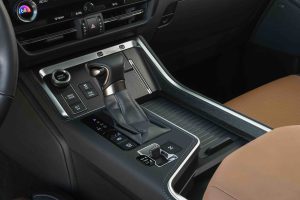
But V8s “emit” more C02 than smaller V6s – because they have fewer cylinders and less cylinder volume – and Toyota (like just about every other vehicle manufacturer) nixed the V8 for just that reason; i.e., to help better comply with federal regs that required ever-lower C02 “emissions.” The change had nothing to do with gas mileage, as can be seen by noting that the new V6 – though much smaller and having two fewer cylinders – rates 15 city, 21 highway while the previously standard 4.6 liter V8 delivered pretty much the same: 15 city, 19 highway.
So, what’s the upside?
Well, the 3.4 V6 makes more power – 349 horsepower (vs. 301 for the old V8) and much more torque – 479 ft. lbs. vs. 329 ft.-lbs. for the old V8. No doubt this explains the GX550’s standard 9,096 lb. tow rating, which is considerably higher than the ’23 GX460’s 6,000 max. The torque is also more available, because the boosted V6 develops its peak torque at just 2,000 RPM, which is a fast idle, basically. The old 4.6 liter V8 did not make peak torque until it was spinning 3,800 RPM – which means it was not available as immediately. No doubt this also explains why the GX550 gets to 60 sooner (6.5 seconds).
It is also standard in the GX550. In the merely Toyota 4Runner, the standard engine is a 2.4 liter turbocharged four that makes 278 horsepower, which explains why the otherwise basically-the-same 4Runner is still only rated to pull a maximum of 6,000 lbs. Also, the current 4Runner is no longer available with a V6. Its optional engine is a turbo-hybrid augmented version of the 2.4 liter four that makes 326 horsepower and 465 ft.-lbs. of torque. Even though this engine is nearly as powerful as the GX550’s V6 – and even though the 4Runner and the GX550 share a common underlying structure – Toyota still only rates the 4Runner to pull a maximum of 6,000 lbs.
Probably because that smaller engine would have to work a lot harder under load, plus the hybrid augmentation porks up the curb weight (which has an effect on what you can pull). Finally, the GX500 is a Lexus.
You get what you pay for – and the reverse.
On The Road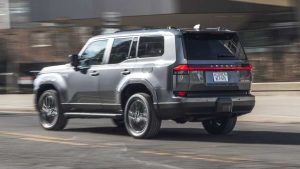
There’s a different feel to a real SUV, which is what the GX550 is – in addition to being a really luxurious SUV. It is the feel that you get with body-on-frame architecture, which is what the GX550 (and its Toyota 4Runner sibling) have. It’s a heavy feel – in a good way. In a solid way. Unibody (body and frame welded into a single piece) vehicles do not feel the same. They feel less . . . substantial. Because they literally are. Body-on-frame does incur a weight penalty – the GX500’s curb weight is 5,580 lbs. – which is why you do not find it undergirding mass-market vehicles, which have to cater to both the government’s fuel economy edicts as well as the fuel economy consciousness most buyers of transportation appliances have.
The GX550 is not a transportation appliance – and not just because it’s a Lexus. The body-on-frame architecture can be understood as something like Wolverine’s Adamantium endoskeleton. The X-Man was super strong because of his bones as well as muscles – and so are body-on-frame SUVs like the GX550, which is more accurately a 4×4. There are many SUVs but few 4x4s. Though among the most opulent – and comfortable – vehicles available, the GX550 is a vehicle that can be rock-crawled, if you feel like doing that. The steel girder frame being much harder to hurt than a welded together unibody. The frame is also harder to bend or stretch, which is if you need a rig that can seriously tow, body-on-frame is the only way to go.
Body-on-frame rigs do sit up higher, which tends to make them less adroit as high-speed cornering vehicles – but no in his right mind expects a Corvette to be a fine rock-crawler, either.
As touched on earlier, the 3.4 V6 may be physically much smaller than the previously standard 4.6 liter V8, but it feels like a 5.5 liter V8. Only the absence of the V8 burble gives it away. If the hood were sealed – and if you went by the “GX550” badges – it’d be very easy to believe this Lexus did, in fact, have a big V8 under its hood rather than a smallish V6.
The only detraction from what is otherwise a wonderful driving experience is the experience of having to fish through the big LCD touchscreen to activate certain desirable functions, such as the seat massagers that come standard in the Luxury and Luxury + trims. It’s a multi-step process of having to first tap the button to get to the screen that displays the seat massager controls and then tap the seats you want to activate. In some other high-end vehicles that offer massaging seats, there are buttons on the lower seat cushions that can be easily turned on and off without needing to deal with the screen, which is much easier. Also, some other-brand massagers stay on until turned off; the GX550’s cycle off automatically after awhile and then you have to go through the whole process again, if you want them back on.
At The Curb
There are some differences – beyond just cosmetic (and amenities) – between the GX550 and its Toyota 4Runner sibling. The Lexus is longer, for one. It is 197.1 inches end to end vs. 194.9 for the 4Runner. There are also more noticeable differences in interior packaging. While both the GX550 and the 4Runner have almost the same front seat legroom (41.2 and 41.8 inches, respectively), the Lexus – being a Lexus – has much more second row legroom – 36.7 inches vs. 34.8 for the 4Runner. On the flip side, the Toyota has more advertised total cargo space – 90.2 cubic feet vs. 76.9 for the Lexus, which is due in part to the GX550 coming standard with a third row.
This is available – optionally – in the 4Runner.
The assumption seems to be that people who buy the Lexus are chiefly concerned about passenger comfort whereas 4Runner buyers are likely the type that will be using the cargo area more often than the passenger area.
You can skip the third row by the way. And it might be the thing to do – unless you have small kids and need the extra seats – because the GX550’s third row is not exactly luxurious, for adults – not because of the seats of themselves but rather as a consequence of the way the floorpans have to be laid out in a body-on-frame 4×4 with a heavy duty rear axle that takes up under-floor room that might otherwise be devoted to legroom.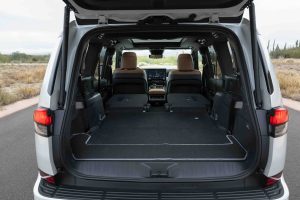
The GX550 shares a rugged exterior silhouette with its Toyota sibling but inside, the tone is softer. Controls that are tap/swipe (as for example for the seat heaters and steering wheel heater) in the Lexus are controlled by big meaty rotary knobs in the 4Runner. Finishes are rougher-hewn in the Toyota, which makes sense because it is the one of the two more likely to get actually muddy – though the Lexus is just as capable of getting muddy.
The Rest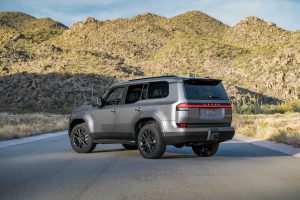
A few minor gripes: The cupholders in the console are small – and boxy – and while there is a 120V household power point, it’s located way back in the cargo area. You also have to step up to the Premium trim if you want heated second row seats, which ought to be standard n a Lexus with a starting price not far from $70k.
The Bottom Line
The GX550 no longer comes with that wonderful V8, but the 3.4 V6 has its own charms – which include the fact that it’s not available in the 4Runner.
It’s arguably worth the tariff tax.
. . .
If you like what you’ve found here please consider supporting EPautos.
We depend on you to keep the wheels turning!
Our donate button is here.
If you prefer not to use PayPal, our mailing address is:
EPautos
721 Hummingbird Lane SE
Copper Hill, VA 24079
PS: Get an EPautos magnet or sticker or coaster in return for a $25 or more one-time donation or a $10 or more monthly recurring donation. (Please be sure to tell us you want a magnet or sticker or coaster – and also, provide an address, so we know where to mail the thing!)
If you’d like a Baaaaa hat or other EPautos gear, see here!










I have been wanting to look at one of these in person, but the Lexus dealers nearby haven’t had any on the lots in the past couple of years. The styling does look a bit odd and doesn’t look harmonious to my eye. Perhaps it looks better in a darker color like green.
I did sit in a Land Cruiser and while it was nice it did not feel $70k nice whatsoever. And what I saw under its hood was just sad.
[…] https://www.ericpetersautos.com/2026/03/30/2026-lexus-gx550/ […]
The lede photo of a white GX550 reminds one of a once-shapely matron of a certain age who has packed on 40 or 50 pounds by middle age: her dresses employ every trick in the book to conceal her growing bulk and make her look at least slightly svelte. But there’s no getting away from the fact that the GX550 is a 5,500 to 5,700-lb vehicle, which will weigh over 3 tons with a couple of people in it.
And it has a square-jawed look, like a woman who overly resembles her father and flaunts just a hint of a mustache.
I recoil in horror from these ponderous, plug-ugly tanks. Will its dainty 3.4-liter V6 choke on its own mis-manufactured metal filings and croak, as other Toyota Tacoma engines recently have done?
Who knows … who cares. I’m not buying this hideous, fat-ass clunker at any price, including free. *discreetly pukes in the wastebasket*
Erratum: Tacoma –> Tundra
The county is fixin’ to re-open the old and decrepit wooden-deck bridge across the creek on my road. Not a re-build — just adding some shims to correct for the piles’ sinking over time. So I suppose the posted weight limit — 2 tons per axle, 3 tons max — will still apply.
Maybe the county will install an ALPR to catch these rolling manatees so they can be safely re-routed? Or maybe just flash a warning to unload the vehicle before crossing?
Morning, Jim!
I am with you. My TA is my new drug – or antidote. I took it out yesterday for another drive. The experience is so contra everything new. In a wodnerfu and yet sad way, as I realize I am driving a relic of a rapidly receding past.
I think the phrase you are looking for is “better vanished time.”
The readership awaits your road test report of the newly-configured four-on-the-floor Trans Am.
No dealer will sell you a new vehicle that remotely resembles it — not for any price.
A $250,000 restomod is the closest equivalent you can actually buy today. But its suspension and drivetrain are quite different — not historically accurate.
I’m working on that, Jim!
I need to get Dawn to hold the camera or rig up a … rig. Because I can’t shift and hold the camera at the same time!
The Land Cruiser has been a big, heavy pig for a long time.
The 2025 GX550 is overall 197 inch long, 75.6 inches tall, 78 inches wide and has curb weight of 5,675 lbs. GVWR is 7,165 lbs.
The US-spec 1995 FZJ80 was overall 195 inches long, 74.4 inches tall, 76 inches wide and had curb weight of 5,313 lbs. GVWR was 6,746 lbs.
The 2025 Land Cruiser, Toyota’s similar cousin of the GX, has the I4 hybrid instead of the twin-turbo V6, so has a battery pack but lighter engine. It’s curb weight is 5,357 lbs and GVWR is 6,724 lbs.
In other words over 30 years from the 80 series to the 250 series the Land Cruiser is pretty much the same size and weight but about double the power. The 1995 1FZ made 202 HP, 266 lb-ft and 0-to-60 of 12 seconds (going downhill I assume) while the GX V6TT makes 349 HP, 479 lb-ft and does naught to 60 in 6.5 seconds.
The gx one of the finest vehicles ever built based on the land cruiser Prado poor man’s land cruiser being it’s cheaper than the lx was always a v8 engine in the past still bigger than the new 4 runner v4 I believe there still built in Japan so should be high quality but out of my budget till there 20 years old
Is that the same turbo V6 that is leaving Tundras dead in the water?
Fun fact: back in 2007, you could get a GX, or you could get 2 FJ’s. In 2026, you can get a 2007 FJ, or 2 2007 GX’es.
Why compare to the 4Runner so much? A Land Cruiser would be the more obvious alternative for a GX buyer on a budget. The 4Runner is a completely different target market and is closer related to the Tacoma (both it and the 4Runner are only sold in the States) rather than the 250-series Prado/Land Cruiser/GX models (which are the global models).
A Land Cruiser !? Those, almost don’t exist in salt-road-land-USA-designed-to-eat-your-vehicle-before-you-get-value-from-it.
4Runners, there’s still a few left on the roads.
You write like a South of The Rust Belt person. …Fortunate, that.
I live in Colorado and daily drive a 1987 Toyota Pickup (Hilux that isn’t a Hilux). I’m far from the oldest or rarest of them in my ‘burb south of Denver. LOTS of FJ40, FJ55, FJ60, first gen Pickups and 4Runners.
The cab and frame are sound but I’m losing the battle on the bed. I mean, yeah, the bed started rusting a long time ago but I’m aging and the rust never sleeps. I got it 27 years ago, when I was younger and single so the clean, sand, prime and paint weekends were a lot easier to do. My summer project maybe this one or next (depends a bit on when I finally fully retire) is likely to take the cab and bed off, paint the frame and do a flat bed conversion. My wife jokes they’ll bury me in this truck but I think she’s a little concerned that if she goes before me that’ll be both of us.
Hi Mick,
Well, they’re all shared platform – as you know. I focused on the 4Runner because – historically – it and the GX were iterations of the same basic vehicle for a long time. But. take your point. For me, the big sell – as far as the GX550 – is that it at least has a V6. I want no part of a turbo-hybrid four.