


Thirty years go – in the summer of 1996 – I had an opportunity to test drive the then-new EV1, GM’s first electric car. Since I am one of not many people who actually drove one of these things – along with Ford’s first less-well-known first EV, the Ecostar – I thought it might be of interest to take a sort-of retrospective test drive – to remember how it was – and still is.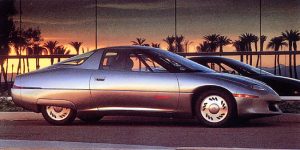
To begin with, the only reason I got to test drive the EV1 was because it wasn’t very far away.
Back in ’96, I was living just outside Washington, DC because at the time, I was working for The Washington Times, in DC. GM’s press pool garage was downtown in those days, not far from The Times’ building on New York Avenue. I lived about 15 miles from there, just across the Potomac river, in the Northern Virginia suburbs. If I lived then where I live now – some 230 miles away from DC – I’d probably not have had the opportunity to get seat time in the EV1 because it would never have made it here.
At least, not on its own.
The first-generation EV1 had a fully charged range of about 60 miles. Much has improved since the EV1’s time as far as range is concerned. Most mass-market EVs come standard with about 250-300 miles of driving range, enough to commute into DC and back (a round trip of say 30 miles, if I go by my old commute) with plenty of margin, which the EV1 didn’t have. On the other hand, it does take about 5-8 hours to recharge a current EV at home, using a Level II (240v AC outlet) electric stovetop or dryer outlet. As it turns out, that’s as long as it took to fully recharge the EV1 using the same 240V power source, 30 years ago.
It’s true that, today, you can plug into what they call “fast” chargers that use high voltage DC current rather than household AC current but you’re still going to have to wait for at least 15-20 minutes to recover any significant charge. A full charge will require waiting at least an hour – because the charging process slows to a trickle charge once the battery reaches 80 percent charged. This is a safety . . . safeguard built into the system to avoid damaging the battery or triggering a fire (due to the build-up of heat).
Either way, it’s the same problem today that it was 30 years ago. Most people haven’t got the time to commit to waiting even twice as long as it takes to fully fuel a gas-engine car, which is about five minutes. This includes the time it takes to pay for the gas. EV apologists never factor in the time it takes to deal with getting the EV “fast” charge kiosk to accept their payment method – no cash! – and deal with the adaptor they may need to get the kiosk to “pair” with their EV.
No “breakthrough” in battery technology will make this faster, either – because it’s not a battery issue. The difficulty is safely conducting the extremely high voltage electricity necessary to charge fully in about five minutes. There is also the matter of figuring out how to deliver that much electricity at scale – to replicate the existing network of gas stations. This would require a massive increase in grid power as well as the infrastructure necessary to distribute it to a vast, national network of charging kiosks.
As with modern EVs, actual driving range also varied according to the weather. Very cold weather could reduce the range by 30-40 percent. It’s not as severe as that today, but only if you keep the EV hooked up to charger when it’s sitting in the cold. If you don’t, the thermal management system – which keeps the battery warm in cold weather – will burn up a significant percentage of your battery pack’s charge overnight. So will using the heater for you – as well as other electrically powered accessories.
The EV1 was quick in its day – just as as EVs are today. Zero to 60 took about 8 seconds – which was very quick, back in ’96. A Mustang GT was only about two seconds quicker. Most transportation appliances were slower getting to 60 than GM’s little electric car. Like all electric cars, it was smooth and quiet. But – then as now – it was unsettling to have to keep track of the charge remaining.
It made you feel something like a scuba diver monitoring his oxygen tanks.
Another commonality is cost. GM never actually sold the EV1; it was leased to a relative handful of people for around $400-$500 per month. In today’s depreciated dollars, that would be equivalent to about $950 per month. For a lease, mind you. The cost to actually buy would have been much higher. This for a tiny commuter car with a best case range of about 60 miles, for the first generation models (this went up to 80-90 for the second generation iterations).
Today, you can buy an EV for less than $1,000 per month – but the “inexpensive” ones still cost about $30,000 to start and that’s usually with what they call the “standard range” battery that doesn’t give you enough range for road trips – at least not without a lot of stops and waits along the way.
In the end, GM did not “kill” the electric car – as asserted in the Michael Moore movie. It collected the EV1s it had leased and crushed most of them, because selling them wasn’t a viable business proposition. Back in ’96, gas cost about $1.50 per gallon and you could buy a small commuter car such as a Saturn SC1 for about $12k which meant your monthly payment would have been far less than GM charged to lease the EV1 – and you’d never have to wait for more than about five minutes to fill the tank, which would give you enough driving range to go a week before you needed to fill up again.
Selling people on less range, more wait and more cost was a hard sell back then – just as it is today.
. . .
If you like what you’ve found here please consider supporting EPautos.
We depend on you to keep the wheels turning!
Our donate button is here.
If you prefer not to use PayPal, our mailing address is: EPautos 721 Hummingbird Lane SE Copper Hill, VA 24079










Question for you, Eric, as I do not know a whole lot about the batteries in EV’s. Let’s say you charge said EV every night when you come home from work, for five days a week, roughly. How long do these batteries last? Don’t these batteries depreciate with every charge? Funn how the more things change, the more they stay the same.
The EV 1 was ugly 30 years ago and it’s still ugly today.
In the useless trivia section the Questionable Garage YouTube channel is involved with the ongoing restoration of probably one of very few non GM owned EV 1s. Sort of interesting and apparently gm is kicking in free parts. Skimming the series there is also lots of interviews with the engineers that designed I and yep they’re still true believers.
As for today’s EVs I’m curious why manufactures can’t standardize on one connector? If it’s a voltage/ amperage issue I suspect that if a smart battery charger can deal with reversed cables I suspect that there is a way that it could be done. As for needing to link it to your credit card I’m surprised that the charging stations don’t sell prepaid charging gift cards just like everyone else does that wouldn’t need your phone to be connected to the card.