

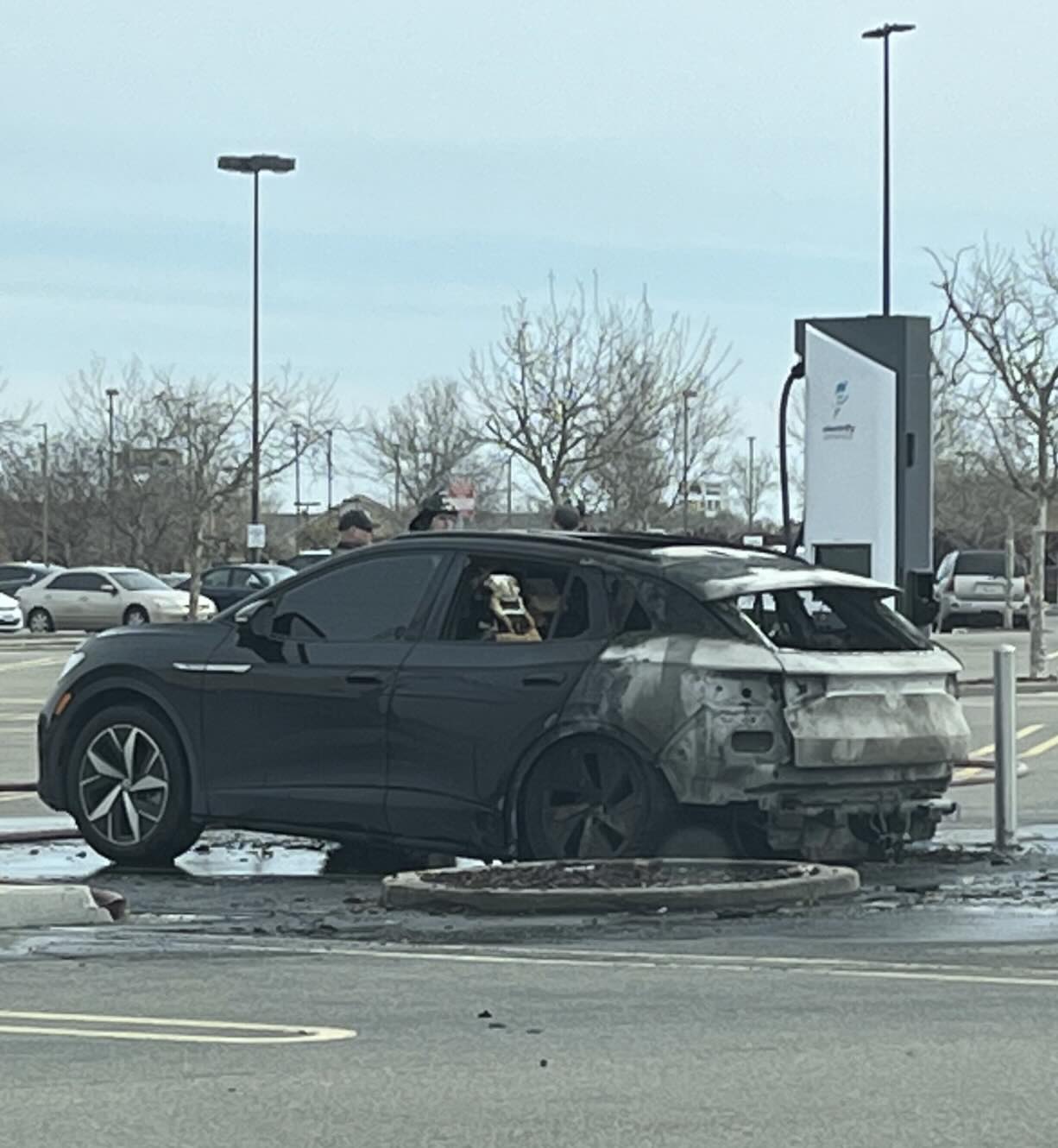

VW is recalling about 45,000 ID.4s made between January 1 of 2023 and Feb. 1 of 2025 – which is pretty much all of them – because of a “potential defect” in the battery pack that could result in what is styled a “fire risk” but which is more accurately a risk of spontaneous combustion.
The distinction is important.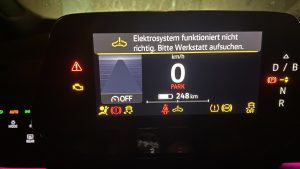
The ID.4s in question (doesn’t the name sound like the latest generation smartphone?) have a higher risk of spontaneously combusting on account of “misaligned electrodes” in their battery packs. The italics are used to emphasize an important thing, which is that the risk of spontaneous combustion is always there. It is just higher in the case of the these ID.4s. It is always there because high-voltage lithium ion batteries are vulnerable to thermal runaway, which is a spontaneous fire arising from a shirt circuit within the battery pack’s lattice-matrix of thousands of individual battery cells. All it takes is for one of these cells to short circuit and – voila – you have a fire.
A spontaneous one.
That’s the oogly thing about these kinds of fires. A gas-engined vehicle can catch fire, too. But it almost always takes two things for that occur: Fuel vapor and a spark. Liquid gas by itself doesn’t spontaneously combust. That’s why it’s safe to keep a five gallon jug in the garage or shed to store fuel for your lawn mower or generator. That’s why spilling gas when you try to pour some into the tank of your mower or generator almost never starts a fire. Ditto at the gas station, where you’ve probably spilled some gas in the course of pumping it into your vehicle’s tank. There are signs on the pumps that say No Smoking – because a lit cigarette is a potential ignition source. So is static electricity. The point is it’s unlikely a gas fire will start absent a spark. This is why even when a car is hit hard enough in an an accident to rupture the gas tank – and gas spills all over the ground – there won’t be a fire unless fumes are lit.
This is why the chances of a gas-engined vehicle spontaneously combusting when parked are close to nil.
Lithium-ion EV batteries, on the other hand, can spontaneously combust at any time – even when the EV is parked. It is not a statistically huge risk, but that misses the point. There is always the chance that your parachute will not open if you skydive out of an airplane. The only way to eliminate the risk is to not jump out of an airplane.
This brings up something worth discussing. If you chose to assume the risk – however slight – of jumping out of an airplane and the parachute does not open and you turn into pizza when you hit the ground, that’s on you. No one else gets turned into pizza. Spontaneously combusting EVs are not like that in the sense that if you had the back luck to park next to one – or near one – in the same parking garage and the thing lights off, there goes your car, too. Also your insurance premiums – as these coerced payments (i.e., these extortion payments) are commonly (and inaccurately) referred to. Because you can’t really refuse to pay them, can you? Technically, you could – but then you’d no longer be in compliance with the legal requirement to carry insurance in order to be legally allowed to drive your vehicle on what they call the “public” roads. Which are, of course, owned and controlled by the government. The same government that says you have to buy insurance because the insurance mafia wheedled the government into being its enforcer.
Point being, you effectively have to pay and that means you effectively have to pay for the increased risk and the actual costs of spontaneously combusting EVs. This includes the premiums most people are effectively forced to pay for home insurance. The cost of that – like the cost of car insurance – has increased by 30-50 percent since 2020, which is interestingly congruent with the increase in the number of EVs out there, some of which have burned down some very expensive properties.
In other words, the risks and costs are being socialized.
Here’s a rad idea: Why not impose the costs on those who risk them instead? Anyone ought to be as free to buy an EV just as anyone is free to jump out of a perfectly good airplane. But if you decide to buy an EV knowing there is a risk of spontaneous combustion – the manufacturers ought to be legally obligated to disclose this risk so there’s no “I didn’t know” excuse – isn’t it reasonable that you pay more for insurance? The mafia already extracts more from people it says present an increased risk of causing an accident on account of their having gotten a speeding ticket, which is a much more loosey-goosey correlation. How come that’s ok but it’s not ok to charge EV owners more for the risk their EVs present – not just to them but to others, too?
The risk of spontaneous combustion could also be eliminated altogether by ditching fire-prone lithium-ion EV battery packs. Most Chinese EVs use Lithium Iron Phosphate (LPF) batteries, which are much less likely to spontaneously combust due to their more stable chemistry. Lead acid batteries are even more stable. The can explode, if there is outgassing – but it takes a spark (the big risk is during jump starting, when a spark is sometimes created by the cable clamps). These batteries are also simple and relatively inexpensive and can be used to power sensible EVs (more about that here).
Unfortunately, sensible isn’t on order.
. . .
If you like what you’ve found here please consider supporting EPautos.
We depend on you to keep the wheels turning!
Our donate button is here.
If you prefer not to use PayPal, our mailing address is: EPautos 721 Hummingbird Lane SE Copper Hill, VA 24079









Glad you are up-to-speed with the LiFePO4 batteries, Eric! No questionably sourced cobalt either and a much longer cycle life as well with those.
A commensurately higher EV insurance rate seems fair enough, as they do with sports cars and SUVs, and I’m not sure this isn’t the case. These insurance mafias are nothing but meticulous about their calculations.
Why am I awake at 1:40 in the morning, you might ask? Woke up after some terrible dreams and haven’t felt quite right since the previous evening. Life is full of mysteries.
Thanks, BaDnOn!
I am also a creature of the night these days; the upside is it’s peaceful. Just me and the cats!
The outrageously long charging times are, by themselves, more than sufficient to conclude that batteries are unfit for purpose as energy storage in electric vehicles. Add the fire risk to the equation, and there should really be no doubt – batteries are a dead end.
So why do EV manufacturers still insist on using this technology? Is it because cars are designed by government committee these days, and auto manufacturers are thrilled at the prospect of complying?
It’s an interesting question, Stufo –
The whole thing is fundamentally artificial in that we wouldn’t even be talking about this absent the various government mandates and “incentives” that resurrected EVs beginning about 15 years ago. I believe the purpose behind this has to do with making vehicles more expensive and amenable to centralized control, among other things. The same “incentives” that push EVs also serve to make IC cars more drone-like and so unappealing to many people, which furthers the goal of alienating people from owning personal vehicles.