

There used to be a Plymouth, which was adjacent to Dodge (and Chrysler) in the Mopar family. The reason there’s no longer a Plymouth is because it stopped selling anything distinctively Plymouth. Instead, it sold the same stuff you could buy as a Dodge, such as the Neon (which Dodge didn’t even bother to rename) and the Caravan, which was the same as the Caravan sold by Dodge. GM at least let its hollowed-out divisions – Pontiac and Olds – name their same-as-Chevy-and-Buick offerings differently. Of course, that didn’t work either. Most people want something different – as opposed to differently named.
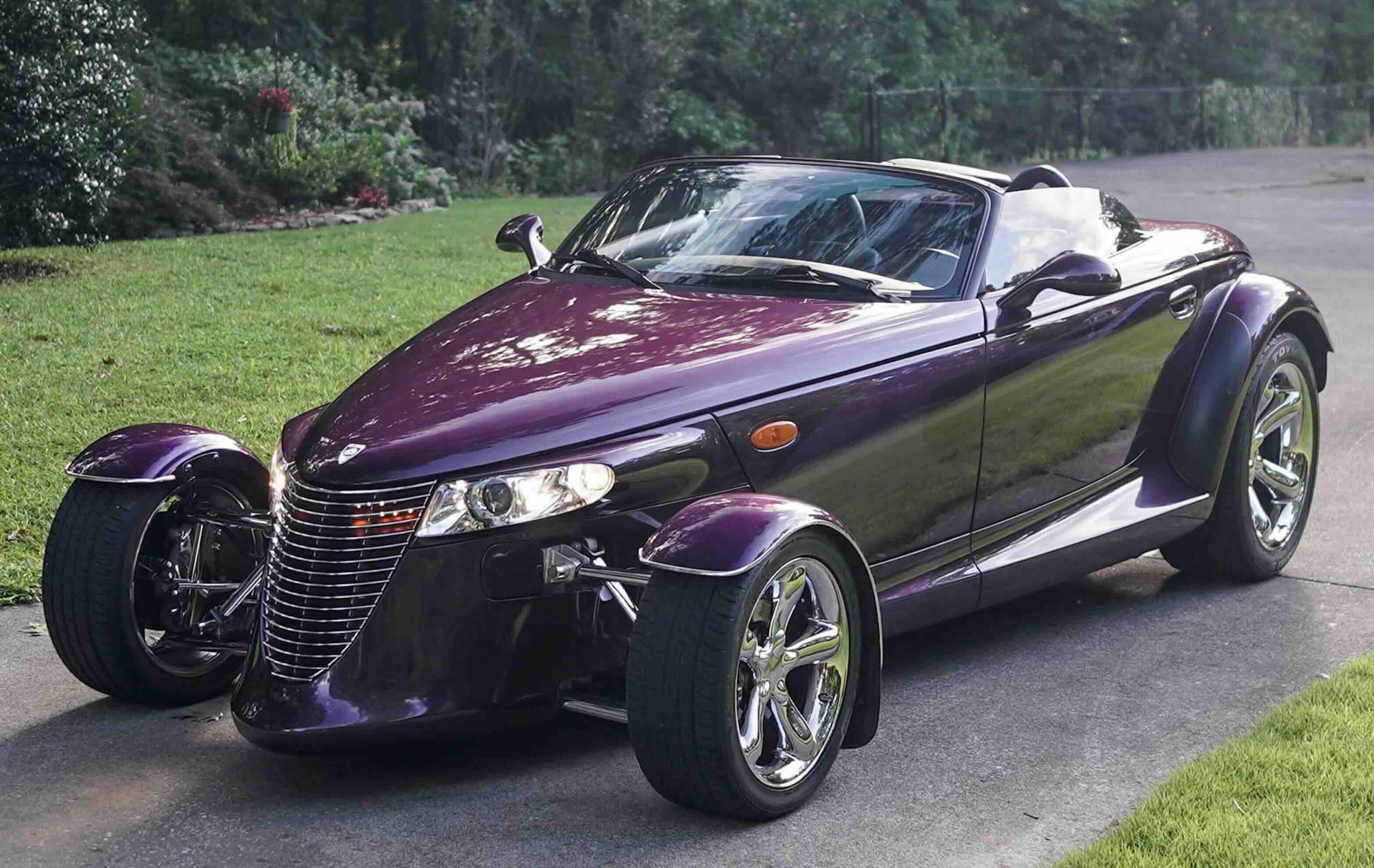
Plymouth was allowed – briefly – to offer something radically different. It was the Prowler – and “different” doesn’t begin to describe what it was, at least for a production car in the modern era. It was something like the Model A hot rod that graced the cover of ZZ Top’s Eliminator album, except it was something you could buy at a Plymouth store, with a new car warranty and everything. It had exposed front wheels that projected outward from the tapered, coffin-like bodywork that maybe was inspired by the look of the Cord 810 of the 1930s. You could thus see the front wheels turn – as well as see the billet steel/aluminum front suspension pieces, including elements of its push-rod-actuated, coil-over shocks (which were mounted inboard, race car-style).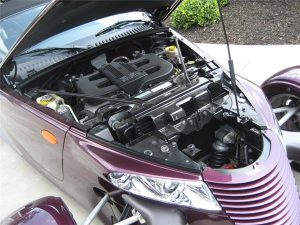
It had a steeply raked, low-cut windshield and side glass. A convertible top. Haunched rear wheels. Hand-assembled aluminum body panels. It looked radical – and was. It had a rear transaxle, to achieve a near-perfect 50-50 weight distribution. Even more radical was its rear-wheel-drive layout. Plymouth hadn’t offered anything that could smoke the rear tires since the late 1980s – when the last rear-drive Gran Fury sedans were made.
But it also had a fatal flaw that had to do with smoking those rear tires; more precisely, it had difficulty doing that.
The Prowler was powered by the same 3.5 liter V6 engine used in many other same-era front-wheel-drive Mopar vehicles such as the LH Series sedans. It made ok power – 214 horsepower at first, upgraded to 253 in later models – but it wasn’t a V8 and a hot rod without a V8 is something like a hamburger without the burger. It’s not that there’s anything wrong with a V6 – as such. If you’re driving a family car or a pickup. That’s not what the Prowler was. Raising that coffin-nosed hood ought to have been something akin to raising the Dodge Viper’s hood. No let-down there. Underneath, a massive V10 that vibed with the raucous bodywork. Under the Prowler’s hood lay nothing special – other than the front-to-rear (rather than transverse) layout.
The problem may have been that at the time – the Prowler was launched in ’97 – Plymouth didn’t have a production V8 it could fit into the Prowler and the Viper’s massive 8 liter V10 would’t fit. ZZ Top and anyone else who wants to build a hot rod can use whatever engine they want to use because individual builds do not require federal emissions certification. Building a production hot rod does require certification of whatever’s under the hood and the 3.5 V6 was certified. On the other hand, Dodge was installing the 5.2 and (later) 5.9 liter V8 in the Dakota pickup. Maybe the problem was that these were certified for light trucks – which fall into a different (less onerous)- regulatory schema than the certification requirements for passenger vehicles, meaning cars.
In any event, the Prowler got the nothing-special V6, paired up with a four (initially; then a six speed) speed automatic. That part was not a deal-killer. Many hot rods – including the ZZ Top car, which has a 350 Chevy small block V8 paired up with a GM TH350 three speed automatic – are automatic. But the growl was missing from the Prowler. Also the smoke. I remember trying to get the Prowler I was test driving back in 2000 to light up the rear tires, which is what a hot rod is supposed to be able to do on cue. Without having to hold the brakes and floor the gas pedal until the engine overcomes the clamping force of the brakes and tires start to spin. The 3.5 liter V6 only made 255 ft.-lbs. of torque (at almost 4,000 RPM) which was a lot less torque (and a lot later) than the Dakota’s available 5.9 liter V8 made ( 345 ft.-lbs. at 3,200 RPM). That would have been more than enough to launch the Prowler properly – and also give it the growl it deserved.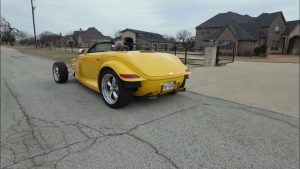
Sidepipes, please!
Without all that, the Prowler came across as what it was, which was looks without the goods. It was targeted at the hot rod set but it appealed to the old man set. I was a young man back then and I felt a little silly driving the thing around. It didn’t help that it wasn’t cheap. Back in 2000, the Prowler’s base price was about $43,000. If you plug that into the government’s inflation calculator – which egregiously soft-peddles inflation – you get $85,831. Very few young men could afford that back then, which is why only about 11,702 Prowlers were sold – probably to mostly older men – during the car’s five year production run, which ended in 2002.
That was one year after Plymouth was ended, in 2001.
The last-year Prowlers were sold as Chryslers before they stopped selling them at all.
Looking back, it was a neat car that got a lot of attention – and still does, when one pops up today. It holds the distinction of being both one of the last Plymouths and the last-ever rear-drive Plymouth.
One wonders whether Plymouth might have survived if the Prowler had been something more than a neat-looking but expensive old man’s car.
. . .
If you like what you’ve found here please consider supporting EPautos.
We depend on you to keep the wheels turning!
Our donate button is here.
If you prefer not to use PayPal, our mailing address is: EPautos 721 Hummingbird Lane SE Copper Hill, VA 24079