


It’s not easy selling what so many others are also trying to sell. The fact that the Nissan Pathfinder sells well in the extremely competitive mid-sized/three-ow crossover class tells you something about why it sells.
What It Is
The Pathfinder is a mid-sized/three-row crossover that competes with others in the segment such as the Toyota Grand Highlander, Honda Pilot and Kia Telluride/Hyundai Palisade, among others.
It’s among the most affordable models in the class – $37,500 to start for the S trim vs. $39,190 for the Telluride, $39,375 for the Palisade, $39,310 for the Atlas and $42,260 for the Grand Highlander. It also comes standard with a V6, which some of the others – including the Atlas, Telluride and the Grand Highlander – don’t even offer anymore.
The S also comes standard with three zone climate control, LED headlights, a good six speaker audio system, proximity keyless entry/push-button ignition and eight-passenger seating. Front-wheel drive is standard; AWD is available as a stand-alone option. So equipped, the MSRP – $39,500 – is only slightly higher than the FWD versions of the Telluride, Palisade and Atlas and thousands less than the FWD Grand Highlander.
The next-up SV trim ($39,900 with FWD, $41,900 with AWD) gets heated front seats and a power rear liftgate, adaptive cruise control and remote start capability, among other upgrades.
An SL ($42,590 with FWD, $44,590 with AWD) gets a surround-view exterior camera system, leather upholstery and a digital instrument cluster, plus additional USB charge points.
The $45,090 Rock Creek gets a set of 18 inch all-terrain tires and a lifted suspension, tubular roof rack and standard AWD that give it near-SUV capability in a vehicle that’s still a crossover, with more interior space for people and cargo than you’d get in a similar-sized SUV such as a Ford Explorer.
You also get an additional 11 horsepower and 11 ft.-lbs. more torque.
At the top of the lineup is the $49,790 Platinum – which focuses on luxury. It comes standard with heated rear seats, a 13 speaker Bose premium stereo, panorama sunroof, second row captain’s chairs, side window sunshades and a Heads Up Display (HUD). This version of the Pathfinder can also be equipped with second row captain’s chairs and a removable center center console.
AWD is optional.
What’s New for 2026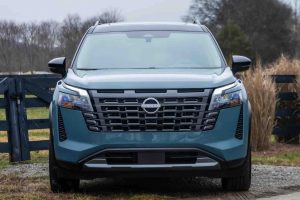
All trims get revised exterior and interior styling, as well as a new 12.3 inch secondary touchscreen.
What’s Good
Priced very competitively vs. rivals in the class.
Standard V6 in a class where turbo fours have been replacing V6s.
Capable of pulling more than some truck-based SUVs.
What’s Not So Good
V6 can be sluggish to respond sometimes.
Toggle-style gear selector lacks tactile engagement.
A bit less cargo room vs. some rivals in the class.
Under The Hood
Every Pathfinder comes with a 3.5 liter V6 paired with a nine speed automatic transmission. In every trim but the Rock Creek, this engine carries a 284 horsepower rating; in the Rock Creek, the engine is tuned to deliver another 11 horsepower (and 11 ft.-lbs. of torque) if you feed the engine premium fuel.
If you don’t, don’t worry. It won’t hurt anything. Knock sensors will detect the lower octane fuel and dial back the ignition timing and other factors (and you’ll still have 284 horsepower on tap).
This eight-passenger rig can get to 60 in about 6.8 seconds and rates 21 city, 27 highway. It is also rated to pull up to 6,000 lbs. – which is 1,000 lbs, more than the four cylinder-powered VW Atlas (5,000 lbs.) which is also less powerful (269 horsepower) and gets lightly worse gas mileage (20 city, 27 highway). The new – and also four-cylinder-only now – Kia Telluride also gets slightly worse mileage (20 city, 27 highway) and can’t pull as much, either (5,000 lbs. max). The Grand Highlander – also powered by a turbo four now – gets slightly better gas mileage (21 city, 28 highway) but is significantly less powerful (265 horsepower) and can also only pull a max of 5,000 lbs.
This is interesting because people have been told that these little turbo-hybrid augmented fours that have been replacing sixes that don’t need turbochargers or hybrid augmentation to make as much power as a six are “gas savers.” This is – obviously – not true. Not only are you not going to save on gas, you’re going to pay more up front for the not-saving it, because it costs more to add additional drivetrain elements, such as a turbo (or two) plus all the related peripherals and maybe a hybrid battery pack/electric motor(s) on top of that. This bumps up the MSRP of the vehicle and that also bumps up what you’re going to pay to insure it, since insurance premiums are partially based on potential replacement costs. If you total a $42k vehicle, it is gong to cost the insurance company more to replace it than it would cost to replace a $37k vehicle.
You may also pay more down the road – once the turbocharged/hybrid-augmented vehicle’s drivetrain is no longer covered by the new car warranty. Even if the turbocharged, hybrid-augmented drivetrain is well-made, there are simply more potential failure points that aren’t there when the drivetrain consists of just an engine, without all the additional elements.
Also interesting is that this FWD crossover can pull more than the RWD Ford Explorer SUV – which comes standard with a lesser 5,300 lb. max tow rating.
On The Road
The Pathfinder’s V6 wants to go; it has a near 7,000 RPM redline and it’s related to the V6 that’s in the current 370Z sports car.
It sounds wonderful, once it gets going – but it could be more wonderful if the nine speed automatic didn’t have so many gears. Specifically, all those overdrive gears. Four of the nine are overdrive ratios. The idea being to “step up” to progressively more favorable overall gearing for fuel efficiency as well as lowest-possible emissions (especially CO2) by reducing steady-cruise RPMs to as low as possible. That’s how the Pathfinder matches the gas mileage of similar vehicles equipped with turbocharged/hybrid augmented fours without replacing that wonderful V6 with a turbocharged/hybrid augmented four.
The downside is that – sometimes – when you floor the accelerator pedal, it takes moment for the computer (the coding) that controls the shifting of the nine speed to calculate which gear is needed and then command the transmission to shift down to that gear. There’s also more “spread” between gears; ninth to fifth, for instance vs. sixth to fourth (as would be the case with a six speed automatic) and so it’s not as snappy as it ought to be.
At least if you leave the the drive mode selector in default Normal – or Eco – both of which induce shift point programming (as well as throttle response) optimized for max MPGs. If you select Sport mode, the dialed-in softness gets dialed put. It’s a slight hassle to have to remember to select Sport – via the rotary knob on the center console – every time you go for a drive (kind of like having to turn off the annoying Automatic Stop/Start “technology” that kills the engine at every red light) but on the upside, you can fix the sluggish reaction problem as easy as that.
Another upside s this thing is relaxed. Once you’re up to cruising speed, in ninth gear, the engine settles down to a fast idle (around 2,000 RPM at 65-70) and that conveys the feeling of an engine that isn’t working hard to keep this pretty big vehicle rolling.
And the thing is, it isn’t.
Those little turbocharged/hybrid-augmented fours in rival crossovers are working harder, even if it doesn’t sound like it – because they are almost always under pressure (boost) to maintain the power needed to keep a big vehicle rolling. They also sound wrong – in context – when you ask them for more power. A four cylinder engine in a little car or a sports car car is congruent with the kind of car it’s in. There is something incongruent-sounding about the sound made by a little four in a big crossover when your floor the accelerator pedal. The Pathfinder’s V6 (courtesy of the way the nine speed automatic is programmed) may take an eyeblink longer to respond – but when it does, it does not sound like a blender on High.
You will also be pleased to discover that the “safety assistants” can mostly be turned all the way off – and easily off, via simple button interfaces. For example, the Lane Keep Assist button is on a dash panel to the left of the steering wheel.
Overall, the Pathfinder is a very pleasant family hauler; it is comfortable, quiet and has the ability to get going as quickly as an ’80s-era muscle car, such as an IROC-Z Camaro, which is really something when you think about it.
The only hair in this otherwise appealing soup is the console-mounted gear selector, which is of course an entirely electronic gear selector. It’s basically a stubby toggle that you move left/right for Drive and Manual and up for Reverse but it’s necessary to look at the display to confirm what you selected because there’s zero tactile feedback – as you’d have with a conventional lever with the familiar PRNDL pattern that has clearly discernible detents for each position.
But you get used to it, like anything else – and once you do, it works ok.
At The Curb
The original Pathfinder (1987-1995) was an SUV that shared its truck-based platform with the compact-sized “hard body” (later on, the Frontier and then the larger Titan) pickup. The current Pathfinder – which is a crossover – looks like it might be a SUV.
Not that there’s anything wrong with that.
First, because it looks good. Rugged but not ridiculous – like that steroid-jacked guy at the gym who lifts weights to build a massive physique that’s just for show. Second, because it allows for a lower floorpan, which allows for more headroom for passengers as well as a lower step-in height, more like a minivan than a pick-up (or an SUV built off a pick-up platform).
Eight passenger seating is also standard – one more than in the roughly same-sized Explorer, which is an SUV. The Pathfinder’s third row is also vastly more adult-viable. 
On the downside, the Pathfinder’s cargo space behind its third row (16.6 cubic feet) and with the second and third rows folded (80.5) is a bit less than some of its same-sized crossover rivals, such as the Toyota Grand Highlander – which has 20.6 cubic feet of space behind its third row and 97.5 cubic feet with its first and second rows folded. Still, 16.6 cubic feet is more trunk capacity than you’d have in many a mid-sized family car such as a Toyota Camry (15.1 cubic feet) and 80.5 cubic feet is many times more. Unless you’re regularly needing to completely fill up a space that size, there is probably more than enough space.
The Rest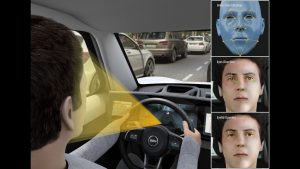
There are still functionally superior rotary-turn knobs for some important controls, such as for selecting cabin temperature and the volume of the audio system. The updated LCD screen is the tap/swipe interface for changing media and channels; the icons are larger and so easier to see now and the system is generally accurate but a simple rotary tuner knob for changing channels is still a better way to change channels.
One very appealing thing about this 2026 Pathfinder is that it does not have the “drowsy/distracted driver” eye-movement monitor that has been effectively mandated for all 2027 model year vehicles. “Effectively” is in italics because the creepy eye movement monitor system seems to be the only way for the car companies to comply with the pending mandate – and many 2026 models already have this “feature.”
If you don’t want it, the 2026 Pathfinder hasn’t got it.
The Bottom Line
The Pathfinder is popular for a reason. The standard V6 is reason all by itself. But it’s also more (and less) than that.
. . .
If you like what you’ve found here please consider supporting EPautos.
We depend on you to keep the wheels turning!
Our donate button is here.
If you prefer not to use PayPal, our mailing address is: EPautos 721 Hummingbird Lane SE Copper Hill, VA 24079




 than that.)