


We hear a lot about how the federal government is “saving” us so much money by forcing the vehicle manufacturers to build more “efficient” vehicles. Well, here’s an example of the cost of that.
Infiniti – which is the luxury division of Nissan – has updated its flagship SUV, the QX80, for the 2025 model year. One of the major updates is a new engine. If you’ve been following the transition under way in the car business, you can probably guess what it isn’t.
The QX – like other big SUVs – used to come standard with a big V8. For essentially the same reason that a Big Mac used to come standard with big patties. Like the Big Mac, the Q comes standard with less now – at least in terms of physical size. The previously standard 5.6 liter V8 has been retired in favor of a twin-turbocharged 3.5 liter V6. This engine has two fewer cylinders and is about 40 percent smaller in terms of the volume of its cylinders (i.e., its displacement). You might think that replacing a big V8 with a much smaller V6 would result in a big uptick in fuel efficiency – else why would you want to replace the big V8 with a much smaller V6?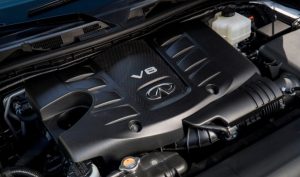
Put another way, what would be the point of doing that?
Well, it doesn’t result in a big uptick. There is almost none, in fact. Last year’s QX80 – which came standard with the 5.6 liter V8 – touted 14 MPG in city driving and 20 on the highway. About what you’d expect from a big SUV with a big V8 engine. The just-updated 2025 QX with the new, much smaller V6 touts – wait for it! – 16 city, 20 highway. A “savings” of 2 MPG.
And the cost?
Well, the base price of the 2025 QX80 – with the new V6 – is $82,450. Last year’s QX with the V8 was $74,150. That’s an uptick of $8,300 – which is a very big increase. Of course, you’re not just paying more for a new (and smaller) engine. The entire 2025 QX is new, inside and out. But the fact remains that the new QX with its much smaller V6 engine isn’t going to save you money – on gas or otherwise. So – to return to the question posed earlier – why did Infiniti decide to replace the V8 with this much smaller, twice-turbo’d V6?
The answer is interesting – for reasons that are are as subtle as they are specious.
The first reason is that the smaller V6 does use less gas. This is not the same thing as saves you money, but it doesn’t make it unimportant. To Nissan, which – like every vehicle manufacturer – must comply with federal Corporate Average Fuel Economy (CAFE) requirements. The two words are italicized to emphasize what matters, which is the average fuel economy of a vehicle manufacturer’s combined fleet; i.e., the average achieved by all of the vehicles it sells. A 2 MPG uptick in city mileage is meaningless to the individual owner of a QX80. But that uptick – when factored over say 50,000 QX80s made in a year – is very meaningful in terms of fleet averages, which determine who much – or little – a manufacture will have to pay in “gas guzzler” fines for falling shy of the federally required fleet average (currently about 35 MPG).
These fines are, of course, folded into the cost of what you pay to “save” on gas – via the upticked cost of the “more efficient” vehicle.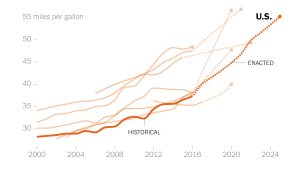
There is another reason. An etymological one that has regulatory compliance cost consequences. During the Obama years, the EPA changed the definition of “emissions” – which used to mean the combustion byproducts that made people’s eyes water, caused or aggravated breathing difficulties and darkened the skies with smoggy haze. That is to say, emissions were understood to be pollutants. This made sense because it was true. But then along came a lie. Or – more finely – a deliberately disingenuous misdirection. The definition of “emissions” was expanded to encompass carbon dioxide, which has nothing to do with pollution.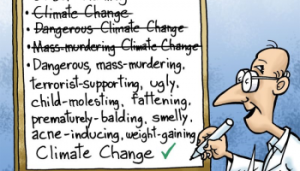
You may believe that it is causing the “climate” to “change.” But that is not the same thing as causing or even having anything to do with pollution. This is an important distinction, if honest language – and honest discussion – are important. It is misleading to speak of carbon dioxide as an “emission” in the sense commonly understood – and that is probably why it was done. Because it is much easier to lump C02 in with the combustion byproducts most people immediately associate with objectively harmful negative effects – pollution – than it is to prove that carbon dioxide is objectively harmful. 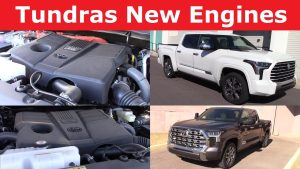
Anyhow, this is the primary reason why the QX80 lost its V8. It is the same reason why the recently-revamped Toyota Tundra, which also used to come standard with a V8, now comes with a small, turbocharged V6 instead. Ditto many others, with more to come. The smaller engine moves less air, you see. Because it has fewer (and smaller) cylinders. Less air flowing through the engine means less air (including CO2, which is part of the air) flowing out of the tailpipe. And that is why engines are getting smaller – in everything – not just big SUVs.
Of course, these smaller engines produce less power – unless they are turbocharged to compensate for it. The turbo is a pressurizer. It forces more air into the engine, which is how the smaller engine makes bigger-engine power. The trick is that this power is produced on demand – when the driver pushes down on the accelerator pedal. When he isn’t pushing down on it – as when the vehicle is idling or just moping along in stop-and-go traffic – the engine is flowing less air and so “emitting” less air (and CO2) at the tailpipe.
This is fine, as far as it goes – if you believe the “climate” is “changing” and that CO2 is a “pollutant.” But it only goes so far, because these undersized engines don’t make adequate power when they are not pressurized, meaning they often are – because the driver (wanting power) is regularly pushing down on the accelerator pedal to get a reaction from the engine. This results in more air flowing through the engine. In most cases, it is probably true that there is no meaningful reduction in CO2 “emissions.”
But there is a meaningful increase in compliance costs. 
In the Q’s case, there is the upticked cost of the vehicle, itself. And the potential cost of increased complexity – and pressure. The new twice-turbo’d V6 being smaller has to work harder and it has smaller critical parts – such as bearings – that must handle increased load. These may not hold up as well for as long as the less-stressed internals of a big V8, which also doesn’t have the additional potential failure points of two turbos and all the related peripherals.
There is one compensation – in the case of the Q’s new engine – which is 50 horses stronger than the old V8. But those extra 50 horses come at a cost. The question is whether it’s worth it. And the deeper question that ought to be on everyone’s mind is why is it being forced on us?
. . .
If you like what you’ve found here please consider supporting EPautos.
We depend on you to keep the wheels turning!
Our donate button is here.
If you prefer not to use PayPal, our mailing address is:
EPautos
721 Hummingbird Lane SE
Copper Hill, VA 24079
PS: Get an EPautos magnet or sticker or coaster in return for a $20 or more one-time donation or a $10 or more monthly recurring donation. (Please be sure to tell us you want a magnet or sticker or coaster – and also, provide an address, so we know where to mail the thing!)
If you like items like the Baaaaaa! baseball cap pictured below, you can find that and more at the EPautos store!









I am helping a friend get a new small suv. she has a small budget. I looked at chevy’s trax and trailblazer. They now come with 1.2L and 1.3L 3cyl T engines…… OMG…. motorcycle engines! Worse with the 3cyl. I will not be suggesting those.
I am so glad I got two of the last older-school hemi V8’s in the grand cherokee a few months ago. I’m guessing/hoping they will be back soon (26?)
Eric: “The definition of “emissions” was expanded to encompass carbon dioxide, which has nothing to do with pollution.” OK Lee Zeldin, how about dissolving the definition of emissions back to just hydrocarbons and let us Americans leave life giving carbon dioxide alone.
That’s what we’re waiting for………………
With what automobile manufacturers continue installing in their new vehicles, what are the odds that there’ll be more & more people saying NO to buying a new vehicle, and government and/ or corporate media concocts a narrative of “New car hesitancy” among the populace like they concocted the narrative of “Vaccine hesitancy” among people who “Did their own research” into the mRNA COVID jabs and/ or just flat out didn’t want to be guinea pigs for Pfizer and other corrupt drug companies.
For those who may have forgotten science class in school, carbon dioxide is what comes out of our noses when we exhale. Going by the absolutely insane definition of carbon dioxide being a “pollutant”, human beings and other carbon based lifeforms are a “pollutant” as well.
I’m surprised there hasn’t been calls for EVERYONE to wear face diapers indefinitely on that basis after the nonsensical face diaper mandates during the COVID hysteria, though there are ongoing efforts by sociopaths & governments worldwide to KILL as many people as possible under guise of “Saving the planet from cliiiiiiiiiiiimate change” or some other BS narrative.
I’ve lived in the west for 20 years. All of those 20 years have been “drought” years. Yet we continue to have enough water to grow crops, maintain population growth and flush into the ocean.
Maybe we’re one climate catastrophe away from losing it all, but doesn’t seem to be the case. Even with Chicken Little screaming about the sky.
One of the few real population reducers/catastrophes coming at us is aquifer depletion. We’re pumping water out of our aquifers faster than nature can replenish them. Once the aquifers are depleted, that’s it- there is no good option for fresh water. Without a doubt, there is plenty of water on this planet. But most of it isnt clean, potable water. If we deplete it enough we have to resort to more complex and expensive things like seawater desalinization, extensive cleaning of not so clean surface waters, or pulling humidity out of the air. So it is in fact possible to both be in a drought and to apparently have plenty of water.
If we could build more nuclear generation that doesn’t take 30 years of regulatory battling, we could desal the Pacific ocean. Now getting that fresh water to the central valley or Imperial valley is another, costly issue.
I’ve been in the U.S. west my whole nearly 60 years and the fact that we live in a desert seems to escape people’s consciousness. Of course it’s dry here. Always has been. J.W. Powell says so in this reports, don’t bother. Sure, great soil just no water west of the 100th meridian. And that long predates geoengineering the skies.
But it’s also true that we have a lot more people in the west now than half a century ago and the amount of water stored in the Colorado River system is lower now than ever. Whether that is reality of carrying capacity of the area (e.g. same snow/rain as ever but double the people and demand and shortages are expected) or by design (e.g. Bureau of Reclamation is mismanaging flows) is unknowable.
I tend to think it’s not necessarily all nefarious. People now are wasteful compared to the pioneers who at least respected the need to store and use water carefully. When we started drilling wells every miles on the Ogallala and growing water intensive crops throughout the Rockies we seemed to thumb our noses at the prospect that we could make the west like the east. Couple that with the fact that the Colorado River planners overestimated annual flows, perhaps as much as 25%, when they divided up the water amongst the 7 states and Mexico just means we cannot avoid the reckoning forever.
There is plenty of air to breathe and there is a whole lot of water out there.
Underground rivers flow, then you can discover an artesian well out there somewhere.
The well at the farm is 46 feet deep and is tapped into the aquifer that exists here.
The well has never gone dry, have run the pump for a solid 16 hours straight and never any problems.
Water is always an issue on the farm, no matter where it is located.
In the San Joaquin Valley, subsidence in one area has lowered the land level 29 feet over the last 90 years in California. The Colorado River used to flow to the Gulf of California, however, general use, demand, and irrigation of crops in Mexico prevents the flow from emptying into the Gulf.
There is a documentary of the Colorado River, the river ended a long way from the Gulf of California.
The discharged irrigation water from the irrigation of crops in Mexico did form an oasis and a new ecosystem evolved, flora and fauna thrived.
In southern Arizona, the subsidence is about one-half foot each year.
Water, water everywhere, but not a drop to drink.
Our family’s homestead land lies over the Republican aquifer on the eastern plains of Colorado (generally called the Ogallala), about 20 miles west of the Kansas border in Kit Carson County. We have two permits that originally date from the 1960s to irrigate 280 acres we own, total volume permitted is about 700 acre-feet per year at pump rates around 400 gpm. They’re just shy of 300 feet when we last drilled them deeper in the early 1990s. The levels have fallen about 15 feet in the past 20 years but they still produce reliably, which isn’t something everyone around there can say.
One acre foot is 325851 gallons of water.
700 acre feet is more than two feet of water per acre on 280 acres.
You must have irrigation equipment and lots of machinery.
Potatoes? Sunflowers? Corn?
Frack those water wells, you’ll get more water.
Hi Pat,
In my area – Virginia – there is ample water for everyone. I have a well; so do all my neighbors. No worries about running dry.
ReadyK et al,
There appears to be an alarming amount of juniper die-off around here and the surrounding areas. Luckily, it hasn’t reached my immediate area in great numbers, but there are a some trees here and there that have gone yellow and died. I also noticed quite a few yellow and dying pine trees along the trip up the 40 to Flagstaff and thereabouts.
The “official sources” list drought as the cause, in association with a changing climate. In my experience, there have been a few very dry years, but some very wet as well. Tritely, I guess time will tell.
No shortage of animal life, however. I’ve killed 18 mice that invaded my house in the last month or so, and my dog ate one that had gotten stuck trying to get into one of my buildings this morning.
‘The previously standard 5.6 liter V8 has been retired in favor of a twin-turbocharged 3.5 liter V6.’ — eric
It’s an example of a deeply-entrenched, long-running trend:
‘DOE’s Vehicle Technologies Office summarized the marked increase in engine specific output: “From 1975 to 2021, horsepower increased by 84% while engine displacement decreased by 40%.” The data is derived from the EPA’s 2021 Automotive Trends Report.’ — SAE
https://tinyurl.com/5dnkddpn
Higher power from less displacement means specific output has more than doubled. This is an impressive engineering achievement.
Some assert that 500 cc per cylinder (e.g., the ubiquitous 2.0 liter four and the less-common 3.0 liter six) is ideal. It implies that a 4.0 liter V8 (245 cubic inches, small by 1975 standards) would be an excellent power plant, and would not need to be highly boosted.
Unfortunately, 4.0 liter V8s are almost nonexistent except in exotic luxury marques. SAD!
If the tangerine in DC doesn’t eliminate CAFE, it will never be eliminated, and the plan to end the ICE will continue.
The twin turbo V6 likely has a broader, flatter power curve which makes the vehicle more pleasant to drive. The V6 is replacing a small V8, certainly not a big block, which only really develops lots of torque at higher revs even if it has VVT. This could also quite easily mean that at 70-90mph the V8 is turning at higher RPM than the V6, which translates into comfort and noise level.
The famous Ford Coyote 5.0 V8 does not produce lots of torque at low RPM’s and needs to be revved to get into the power curve. This may make it more fun in a Mustang, but really serves less of a purpose in a large SUV.
Hi Brosi,
What you say is generally true – but it doesn’t account for the . . . transition. These smaller/turbocharged engines are fundamentally compliance engines. Were it not for CAFE and “emissions” regs, do you believe Toyota would have dropped its bulletproof V8 in favor of the new twin-turbo V6? Or Nissan? Or any of the others?
I highly doubt it.
It’s like they sit around and try to dream up ways to “regulate” V8s off the road, with no other purpose in mind. Other than to displease V8 drivers.
That gnawing fear and horror that someone, somewhere is enjoying himself… Yep, the ancients nailed it with Envy being one of the seven deadly sins.
Excellent observation John, it seems like that’s all that the different Govco agents do, pull down a paycheck (of our money) and dream up ways to make our lives difficult.
I won’t deny that manufacturers probably would do this voluntarily. However the V configuration exists to solve a problem they had originally when they were using inline engines, which is to fit more cylinders in a smaller space. And in high end luxury cars the inherent balance of a V12 was for quiet, smooth power. The V8 is mostly about cramming the most displacing in the smallest space. So it persisted mainly because the alternative wasn’t demanded. Turbos had a brief fling in the 70s and 80s but fell out quickly from general use due to maintenance headaches. But Toyota and Nissan continued to develop them for their diesel engines, where a turbo is basically mandatory. It’s still a complexity of debatable need for gasoline engines but also might not be as noted there are benefits in driveability to having the torque come on lower in RPM. As technology progresses and the car buying market is less interested in long term ownership the downsides of seeing proliferation turbos might have been somewhat inevitable. The central planners in D.C. aren’t forcing anyone to take 3 year leases and car swap all the time. That’s maybe the FED but even the banksters aren’t holding a gun (yet) to anyone’s head to buy and sell cars so often. So when you bought a car that you intended to fix and keep as long as possible the cost of repairs was more important. But people view cars as disposable so planning on turbo rebuilds every 200k miles isn’t on their minds anymore.
I meant probably would NOT do this voluntarily.
Hi Pat,
Yeah, but will these pressurized little engines go 200,000 miles without needing a major/expensive repair? I doubt it. The fact is new vehicles are becoming more expensive and less reliable … a reversal (at least as regards the latter) of the trend of the past 50 years. You’re right that lost of people buy into this – in that they can buy into extravagant debt. But I think we have already reached if not passed the high water of viability of that. Most people are having difficulty paying for groceries. Forget an $800/month car payment.
I recently rented a BMW 118 with a 3 cyl 1.5 liter turbo engine. It had a surprising amount of grunt starting from 0. The engine was also far smoother than any 4 cyl rice burner of my youth. With modern technology balancing shafts smooth out anything, and with the right turbo(s) the engineers can produce an engine tailored for every application.
The VW 1.1l 3cyl is also (I have rented one) smooth and surprisingly peppy. Both of these engines spin much slower than the old unbalanced or poorly balanced 4cyl from a decade or two ago.
Longevity will be somewhat mitigated by modern electronics and OBD diagnostics.
Emmisions kit, like catalysts and EGR, also have a limited lifespan, as does direct injection and ultra-high pressure and high precision fuel pumps.
I see know way around high repair bills for old cars, but don’t blame the turbo.
Hi Brosi,
I’ve driven those (and others) myself and – agree – they are smooth. But are they durable? A 1.5 liter three is basically a motorcycle sized engine. It only has adequate power to propel a car if turbocharged – heavily. This imparts pressure (stress) and heat. These tend to detract from longevity. My point is – again – that these engines are fundamentally compliance engines that offer little if any benefit to the vehicle’s owner vs. a larger, less-stressed (and simpler) V6 – vs. a turbo four – or V8 – vs. a turbo six.
There is also the issue of weight. Cars have also gotten bigger and have more equipment and insulation. The Camry may have come in at under 3000lbs 20 years ago probably is close to 4000lbs today, even with a small 4 cyl turbo.
Less weight is beneficial around town and in the curves.
I agree that in the end the consumer will have to factor in higher maintenance costs. One can see this in the price of used German luxury cars, like a Cayenne or Range Rover. Powerful V8’s that still drive wonderfully take on a hellish depreciation over their often short lives. I believe that if one could model the prices accurately one would see that certain models reach a certain point and then depreciate hellaciously.
Across Europe the Jeep Cherokee 3.0 with VM Motori V6 diesel was very popular from about 2010-2020. It turned out that the Bosch diesel injector pumps often self destructed and shredded the motor with steel shavings. Those 3.0 Jeep diesels go for a song now.
Hi Brosi,
Sure; I agree – because it’s absolutely true cars have gotten heavier. But how much heavier is a 3.5 liter V6 vs. a turbo 1.5 liter four? Both are made of aluminum. The difference is prolly less than 100 pounds, so not every consequential. I circle back to the compliance engine analysis. The trend of replacing sixes with turbo fours and eights with turbo sixes is due to compliance pressure rather than buyer/market demand or any tangible benefit to the buyer.
Fair question and no, I wouldn’t expect a small displacement engine with a turbo to last as long as large displacement anything. There’s no question a twin turbo V6 Tundra engine won’t famously go a million miles like a relatively unburdened 4.7L and 5.7L V8 it used to get. But the question Toyota and all OEMs ask are “Why are we building million mile engines when people don’t keep them for a million miles?” CAFE is one aspect of it but when the TTV6 gets the job done, burns a little less fuel, actually increases on the ground performance and doesn’t struggle going over passes when I have to get up to SLC it’s hard to say for sure it wouldn’t happen anyway. If you go back far enough Toyota used to sell really underpowered engines that lasted forever but people complained about those 115 HP engines even in small trucks, so they brought out V6s and that 1989 so we no longer were doing 35 MPH in 3rd gear for a pull through the tunnels west of Denver. That was long before the regulations forced their hand. Those early 3VZ 3.0L V6s had headgasket issues and recalls. The good old days we remember really weren’t all that perfect. Overseas Toyota diesels have had turbos for decades and they just deal with the maintenance. They crack heads, burn up turbos. These are those “militant” vehicles you see, not the soft “lifestyle” trucks we get here.
A turbo engine may be nice, Eric. Until the turbo wears out and has to be replaced. Such as with my old, ’07 WRX. I took care of it, but even still, the turbo and engine both have 235K on it, and naturally, wear out and need replacing (as you mentioned) at some point. So not only would I have to replace the engine one day, but the turbo, as well, giving me two expenses to contend with. Had this come with a standard, six-cylinder, I would not have two prices to factor in. Talk about CAFE shooting themselves (and the rest of us) in the foot. Personally, I would just rather have the V-6 or V-8 and have the choice of either, rather than being forced into these smaller vehicles. For if CO2 is baaaad, then hell, exhaling is bad for the environment, as well.
Hi Brosi.
What you say may well be true but what you forget is that long term a non turbo V8 will run longer and need less repairs than a turbocharged V6. A lot of people hold onto their cars till they’re rusted out and the drive trains are dead; a turbo V6 will need expensive repairs at a time that the car is worth much less than the repair costs.
The auto companies benefit from this as they are generally more into selling you a new car rather than selling you parts and repairs.My summer daily driver is over 25 years old and the only thing holding it back from going another 25 years may well be that parts are getting harder to find now.
Landry, what you describe is why I am hoping to hang onto my 2012 Subaru Outback 3.6R as long as I can. It has a 3.6 liter H6 and a 5 speed automatic transmission with actual gears.
This vehicle is closing in on 13 years and has broken the 150,000 mile barrier. Yet in the time I owned it, it needed no major repairs.
That’s because that H6 “Boxer” engine is not really stressed or pressurized—with 256 horses, it doesn’t have to work very hard to get and keep moving a mid-sized station wagon, its occupants, and their luggage, and it can do it without needing to be turbocharged.
Yeah, it doesn’t get great mileage. But I’d rather pay a little more for gas and get more power, more reliability, and more durability.
But it’s all part of the game: Cars got to be TOO reliable and durable, so they need to, well, do something about that.
I am not so certain that a direct injected VVT V8 will have the same problem-free lifespan as your run of the mill carburated V8 of the last century.
Turbos also have a long lifespan, possibly longer that high pressure fuel pumps and injectors and valve gear.
There is also a lot of plastics used on modern engines that quite possibly will require replacement after 10-20 years.
This means that the turbo could be in “balance” with the rest of the engine and not reduce its overall lifespan.
How long did the Coyote V8 last compared to the turbo-charged engines Ford uses in the base F150 these days?
How much did the trucks cost?
Coyote remains available currently along side the EcoBoost 6’s.
Friend of mine owns a 2020 F!50 with the 5.0.
He’s been dealing with it now chronically burning oil at all of 40k miles.
Dealership replaced his dipstick and did some computer reflash.
Even N/A V8s will have problems when they’re engineered to their limits – including COST limits set forth by bean counters – who force use of substandard engine components.
In 2025, almost EVERY new engine/powertrain is a varying degree of garbage.
Such is what happens when accountants run the business,
The oil burning is probably due to piston rings that are stuck as a result of extended oil change intervals. The Car Doctor radio show mentioned some thing called Stiction Eliminator by Hot Shot that can help. If you have a newer car; go with a 5K oil change interval as opposed to the extended oil change interval pushed by the manufacturer.
https://www.hotshotsecret.com/stiction-eliminator/
Actually modern engines are put together with very loose piston rings. So loose, in fact, that you can install a lot of piston assemblies nowadays by HAND, when any mechanic with a few years under their belt can recall using a piston ring compressor as the only method feasible to install a piston.
They put in loose fit piston rings to decrease the internal resistance of the engine and thus provide a menial increase in fuel economy, but of course the tradeoff is when the rings start to wear even a little, oil consumption climbs quickly.
Compared to catalytic converters and other emissions equipment, a turbo may not even be that expensive. Turbos also are lighter than a larger displacement, which not only could allow for a lower weight, their lower weight could save money somewhere else, ie suspension and transmission.
The massive increase in prices has more to do with other factors than the marginal cost increase due to using a turbo instead of more displacement and block size.
Engines in general are quieter smoother that 25 years ago, and also consider transmissions. The ZF 8-speed auto is a far nicer transmission that the old 3 or 4 speed clunkers of the bygone era.
No only do newer cars use less fuel, they are smoother, quieter, more comfortable, smarter and safer.
You’re supposed to tilt at car windmills here. The pinnacle of automobiles was the 1978 Trans Am!
What frustrates me isn’t that technology rolls on but that it’s not organic or market driven. At the same time I’ve owned cars with carbs (and still do own one, along with other engines in a generator, chain saw, motorcycle with them). Regardless of why it exists I have no desire to replace my daily driver with one. I like EFI. Same with having 6 speeds instead of 4, even though I still drive a stick.
I think turbos and EVs have their benefits but we aren’t being offered vehicles based on merits but diktat. So it’s one size fits all rather than a range of products that you can evaluate and find the one that does what you need it to do. The real innovation I think stopped about 2000, when fundamental technology and manufacturing intersected to make some good cars but not yet going over the top with novelty tech and regulation compliance. Had we stayed on that path we would have 30 MPG pickups that run 500k routinely but instead we now have cheaply built vehicles stuffed full of pointless distractions inside.
Hi Pat,
The ’78 Trans Am was a fine car; but I prefer my ’76! It was the last year for the 455 and the round headlights, as well as the Honeycomb wheels and the original style (Shaker scoop).
Hi Brosi,
I just thought of something that I think addresses the issue you raised about the improved low-end torque (of the small turbo’d V6). Why not just add a turbo to the existing V8? It would result in even more torque – with less boost and so less stress imparted on the internals – and with negligible “gas mileage” downsides.
Your comment about “smarter” and “safer” I leave without comment!
Hi Brosi,
It looks like the ’25 QX80 isn’t any lighter than the ’24 with the V8. I’m not surprised. Alloy block V8s are light enough for a reasonably strong man to hand carry. I know because I have carried them. No way could I even pick up the cast iron 455 block that is under the hood of my Trans Am!
New cars lack character and soul. Hell, they are just gay. The safety cult and authoritarians have ruined the automotive industry.
My 79 F150 with a 300-6 and 4-speed will still be hauling dead deer out of the woods when the smooth, quiet, smart, and safe technofag has been recycled into leggings for some metro-puss!