


Is it too early to start drinking?
I read the headline of this Automotive News (sic) article – which is the headline of this one and the urge struck me powerfully. Especially after I read the first paragraph of the article:
“President Donald Trump’s nixing of fines for automakers failing to meet corporate average fuel economy standards through his new budget law guts the regulations and will encourage the return of the gas-guzzler, analysts and environmental organizations say.”
This is the first bit of good news we’ve had about Trump and his doings in months. The federal regulatory apparat may soon stop punishing people for buying cars it does not want them to have. This is almost as good to hear as news that Fauci has been arrested.
The AN piece goes on to quote someone named Tom Alongi, identifed as a “partner” at a “national accounting firm” called UHY. The Automotive news article does not say anything more about UHY or Alongi. So I will. Alongi is “head of the global automotive special interest group” at UHY, which provides “insights on the automotive industry’s challenges and transformations, particularly regarding electric vehicles.”
Back in 2023, UHY published something titled a “Winning Electrification Strategy,” in which you will find such unbiased, nonpartisan statements as the following: “Our national automotive practice continues to assist clients in preparing strategies to embrace electrification and the opportunities that it brings.”
Why the Automotive News piece fails to mention UHY’s agenda as regards “electrification” as context in a piece about Trump “gutting” regulations that will “encourage the return of the gas guzzler” says a great deal about AN’s agenda.
The loaded (and pejorative) terminology is interesting. “Gutting” implies something negative – which is of course how shill factories for “electrification” regard the rescinding or (egads!) the elimination of regulations that are approved of by outlets such as AN that pretend they are just reporting the “news.” In the old days, this was understood to be editorializing and frowned upon in journalism when it manifested in a “news” article. Trump – for all his many faults – is exactly right about what he likes to call Fake News precisely for this reason.
Alongi is further quoted by AN:
The car companies may “begin to fall back into producing less efficient engines,” he warns. By which he means less compliant ones. A news story would explain to readers the distinction and why it matters. “Efficient” is a subjective. Some buyers consider a brawny diesel engine extremely efficient because it uses about 30 percent less fuel and produces more torque, which equates to being capable of doing more work. But diesel engines have been pushed off the market outside of the last redoubt of heavy-duty trucks in the 3/4 ton (2500 and up) class, where they are extremely expensive optional engines whose efficiency has been gimped by regulations that effectively force their manufacturers to add particulate traps and DEF injection. 
Hybrid-powered vehicles are now common, but not because they are efficient. Rather because they are compliant (again). A hybrid set-up works by shutting off the engine as often as possible, whereupon power to move the vehicle and power accessories is provided by electric motors and high-voltage batteries. This “saves” gas but adds a great deal of weight and complexity, which is not very efficient. It also costs. A hybrid is typically at least several thousand dollars more expensive and that negates the typically slight “savings” in what the owner spends on buying gas. 
“Maybe we turn back and go, ‘Hey, maybe those V8s aren’t so bad anymore,’ ” Alongi says.
Well, they were certainly a lot less expensive before CAFE regs and “emissions” regs that frame C02 as a “pollutant” forced them – and the cars they used to come in – off the market. Some will remember models like the Ford Crown Victoria sedan, which was very popular for decades before Ford had to pull it off the market because it was not sufficiently CAFE complaint, due to it being a full-size, six passenger sedan with a standard V8 engine. One you could have bought as recently as 2011 for about what it takes today to buy a four-cylinder/hybrid powered hybrid five passenger sedan such as the ’25 Toyota Crown. The Last Vic’s base price was $29,905. According to the Bureau of Labor Statistics inflation calculator, that amounts to $43,653 in today’s money. A 2025 Crown hybrid – a smaller car with a much smaller engine – stickers for $41,440 to start.
It’s not very “efficient,” either, to use up more resources to make drivetrains that have an engine and electric motors and high-voltage battery packs. All of which adds weight, which reduces efficiency by definition.
Actually efficient light-weight and simple cars such as the old Geo Metro that got gas mileage as good as or even better than modern hybrids without the hybrid drivetrain have been effectively out-regulated by “safety” regs. Instead we get “efficient” but expensive and overweight and expensive hybrids that cost more money to “save” gas.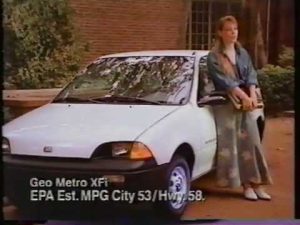
Another example of the cost of compliance is the new (just re-engined) Toyota Tacoma pick-up. Two years ago (2023) this truck was available with a 3.5 liter V6 widely esteemed for its durability and reliability as well as its affordability. You could buy a ’23 Taco so equipped for $31,590. But the V6 was pulled from the lineup because it was not sufficiently compliant. In its place, a turbocharged four that produced about the same power (under boost) but the cost of a new Taco so equipped jumped to $36,220.
The good news is the new Taco gets 20 city, 26 highway vs. the 19 city, 24 highway achieved by the old V6-powered Taco.
That roughly 2 MPG overall improvement for $4,630 (the difference between the price of the ’23 Taco with the V6 and the ’25 Taco with its turbo-four) is the cost of compliance. There is also the probable down-the-road cost of more expensive and sooner maintenance.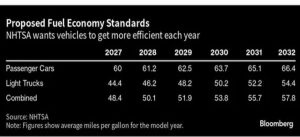
Back to Trump and his “gutting” of the regs. What he’s done, apparently, is to dial back the fines applied to vehicles that do not comply with CAFE standards. These fines being interesting in that the are designed to punish people who prefer a vehicle with a V6 or V8 engine rather than a turbo-hybrid four cylinder drivetrain.
Or an EV
But why is the federal government in the business of punishing people for choosing to buy a vehicle that uses more gas but offers other attributes they esteem more highly? The italics are there to emphasize something that people such as Alongi (and shill organs such as AN) never mention. That being no one is forced to buy what they disparagingly refer to as “gas guzzling” vehicles. It is their availability that offends. The fines are designed to make them less available, by making them less affordable (via the fines).
Efficient – actually so – vehicles have always been available, even before there were CAFE regs. Because there are plenty of buyers who want efficient cars; the vehicle manufacturers made them for that reason – without any CAFE compliance compulsion. The issue then is not efficiency.
It is compliance.
AN does not explain these facts, of course. Instead, it emits this:
“CAFE did impose increasingly substantial fines for average fuel economies above (sic) the applicable standards. It is credited with pushing automakers to develop more efficient vehicles. And it created a lucrative market for the least polluting fleets, such as those from electric vehicle manufacturers, to sell credits.” It goes on to say: “While some automakers may breathe a sigh of relief as fuel economy standards are loosened, other stakeholders see stark negatives.”
Italics added.
And who might these “stakeholders” be? AN does not say. Of course not. Probably because these “stakeholders” are not car buyers. They are people such as Alongi.
And because AN does not publish news.
. . .
If you like what you’ve found here please consider supporting EPautos.
We depend on you to keep the wheels turning!
Our donate button is here.
If you prefer not to use PayPal, our mailing address is:
EPautos
721 Hummingbird Lane SE
Copper Hill, VA 24079
PS: Get an EPautos magnet or sticker or coaster in return for a $25 or more one-time donation or a $10 or more monthly recurring donation. (Please be sure to tell us you want a magnet or sticker or coaster – and also, provide an address, so we know where to mail the thing!)
If you’d like a Baaaaa hat or other EPautos gear, see here!









Those of us who want performance will spend over $10 per gallon of special gas, turbo-chargers, special cams and lifters, tires, suspension, etc. We don’t need no stinkin mileage requirements.
Those of us who are everyday drivers want a comfortable and reliable vehicle. A three-cylinder turbocharged engine that needs replacement turbos every two years is not cost effective or comfortable. Cost of fuel is important but may not be THE most important feature.
Then there are those businesses that rely on transportation such as taxis, limos, charter vans and busses, delivery vehicles, etc. They also want reliable vehicles. Spending millions of dollars annualy on fuel, these companies actively seek fuel efficiency as well as dependability.
In short, money talks and most everyone wants efficient trade-off between features, comfort, fuel efficiency and dependability.
Getting rid of CAFE standards wouldn’t change that one iota.
Modern turbo engines are quite reliable. They have been for decades.
So glad I didnt get a truck yet, watch Toyota bring back the V6 and V8 for the Taco, Tundra, 4runner and Landcrusher for example.
Big engines in big cars are back, what a wonderful time to be alive, no matter what the naysayers claim.
Doubt the president will get rid of the EPA, or CAFE regs. He’s not really president. He cant even get the FBI moved out of DC, or the gold in Ft Knox brought out into the sunshine, as proof of life for Dollah Dollah Bill Yo. He’s already failed, and I’m not sure how he turns it around. Short of asking people forgiveness for whatever they have on him, then exposing every single last one of them, he might as well hand the reigns over to Vance, Trumps cooked.
We need to shatter of the myth of climate change. Dash it on the rocks, light it on fire, and speed any remnants across the Mohave desert. People need to put down their childish toys and get back to talking to each other. The way we used to. Those of us over fifty, can remember doin this. The hour is late and we stand at a crossroads. A mass non compliance movement, mass work and spending stoppages, mass boycotts where everyone dons Guy Fawkes mask. Revilement and derision of all authority, on an unprecedented scale, at every level is whats called for. Sadly, half the country still thinks Trump will succeed by tinkering at the margins.
I agree Norman!
The hour is late.. we stand at a crossroads.
https://www.soundclick.com/share.cfm?id=15046610
They are about to “Take Everything”
We should try to spread the word. 🙂
Hopefully they can get gigs playing at state fairs and such. If its some one you know, tell them great job. The music industry, just like all our institutions has been taken over by the usual suspects. Doesn’t mean it has to stay that way. Music has power to change minds and reshape the negative arc of our countries story.
“Kick em in the teeth, hang em from a rope, put em in the ground. Put the counterfeiters down.” Would be nice to see more young people taking this attitude.
And, for those who aren’t radicalized, “Got to get closer to God, its the only way.”
“Would be nice to see more young people taking this attitude”
Indeed.. it sure would! 👍
I was a fan of hybrids 65 (not a typo) years ago. But I have gotten over it. To me it is building something with two fallible systems, and in cases like that it does not usually mean less, or even twice the trouble. Complexity works to cause exponential probability of failure. The only merit I see currently is that, providing the design allows for it, failure in one of the systems will allow you to return home on the the other. I do not believe that is the design of most hybrids. Maybe get home on the battery if the engine fails, but not the engine if the battery fails. When you actually look at the ICE side of the hybrid, except for the electronics, a kind of mini-hybridization in itself with ICE, how many engines fail during use?
A small step in the right direction. He needs to get rid of CAFE completely, and then the EPA, an agency that has long passed its expiration date.
Automotive design cycles take years, and one design is sold for 7-8 years. It costs $billions to build out the tooling in a factory, so when designing engines (or chassis) manufacturers have to read the political winds and try to spend that money on something that can be sold for the entire cycle.
The second a Democrat takes back the presidency, these penalties and other emissions rules are coming back, so relaxing this penalty isn’t going to make much of a difference. I guess what it will allow is building a few more current vehicles with bigger optional engines where those are available.
Our government is now the biggest impediment to manufacturing, not just in the automotive sector. Our economy still functions despite it, not because of it.
Instead of just deciding *not to fine* firms for building and selling what the public wants, Lee Zeldin needs to make a statement that CO2 is not a pollutant, is not regulable, and CAFE has failed. Time for the EPA to be out of the auto industry. Moreover, dissolve the EPA entirely and block grant the funding to the states.
Don’t care. I just got my latest truck, a 51 Ford F6. Low miles, no rust, 2 dents. Can haul 10 tons, and dump it if needed. Has a 4 speed brownie and a 2 speed axle for 32 available forward gears. A gas to drive. MPG? Who cares, probably 10.
Had a friend post this video… the future is old.
https://youtu.be/XXIzlOd9DGw?si=LRGrY2hoBljbYbzA
Ernie,
Nice old school truck! My brother has a 55 Ford F350 flatbed duely sitting in his barn in Idaho. I keep bugging him to get it going.
Stubby Bob was a ’50 F6!
https://www.youtube.com/watch?v=g7uKfRunHTM
Congrats on the old truck!
“And who might these “stakeholders” be?”
These are people who want to save the world. The government has a lot of them. The government makes them powerful. These people might be your neighbors.
Itz a big world and there are many people who do not think like you or me. There are people who believe in spirits, ghosts, global warming, global freezing, “we’re all created equal”, etc, etc. All it takes is faith. And if your faith is weak then government, academia, media will make sure you receive the right message. There’s a big Matrix out there and we live in it.
The Crown Vic was popular with police and cab fleet managers because, unlike even the Ford Explorer of that era, the vehicle could roll for 400,000 miles with morons doing the maintenance, simply changing the oil.
And that’s EXACTLY why the Crown Vic had to go. It was just “too damned reliable”!
Morning, Blue –
Yup – they all had to go. I don’t think there’s a single new car – or truck – on the market anymore that can be described as reliable in the sense that it wis reasonable to expect it will run for 12-15 years or more without needing more than basic maintenance. I enjoy driving the new stuff – well, some of the new stuff. But I would never buy one and not just because the cost of buying is absurdly high. They are all financial time bombs waiting to explode. The LCD touchscreen interface especially. How long does a smartphone last before it either bricks or becomes obsolete? Maybe five years at the outside? What happens with a ten-year-old touchscreen when it goes dark? Will replacements even be available? No thanks. Not for me!
I watched how vehicles are manufactured for about half the day yesterday.
Finally made it to truck manufacturing, there isn’t a bunch of junk laying around on the plant floors. Very clean work areas and plenty of machinery used to build a truck from scratch.
The manufacturing company assembles a 13 liter diesel engine, the frame rolls along the assembly line until the body is fit to the frame, the 13 liter diesel engine is mounted then the bonnet is placed and attached to the cab.
Has to have a seal of approval at the end of the line.
A sleeper cab, refrigerator, microwave, up-to-date electronics, a comfortable cab, a truck owner’s dream come true. Sans DEF, you can go places, haul your fifth wheel home on wheels behind the brand new tractor.
I’d take two, but one is enough. Money is going to be needed to have one, I can wait.
I want my 5000 dollars, Musk discovered that DOGE will have Trump signing checks by the millions for five grand each. If the gov is going to be efficient, get with it.
I won’t hold my breath.
There is so much smoke in the air, you can smell the fire itself.
The sun is orange/red way up high in the sky.
The whole CAFE thing was a well intentioned policy with unintended and unforeseen consequences; namely the SUV and turbocharger boom, that ended up being put in place because of other policies with unintended and unforeseen consequences, namely going off the gold standard and ending Bretton Woods (From what I hear, the 1973 oil embargo was an excuse for OPEC to raise prices and cut output couched in terms of retaliation for support for Israel, but was really about their displeasure at not being paid in gold, but in increasingly inflated dollars.)
That said, the way that the EU, for example, had historically addressed fuel efficiency is not by dictating to manufacturers what cars to make, but by imposing taxes on fuel, as well as taxes on engine displacement. (That’s why Ferraris have V-12 engines that are only 3 point something liters big, and why a “big” engine in a European car was a 3.0 liter six—Mercedes Benz touted the power and status of its famous 6.9 liter engine in the 450 SEL/SL.)
Those started as a way to price Model Ts out of the reach of many people in favor of locally-made cars.
Even now, many European countries have a tax cutoff at 2800cc and smaller. The T had a 2900cc engine.
The only way we’re going to get affordable cars is going to be going back to 1980’s style regulations and maybe two front seat airbags, TBI and no ABS or stability control and we know what the odds of that happening are.
$30K economy cars until inflation makes them $35K economy cars.
Pretty much proves the government is actively working against the US consumer. If we want efficient vehicles, the automakers will build them. Might take a few years for them to dial it in, but they will build what sells.
I want to know what ever happened to carbon fiber? Why isn’t it getting any cheaper? India provides much of the global CF output not counting aerospace and it’s still mostly bicycles and cheap aftermarket bolt-ons for tuner cars. Where’s the big breakthrough that would allow carbon fiber monocoque bodies?
Carbon fiber is much, much stronger in tension than it is in compression (I.e., a collision). It also tends to fail suddenly, and without giving visible warning signs. (Which is why the Titan submersible imploded).
I doubt I would want such a car.
‘“Efficient” is a subjective.’ — eric
In vernacular speech, yes. But efficiency is concisely defined in thermodynamics as the ratio of the useful work done to the heat provided:
η [eta] = (work done / heat absorbed) = (Q₁ – Q₂) / Q₁
where Q₁ = heat absorbed and Q₂ = heat rejected [waste heat]
Generally, efficiency can be increased with more complexity. A turbocharger extracts additional energy from otherwise wasted heat in the exhaust gas to increase efficiency.
Gas mileage is related to efficiency, but includes other factors such as rolling resistance and aerodynamic drag. Vehicle weight enters into gas mileage, whereas weight does not affect engine efficiency considered by itself.
Unfortunately, search ‘energy efficiency’ and you will get woolly, circular definitions such as ‘using less energy to perform the same task or provide the same service.’ These idle semantics are needed for the innumerate, who choke on algebraic equaaaaaations such as the extremely simple one above for efficiency (measuring heat is the hard part).
Accountants are numerate when it comes to arithmetic. But most know little about the physical sciences. UHY’s 2023 electrification strategy is just standard conventional thinking from a consultant, telling clients what they want to hear.
I manage consultants with a chair, a bullwhip and a cattle prod.
If Trump told people to drink more water, the news would report he told people to drown themselves, per the Babylon Bee.
So this is excellent news, but it does nothing about the safety cult of FMVSS (Federal Motor Vehicle Safety Standards). Cars will still weigh way too much, and I suspect people will have words when they discover the 2026 Model Year vehicles act as breathalyzers, measuring the temperature of the drivers breath, and how often they don’t Sit Up! And Look Ahead! For now a piece of tape over the system works, but for how long? And will it be illegal to remove the system?
Still, this is what I voted for. Good News indeed.
Great. Now if only he can fulfil his “drill, baby, drill” promise and encourage the national retail gasoline price average to fall below $3/gallon where it belongs, he’ll have scored his first “win” for doing something positive for the middle class. Otherwise, the return of gas guzzling cars will ring hollow if gas prices remain high.
It’s still a win. These hybrid drivetrains can’t be serviced anywhere but a dealer. If they don’t need it to make the extra 2 MPG, all the complex design gets thrown out of the window.
Indeed, my 2014 RAM Ecodiesel will get 30mpg in a full size 4wd half ton pickup.
But its 5.7 hemi sibling will get 21 driven the same way, and that 7mpg advantage for the eco goes completely away when it seems to require a $500 heater hose and 3 days of service on a regular basis.
There is truly something interesting thinking in that European VM Motori turbo diesel, interesting in the Chinese curse sense. There is a lot of things to like about these new vehicles, but in the end they are ridiculously expensive, un-maintainable luxury/exotic junk.
Meanwhile in America, it took a lot of phone calls to find a shop that will still turn rotors for me, to do brake jobs for people. Before biden rotors could be turned for $20/ea at firestone. Now they want $80 per rotor. The labor cost presumes an idiot standing there for half an hour watching it turn. Finally managed to find a shop that would do it for $30/ea, a bunch of old guys. I needed to find this because, on a 2012 Mazda 3, a buddy was quoted $1200 for all 4 disc brakes. They wanted to replace rotors on all 4. A dealer if anyone should turn the OEM rotors, per how they were designed to be serviced. Got all 4 done, and each one has .040 left on them, or atleast one more life. This $150 – 300 dollar per hour rate of shops has made them unable to bill for turning rotors at a reasonable rate, even if it’s supposed to be something you do while doing something else. The brake lathe is collecting dust, at a mom and pop shop I know that asked $291 dollars to replace 2 bulbs on said Mazda 3 (.5 labor hours each). They gave me the bulbs for free, and like an idiot I drove it back to the guys house, presuming it needed a socket or something to do after that quote. I needed no tools, maybe a flat screwdriver for some plastic push pins. Drove it back, passed inspection. Thankfully VA limits that to $20. Another inspector cussed me out for wanting an inspection but knowing I would buy no work from him. Labor costs got fucked up because of Biden’s inflation!
Amen, Ernie!
My tractor has a mechanically injected diesel engine. It does not even need a working alternator or a battery to start/run. You can use a jump box to rotate the engine (or just roll-start it down a steep hill). Other than changing the oil once each season and making sure the diesel fuel doesn’t grow algae, it’s almost literally maintenance-free and as reliable as an anvil. It is almost 50 years old, too.
The unfortunate reality is that a modern truck diesel engine requires turbocharging, plus ultra-high-pressure fuel injection, plus DEF fluid plus particulate filters.
Lots of maintenance, lots of things to go wrong.
Even if you ‘delete’ the last two.
That’s because it’s a 2007+ diesel. They’re all terrible.