


The Mini Cooper is one thing few new cars are.
It is instantly recognizable – because nothing else looks anything like it. This has been one of the Mini’s greatest appeals, which transcends even the nostalgia factor of owning a new car that looks a lot like an old car.
It’s nice to drive something that doesn’t look like everything else.
Or drive like everything else, either.
What It Is
The Mini is a reincarnated iteration of the iconic Mini Cooper micro-car of the ’60s that was made by the Brits. The current Mini is made by the Germans (BMW) and made to look British.
It’s still small – by modern car standards. But it’s also much larger (and heavier) than the original Mini Cooper, which has its upsides and its downsides.
Prices for the two-door hardtop start at $30,675 and $31,675 for the four-door hardtop. The S trim – which comes with a more powerful iteration of the standard turbocharged 2.0 liter four cylinder engine plus related performance upgrades to the suspension and so on – stickers for $33,975 for the two-door hardtop and $34,975 for the four-door hardtop.
You can also get a Mini convertible (two door).
Prices for this one start at $35,775 for the base trim and $39,075 for the S with the more powerful engine and related upgrades.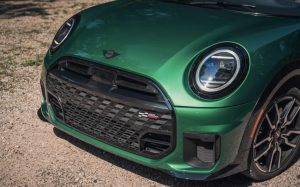
Both the two-door hardtop and the convertible are available (again) with the John Cooper Works package that centers around an even-more-powerful iteration of the 2.0 liter turbo four, with a driver-selectable momentary overboost button for maximum power/performance. The JCW package also includes an adaptive suspension, electrically locking differential, upgraded brakes and a Go-Kart driver display mode that shows real-time engine output and cornering Gs registered.
The JCW coupe lists for $39,375; the convertible for $44,875.
What’s New For 2026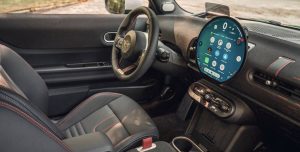
A new JCW Style package can be added to any Mini S; it bundles most of the visuals that come with the JCW but leaves off the high-performance JCW engine; you do get the adaptive suspension and a unique set of JCW wheels, plus a wider palette of stripe/color options. It’s a way to get a Mini S that looks like a JCW Mini without the pushing (and exceeding, if it’s a convertible) $40k price tag.
What’s Good
Hasn’t changed much on the outside.
No more three cylinder base engine.
Two or four doors; hardtop or convertible.
What’s Not So Good
Has changed a lot on the inside.
No more manual transmission (even in the JCW).
Base price is now about $5k higher than it was in 2024.
Under The Hood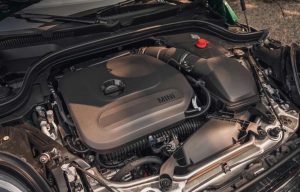
When BMW updated the Mini for the 2025 model year, most fans of this car were happy to hear that the 1.5 liter three cylinder engine that came in the base trim had been retired. It has been replaced by a 2.0 liter four cylinder engine that makes 161 horsepower – 27 more than the 134 touted by the smaller, three cylinder engine. On the downside, that 27 horsepower boost comes at a cost – and not just in dollars and cents.
The base price of the ’24 Mini two-door hardtop was just $25,800 – and for that you got a six speed manual transmission. The ’26 Mini – which costs $4,875 more to start – comes only with a dual-clutch automatic transmission.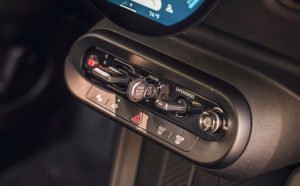
Interestingly, the larger standard engine in the current Mini touts slightly higher gas mileage – 28 city, 39 highway vs. 27 city, 38 highway for the ’24 with the 1.5 engine – even though the 2.0 liter engine is larger and stronger and even though it is paired exclusively with an automatic transmission. In the past, it was usually the case that (all else being equal) a given car would get better mileage with a manual than with an automatic, chiefly because manuals are more efficient.
In theory.
The actuality is dependent on the driver.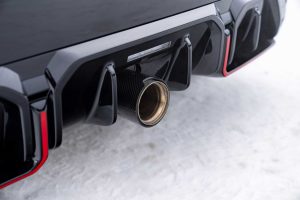
A automatic can be finely programmed to shift at the optimum moment for best-case mileage and (of course) an automatic never rides the clutch or lets it out too soon or misses a shift.
S trims get a 201 horsepower version of the 2.0 liter engine; it’s basically the same engine with more boost – to make more power. This engine is also paired exclusively with the seven speed automatic.
JCW Minis get a 228 horsepower version of the 2.0 liter four with even more boost (including the driver-selectable momentary “overboost” button) and 280 ft.-lbs. of tire-skittering torque. This is a big boost in torque; the last time Mini offered the JCW upgrade, the 2.0 liter engine touted the same 228 horsepower but only 236 ft.-lbs. of torque. This is a difference you can literally feel – about which more below.
All Minis are front-wheel-drive – enabling the tire-skittering in the S and JCW iterations.
On The Road
Let’s begin with tire-skittering, which can be done in the Mini because it’s not AWD; not even the high-performance JCW, which now has close to 300 ft.-lbs. of torque. That’s more than enough to skitter the tires, which is fun.
There are of course people who do not see it that way. This is not the car for them.
On the other hand, the automatic-only thing does detract from the fun. The seven speed automatic is snappy-shifting when you select “s” mode via the toggle just below the big pie-plate LCD screen and punch it. The JCW’s open-baffled exhaust burps at each upshift enhance the effect. Downshifts are just as slick. But you’re not doing the shifting and that’s why it’s not as fun as it could be. This little firecracker deserves a clutch pedal like a firecracker is most fun when its fuse is short. It keeps you paying attention. It demands timing and skill.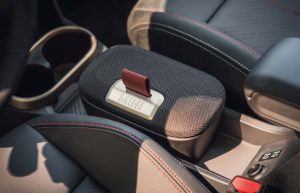
It’s also a shame the base Mini is no longer available with a manual as it made driving the last generation Mini with the three cylinder engine fun, even if you only had 134 horsepower to work with. And that’s just the point. The manual makes up for the power that’s not there by giving you something to do. If the car has an automatic, it feels slower than it is because you focus on how slow it is – because there’s not much else for you to do.
The tested JCW iteration’s ride is skateboard firm, so be careful with your coffee. The upside is it handles like a skateboard; the short wheelbase (98.2 inches for the two-door) feels like it could do one of those 180-degree turns-on-a-dime the kids do at the skate park. It can definitely dart through holes in traffic unlike anything else that isn’t another Mini because the thing is only 152.6 inches long – which is only a little longer than some motorcycles. This also makes it extremely easy to park curbside in traffic because you can often just slot in, without having to maneuver.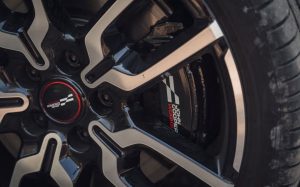
One thing about driving the Mini that’s not-so-great is a function of the automatic-only drivetrain and compliance technology, meaning the stop-start (ASS) system that cuts off the engine whenever the car stops moving. If you lift off the brake pedal, the system re-starts the engine so you can move again but this also sometimes causes the car to move before you’re wanting it to because easing off the brake pedal just a little can result in the engine restarting and the vehicle lurching forward because – remember – it’s an automatic and you’re in Drive.
This can’t happen with a manual when you’re in neutral or have the clutch pedal depressed.
At The Curb
The Mini is a iconically cute as ever – which it manages to do without being effeminate and that’s not easy. It is also, like the original Brit-built Mini of the ’60s – a little car that doesn’t feel little on the inside. It feels much roomier – at least for the driver and front seat passenger – than a Mazda Miata (which is about two inches longer) – which is more than a feeling (apologies to Boston) because of the greater headroom in the Mini. You also have back seats, even the two-door. They’re tight insofar as legroom (30.8 inches) but the car’s Mr. ’60s flat-top roofline maintains 36.3 inches of backseat legroom. And if you need more legroom and better access, the four door offers both.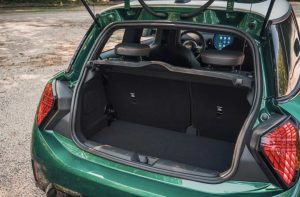
The inside, on the other hand, is less cute than ever. The charmingly retro chrome toggles are all gone. Almost everything is gone – replaced by a single pie-plate LCD screen mounted in the center of the dash that houses the controls for almost all of the car’s peripheral systems such as the climate controls, the controls for the seat heaters and the audio system. Just about the only non tap/swipe controls remaining are the “key” for the ignition – which isn’t really that because the car won’t start without the fob. There’s a little lever to its left that you use to engage Drive, Reverse and Sport mode (there’s a button to push for Park).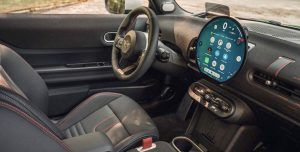
This declutters the dashboard but it also dehumanizes it. There’s a coldness to all this tap/swipe/LCD screen stuff. Plus it’s not the least bit different let alone iconic. Mini tries to make it so by embedding “experiences” that can be selected that change the images displayed by the LCD touchscreen but the charm of the last generation Mini’s ’60s-looking gauge cluster and the aircraft-stye chromed toggles is lost in translation.
It’s also a detraction from driving because it’s distracting to have to look at the screen and deal with tapping/swiping while the Mini is moving and your finger is bouncing.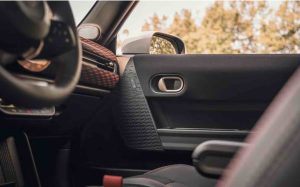
Storage, on the other hand, is abundant. There’s a flip-top cubby on the center console where the shifter for the manual used to be and this is a perfect place to put a wallet and keys and so on. There’s a decent sized glovebox, too – and just shy of 9 cubic feet of cargo capacity behind the back seats. This can be increased to 34.4 cubic feet by folding tehe rear seats forward. For such a small car, the Mini is remarkably practical car.
The Rest
The Mini has become an expensive car.
Just two years ago, this car’s base price was $25,800. It is now over $30,000. In 2022, the base price was $22,900. That’s a $7k uptick in just four years. How did an affordable, entry-level little car become an entry-luxury car so quickly?
Well, the ’26 comes standard with 17 inch wheels (vs. 15s back in ’22) plus a sunroof and a bigger/fancier LCD touchscreen (which actually ought to lower the car’s price because electronic displays are the one thing that has gotten less rather than more expensive). So it’s not the car as much as it is inflation – and the galloping MSRP of the Mini is a good way to see just how much more money it takes to buy pretty much the same thing now vs. just a few years ago.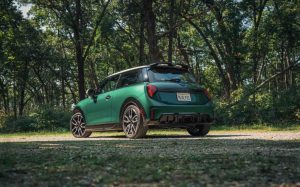
The fact that the Mini costs as much as it does is probably going to hurt sales because this is a car – especially the two door – that appeals most to young, single people who don’t yet have families to haul around. The older crowd that can afford it, meanwhile, probably needs something bigger to haul the family.
The Bottom Line
It’s still cute and also fun but the automatic-only and the high starting price have taken away some of the fun.
. . .
If you like what you’ve found here please consider supporting EPautos.
We depend on you to keep the wheels turning!
Our donate button is here.
If you prefer not to use PayPal, our mailing address is:
EPautos
721 Hummingbird Lane SE
Copper Hill, VA 24079
PS: Get an EPautos magnet or sticker or coaster in return for a $25 or more one-time donation or a $10 or more monthly recurring donation. (Please be sure to tell us you want a magnet or sticker or coaster – and also, provide an address, so we know where to mail the thing!)
If you’d like a Baaaaa hat or other EPautos gear, see here!









I used to have a 2003 MINI, and it was a fun car. It had analog gauges, the toggle switches, and a manual tranny. The fact that new ones don’t just ruin the appeal for me.
How’s that thing ride Eric? From the video in the other article, it looks like it is really unsettled on questionable roads. Does look fun though!
Hi Klink,
Let’s just say “firm” is the word! But it’s fun; I just miss the manual…
Just out of curiosity, I looked on Mini sites from both the UK and Germany and unless I missed something it’s not available with a manual there either which is kind of shocking.
Morning, Klink –
Yup, the Mini is available with a manual in the UK and elsewhere. Just not here.
The Mini has the same problem all the few remaining small cars have. A not mini price tag. It’s just too expensive for what it is.
IMHO, the outgoing version was vastly overpriced as well. It’s now even worse! The high trim is almost 40k! It’s fine that they offer higher level trims, because some people want it and even afford it, but they need to offer ACTUAL entry level prices. They will say the discontinued entry level model didn’t sell, but even that is vastly overpriced. There should be an entry level at under 15k. It’s DOUBLE that.
It just won’t sell in huge volumes that it could if it was affordable. This in not an affordable car.
Agree. This car just isn’t worth the price.
It comes across as an economy car at least in looks. For the price tag, you should be getting a lot more – and more options.
And I will agree that the controls look like a let down with that stupid frisbee touch screen.
How do you redo a car but still can’t figure out how to integrate the computer interface?
Hi Dan –
This is a car that makes sense as a $15k commuter that has some verve and charm. The irony is Mini (BMW) would probably sell three times as many as it does if people could buy them for $15k rather than $30k-plus.
That’s one ugly touchscreen.
… with icons that look just like, you guessed it, a cell phone. Which is a total turn-off.
Auto designers are such pathetic incels. In their Walter Mitty fantasies, they are working for Steve Jobs on the next iPhone, in his glamorous secret development lab. Jony Ives wanders by, bestowing an avuncular pat on the shoulder for radiused corners.
But cars are not cell phones. And auto designers’ feeble 1.5-liter, three cylinder intellects just aren’t up to the task of picturing the difference and developing their own design language.
Aircraft cockpits would be a better starting point than cell phones, to define a human interface appropriate for lots of dashboard real estate, plus a driver who shouldn’t be visually distracted to perform simple functions.
I don’t even like cell phone design on cell phones, let alone something else…….