

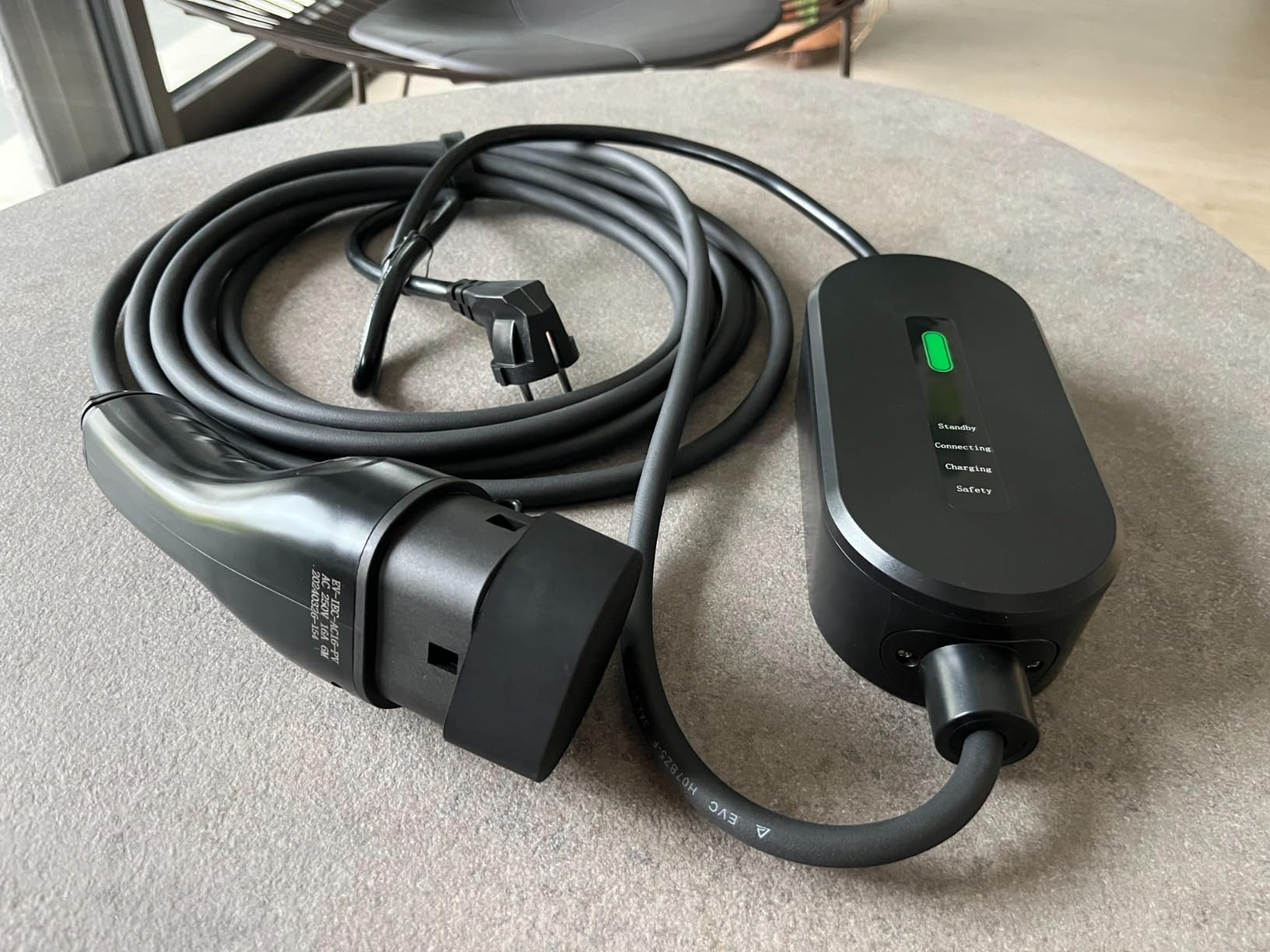

No vehicle manufacturer does that . . . yet. But several EV manufacturers do charge extra for a home charge cord, which is tantamount to charging extra for tires in that an EV you can’t charge at home is a vehicle that isn’t much use on account of all the time you’ll be spending driving to (and from) public “fast” charging kiosks – and waiting there, while your EV charges.
The ability to charge at home at least allows the EV owner to do something else while he waits, such as sleep (in his own bed, rather than in the car) and it also reduces and may even nearly eliminate the having to drive to and from a public “fast” charger kiosk, if one is diligent about keeping the EV plugged in at home.
But there’s a catch – and it’s rarely discussed. It is that you’ve got to be able to plug the EV in. This is not possible if you don’t own a single family home or townhouse with a garage or at least an outlet within about 12 feet of where you park the EV. That’s about the length of a home-charge cord and you can’t make it longer by running an extension cord from an outlet inside your apartment or condo to the street below because the controller box that comes with the EV charge cord won’t let you charge that way (because of the resistance difference) and even if that weren’t an issue, it’s not practical to run a 100 foot (or longer) extension cord from an apartment or condo window to the street below.
So, if you have to park on the street, having a charge cord is like having an appendix in that both are essentially useless. This makes the EV a great deal less useful. I speak from experience and will relate one I am having right now to make the point:
This week I am driving a ’25 Hyundai Ioniq 5. Thankfully, it does come with a home charge cord – unlike the VW ID Buzz I got sent to review a couple months back. Because the latter didn’t come with a home-charge cord, I was effectively forced to drive to a “fast” charger kiosk and the closest one to me is about 30 miles away. It takes about 30 minutes to get there – and about 30 minutes of waiting to get about the equivalent of half a “tank” of electricity.
Then there’s the 30 minute drive home.
I could have avoided most of that if I’d been able to leave the VW plugged in at home – but I wasn’t able to, because the thing didn’t come with a home-charge cord. It’s a $700 option that was not included with the ID Buzz press vehicle sent to me to review (you can read about that here).
Well, when I got down to the first “fast” charger, it was being serviced and so was out of service. I had to drive more miles down the road to another “fast” charger and when I got to that one, I discovered I could not pay with a credit card because it would not take just a credit card. I had to download an app on my phone and since I was unwilling to give whoever runs the “fast” charger kiosk access to my phone, I was not able to charge the VW there, either. But now I had very little charge remaining; just enough to gimp the VW back home – where it sat for the next five days like a three-ton paperweight waiting to be hauled away by the delivery service – because I was not able to recharge it home.
Now, consider that a person who does not own a single family home or townhouse – i.e., does not have a place at home where he can plug an EV in to charge overnight – is rendered effectively dependent on the “fast” charger infrastructure, which is inconvenient and also unreliable. He is also thereby effectively forced to use not just a credit card to pay for electricity, but also to download the app that gives whoever runs the network access to his phone and thereby almost certainly the ability to track his movements as well as control (at least in principle) how much electricity he’s allowed to pump into his EV.
But wait, there’s more!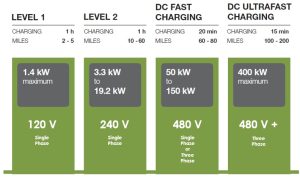
Literally.
You pay more – much more – for electricity at these “fast” charger kiosks than for the electricity you feed an EV at home. High voltage power comes at a cost – and if you are (effectively) forced to use commercial “fast” chargers, the likelihood is you’ll be paying the equivalent of premium unleaded to fill up your EV, which (compounded by the typical EV’s need to be recharged at least as often as the gas-hoggiest car needs to be refueled) means you’ll almost certainly be spending more to recharge an EV than you’d spend to refuel a gas-hog car.
What’s the point of owning an EV, again?
The kicker? It takes a small fortune – $400,000 on average these days – to buy a single family home or townhouse in most parts of the country. This means that people who cannot afford one are (effectively) forced to pay top-dollar for electricity at a commercial “fast” charger! Put another way, the nature of EV charging is highly regressive; i.e., it costs those least able to afford it the most.
If you needed more evidence that the EV push is fundamentally about pushing working and middle-income people into public (i.e., government) transportation by making privately owned transportation unaffordable, well, here you go.
. . .
If you like what you’ve found here please consider supporting EPautos.
We depend on you to keep the wheels turning!
Our donate button is here.
If you prefer not to use PayPal, our mailing address is:
EPautos
721 Hummingbird Lane SE
Copper Hill, VA 24079
PS: Get an EPautos magnet or sticker or coaster in return for a $25 or more one-time donation or a $10 or more monthly recurring donation. (Please be sure to tell us you want a magnet or sticker or coaster – and also, provide an address, so we know where to mail the thing!)
If you’d like a Baaaaa hat or other EPautos gear, see here!










A couple of rubs I have had lately with new cars are the dealers.
I moved to Alaska a while back but still listen to an Atlanta radio show because I have enjoyed it for decades. The host is in his 70s now…. but that is not the point, the ads I hear are.
One of Atlanta’s premier dealerships is offering to come to your home and upgrade your electricals to make the “transition” to electric easier. It just sounds like a liberal gender bender, you just “transition”.
The next is the “honest car guy”. They say ‘tell us what you want, we’ll get it, show you what we paid, then charge a small markup’, is the gist of the ad. Well, that has morphed into them telling you “Don’t come in here saying you will only pay 20k for a car, we can work with you on getting the same payment and into a newer car”, essentially. They are not being honest at all. My father was a car salesman, I am not surprised one bit the “honest” folks aren’t. They literally say to potential customers “don’t come in here and say….” Who the hell do they think they are?
The real problem is decades in the rear view mirror. Our ‘Merican middle class lifestyle has been inflated away. Real, decent Americans are still standing on solid ground, but the drowning waters of inflation and taxation have been flooding in for so long we’re clinging to the roof with our noses up in an air pocket.
A $60000 EV should be a harmless fad, like tall tail fins. Had incomes still been paid in silver, and taxation not been radically increased to fund the fantasies of the democracy, suckers could buy and try an EV, then abandon its foolishness in 2 years and replace it with a new diesel VW or gas powered Ford.
That world is gone. Mommy and Daddy both have to work, one for survival and one to pay the communists’ taxes on income, property, purchases, fuel, and everything else nailed down or not. If their combined income is 120k, 60 goes to taxes, and the remaining 60 is the equivalent of $1200 silver dollars from 60 years ago.
And electricity should have been too cheap to meter, but the greedy quashed clean and efficient nuclear power because it would have diminished their control over the benighted land.
And until they repent of the communist heresy, it’s only going to get worse.
Hers what happens when Gov gets involved. Broken for over two years now, hoopla when installed then ignored when busted. WA State Parks, and our Discover Pass went up 50% now $45 a year. Plus they beg for more when you renew your yearly car tabs.
(In the ‘60s WA parks were free admission)
https://www.plugshare.com/location/188582
The other thing that’s not included is the cost to install a proper 22V outlet or hard wired charging cable in your garage. In my case the subpanel in the garage has plenty of empty breaker positions, and I have a 200A service. My service drop is less than 50′ so I get almost no voltage drop, with 242V at the main breaker. It would be an easy job, just add an outlet. But there are millions of homes built prior to 1999, when my place was built, many of which only have 100A or less service drops. My parent’s 1961 midcentury split level has a 100A fuse panel that’s full. The three 220V fuse positions are occupied by the electric stove, clothes drier and auxiliary electric heater for the basement. So either upgrade or piggyback on one of the existing circuits like the drier with the understanding that you could do one or the other. There are devices that will make that decision for you, by sensing current on the shared device (like the drier) it will cut off power to the EV, but these are fairly expensive, between $200 to $500, and you’re not upgrading the service to the house, just reducing the total available power. If you have to install a new panel and upgrade the service drop, you’re talking about thousands of dollars in material and labor. Even if you cut corners by installing a combined meter pan/main breaker outside turning the fuse panel into a sub it’s still going to be ~$3k or more.
Added capital costs you describe apply to the grid as well. If everyone converted to EeeVees by 2035, as the Bidenites assumed, electric subscribers would get dinged for new generating and grid facilities. It’s already happening because of AI data centers.
Effectively, CARB and its 14 acolyte states assumed that unlimited generating and distribution capacity was on tap. How could they be so foolish? Or were they deliberately trying to crash the system — which might happen anyway?
Goldman Sachs writes, “We find that 9 out of 13 US regional power markets have already reached critical tightness this summer, and expect all but one to reach critical tightness by 2030.”
This is shown in the bar chart at the bottom of the linked article. The criterion for ‘critical tightness’ is less than 15 percent spare capacity. Currently five regional markets have almost NO spare capacity: TVA (Tennessee); NW (Northwest); NYISO (New York); CARO (Carolinas); and ISONE (New England).
https://www.zerohedge.com/ai/mapping-five-states-leading-americas-data-center-boom
Looks like central planners have screwed the pooch, big time, even without mandatory EeeVees recklessly piling on more load. Jean Hegland wrote a novel called Into the Forest (1996). One day the power clicks off … and doesn’t come back on. After a few days, no more planes are flying overhead either. Life becomes really local. 🙂
So everyone will need to choose between transportation, warmth or a hot meal, even if your home is capable of much higher capacity.
Maybe they’ll just require EV manufacturers to assume a 20A circuit and severely limit potential charge current. Most small appliances top out at 1500W because that translates to a 15A circuit with some margin. Do the same thing for EVs and now you’re stuck with a far longer recharge time. A 50A circuit will recharge a small EV battery from ~50% to full in as little as 4 hours. When you drop that circuit down to 20A recharge time goes up to 10 hours.
NEC (Article 625) and ICC now requires new construction to have EV spaces and electrical. At least one of the national labs wants to see codes support 7200 KVA per space unmanaged or 3300 kVA if managed, low power Level 2 charging. Soon I imagine it’ll be adopted as a requirement for retrofit. It’s what the gubermint calls “EV Ready” building code. I assume you know that based on your handle, though.
On an automotive podcast a couple of years ago it was admitted that just 10% EV usage and charging was enough of a load to crash the grid. My neighbor put in a whole house generator just in case.
Barely enuf to spark up a “legal limit” ionosphere heater and now no extra juice for a personal AI server farm, so sad.
Oregon’s Queen, er, Governor, wanted to shove all sorts of new and increased taxes down the throats of Oregonians who use an automobile for transportation instead of public transportation under guise of funding the state’s transportation department. She got her wish a few weeks ago when the Democrat supermajority legislature passed them despite overwhelming opposition to such taxes. However, she has yet to sign it, as there are efforts to put it on the ballot for next year for people to vote on it. Is she trying to “Stall democracy” while claiming she’s “Protecting Democracy” regarding President Trump wanting to send National Guard troops to Portland? Also, the state department of transportation has a history of corruption and waste, plus they’ve been wasting taxpayer money the past several years on this demented climate change agenda that isn’t about “Stopping cliiiiiiiiiiiiiiiiiiimate change” at all but really about making people like Al Gore, Bill Gates, and John Kerry even MORE wealthy at the expense of American taxpayers. People who STILL buy the cliiiiiiiiiiiiiiiiiiimate change narratives are ironically useful idiots for the same billionaires they constantly say they hate.
Most of the money that’s going to the Department of Transportation is probably going directly into the pension fund.
Could be RK, but they’ve also been wasting taxpayer money on demented road diets and confusing road designs under guise of “More inclusive transportation options” or “Saaaaaaaaaaving the planet from cliiiiiiiiiiiiiiiiiiimate change”. Oregon government seriously needs an audit, though people in power and special interests will likely do their dirtiest to prevent one given it’s under one party DEMOCRAT rule.
Here’s the 2022 estimate for each state’s pension, right from their own special interest group.
https://www.csg.org/2023/05/03/unfunded-pension-liabilities-the-growing-cost-of-retirement/
I’d bet most of the “traffic calming” and inclusive transportation cash comes from federal grants, not the general fund.
‘People who cannot afford [a house] are (effectively) forced to pay top dollar at a commercial “fast” charger.’ — eric
Most of the houses in my small town were built as weekend vacation cabins. Only about half of them have garages. Thus despite owning a $400,000 house, many here STILL don’t have the facilities to charge an EeeVee.
The nearest commercial charger is 15 miles away — fine if you’re headed to the bigger town for shopping, but not okay if you’re just low on charge owing to its steady depletion. A 30-mile round trip just to top up the baaaaattery makes the costly price of commercial charging even higher.
Lightning Jim Farley, Ford’s CEO, enjoyed the exorbitant privilege of importing a Xiaomi SU7 for his personal use, despite it not being approved for sale in the US. He seems not to understand that the average American doesn’t have an income in the millions, and corporate lawyers to work around Customs barriers that block little people from buying contraband foreign vehicles. And a 3 or 5-car garage with 240-volt Level 2 chargers in every bay. And so forth.
In his book Class: A Guide Through the American Status System (1992), the late Paul Fussell claimed that old-money millionaires — the kind who prefer to keep a low profile — buy their cars at the lowest cost per pound. At the time, that meant big Buick and Caddy Detroit iron, with V8 and rear drive. Fussell further asserted that they tend to drive slowly and hog the middle of the road, making them Clovers as well.
In any case, these well-heeled folks who viscerally disdain ‘fashion forward’ products ain’t buying no shiny stinkin’ EeeVee from the sorry likes of Lightning Jim. Batteries are for flashlights, not cars. Sheesh.