


Scout Motors – which is VW’s peripheral EV albatross – is likely to sell as many EVs as VW already hasn’t. The “market” for $60k-plus EVs such as the ones Scout plans to offer being something like the “market” for ice-making machines in Antarctica, with the difference that ice-making machines are useful in places other than Antarctica.
$60k-plus EVs not so much.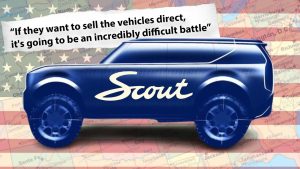
Anyhow, VW bought Scout – the rights to the name – to try to market EVs under that name. Scout wants to sell them – well, it wants to try to sell them – directly to buyers (assuming any such exist) rather than offer them through a network of dealerships. Believe it or not, it’s actually against the law for vehicle manufacturers to sell a vehicle directly to a buyer rather than through a middle man.
That is to say, a dealer.
Well, Scout just won a court case that will allow it to sell its devices directly rather than through dealers and – not surprisingly – some dealer organizations are very upset.
Mike Maroone – who was a former AutoNation executive and who is currently the CEO of a major dealer chain – Maroone Auto – says that Scout should be barred from direct selling because it is part of the VW/Audi combine and for that reason is barred from direct selling under existing laws that forbid direct sales of vehicles. Scout argues it makes devices – electric vehicles – and these have been exempted in a number of states from the laws requiring vehicle manufacturers to sell through franchised dealerships.
Tesla, for instance, has been selling its devices directly for years in several states – because it can. Because EVs have always been treated like a Special Needs child by the government.
Because of course that’s what they are. But that is a subject for another time.
Maroone says Scout’s claim that it is a distinct entity vis-a-vis its VW (and Audi) parent is “insincere” and that it ought to be bound by VW and Audi’s agreements with its dealer networks as well as state law forbidding direct sales of vehicles.
As distinct from devices.
“If it walks like a duck and quacks like a duck, it’s a duck,” he says – and of course, he’s right. In the sense that Scout Motors is an appendage of VW/Audi and Scout is a device-maker, like Tesla. But that isn’t really the issue, aside from the legal technicalities. The issue, fundamentally, is whether any vehicle manufacturer ought to be prevented by law from selling directly to buyers. That this is a contentious issue says a great deal about the state of things in this country. 
We have gotten so used to guilds and cartels – though those words aren’t used much anymore – that we no longer understand that there are guilds and cartels. The American Medical Association is one such. It is very difficult to practice medicine without AMA approval. Many other professions are hemmed in and controlled in similar fashion. It makes professions easier to control. If you want to work in certain professions you must join the guild and thus become part of the cartel, which is also a racket in that it uses the law to protect itself from the “sinful” thing – per John D. Rockefeller – called competition. 
Laws that force people to deal with dealers are among the worst offenders.
Not that there is anything morally objectionable about dealers – as such. A dealership can provide services that some people want, such as having a network of support in multiple different areas; in-person help with the buying process and sales staff that is knowledgeable about a vehicle’s features, the opportunity to see new vehicles in person and to “kick the tires,” as the saying goes.
Dealers typically employ staff that prep new vehicles prior to delivery, meaning they clean the vehicle up inside and out, remove the plastic coverings used by the factory to protect the interior, etc. There is also usually a pre-delivery inspection during which the salesman and the owner go over the vehicle to satisfy that there is no damage such as paint chips/dents or something not working properly – so that it can be fixed before the new owner drives the vehicle off the lot.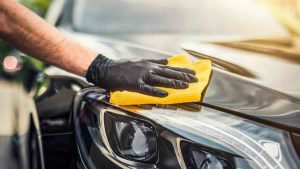
Some people also value the relationship they have with the staff at a dealership and they also like knowing they can bring their vehicle in for service to a place where they have done business and (they hope) will be treated well on account of it.
Franchise dealers can thus compete with manufacturer/direct sales (these latter, by the way, can also provide similar services).
But note the italics.
There is no issue – morally speaking – when services are provided to those who want them. When there is competition for business. The moral affront bubbles up when certain business are protected by the government; when people are told they must pay for services they neither want nor want to pay for. That’s what some dealers – such as Maroone – want. Scratch that. It is what some dealers such as Maroone are demanding. They want the government to force people to deal with dealers, which means to pay them for their services. This is bad enough, but it’s made worse by eliminating that dread thing – competition – by outlawing it. 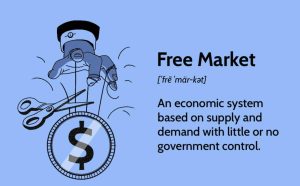
If the free market is allowed to operate then buyers have the choice to buy a vehicle through a dealer and pay for the services the dealership provide which they want and – more to the point – consider to be valuable enough that they are willing to pay for them.
Technically, they pay more for the vehicle – but it amounts to the same thing. The interesting thing is they’d pay less, probably, if the dealer had to be competitive with the alternative (the direct-buy option). The axiom is: When you have to pay more, you will pay more. This is the principle the car insurance mafia bases its operations on. Car insurance would almost certainly cost most people – the people with claims-free history, at any rate – half or less what it currently does if those people had the option to not pay the insurance mafia. 
The insurance mafia naturally prefers that option not be on the table; the car dealer mafia prefers the same.
“Dealers are resilient,” says Maroone. “They’ll figure this out and continue to succeed but the traditional franchise system must be respected.”
Italics added.
He means imposed. “Respect” in this context being of a piece with the “respect my authority” – that is, obey – refrain that is regularly emitted by armed government workers.
The good news is that the mafia lost this case.
Here’s hoping more such to come.
. . .
If you like what you’ve found here please consider supporting EPautos.
We depend on you to keep the wheels turning!
Our donate button is here.
If you prefer not to use PayPal, our mailing address is:
EPautos
721 Hummingbird Lane SE
Copper Hill, VA 24079
PS: Get an EPautos magnet or sticker or coaster in return for a $25 or more one-time donation or a $10 or more monthly recurring donation. (Please be sure to tell us you want a magnet or sticker or coaster – and also, provide an address, so we know where to mail the thing!)
If you’d like a Baaaaa hat or other EPautos gear, see here!




Who the hell wants a electric high priced pile of shit the scout was cheap easy to fix and could go anywhere the new trash has nothing to do with the original just living off a name bring back the original and it would sell I would buy one .
Preach it, Angelo!
I – like you – am weary of the Culture of Disposability (and Debt). Maybe it’s because I can remember a time when vehicles were both affordable and durable; I love my ’02 Nissan truck for these reasons and because I can repair and maintain it inexpensively. I am not interested in paying $800/month for a new vehicle that will become a throw-away vehicle by the time it is half the age my Nissan truck is now.
The problem with direct sales. You get Apple. Yes, they have amazing stores, at least they once did. But there is a big problem with their retail model.
They really don’t want to operate stores evenly over the US because it’s a big place. So they cherry pick what they think are the best places for their retail locations. That is not very many places. For example, in the Chicago area, their stores are clustered in one little area to the north and west (where they consider their high income customers to be). The rest of the area has no locations. There are no locations in middle income areas where most of their customers are.
They also picked very expensive places to operate, so their prices are going to be high.
Those stores do very well, and many retailers noticed that. They want to copy that model. They are really boutiques, but their products aren’t the traditional boutique products. It shouldn’t have worked and most retailers have found they really can’t copy it. But many are dead set on trying. Because they want that premium price for that thing that isn’t.
‘Scout Motors — VW’s EV albatross’ — eric
Many people, including auto execs, were caught up in EeeVee Fever during the so-called ‘Biden’ burlesque — a phenomenon exacerbated by their childlike credulity and poor judgment. Naturally, the pinheads of Clowngress led the witless charge, taxing actual working people to subsidize EeeVees for Commiefornia toffs with a $7,500 tax credit.
But finally this year, Clowngress — perhaps the most uninformed and disengaged institution on earth — actually repealed the EeeVee tax credit, though they failed to issue an arrest warrant for Joe Manchin.
Auto makers have cancelled EeeVees in droves. But not the lunkheaded krauts, who fully intend to go bankrupt proving to buyers that they are just wrong not to want Scout’s battery-beclowned Elektrofahrzeuge.
At this late stage of the game, the deluded losers of VW’s management and board have no excuse. The world has left them behind. But the world, they insist, is out of step.
‘Fog in the Channel, continent cut off,’ as a former auto-making island used to say, back when its coal-fired navy ruled the waves. Stupid and stubborn is a fatal combination. Deutschland unter alles.
p.s. I have estimated, based on maff and stuff, that Scout Motors will convert six (6) percent of its 130,000 hundred-dollah-deposit reservations into sales. This forecasts first-year deliveries of 7,800
vehiclesdevices.Would you invest several billion dollars to sell a trifling 7,800 EeeVees?
Agree Eric. It’s all about the force, or not.
Biz should be free to go to market anyway they want. Let them succeed and fail on their own.
The dreaded middleman is always a debate.
My biz is a middleman between the manuf. and end-user. We believe we provide a valuable service. The end-user and manuf. decide if that’s true or not. However, in our industry, manuf. are free to sell direct to the end-user if they want. Our industry standard contracts are 30 day cancelable, both sides, not kidding.
The pendulum swings back and forth all the time.
I always thought, going back 20yrs, that car manuf. would go to a direct model by creating regional sales centers with separate regional service centers. So basically GM would have all it’s models under one roof. It hasn’t happened, but probably because of the force thing.
The term you’re hinting is value added.
A manufacturer likes having a small number of major distributors. It’s easier for GM to load a few trains or ships and let someone else deal with moving all those cars to all the dealerships.
It used to be like that with computers. You had DIY kits from small companies in a magazine or you bought an Apple or IBM from a business reseller. Then Dell shook all that up going direct to consumer.
With cars what value is added by a middlemen? It’s not a simple answer. Having no middleman could lead to fewer choices. Manufacturers don’t want to deal with a million individuals so they’d probably reduce the number of models and configurations. The market would respond of course with niche brands. But they’d struggle on the support and repair side. So it’s unlikely you’d get much middle ground in the end.
In a way the EV market has proved this. Regardless of what you think it was a view into what a competitive auto market might look like. Tesla still dominated and little startups never got much foothold. Rivian sort of did but mostly it was still the 800 lb gorilla that won even with a direct to consumer model.
Now you see of course the fundamental flaws in the concept but a few years ago before the structural cracks became obvious you should have seen a dozen EV companies but you didn’t. People shop on price more than anything and that benefits first in, first established and economy of scale.
Same with computers. You have big tech giants and a few super speciality shops who mostly build gaming PCs to people with specific demands.
Direct to consumer therefore tends to benefit the Amazonification of things.
While I agree that being forced to buy from the Stealership costs more and is coerced by law there are other issues to consider.
One thing not mentioned is what if you have a problem with your direct sale product? Whether you buy from Amazon, Costco or Temu if you buy say a tube of lipstick, TV or a toaster and there is a problem with the product they just give you a refund if it is within a certain time period.
Cars on the hand are a lot more complicated and tend to be held onto for potentially many years and your odds of getting a refund if the car fails to run properly are a lot lower; lemon laws notwithstanding.
Tesla has very few service centers and apparently you have to wait a long time for service whereas gm has many service centers and your odds of a quick repair are likely to be higher.
Consider for a moment the category of outdoor power equipment. You could go to Lowes and buy a garden tractor or you could go to say Grass Rats Garage (who is a servicing dealer) and buy the same model of tractor but if it breaks who will service it? Lowes doesn’t service it they just tell you to call the 1-800 number on the box for service and while Grass Rats Garage may well be where you wind up in the end as a non customer wanting service your repair will be given a lower priority as you didn’t buy it there.
The big question is what level of service will Scout offer customers if there is no dealer network? On new cars today apparently dealers might spend a couple hours explaining how the car works in part so the customer doesn’t come back screaming that it’s broken because he can’t figure out how it’s supposed to work. Actual repairs are likely to be painful also.
“The big question is what level of service will Scout offer customers if there is no dealer network? ” Landru
Caveat emptor, baby.
That phrase has been relegated to the ash heap of lexicon history…much to our detriment. People seen to think GovCo has taken all risk out of society to the point some think life is Sealed For Your Protection. It’s not. And to depend on GovCo politicians, bureaucrats and lackies to keep you safe is a fools errand at best. Kids need to learn the Hard Way if we are to have responsible adults. But, it’s in GovCo’s interest to, to paraphrase Mencken, keep the populace alarmed and clamoring for GovCo’s tender arms of protection.
I hope you have a blessed New Year.
I hope you have a great New Year Mark.
I agree with the concept of Caveat Emptor Mark but I reserve the right to offer a substantially lower bid for sketchy or probably unreliable items. On an EV Scout I’d probably offer 10% of retail for a vehicle with a clean and clear title if they threw in manuals along with a factory grade scan tool.
Generous I know but that’s me. 🙂
My experience is that most people do not know these laws exist. It goes along with people believing that we have ‘free markets’. Not even close. The sooner we get rid of these laws, the better off we all will be.
Similarly – even on this site, I’m continually amazed by the number of people that think the OEM’s own or have control over the dealerships.
The chain to get a car from a factory to the consumer in the U.S. is very convoluted.
It’s surely not a small reason the Hilux Champ is offered and sold cheap in Thailand. Toyota Motor Thailand is a wholly owned subsidiary of Toyota Motor (TMC) in Japan. They directly control the factories, distribution and dealers. It’s very nearly a direct line from Toyota to the owner. At least as direct and probably even more simple than Tesla.
In the U.S. Toyota Motor North America is an operating subsidiary of TMC. The factories and offices in the U.S. don’t exactly operate independently but at the same time the organization is less directly involved with each other. It’s more akin that TMNA is a very major (but not only) customer to TMC. They don’t even always use the same designers and suppliers.
Couple that with many states in the U.S. the cars built by Toyota (either in Japan or North America) are not distributed by Toyota, but rather a 3rd party private company (Gulf States Toyota and Southeast Toyota).
Then there’s the dealerships, which are independent franchises not owned by Toyota. They often have competing interests.
In the late 70’s we moved from Ohio to Florida. We needed a car with A/C and went to a Toyota dealer. There I found rows and rows of Corollas with padded vinyl roofs, chintzy hood ornaments, ridiculous side moldings and moe. The prices were about 20% higher due to all this crap…installed by…you guessed it, Southeast Toyota.
I bought a VW Rabbit.
Gulf States and Southeast are a throttle. They’re big enough to dictate but desperate to hold on in the era of Internet shopping. People in TX or FL can shop and buy a car in Kansas or Indiana to get around this stranglehold. Why anyone would buy a Toyota at a dealership getting cars from Gulf State or Southeast is hard to understand. But it also forces Toyota to normalize their prices in other regions so prevent and protect dealerships from being undercut. The dealers in KS or IN are happy to have the extra MSRP padding to work with. And this ripples beyond Toyota, they’re not the only one with twisted chains of ownership and control. Then since the dealers are usually multiple franchisees they are pitting Toyota against Jeep and Chevy to keep enough dealerships to support their volume. Toyota might want to offer the Hilux Champ and they could deal with the EPA and DOT if they wanted to make it legal at the Federal level. But if a few large dealership owners say they won’t sell it because it would sap sales of high margin Tacomas and F150s then it there’s nothing Toyota can do. They don’t care, there’s dozens of other countries to sell them without all the bureaucracy. In the end the consumer loses options and prices spiral up faster.
That’s a good point. Honestly until Musk/Tesla made waves about it, I didn’t either.
‘Most people do not know these laws exist.’ — Auto-outsider
Most people don’t know that when Prohibition ended in 1933, Clowngress dictated a three-tier system consisting of brewers/distillers, distributors, and retailers, each independently owned. Distributors, with a government-sponsored sinecure, are notoriously unresponsive to their retailer customers.
Likewise, the US health cartel features useless middlemen called Pharmaceutical Benefit Managers, who help make US health care three to five times more costly than in normal countries. The word ‘Benefit’ tells us that the insurance mafia is involved, and intrinsic to the rake-off.
Antitrust enforcement in the US is episodic and often partisan. The liquor and health care and Tech Lord cartels (*cough* — ‘Google’ — *cough*) should be busted to kingdom come. As a commentator pointed out last week, if the health cartel were obliged to post a price schedule applicable to all, it would melt down like the wicked witch of the West.