

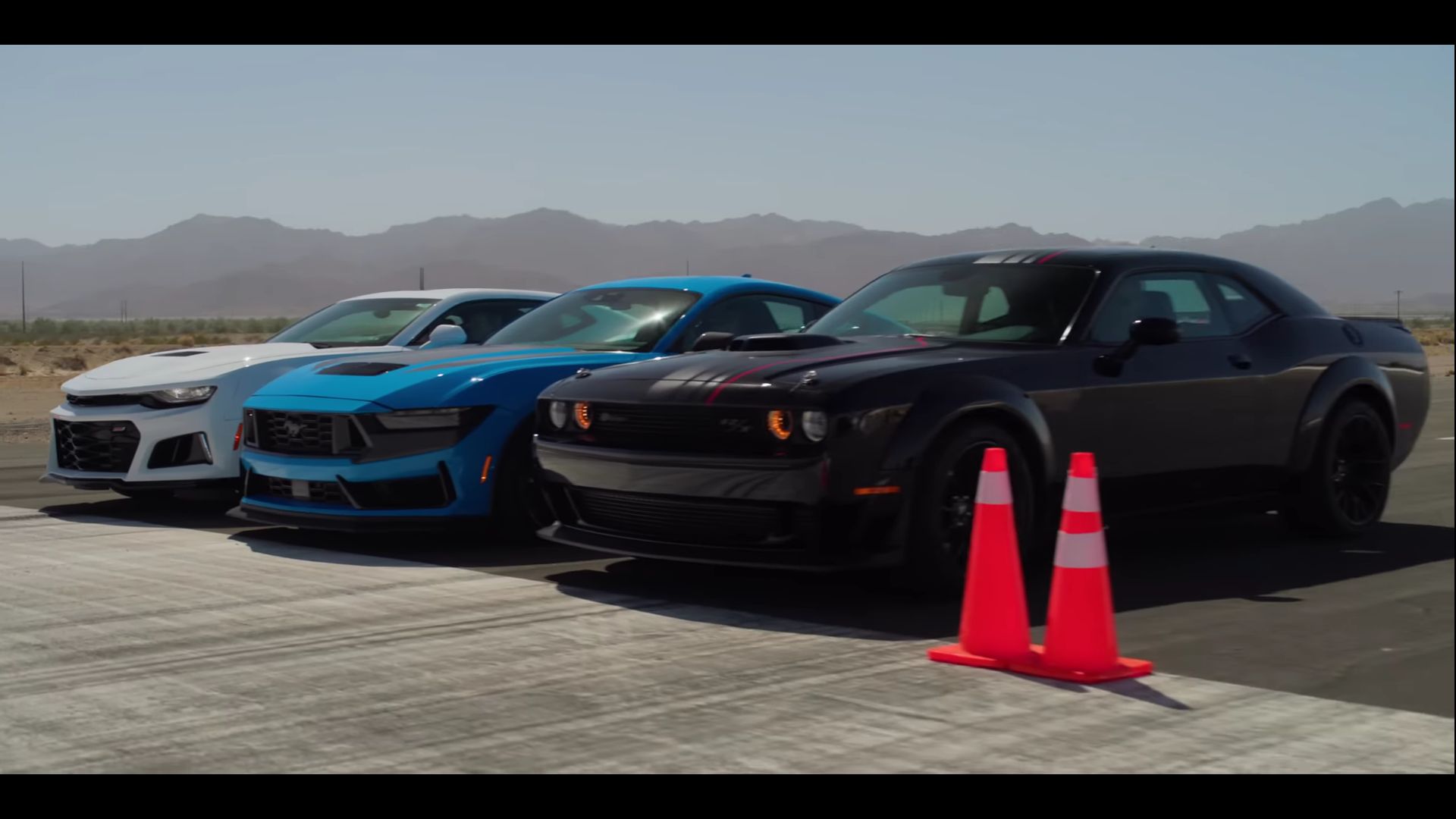

It’s interesting to take note of the failure of two of the three original pony cars – Camaro and Challenger, which were both recently cancelled a second time. Each had been resurrected after a prior cancellation. In the case of the Challenger, the hiatus was longer. Dodge dropped it after the 1974 model year; it made a comeback in 2008 – and got retired (again) in 2024.
Camaro almost got cancelled a first time, too – back around 1974, too. But GM kept the car going until 2002, when it, too, got dropped. Then it came back eight years later – in 2010 – and lasted until 2024, when it got cancelled a second time.
Only the Mustang has managed to not get cancelled – so far – though it has come close to being canceller (or replaced) at least twice. Once around the same time as the first time the Challenger got cancelled, back in ’74 – and once again in the ’80s, when Ford flirted with replacing it (with a Mazda-based “Mustang” called the Probe).
The interesting thing is that all of these cars – especially Camaro and Mustang – were for many years extremely popular cars that sold extremely well – to the tune of more than 100,000 annually. But then they stopped selling well, even though – in the case of the early-mid 1970s Challenger and Camaro – they were still pretty much the same cars that they had been when sales were good.
Well, visually.
The 1974 Challenger looked pretty much the same as the ’73 and earlier Challenger. But by ’74, the big V8s (like the 383 and 440) that had previously been available no longer were. The biggest, strongest engine available by ’74 was a 360 that touted 245 horsepower. This was respectable power – for 1974 – but it was much less power (and much less engine) than had been available before. The same watering down happened to the Camaro. By 1974, the Z28’s 350 cubic inch V8 had been tamed down to the same 245 horsepower you got in a Challenger. It wasn’t weak. But it wasn’t nearly as strong as the 360 horsepower iteration of the 5.7 liter V8 that came in the 1970 Z28. That one had a hot solid lifter cam and a Holley four barrel. The ’74 had a milder hydraulic cam and a Quadrajet.
Not that there’s anything wrong with that!
These attenuations were concessions to the ever-tightening noose of federal emissions regs, which were in the process of strangling the performance out of performance cars. It was anticipation of further tightening that did kill off the Challenger and the Z28 version of the Camaro, which was dropped after 1974.
Probably because 1975 was the first year for catalytic converters and single exhaust (because the early cats were huge and hugely expensive, V8s exhaled through a corked-up single exhaust with one cat). The 1975 Camaro was still available with a 350 V8. But horsepower was down to 170 – and GM decided that a 170 horsepower Z28 would be an embarrassment. So no more Z28. Worse happened to the Challenger, which was entirely gone for 1975.
Interestingly, the Camaro Z28’s sibling – the Pontiac Firebird Trans Am – survived. Probably because Pontiac’s still-big 400 and 455 V8s were still available. Though gelded, they were still credible. The ’75 455 still managed 200 horsepower, even though it also had to exhale through a corked-up, single cat exhaust.
It was also around this time that Ford brought out the Mustang II – which was much smaller, much lighter and much less powerful than the ’73 Mustang. A lot of people laughed – at the time. But the Mustang II was the right car for that time. Ford sold a lot of them, at a time when Dodge wasn’t selling many Challengers and Camaro sales were sickly.
The Camaro did snap back – and by 1978, Chevy was selling more than a quarter million annually. The car continued to sell well into the ’90s – but it began to not sell as well after Chevy replaced the 1982-1992 bodystyle with controversial bodystyle in ’93 that many people didn’t like – despite the fact that these ’93-2002 Camaros were more powerful than the previous Camaros. By 2002, they were selling so poorly that GM pulled the plug. Only to plug it back in for 2010, with a restyled body that was meant to visually recall the original Camaros made from 1967-1969.
It just got cancelled – again. Well, it did – back in 2024. The rebooted challenger also got cancelled that same year. What did these two cancellations have in common?
It certainly wasn’t low-performance as both of these cars performed better than any of their ancestors. The highest-performing version of each had more than 700 horsepower – which in comparison makes even the ’70 Z28 (and the ’70 Challenger) seem almost effeminate, insofar as the power they had.
Almost everyone who likes these kinds of cars agrees the last Challenger was a great-looking car – and the last Camaro was better-looking than the Camaro that got cancelled back in ’02. The last Challenger was also a pretty practical car, for the kind of car that it was. It had usable back seats – and a big trunk. The Camaro had neither – but it never did, so that can’t be why it failed this time.
These two failed for one simple reason. Not enough people bought them to make it worth trying to sell them. Why didn’t enough people buy them? Another simple reason: They were both too pricey for the majority of people – mostly young men – who (being young) aren’t generally flush. It has always been thus. But it wasn’t a problem back in the heyday of the pony car because young men didn’t need to be flush to buy a pony car – or a muscle car.
It is a forgotten fact that when the pony cars first appeared – Mustang first, Camaro and Challenger after – along with the muscle cars that appeared around the same time (beginning with the 1964 GTO) the target audience was young guys in their 20s. Believe it or not – as Jack Palance used to say – it was common for guys just out of high school to buy a new Camaro or Challenger or Mustang. Because in those days, desirable cars were affordable cars. The dollar was much stronger, in terms of what it would buy – and so people needed to earn fewer to be able to buy more, then vs. now.
Until that changes, cars such as these will remain a very tough sale – except to a relative handful of older guys – and that includes the current Mustang, which Ford hasn’t cancelled yet only because the continued existence of the car has a “halo effect” for Ford. People see them in the showrooms and admire them – but they drive away in an Escape, because it’s all they can afford. Because they can only afford to buy one.
Guess which one?
It’d be nice if – some day – young guys could afford to buy a new Mustang or something like that, again. Just for the fun of it.
. . .
If you like what you’ve found here please consider supporting EPautos.
We depend on you to keep the wheels turning!
Our donate button is here.
If you prefer not to use PayPal, our mailing address is:
EPautos
721 Hummingbird Lane SE
Copper Hill, VA 24079
PS: Get an EPautos magnet or sticker or coaster in return for a $25 or more one-time donation or a $10 or more monthly recurring donation. (Please be sure to tell us you want a magnet or sticker or coaster – and also, provide an address, so we know where to mail the thing!)
If you’d like a Baaaaa hat or other EPautos gear, see here!









My father owned four Mustangs in his life, after the fourth, he said he would never own another Mustang again. That was in the mid 80s. He passed in ’22 and held true to that statement.
I also remember the 1978 Dodge Challenger that was a rebadged Mitsubishi Galant coupe.
It comes down to this:
There is a small “elite” group of rich busybodies and know-it-alls in big government and giant corporations that for whatever reason, hate that little people, have little things that bring them some joy in life to their families.
They hate the muscle cars, even the regular private cars, the suburban (and rural) single family house, the weekend summer cottage, boat and a comfortable retirement. They hate that millions of North Americans managed to accumulate those things in the years after World War Two. I grew up in a community (ethnic church) that had done very well in the post war years. I know a lot of families that had all those things I have said. Including mine.
So in the USA, in the late 1960’s began the war on the little people. Never mind that the little people have never blocked the elite from their fortunes and empires. In fact many of the elite profited hugely because of the post war boom created by the little people.
It’s taken fifty years, and they are slowly winning this war. Most little people don’t even know how much they are losing and how they are losing. They think people like Ralph Nader and Bernie Sanders are on our side (they are most definitely NOT!).
It didn’t need to happen, but these people are power hungry and won’t stop until somehow they are stopped.
We are inputs to their system. We must all be the same so as to be interchangeable. Free thinkers are not able to be plugged in and controlled so easily and that is a problem. Makes it harder to own nothing and be happy, which is just a way of saying do what you’re told plebe.
As much as I hate to admit it, there is an us vs them world. Uncle Ted was right. The elites are industrializing society itself. Welcome to the machine.
My grandson n I recently saw a Mach-e. He said “pawpaw in what freakin world is that a Mustang?” I said it ain’t son, it aint.
Don’t know why they they didn’t just name it the Mach-E. If Ford wants to use Mustang design cues, I think few would have a problem with that, go ahead and do so, but don’t call it a Mustang because it ain’t.
Family friend bought a brand new ’66 Corvette with an L36 427 and 4-speed.
He was 19 years old and was working as a mechanic out of high school, although he said his mom had to co-sign for it.
That’s probably not a thing that happens too often nowadays.
(But in better news for the young people, Subaru re-introduced the base WRX again – https://www.roadandtrack.com/news/a70075735/2026-subaru-base-model-wrx-34360-dollars/ . Even when adjusted for worthless Fed FunBux, its cheaper than the base 2002 variant. So there are a few cheap speed options left….for now)
I’ve thought a while now that the old enthusiasts (me, yeah, GenX) are stuck in a paradigm thinking of things in terms of muscle cars. The kids are taking Civics and Subarus and putting their stamp on them. So what, they don’t have a satisfying rumble, rather make a kind of annoying wasp buzzing sound. But some of them are well done aesthetically. Performance-wise, the cool British sports car sound is musical in its way and some of them are legitimately fast and can be so even in turns. And that they annoy me a little IS some of the point. That’s the spirit kid, send it dude!
They sometimes do interesting things with them. Especially with the limitations of modern cars, they actually do a lot. And you have to keep in mind too, they are the cars of their generation, not the old rear drive cars of our youth.
With the old cars, things just has to fit. Modern cars you have to do that, and then bypass the blocks by the electronics and software which can be challenging. Even more so if you are stuck in the peoples republic of California.
The car culture isn’t as dead as we think it is. It has the change with the time and the over the top regulatory environment we are stuck with at the moment. It helps to have more open car shows. Us old guys have to look at what they are doing with what they have and accept it a bit more. They are allies in the war against personal private cars, and many understand that more than we realize.
I remember my friend’s mom had a Mustang II. Mostly I remember watching it rust out. The cream color paint started to bubble up and then orange streaks ran down the back and fenders. I’m sure that was over the course of a year or so, because that’s the speed of time when you’re a kid.
Cheap cars were made to last 3-5 years, at least in the snow belt. Didn’t matter much because everyone had jobs that paid well enough to trash a car every 3-5 years.
Ford’s commitment to racing is part of the reason the Mustang is still around. Yesterday’s Michelin Pilot race had 8 Mustangs in the GS class. Today 4 Mustangs will be in the GTD and GTD Pro classes.
GM has both Corvettes and Cadillacs in the races at Daytona. The pole sitting Caddy, driven by Conner Zilisch and three others, is a likely winner. The ads for Cadillac, however, will feature four black chicks driving and Escalade in NYC at night…hardly the viewer demo for a 24 hour sports car endurance race. Also, with Cadillac going F1 they seem to be missing the boat on a hyper-car to go along with the project.
Miscellaneous Ramblings (h/t R&T) is over…
‘Desirable cars were affordable cars.’ — eric
Sadly, history offers no example of a dying empire that turned itself around. Since the Renaissance, a series of powers amassed empires — Portugal, Spain, Holland, France, Britain (after 1815), and finally America, after 1914. Having lost the global lead to a successor empire, none of them ever recovered from second-rate status.
China clearly has taken over from the USA as the leading global manufacturer. What does China do differently than ‘we’ do? It exerts power through trade, nor through hundreds of menacing overseas military bases.
China’s policy is the polar opposite of the Orange Emperor, who is systematically shutting down trade with tariffs, as he proposes to hike the annual tab for America’s deadweight-loss military empire from $1.0 to $1.5 trillion. This is the recipe for demolishing an empire from within.
On my first trip to Mexico, barely out of high school, in Veracruz I saw a middle aged man driving a donkey cart. ‘Looks like fun,’ I naively remarked to my girlfriend. A young man overheard and translated my gaffe for his friends, who tittered at the obtuse Norteamericano who bought a [used] car at 16, but didn’t realize that cars were but a distant dream for working-class Mexicans.
Animal power, not EeeVees, is the future of bankrupt America. We’ll be like tenth century Italians, gazing back on the lost glory of Rome and wondering, How the hell did they do that? Sic transit gloria mundi, bitchez.
At a certain level, another thing that has drastically pushed up prices is this desire to get the fastest times on the Nuremberg Ring. It may well be a selling point but I’m guessing that almost no one uses these cars for other than regular driving on the interstate which has speed limits, in other words your super car is not going to get to its destination much faster than a Honda Accord.
All those airbags, cameras, 24 inch wheels and other stuff pushes prices way up also.
Amen, Landru!
My ’76 Trans Am is not as quick as a new Mustang but it’s much more fun. This is what’s been lost as a result of the blinkered fixation on 0-60 and quarter mile times. Objectives – vs. subjectives.
You’re onto something, all that performance and handling tech don’t get used, the vast majority of enthusiasts only occasionally get to push it hard in a short straight line, all while scanning with great worry for the presence of law enforcers. All that matters is how it feels and sounds.
We forget that the early muscle cars were built off of economy car platforms too.
The Mustang could be cheap because they started with the Falcon platform. It saved Ford a bundle of money developing it. It could be cheap because it actually was cheap to make.
Now it needs its own expensive platform, because you can’t build a Mustang off a Focus (not that they have a Focus or an economy car anymore either).