

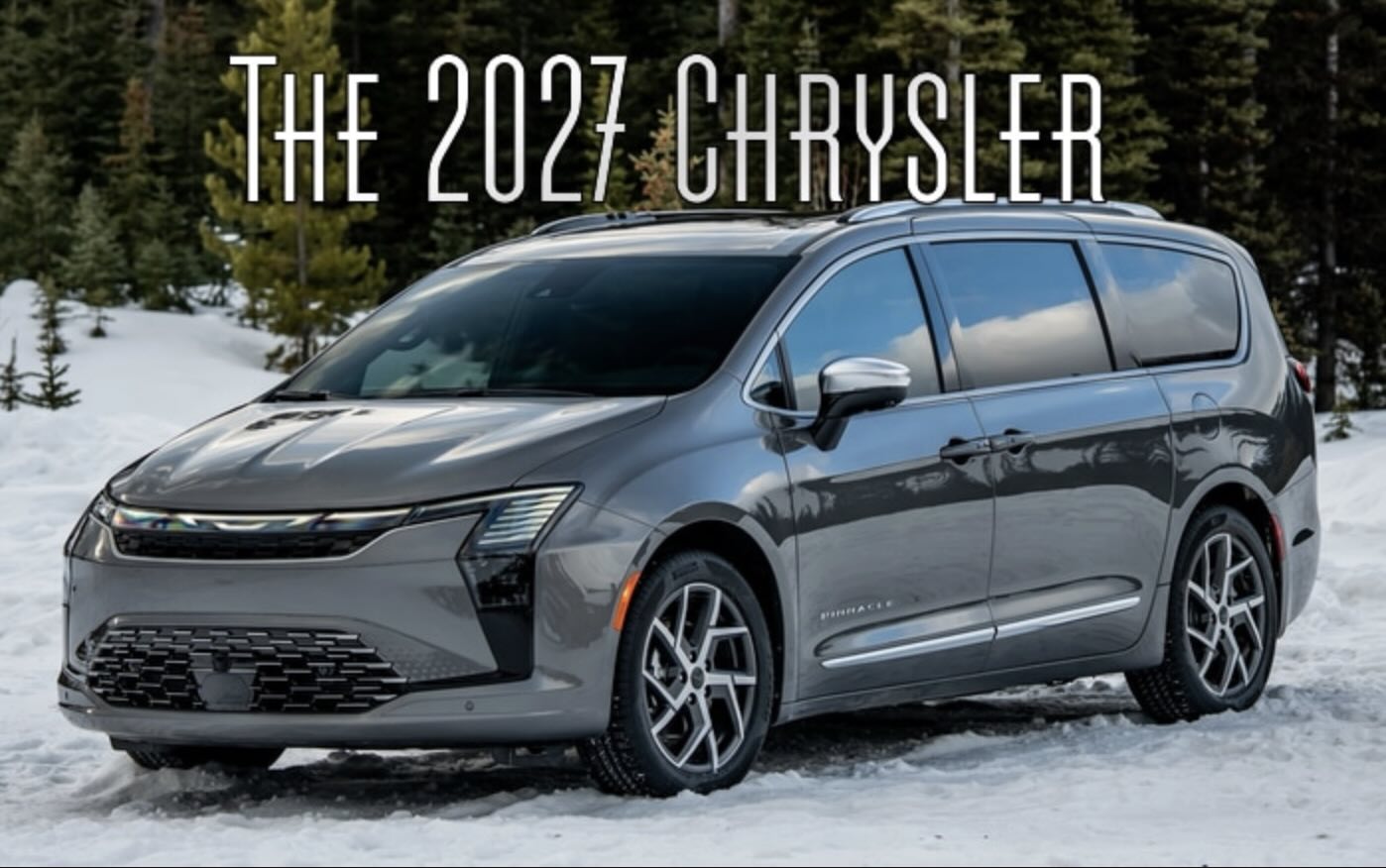

Chrysler has given its Pacifica minivan a facelift for the 2027 model year – but nothing more. More finely, nothing else. Chrysler is the only brand that sells just one model. How much longer will it be able to survive as a brand on that basis?
It is also the last V6 powered Chrysler – which brings us part of the way toward an understanding regarding why there is only one Chrysler left and why it’s not unlikely there will shortly be no more Chrysler.
Until 2023 you could buy a Chrysler sedan – the 300 – with the same 3.6 liter V6 that’s currently under the hood of the Pacifica. The 300C – which came with the 5.7 liter Hemi V8 – was the glamorous version of the 300 that got most of the attention, but it was the 300 with the standard V6 that sold the most. Probably because it had a base price of $34,295 (vs. $46,350 for the C with the Hemi).
Re-read that.
It was a mere three years ago – just barely – that Chrysler sold a large, rear-drive family sedan with a six cylinder engine that compared favorably with a Mercedes E-Class or BMW 5 Series sedan (both of which cost $20,000-plus more to start and come standard with emasculated 2.0 liter four cylinder engines) for about what it costs to buy a four-cylinder powered, FWD Honda Accord sedan today.
Unsurprisingly, the 300 sold very well.
It sold well for nearly 20 years, from 2005 all the way to 2023 and was singlehandedly responsible for resurrecting something that had disappeared: The American luxury car that middle-income Americans could afford.
Before the advent of the rear-drive, V6 standard (and V8 optional) 300 in 2005, the only vehicles on the market that fit that description were expensive European luxury-brand models like the Benz E-Class. Americans – working and middle income Americans – had been pushed into smaller FWD and four cylinder cars by the mid-late ’80s. Put another way, nice things that working and middle income Americans once commonly owned had become luxury items for the relative few who could afford them.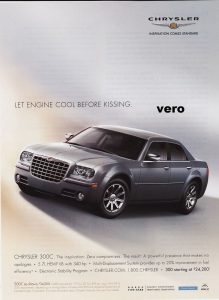
Then along came the 300, which was very similar – in part because it was related. Some will recall that, for a time, Chrysler was partnered with Mercedes (Daimler, the parent company of Mercedes) and on account of that, there was some cross-pollination. The original 300 sedan shared its underlying platform with the Mercedes E-Class, so people who bought a 300 were literally getting a Mercedes – just for a lot less than Mercedes money. When Mercedes (and BMW and Audi) began putting emasculated little fours in their (sic) luxury sedans, Chrysler buyers were getting more – literally.
Chrysler kept the V6 as standard and even offered a V8, something you had to move up to a Benz S-Class or BMW 7 (or one of their ultra performance AMG or M sub-models) to get and in that case, you’d be paying twice as much for one as what a 300 with the V8 cost.
It was a wonderful car. Past tense emphasis.
In the needless tragedy sense.
There was no good reason for Chrysler – for Stellantis, which currently owns Chrysler – to cancel the 300 or the Charger sedan it shared a platform with, because it was popular and making money for Chrysler (and Dodge). But it was also costing Stellantis money – because the V6 and V8 engines “emitted” too much carbon dioxide – as far as regulatory compliance requirements went – and that caused Stellantis to have to pay extortion to Elon Musk (via Tesla) for “carbon credits.” These operate kind of like income taxes in that you’re bled to pay for something you do not want to buy – or subsidize, as in this case. Elon Musk, the rent-seeker par excellence, has raked in billions extorting money from car companies such as Stellantis, thereby forcing them to finance his electric car grift. So-called “legacy” car companies such as Stellantis had to subsidize their government-mandated competition.
The chutzpah of this leaves one sputtering for words.
It was bleeding Stellantis white. Then-CEO Carlos Tavares decided it would cost the company less to stop selling engines – in cars like the 300 and the Charger sedan – and instead sell devices with batteries. Stellantis would be freed from having to fork over billions to Elon Musk as penance for manufacturing vehicles people wanted to buy, like the 300 and the Charger. But as became quickly evident, very few people wanted to buy a Charger that needed to be charged up. Sales cratered from what they had been before and for that reason, plans for Chrysler devices based on the Charger device were cancelled – which is why there’s only one Chrysler – the Pacifica minivan – left manning the fort.
It is a measure of what’s been lost. More precisely, what has been taken away.
It is a distinction that matters.
Maybe – hopefully – there are plans in the works to bring forth a new 300 based on the new Charger sedan, which has an engine again. Arguably, the new inline six that is available in the 2026 Charger would be better-suited in a new 300 because inline sixes are even more appropos in a luxury vehicle. They are smooth and sound wonderful. Both Mercedes and BMW offer them in their premium cars.
Imagine if Chrysler offered something similar – but for $20k less.
It could have the same effect as successfully defibrillating a flat-lined heart-attack victim.
. . .
If you like what you’ve found here please consider supporting EPautos.
We depend on you to keep the wheels turning!
Our donate button is here.
If you prefer not to use PayPal, our mailing address is:
EPautos
721 Hummingbird Lane SE
Copper Hill, VA 24079
PS: Get an EPautos magnet or sticker or coaster in return for a $25 or more one-time donation or a $10 or more monthly recurring donation. (Please be sure to tell us you want a magnet or sticker or coaster – and also, provide an address, so we know where to mail the thing!)
If you’d like a Baaaaa hat or other EPautos gear, see here!










Recently bought a one owner, garage-kept, low mile 2005 300C with the 5.7 Hemi for $6000. It’s spectacular. When I’m not hot-rodding around in my Firebird, I drive around in absolute luxury in the 300. Granted, I have no experience with actual luxury vehicles, but this thing is superb.
I see why they were so popular. And why they had to be killed.
First gen and first year for that great car. You could get the 5.7 w/AWD too.
2011 was second gen, but they dropped the AWD for the V8 and sales took a little hit w/RWD only (v8). 2017 got a facelift and I had an ’18 V8 RWD-only and loved it, but I also had to have a 4×4 for the winter. Some will say “you can drive RWD in the winter”, yes, and I did, but the 300 RWD V8 did not come with, nor could you order, a posi rear (dumb). So one wheel drive that couldn’t get up a modest slope with ice/snow.
The new Charger is AWD std. and I have my eye on them, and hoping they come out with a 300 version.
Lincoln could have gotten away with selling one model when Ford was profiting $1.2 billion per year just on Town Cars.
That is in 1990 dollars. Even according to the feds, that’s $3 billion in 2025. Toyota’s worldwide profits last year was $4.7 billion in 2025 dollars.
You can still get their good V6 in the Grand Cherokee lowest Laredo trim (for now).
And the lost 300, one of my favorite cars I’ve owned. 300 RWD-only V8, it was very good for $45K’ish, but I wore it out and couldn’t get another one.
I do believe that there will be another 300 and with the strait 6 (not sure on hemi yet?). I would buy it for sure, and this time it will be AWD so 4 seasons, required for me.
Pretty sure US-based Stellantis is pretty busy playing catch-up with their disaster role-out of their EV crap (like many), and cancelation of the hemi which is now avail in the RAM.
If only they would offer a new early 70s style Imperial with an engine over 350ci; but that would be too smart and popular.
Gas is going to be very expensive for a while, that would probably be an ill timed decision.
when I wrote that, I totally forgot what just happened in the past 2 weeks, but assuming it is temporary….funny how every time gas gets cheap and bigger engines come out, something like this happens
The Chrysler LX platform cars are unibody, not body on frame. A real BOF car would have truly been something special.
Too bad they axed it, great example of a flexible platform that resulted in a lot of interesting variations.
Regulation could be a cause but seems more idiot non-car people running the company. It doesn’t take a Harvard MBA to recognize the market liked them.
The Mercedes CLA and GLA have always struck me as Chrysler designs which were in the pipeline when the Germans gave up on the combined company, taking everything which wasn’t nailed down back to Stuttgart when they bugged out of Auburn Hills.
Squint and you can imagine the pentastar badge on those vehicles, especially the early iterations of the CLA.
the problem with the Pacifica is that 3.6 liter V6 engine.
or at least the way Chrysler decided to engineer it in the Pacifica.
the upstream catalytic converter generates so much heat that it warps the head gasket.
so severely that replacing the head gasket is only a temporary band-aid.
the real fix is a new engine, which will eventually fail the same way.
meanwhile the over-20-year-old 3.8L V6 in my Grand Caravan just keeps on truckin’
The 3.8 is an anvil of a motor, but I’ve had great luck with the 3.6 also. I just don’t see the DOHC pentastars lasting as well as the 3.8 pushrod engines.
Under the fun and games column at the stealership. Read the fine print regarding any updates before getting them done.
https://www.msn.com/en-us/news/technology/i-took-my-car-in-for-a-software-update-and-when-i-got-it-back-half-the-features-were-locked-behind-a-subscription/ar-AA1YlE8c
I listened to the video, and would be interested in hearing what the gentleman has to say about the other 30 or so useless “features” that are now being included in new vehicles. A friend of mine has a new Forester. It came with an auto start. The caveat? She is only “allowed” to start it (remotely) twice, and then, the vehicle only runs for 10 minutes each time, and no more! She was better off just going to an Auto Trim place to have one installed. My vehicle has an after-market auto start, and it is very nice at -40 below, to be able to start the vehicle as many times as is necessary. Same goes with the heated seats. Better to just have the vehicle not come with such a “feature”. You can have such installed, and know you can actually use the feature as many times as you need to. Sadly, new vehicles are merely computers-on-wheels, and not much safer or any more secure.
One reason that minivans cost so much might be all the airbags they are required to have by law. I’m curious why they haven’t started making the 300 again; sure it’s obsolete but have regulations gotten that much tighter that you couldn’t build it for a few more years?
How hath the mighty fallen.
I always liked the 70s era Newport convertibles. Oh well.
‘Chrysler has given its Pacifica minivan a facelift.’ — eric
*yawn*
I’m not opposed to minivans. The first-generation Dodge/Plymouth minivans were simple, bare bones, maintainable vehicles that weighed in the 3,300 to 3,500 lb range. Though underpowered with their original four-cylinder engines (available with 5-speed manual), they later offered a V6. These minivans were a classic low-profile, stealth vehicle.
Like all other vehicles these days, minivans have bloated out, as they became festooned with chips, airbags and douchescreens. The bubble shape of the 2027 model is awkward — like a lumpy 55-year-old matron with a ‘low-slung chassis.’
I vastly prefer the simple, honest, square-jawed lines of the first generation. But it’s yet another desirable vehicle that’s not available anymore, at any price.
I second that, Jim –
The prices are just stupid, too. Minivans were once cheap. As family haulers ought to be. The current (2026) Pacifica’s base price is just shy of $45k.For a got-damned minivan! Sure, it’s a nicer minivan than the vans Chrysler was selling back in the ’80s and ’90s. So what? How many families would love to be able to buy a 7-9 passenger kid hauler for $20k or so?
The high price is another strike against buying one. Young families can’t get one even if they want one. So its for “well to do” senior citizens, which is not a long term market for them. And when they buy, they only get one, because they won’t put loads of miles on them.
At least they can be picked up used from estate sales at an affordable price.
They are super useful yet the “suburban mommy mover” social scorn seems to stick.
Family friend has an aging KIA van. Two slider doors, captain seats in the middle, third row too, all foldable. She loves it, and has camped in it as well. I’ve driven it, fine by me for what it’s designed to do. V6 is plenty zippy.
Hi Sparkey,
Yup. Dawn used to have a Kia minivan and it was a nice rig. We ought to have kept it.