

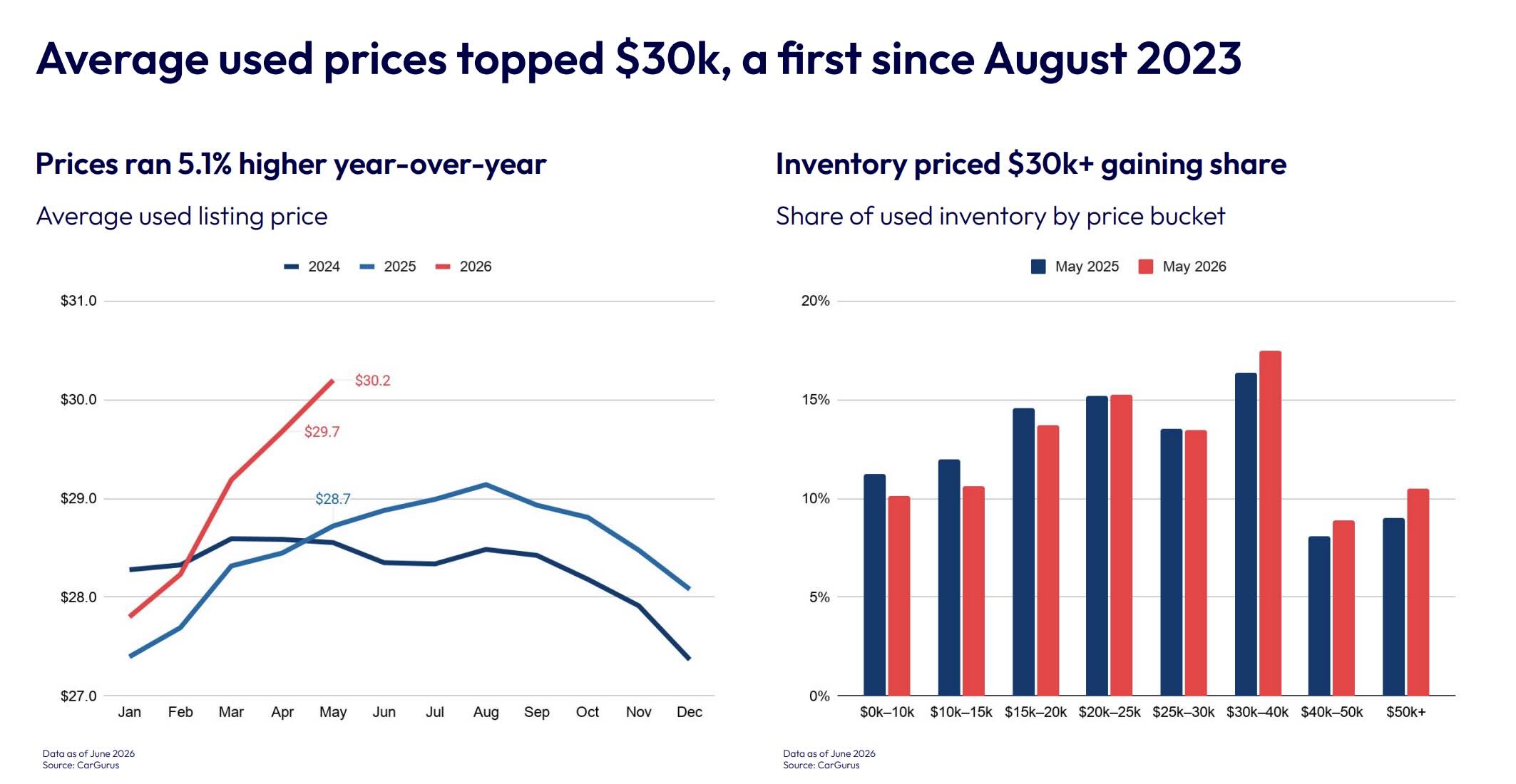

The average price paid for a new car is now just shy of $52,000 – so it’s not really surprising to hear that the average price paid for a used car is now more than $30,000 (a new post “COVID” high). The latter figure sounds almost affordable – relative to the former figure.
Used car prices are of course tied to the prices paid for new cars. A new car that cost $52k when it was new will lose about $20k of its original purchase price in depreciation over just a couple of years; hence the $30k used car. When new cars sold for $30k, after three or four years, there were used cars available for $15k or so. Relatively new, low-mileage used cars. In other words used cars that weren’t high-miles, ten-plus-year-old beaters. Which is what the same money buys today.
A personal example will perhaps serve to make the point. Back in 2007, I bought my 2002 Nissan Frontier for $7,500 – which was about half what it stickered for when it was new five years prior. So it was only about five years old when I bought it and had about 50,000 miles. It looked new and it functioned as-new, since 50,000 miles on a vehicle made in the early-mid 2000s is something like a 25-year-old person in that life is only just beginning. I still have the ’02 Frontier and drive it regularly. I was able to pay cash for it back in ’07 because $7,500 isn’t really that much money, in terms of buying vehicles. It used to be pretty commonplace for people – not just rich people – to pay cash for a good used vehicle, like my ’02 Frontier was back in 2007. Today, something comparable – in comparable condition – would cost as much as a brand-new Frontier cost in 2002 because there is nothing available that’s new like my old Frontier that costs less than around $32k brand-new.
Have you checked out what used late-model Frontiers and Tacomas and Rangers are selling for?
What I spent to buy my ’02 Frontier used in ’07 with low miles and in excellent condition and only five years old would perhaps get you something comparable to what my ’02 Frontier is today – which is 25 years old (almost) and with another 100,000 miles on the odometer. That’s low miles for a 25-year-old truck and mine still looks pretty good and everything still works, which is why it’s still worth about two-thirds what I paid for it back in ’07.
But I hope I have made my point.
It takes more like $10k on the low end and realistically more to get a used vehicle in 2026 that isn’t a beater; i.e., one that can be driven as it is, that probably isn’t going to need major repairs right away. This puts people who are not pretty affluent (only pretty affluent people can generally come up with $10-15k in cash to buy a good used vehicle) or pretty handy with a wrench in a spot. Those with fix ’em-up skills can still buy beaters that need a new clutch or transmission or major brake work and get them fixed and roadworthy again for manageable money. But people who haven’t got fix ’em up skills – or the money to buy a good used car that isn’t going to need fixing up – will probably have to get a loan to buy a decent used car.
The average interest rate on a used car loan is right now is just shy of 12 percent, according to Experian. That’s about twice what it costs to finance a new car (about 6.5 percent). The reason for disparity is that used cars are used cars; they’re worth less already – and that means a higher risk of the lender ending up owing more than the car is worth, sooner. (It takes longer for a new car to depreciate enough to be worth less than the balance still due on the loan.)
The used car buyer’s monthly payment often ends up being higher than what it used to cost to finance a new car. And he’s driving a beater.
Salt in the wound is that the beater is probably no longer covered by its factory bumper-to-bumper warranty, or soon won’t be. This places heavy pressure on beater buyers – if they aren’t fix ’em-up types – to spend (to borrow) even more money, for that “peace-of-mind” extended warranty coverage.
It’s not just that new cars are becoming the indulgences of the affluent. It is also that used cars are becoming indulgences for the rest of us. The multi-pronged effort to get most of us out of cars altogether is working. If current trends continue trending, owning a car – new or used – will soon be something like what it was more than 100 years ago, when cars were luxuries that only a few were able to afford. Freedom of movement was not for the masses.
A return to that state has been the goal for at least the past 50 years – using “safety” and “the environment” (lately, the “climate”) as the pretextual excuses.
Why? Because the people who run things don’t like it that we who do not run things have been able to own and drive cars not-too-similar to the ones they have. A Bentley is a quarter-million dollar car. But a $25k Hyundai’s climate control AC works just as well – and now it even has huge touchscreens, too.
This is intolerable.
Also that the masses – that’s us – have had the kind of free-range mobility that was in former times a luxury. This detracts from its exclusivity and it also means crowds in places where those who run things go and they do not like crowds anymore than we do. The difference being they have the power (and the desire) to thin out the crowds that get in the way of their enjoyment.
It’ll be a lot more enjoyable for them when the average cost of a used car is $50k – which it’s likely to be a lot sooner than it took for it to get to $30k.
. . .
If you like what you’ve found here please consider supporting EPautos.
We depend on you to keep the wheels turning!
Our donate button is here.
If you prefer not to use PayPal, our mailing address is:
EPautos
721 Hummingbird Lane SE
Copper Hill, VA 24079
PS: Get an EPautos magnet or sticker or coaster in return for a $25 or more one-time donation or a $10 or more monthly recurring donation. (Please be sure to tell us you want a magnet or sticker or coaster – and also, provide an address, so we know where to mail the thing!)
If you’d like a Baaaaa hat or other EPautos gear, see here!










In other news: stamps used to cost a dime
I bought my 2005 Dakota in 2008 with 30k miles for 10k cash at the dealer. It’s at 200k miles now, and today I can’t find a deal like this. This was purchased during the “GFC” when cars were cheap. I think I’m stuck with this Dakota till the end since the stock market is no longer allowed to go down and prices keep going up.
Hi Ben,
Yup. It’s like musical chairs, isn’t it? Those of us who had the sense or just the good luck to get a long-term-term reliable vehicle at a affordable price are exempt (for now) from the outrageous increase in the cost of a decent used car. It behooves us to baby what we have.
Let’s be honest, Goyim. They don’t want you driving. They want you penned in a 15 minute city like the cattle they describe you as, collecting UBI till they kill you off with pills and injections. Until we get to non jew$, we’re on a plantation.
No probs. Maryland is considering banning cars 2006 and older. That’s probably half the vehicles in the`state. For sure the cars Eric is talking about I imagine the people. like 99% of the other Don’t Care Americans, won’t pay much attention so dump your older cars quickly!
Off Topic,,, about Food,,, Trump states from Zeronews referring to Regenerative farms;
“Trump said in his order that such practices can “strengthen soil health, lower input costs, improve chemical efficiency to reduce overall use, improve farm profitability, maintain yields, increase market value, expand access to new markets, and strengthen rural economies.”
All lies,,, of course! It’ll result in less production,,,more cost,less efficiency, less small farms etc, etc. He is presently buying them off with 11 billion dollar relief payments. Knowing Americans he’ll be successful.
It’s troubling that even here on ‘Eric Peters Auto’ is seems that sufferers of TDS(Trump Derangement Syndrome) feel the need to inject their mind virus in an attempt to infect an article about Used Cars.
I think it’s called deflection and/or projection or propaganda.
Get a life anti-Trumpers. He had little or nothing to do with current or past federal government rules and regulations on the auto industry. The environmental whacko’s(like Algore) of decades past and the ‘beloved’ Barrak Obama are front and center the reason for over-reaching regulation and high prices of todays autos.
Recently bought a brand new Honda Accord SE, for a used car price, at $27,500. Even with the BS dealer fee of $1200, at $28,800, it wasn’t a bad deal. Went ahead and got the 100K warranty, too. Yes, it’s a turbo, and a CVT, but it’s a honda, too, so hopefully, it holds up for another 15 to 20 years, just do the maintenance as required. Currently still driving a 1st generation Honda Pilot with 272K miles and still rolling.
Compared to the absurd $50,000 or $51,000 average new car prices today, and the 2027 requirement to have cars linked to a network that allows the (((authorities))) to cut off the ignition remotely, it was a no brainer.
Looked hard at used 1 or 2 year old cars, and even with 5K to 10K miles, the dealers only wanted $1,000 or $2,000 less than for those than a new car!! Easiest extra money I ever spent for a decision like that.
With the way things are going, it’s probably better to buy a new car, rather than a low milage used one for such a minimal price difference. Didn’t really want to buy it, but I have a suspicion that things are going to get worse before they get better here in the US.
YMMV….
Ken,
MD is far from the only state pushing something like this; there are quite a few of them actually. MA, CA, MN, and IL are among others pushing through similar laws; while the age of the vehicle is different in their bans (some states want to ban cars older than 2009, while others, like MD, use 2006 as a cut off), there are multiples of these bans working their way through various state legislatures. TK’s Garage on YouTube has been detailing this recently. Don’t think MD is the only state pushing this though!
I sent an email to Eric about it. I don’t know if he got it, let alone read it, but I sent him a link to one of TK’s Garage videos about these impending bans.
what the hell hasn’t commie maryland banned?
It won’t be long now before the president tells people that under his administration that used cars have never been cheaper.
cnn mslsd tell you that
“….which is why it’s still worth about to-thirds what I paid for it back in ’07. But I hope I have made my point.”
Yeah, you did, albeit you failed to spell it right – “to-thirds”.
As a parody, I’d like to retrofit the gigantic digital center console screen in a Tesla with an NTSC-spec cathode ray tube … as seen on TeeVees three generations ago.
Of course, it wouldn’t do anything when you touch it. It would need a big channel changer knob at the bottom, plus ‘vertical’ and ‘horizontal’ controls, to navigate through the menus.
‘Kept alive for <i<luvvvvvvv,’ as MIT professor Carlo Ratti would say. 🙂
Speaking of the elites not wanting us to travel freely as they do, a news report out of Maryland has the state government wanting to ban any auto older than 2006 off the roads except on sundays.
Hi Allen,
Seriously? That is outrageous what Maryland is proposing. That definitely sounds like a way to ensure that only super wealthy elitists can drive an automobile on the roads. Are they using the bull shit excuse of cliiiiiiiiiiiiiiiiiiimate change? If Maryland’s government gets its wet dream of getting cars older than 2006 off the roads, that insane idea is liable to spread to states that have gone ALL IN with Cliiiiiiiiiiiiiiiiiiimate change lunacy. I foresee Oregon, California, Washington, New York, and even Virginia (under its current governor) pushing such an insane idea.
And if that does pass, given that 2006 was 20 years ago, and we’re only a few months away from 2027, will they eventually change it to banning automobiles older than 2007, 2008, 2009, and so on?
John,
MD is far from the only state pushing something like this; there are quite a few of them actually. MA, CA, MN, and IL are among others pushing through similar laws; while the age of the vehicle is different in their bans (some states want to ban cars older than 2009, while others, like MD, use 2006 as a cut off), there are multiples of these bans working their way through various state legislatures. TK’s Garage on YouTube has been detailing this recently. Don’t think MD is the only state pushing this though!
I sent an email to Eric about it. I don’t know if he got it, let alone read it, but I sent him a link to one of TK’s Garage videos about these impending bans.
Oh I don’t doubt that other states are pushing something similar to what Maryland is pushing (under guise of “Stopping cliiiiiiiiiiiiiiiiiiimate change”), while at the same time claiming that they want to make daily living “more affordable” for the masses. This demented idea would almost certainly make daily living even MORE UNAFFORDABLE for the masses, to which they might simply respond with “It’s ALL Trump’s fault!”, and thoroughly propagandized people in such states will EAT IT UP as TRUTH.
Also, this $30k used car will likely have a teensy-weensy turbo 4 that is trying to lug around thousands of pounds of weight added by all of the safety regulations that have made modern cars so danged porky.
Those engines aren’t like the naturalally aspirated V-6s and V-8s of yore. They are under heavy boost and will likely require costly turbo rebuilds or replacement. The acres of screens will also be a failure point.
That $30k used car might be even more expensive when repairs wrought by Uncle Sugar and his contradictory regulation regime come due.
As I’ve said before, the Orange Man could, if he really cared about normal Americans, could eliminate these regs with the stroke of a pen. But he doesn’t and here we are. It is to weep.
Absolutely, Dr. Mantis –
My ’02 Frontier’s four is appropriately sized and it isn’ turbocharged. That’s prolly why it still has factory-spec compression and does not appreciably burn oil even after almost 25 years of service. It prolly has another 100,000 miles of service left and – the kicker – I could replace it economically if that becomes necessary. The five speed manual can also be economically rebuilt (if that ever becomes necessary). Imagine a current (2026) Tacoma with the turbo-hybrid four and the automatic ten years from now, with 150,000 on the odometer.
Toyota is maybe not the best example since they’ve been putting turbos on their truck diesel engines since the late 1980s. Some of the 1st generations (13B or 2L come to mind) tend to crack heads, so it took a while to dial them in. Now a turbo diesel Toyota engine (1GD and 1VD) is rightly expected to last several hundred klicks. I wouldn’t worry too much about trusting Toyota knows a thing or two about building a forced induction engine. Well, assuming they hadn’t forgotten how to do the basic stuff, like when machining a block clear the chips and debris anyway.
I hope so, Mick –
But I’ll wait to see how it pans out!
Toyota is the BEST example. They can’t build a naturally aspirated 4 cylinder whose rings won’t fail at 75,000. The current Tacos have seen engine failures at less than 1000 miles. Toyota slapping a turbo on a 4 cylinder is a double whammy.
To think, that’s what they ditched the live forever 4.0 liter six with. And to the best of my knowledge, they don’t sell a diesel anything for the US market in 2026.
Recognizing that the (((FEDGOV))) has created this entire situation of absurd prices is the most important point.
It’s because of FEDGOV’s increased safety requirements and regulations requiring them, that car makers have had to engineer extra crap, adding huge weight, and huge price hikes, to new cars.
We can’t hate the (((FEDGOV))) enough, because until you’ve worked for them, like I used to, you won’t understand how much the (((FEDGOV))) hates us Goyims.
Resist, resist, and then resist some more!!!
YMMV…
“… the Orange Man”…right. We WON, dude. Get over it.
Sorry Eric. My last comment was for Richard, not you.
No worries, amigo!
You’re missing the point, everything is too heavy.
Hi Not,
I haven’t missed it. I’ve written and spoken of this often.
The best thing we can do as gear-heads is to teach our children and grandchildren as much as we can about working on vehicles. And if we can’t teach them, pay for a couple of auto tech classes at the local community college so they can get some basic knowledge. Buy them a set of ratchets and wrenches for Christmas, a pair of ramps for their birthday.
It’s very gratifying to see a young person’s face light up when they say, “I fixed that!” It’s part of the path to freedom.
Amen, Mark –
I don’t have a son (or a daughter) to pass on my knowledge or my tools or my Trans-Am to. I’m hoping I will find someone worthy before I shuffle off to Buffalo!
Perhaps too personal a question, in which case feel free to ignore: why don’t you have kids, Eric? Certainly you’d make a great dad.
Hi cobblestones,
My ex and I had issues; we’re divorced now, so that horse has left the stable.
Better then that no kids were involved. The damage to kids from broken homes was once widely understood, and relevant laws worked to minimize the possibility. No longer – we’re fast approaching the point where such kids are the majority.
Unstable families -> unstable nations.
Takes only ten minutes with a young, fertile woman, and in nine months, your in business.
Mark – Ratchets and wrenches no longer cut it in the backyard mechanic department! Now you will also need about $10K worth of computerized diagnostic equipment just to figure out what is wrong. I used to do virtually all of my own repairs on pre-2000 vehicles – but I simply cannot afford the tools need to work on modern cars. Once again, thanks to the climate creeps.
You can get the diagnostic tools cheaper than this. Assuming you’d want legitimate tools and not Chinese knock-offs and virus laden cracked versions the cheapest option is a $600 Opus Mongoose for an interface. That sounds expensive but what did your chest of hand tools cost? It’s a tool that will last the life of the car.
Anyway, the Mongoose is usually recognized fine by the OEM software. I know it is for Toyota Techstream (it was one of the recommended interfaces by Toyota). Then you get a short term license from the manufacturer for the software, which last time I needed Techstream was $70 for 3 days. The only thing you need to be a business to do is program chip keys, which requires vetting to a 3rd party who verifies your business license and a few other documents so they aren’t giving out codes for a thief to make keys. If there’s one thing I wish was changed was right to repair laws that stipulate that if the owner wants to program keys then they should be given the ECU unlock master code for that.
The short term or light version is enough to do the job usually since you only need the software if the test requires two-way communication. For simple code scanning and resetting faults you can get a $100 code reader that does that. Not all troubleshooting needs the diagnostic software and it’s usually because you need to initiate a built-in test. The reason I needed the software was the procedure to bleed the brakes called for it. Which seems odd when you hear it but my vehicle is a 2016 4Runner and the brakes are used in the traction control (TRAC/VCS/ABS) and you need at a couple steps tell a pump to run so you can push the fluid through an actuator.
If you’re using the tools daily a professional interface and annual license could be $5K for each brand. So there’s no doubt the system has a lot of monetization baked in. A professional mechanic has to specialize on a couple of brands to make it work economically unless they are a huge shop.
‘The multi-pronged effort to get most of us out of cars altogether is working.’ — eric
As MIT professor Carlo Ratti exults, ‘electrification and autonomy will ultimately change everything.’ He’s positively giddy about the Ferrari Luce:
‘[Gearheads’] animosity is out of alignment with how innovation works. The Luce — “light” in Italian — is meant to carry Ferrari into the age of electrification. The Luce’s critics should be praising the company for its willingness to rethink what an E.V. is.’
Likewise, the MIT egghead is cock-a-hoop over ‘autonomy’ [for the vehicle, not for us, mind you]:
‘The self-driving technology available in most E.V.s turns the car into something summoned on demand. Once your hands and eyes are freed from the steering wheel, they can be used for other activities, like eating, working and
self-pleasuringscrolling through your internet feed.‘Quartz [watch movements] nearly buried Swiss mechanical watchmaking. [But] the mechanical watch survived, reborn as a luxury product that sells precisely because it is revered old tech. The internal combustion engine may follow the same path: kept alive for love.’ — NYT
https://archive.ph/K1zn1#selection-4905.323-4905.511
This is the slant from the spinmeisters of the Lügenpresse: internal combustion vehicles that require human control are colorful relics, fit only for museums and a ragged, dwindling band of knuckleheaded, gray-haired eccentrics.
Count me among these bitter clingers!
Hi Jim,
It’s beyond effronterous that Ferrari would call that fat pig “light.” A five thousand pound Ferrari! It’s early, but I feel the need to reach for the bottle…
I’m sure Richard will explain why it’s actually a fine thing.
Ferrari Luce EV: Has a curb weight of 4,982 lbs (2,260 kg)
GTC4Lusso (V12 AWD): Has a curb weight of 4,233 lbs (1,920 kg). Its empty dry weight is 3,946 lbs (1,790 kg).
Why would anybody care that the EV weighs 1000 lbs more than the gas V12?
Do you criticize pickup trucks for weighing too much?
For a typical 4-door Ford F-150:
SuperCab 4×2: ~4,391–4,800 lbs
SuperCab 4×4: ~4,600–5,200 lbs
SuperCrew 4×2: ~4,838–5,300 lbs
SuperCrew 4×4: ~5,000–5,863 lbs,
Richard,
Exactly my point. This Ferrari weighs as much as a full-sized truck. But – you see – a Ferrari is not a full-sized truck. It is something like a super-plus-sized supermodel. That you do not understand why adding 1,000-plus pounds of deadweight to a performance car is at odds with the fundamental concept of a performance car shows how little you know about cars.
Hilariously, “Luce” translates as light.
In Italian, “luce” literally means “light”, referring to the natural illumination from the sun, a lamp, or any source that allows visibility. Not lightweight.
Dodge Challenger SRT Hellcat: Weighing around 4,400 pounds, this model is a very heavy, gasoline-powered muscle car.
Bugatti Chiron: Tipping the scales at 4,450 to 4,586 lbs, it is a very heavy, gasoline-powered hypercar.
Lexus LC 500: At 4,280 lbs, it relies on a V8 engine and prioritizes grand-touring comfort
Ford Mustang GTD: Weighing about 4,404 lbs, this track-focused, gasoline-powered sports car
if you reviewed these cars would you say they were all no good because they’re too heavy?
Richard,
I’d say they are a lot lighter than the Luce! Do you know what the 7.5 liter (455 cubic inch) cast iron V8 that’s in my Trans-m weighs? About 600-700 pounds. So the Luce is like a Hellcat with a fully dressed cast iron V8 dumped in the trunk.
It’s also without character. Which the Hellcat has in abundance. A Luce is essentially a very quick (and very expensive) Nissan Leaf.
Even with that 1,800 Hp turbocharged, multifuel engine, an M1A3 Abrams is still four tons heavier than a King Tiger tank.
Hi Douglas,
There is a fundamental absurdity expressed in an ostensibly “efficient” and “environmentally sensitive” vehicle that weighs 5,000-plus pounds. I mean, no apologies necessary for a ’72 Sedan de Ville; it was supposed to be about excess and extravagance. But it’s nauseatingly pretentious to present a 5,000-plus pound EV that gets to 60 in 3 seconds as anything other than excessive and extravagant. Spare me – please – the pieties about how “green” it is.
Holy shit, that was uncanny!
On command, Eric’s nemesis and evil twin Richard Greene shows up like a pestiferous djinn to refute whatever Eric says today.
If Eric claims the sun is yellow, Richard surely will counter that the sun’s highest-energy emission from a wavelength perspective is at 500 nm, or blue-green.
‘The sun ain’t yellow, it’s chicken!‘
— Bob Dylan, Tombstone Blues
Is it magic … or is it AI?
Ask your agent about crazy pills.
Morning, Jim!
Yup. I think Richard posts here to try to gin up attention for his “climate” and “economic logic” blogs. He includes links to them in every post he leaves here. He really ought to send me some money for the free advertising I provide!
the links don’t work here
you want money for that?
my website is free with no ads and no begging for money … this would not be a good place to advertise because i suspect most people here think CO2 does little or nothing & believe global warming is a hoax
The heaviest Corvette ever built is the 2026 Chevrolet Corvette ZR1X, which has a curb weight of 3,914 pounds (1,775 kg) for the coupe and 3,978 pounds (1,804 kg) for the convertible. The 2026 corvette handles well for such a heavy car.
Hi Richard,
Yes, I’d like you to pay for the free advertising/publicity I provide. It’s the decent thing to do. If you think you’re not getting much action, then why not just use your email in your handle (and only your email) like everyone else does? Why do you include plugs for your blogs in every comment you leave here?
You keep trying to make excuses for the 5,000 lb. Luce by referencing much lighter vehicles, such as the Corvette – which weighs 1,000 pounds less.
My ’76 TA was considered porky back in its day. It weighs about 3,800 lbs. Notwithstanding it has a massive cast iron V8. And a bolt-on steel front subframe similar to a truck’s. It has a solid (cast iron) rear axle and stamped steel control arms and steel wheels. And it still weighs 1,200 pounds less than the Luce.
You make it too easy.
Richard is a true believer in the church of CO2 Climate Change, a dead, false church with zero redeeming value. If you doubt me, look at his posts on What’s Up With That site.
If Richard is a true believer in the church of CO2 causing climate change, he should watch segments on the internet from comedian Jimmy Dore that shredded the whole cliiiiiiiiiiiiiiiiiiimate change thing. IIRC, Dore himself once believed the narratives until a few years ago.
Ironically, the BIGGEST pushers of that particular narrative are billionaire elitists that people on the Political Left constantly claim to hate. Dore has also interviewed someone named Tony Heller, who himself is actually a climate scientist instead of those who CLAIM to be one or get paid handsomely to peddle BS narratives on climate change.
Indeed, John –
Also, I’d love to know whether Richard walks the walk or just talks the talk. Does he own a single family home? What about its “carbon footprint”? Does he eat meat? Oh, the CO2! Those cows are “emitting” it bigly! Does he drive an EV or wait for the bus? Or has he got a car with a combustion engine? Inquiring minds want to know!
My bet is he’s an affluent retired guy who lives a comfortable life but likes to preen green. If I am wrong I will apologize for saying this.
Hi Eric,
It’s telling that Bill Gates, who himself was a BIG pusher of the cliiiiiiiiiiiiiiiiiiimate change narratives for years, changed his tune on it last year. There was speculation that he did that because the whole climate change thing has been exposed as a GINORMOUS SCAM for billionaire grifters like Gates. There was also speculation that vaccines has become the latest grift for him as he has also been pushing vaccines on the world for years, particularly 3rd world countries, under guise of “Promoting Global Health”. The funny thing is, Gates has NEVER been a doctor as far as I know, and the only experience he has with VIRUSES is COMPUTER VIRUSES, having been a co-founder of Microsoft.
Thankfully, the ZR1X weighs two tons, that car that makes 1,250 HP, it would be mildly terrifying w/o some mass holding it down…and in 20 years will be a classic…and you can buy more than a few of them for the price of one FerraGay…
And by then, the FerraGay Il Douche will need a new fortune-smashing battery, if it hasn’t already burned to crisp…Oy Vey!!
YMMV…
Stopped reading Richard’s comments many moons ago. Eric is spot on, Richard is getting free advertising. From what I recall of his writing, he needs it
My name, address and website address are filled in to comments automatically with one click of my mouse. My website address does not work at this website, so clicking on my name doesn’t get to my website, unlike all other websites where i comment … My free website does not need any advertising, as i had 688 page views yesterday, and over 650 so far today.
EP seems offended by anybody who does not agree with him 100%, and feels that insults have to be directed at such people. That’s how to encourage an echo chamber in the comments.
That somebody can click on my name above my comment, and NOT get to my website, somehow leads to insults? EP often sounds like a graduate of Trump Charm School
The person who falsely claimed EV’s will need a new battery pack during their lifespan, has a lot of nerve telling me i know nothing about cars after my 27 years working in product development at a US auto manufacturer
Richard,
I have no problem with disagreement; I merely point out when you are wrong about things.
PS: I’m curious. You mention 27 years in product planning; did you ever turn a wrench? Do you now?
Every commentariat needs a pinata, thanks Richard for stepping up!
“….‘The self-driving technology available in most E.V.s turns the car into something summoned on demand.”
Right. Like the Tesla in this past week’s news that was reportedly “self-driving”, and drove itself through the wall of a home in Katy, TX and killed the occupant.
There’s ya some fine “summoning on demand”.