

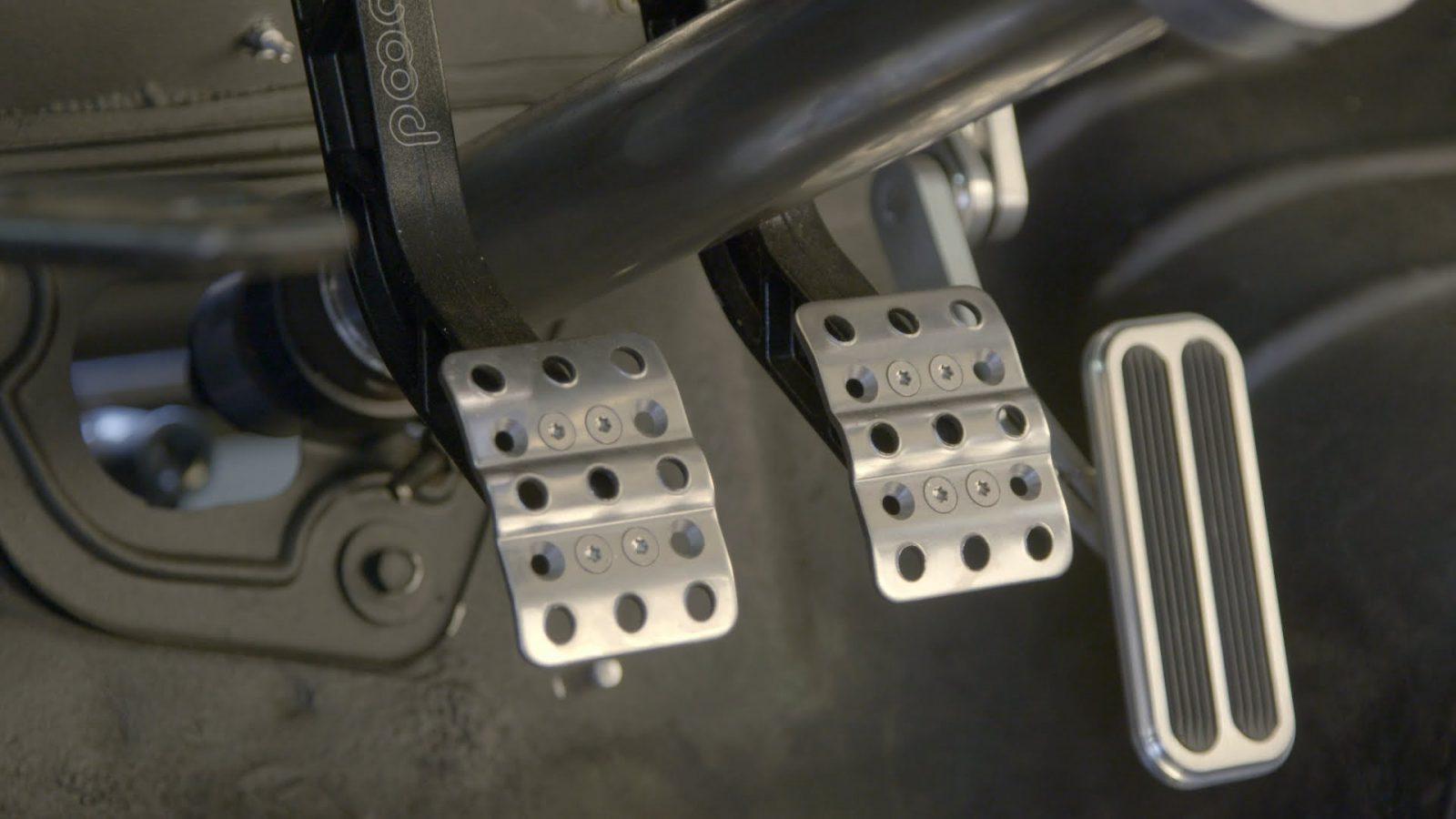

If you own a car with a manual transmission, you have a third pedal – and a clutch. What you probably also have is a slave cylinder and a brake-like hydraulic system to actually actuate (engage and disengage) the clutch. Unless your manual transmission-equipped car was made before the early 1980s, in which case you probably have just a third pedal that mechanically engages and releases the clutch – usually via either a cable or (as in the case of an old car like my ’76 Pontiac Trans-Am) a rod connected to the clutch pedal that directly pushes the clutch lever arm in (and out).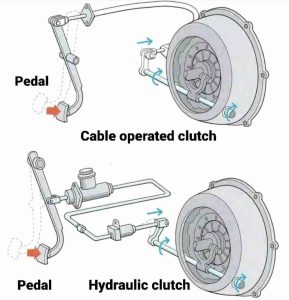
What are the advantages – and disadvantages – of these differing ways of engaging and disengaging the clutch?
Hydraulic clutch advantages:
Consistency of pedal feel; less pedal effort (usually) and self-adjustability.
Hydraulically engaged clutches work like hydraulically engaged brakes, which cars have had for 100 years. Both use brake fluid to transfer force – you pushing down on the pedal. Because the force is applied hydraulically, the force is applied more fluidly. Also, more consistently as there is less (if any) variation from car to car as they leave the assembly line.
Mechanically actuated brakes (which Henry Ford favored) and clutches have to have their mechanisms – the rods and levers or cables – adjusted as the cars are assembled and afterward. Clutches wear as the vehicles is used; i.e., the friction material (which is similar to brake pad material) thins as it wears and this play requires occasional adjustment to dial out, which must be done by hand. If it’s a rods/levers system, the adjusting rod must typically be turned in/out by hand to get the play (or slack) out of the system. Not too tight – or too loose – or the clutch will be partially (or prematurely) engaged/disengaged and wear will happen faster!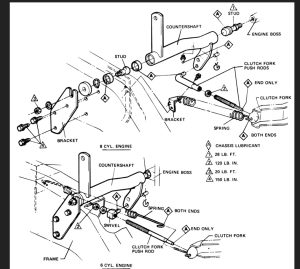
Hydraulic clutch disadvantages:
More components always means more potential failure points; need to regularly bleed the hydraulic system – which many people forget to do. Can be a expensive to fix.
A car that has a hydraulically actuated clutch has an additional hydraulic system, including (usually) a separate master cylinder for the hydraulic fluid and (always) hydraulics lines and a slave cylinder, which is the part that works kind of like the brake caliper (and drum) pistons in the braking system that are pushed outward by hydraulic pressure applied by your foot pressure. It transfers (via the brake fluid) the pressure exerted by your left foot when you push down, to disengage the clutch.
There are several potential failure points here. Hydraulic systems can (and do) develop leaks; master cylinders and slave cylinders can (and do) fail. When that happens, you may not be able to drive the car – just as you may not be able to drive the car when its braking system develops a line leak, or the master cylinder fails. The clutch pedal will typically go to the floor when there is a failure in the hydraulic system. It’s not an easy fix by the side of the road.
These failures are more likely to occur if the brake fluid in the system is not regularly (about every three years) replaced by bleeding the system, which many people forget about or don’t know about.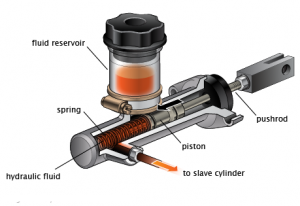
In some vehicles, replacing a failed slave cylinder can mean having to remove the transmission – in order to get at the slave cylinder. That is obviously not a simple or inexpensive job, if you have to pay someone else to do it.
Mechanical clutch advantages –
Fewer potential failure points, simpler system; more direct/connected pedal feel.
Cables do sometimes snap; had that happen to me once while driving my ’74 VW Beetle. But the fix was easy – just replace the snapped cable. This can often be done with just a few basic tools or even just by hand. The transmission didn’t have to come out to do this job. No clutch slave cylinder or master cylinder, either. My ’76 Trans-Am’s clutch does need to be occasionally adjusted, but the adjustment is easily made – by hand and by feel. There’s a rod that you screw in (or out) to increase (or decrease) the play and a 9/16 locknut that you tighten once done and that’s it. The rods/levers and Z bar are sturdy pieces of steel that are unlikely to ever fail and if they do, they are easy and cheap to replace.
Pedal – though this is subjective – feels better, too. More connected and real. You have a better sense of clutch engagement; hydraulically boosted systems can feel mushy and vague.
Mechanical clutch disadvantages –
You do have to make those occasional adjustments; pedal effort can be higher.
If you’re not handy – or just prefer not to have to be handy – you will have to pay someone who is to make the occasional adjustments, to keep the play within spec. It’s not a big expense, but it is an expense you don’t have with a hydraulically assisted system, which adjusts itself. It can be more work to drive a car with a mechanical clutch, especially if that car is a performance car with a high performance/heavy duty clutch (and springs) that requires more effort to engage/disengage. It’s much easier to drive something like a new Mustang GT (with a manual) in stop-and-go traffic than it is to drive an old muscle car like my ’76 Trans-Am.
But my ’76 Trans-Am is much more fun to drive!
. . .
If you like what you’ve found here please consider supporting EPautos.
We depend on you to keep the wheels turning!
Our donate button is here.
If you prefer not to use PayPal, our mailing address is: EPautos 721 Hummingbird Lane SE Copper Hill, VA 24079










I prefer a hydraulic clutch because the action is smoother. A mechanical clutch on a torquey v8 be design has to be heavy. One advantage to hydraulic clutches is that the manufacturer has far more freedom to set resistance and other rates. This becomes more important as joints wear out due to aging. An even bigger factor would be driving with gout somewhere in your left foot. A gout flair up can easily last a few weeks and a heavy clutch can be painful even with just a remnant on a toe joint.
There is also the issue of the clutch cable / rod going through the firewall. When it comes time to replace the cable there likely be a lot of cramped work under the dashboard with and around old rubber grommets and old electrical cables with hardened insulation. Another exercise rendered less enjoyable in conjunction with gout.
Of course these are reasons why old men tend to prefer automatics.