

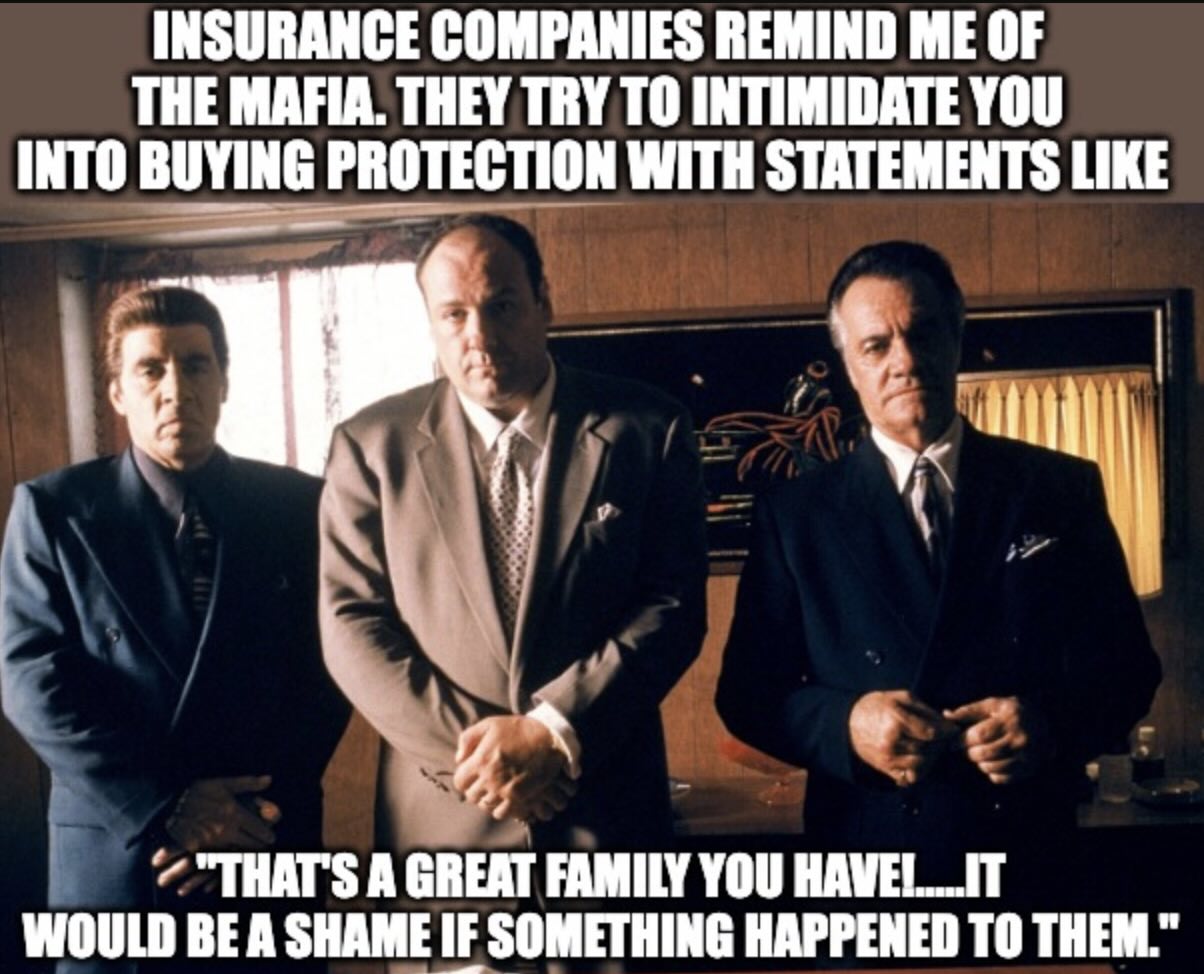

Over just the past 2-3 years, the cost of government-mandated car insurance “coverage” (more about the reasons for the air fingers quote marks shortly) has gone up by more than 25 percent, on average. I’m paying three times what I was paying for a liability-only policy that doesn’t cover anything – as regards my old, paid-for truck. The coverage applies, hypothetically, to damage I might cause someone else’s vehicle rather than any damage to my own.
Note the might.
I italicize the word to initiate a few additional words about this very strange business we’ve all gotten used to of being forced to pay for damage we might cause. It is an interesting concept. Almost anything one does – other than lie quietly in bed – might end up causing damage.
If this “might cause damage” business is the accepted basis for government forcing people to buy coverage, then there are almost limitless possibilities for additional such requirements. It could be logically argued – using the logic government uses – to require every man capable of throwing a punch to buy Fist Insurance, since he might (and could) punch someone in the mouth.
Who is going to pay for those lost teeth?
Its not silly. It’s serious. Because it follows. The government says people who own cars must buy at least liability coverage because they might run into someone else and that could cause damage. Well, how is it logically not the same thing to argue that a man might punch someone else in the face? How is it that any man capable of throwing a punch is allowed to walk in public without having purchased coverage to pay for the damage he might cause with his fists?
The only sane answer is that government hasn’t gotten around to that yet.
Government-mandated liability insurance doesn’t just force us to pay for the damage we have not caused but might. It also forces us to pay for the costs government imposes on new vehicles that we do not buy – and also the choices made by other people as regards the vehicles they choose to buy. This circles us back to the theme of this article, which is how government forcing us to buy liability insurance will soon force many of us out of our vehicles.
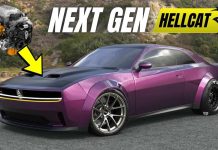
Why has the cost of liability-only coverage gone up by so much over the past 2-3 years? The main reason is the cost of repairing (or replacing) the cars made during the past2-3 years. Every new vehicle costs thousands more to buy than it did 2-3 years ago and some models tens of thousands more. One example of the latter is the 2025 Dodge Charger EV, which replaced the Charger with an engine. The latter stickered for about $33k just two years ago (2023). The 2025 Charger EV stickers for $57,995.
The proliferation of $50,000-plus EVs over the past 2-3 years has hugely increased potential liability costs and it is not just the EVs. Many new/recent-vintage vehicles have shockingly expensive bits and pieces, such as LED headlight and tail-light assemblies that can cost hundreds each to replace. Break two of these, plus the enormous gaping fishmouth plastic grill that most new vehicles have – as can happen in a minor accident – and the repair costs can amount to thousands of dollars.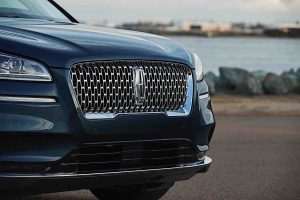
Government-mandated “safety” equipment that relies upon arrays of little cameras and sensors built into the front and rear ends (and windshield glass) of new vehicles is both fragile and costly to replace when damaged.
Someone’s got to pay for that. Even if you didn’t break it.
Guess who?
So, because other people have chosen to buy a new vehicle laden with expensive features both desired by them and mandated by the government, the people who chose not to buy them are forced to pay for the damages they might cause to them. The effect of this rip-tide is that people who are trying to keep the cost of owning and driving down by driving older, less-expensive vehicles and having liability-only insurance are dragged along by the cost-choices of others as well as by the costs imposed by government.
Everyone else pays more, too.
But the distinction here is that when someone chooses to buy a new vehicle they have chosen – morally speaking – to assume the higher costs associated with owning it. This ought arguably to include the higher costs of fixing/replacing it. If there were even a whiff of fairness to this forcing people to buy at least liability coverage, those who chose to increase their own liability potential ought to pay for that. Not the people who very deliberately chose not to increase their own potential liability costs.
Limiting the liability for damage that might be caused to someone else’s vehicle by you to $30,000 would protect people who can’t afford to spend $50,000 (or more) on a vehicle from having to pay more to cover the costs of other people’s choices. Affluent people’s choices. There is something off about the government forcing people who are not affluent to absorb the costs of the choices made by affluent people.
Of course, the government understands perfectly well that forcing people to buy insurance is a brilliant way to force people out of their cars without actually passing a law that says they’re not allowed to own or drive a vehicle.
In particular, people who are not affluent. When the cost of a basic, liability-only policy becomes more than they can afford, what will they do? One of two things.
The first being they give up driving. But this is not just obnoxious, it is not viable. Not without completely changing their manner of living. As by moving from the suburbs or the country to the city and living a Proletarian Life – which isn’t very appealing. For many, this isn’t feasible, either – even if they wanted to live the Proletarian Life – as their jobs are not accessible or doable without a car. What are they gong to do? How are they going to pay for their Proletarian apartment in the city?
This bring up the other thing. Noncompliance.
Stop paying but keep on driving. Why not? It is no moral sin to ignore the government’s demand that we pay to “cover” the cost of damages we have not caused. Arguably, it is morally righteous to refuse to pay such costs as it amounts to punishment for something we did not do, which is inherently wrong. Obviously, if a person’s actions result in damages, then that person owes a debt. But it’s bizarre and vicious to say a person whose actions have caused no damage to anyone must pay up. Over and over and over. Year after year after year..
Yes, of course, the government will go after those who do not pay for the damage they haven’t caused and some of the latter will pay in other ways when they are caught. But if enough of us practice noncompliance, it becomes difficult to enforce compliance. Prohibition is an example of the power of noncompliance; so also the 55 MPH highway speed limit. The government enforced it for 20 years but it became unenforceable because of widespread noncompliance, which made it obvious that Drive 55 was ridiculous and that punishing people for driving faster was vicious.
It is just the same as regards the viciousness of forcing people who do not want to pay for the damages they have not caused to other people’s $50,000 (and up) vehicles. Limiting liability to $30,000 would serve to curb such costs – because those who choose to assume them would be obliged to pay them.
If not, then it’s time for noncompliance. It beats Hell out of waiting for the bus.
. . .
If you like what you’ve found here please consider supporting EPautos.
We depend on you to keep the wheels turning!
Our donate button is here.
If you prefer not to use PayPal, our mailing address is:
EPautos
721 Hummingbird Lane SE
Copper Hill, VA 24079
PS: Get an EPautos magnet or sticker or coaster in return for a $25 or more one-time donation or a $10 or more monthly recurring donation. (Please be sure to tell us you want a magnet or sticker or coaster – and also, provide an address, so we know where to mail the thing!)
If you’d like a Baaaaa hat or other EPautos gear, see here!



The Tariff Cost Crucible
General Motors reported second-quarter earnings that surpassed analyst expectations, even as the automaker absorbed a $1.1 billion hit from tariffs – but it also warned about a coming steeper impact from tariffs moving into the second half of the year.
Strong U.S. demand for gasoline-powered trucks and SUVs helped bolster results, but the company warned tariff headwinds will intensify in the third quarter, according to Reuters and the company earnings report. GM maintained its estimate that tariffs could cost between $4 billion and $5 billion this year.
The company said it aims to mitigate at least 30% of that impact through cost-cutting and strategic adjustments. Despite the earnings beat, shares were down more than 7% heading into the end of Tuesday’s trading day. — ZeroHedge
https://tinyurl.com/4wut5ce6
Despite letting auto makers off the hook for CAFE fines, the Tariff King may be the worst enemy they ever had. He just arbitrarily whacked them for BILLIONS of added
coststaxes. And the final outcome isn’t even known yet.Read my lips: no new tariffs.
Last Car in U.S. Under $20,000 to End Production:
https://www.the-sun.com/motors/14788407/popular-sedan-discontinued-us/
Your insurance ONLY went up 25%? You are ONLY paying $300 per annum? Lucky you. Mine DOUBLED after I hit a deer with one vehicle and had a cracked windshield on a different vehicle.
A large part of the problem is not just the cost of new vehicles, but the scumbag lawyers advertising every five minutes about how many millions they can get you if you were in a fender-bender.
I’m all for people getting compensated for injuries caused by others, but personal injury law is clearly a racket intended to enrich the lawyers.
Hi X,
I hear you. But I was only paying $133 annually just three years ago. And that’s reasonable for a liability-only policy for a guy with 30-plus years of accident/claims-free driving, zero “points” and an old truck that is driven maybe 5,000 miles annually. I resent being forced to pay a cent, of course. Because I resent being forced. I “owe” no one a cent whom I have not injured. Their fear that I might is not a legitimate claim.
But now I am paying a sum that is getting disproportionate. If it goes up appreciably, I am going to tell them to go to Hell and just drive without. I am getting to that age of “I don’t give a damn” anymore.
But, but, but. . .I feel unsafe when I take my own car out in public among the thousands of other drivers around me. In order to quell my icky feelings of being unsafe, I demand that each and every one of those drivers obtain an insurance policy. This is much better than me going out and getting uninsured motorist coverage to quell my icky feelings. Oh, and I like the fact that making a claim against other people’s insurance policies has become so complex that I’m virtually required to agree to give at least 33% of my damage claim to a lawyer. There. All my icky unsafe feelings are all gone.
Hey, I just heard that if I download the app and bundle my coverage I could save money. The more I bundle my “coverage,” the more I save. [happy thoughts]
I was listening to Marxist propaganda on YouTube this morning.
The contention was that there are too many cars in private hands and public transportation will be better and less expensive.
Car rentals could handle demand for private use for a limited amount of time.
Too many resources are wasted said the narrator, when automobiles can be removed from private hands, resources will be conserved and money will be saved in the long run.
Insurance companies would squeal like stuck pigs.
I don’t want to take public transportation, I don’t want to rent a car, I want my own. My choice.
Who in God’s name wants to use public transportation?
Even the Amish have horse drawn wagons, four wheels of some kind, a buckboard, a place to haul some cargo, good to go.
The Amish aren’t going to change that at all.
Public transportation won’t work, lots of problems already.
No private ownership of automobiles will create a huge vacuum.
Nature abhors a vacuum, what it will be.
Recently bought a liability policy for the Jeep I purchased.
The cost is 62 dollars each month, 744 dollars per year.
I feel like I’m being taken to the cleaners.
You’re on the hook no matter what, pillaged, plundered, robbed.
All lawfully done, you pay through the nose once again.
Those guys aren’t there for you.
I need a drink.
Amen, Drump –
My old truck is paid for and maybe worth $4,000. I am now paying – being forced to pay – roughly $300 annually to “cover” the chance that I might damage someone else’s vehicle. Assuming no rate increase ( a silly assumption) over the next six years I will have been forced to pay about half the value of my truck to the insurance mafia; I have already paid the other half of its value over the course of the past eight years. So I have – effectively – had to buy a second truck like mine, except I don’t get to have the second truck.
We’ve been on this road to Marxism for quite a while, but it was Chief Justice Roberts who codified the decision that the government can force you to buy a product because…it is a tax, and the government has the power to tax.
It’s actually worse than that. It’s not a “product.” It’s a forced wager on a medical expense bet. But what if I didn’t want to place that wager? Tough shit. Then I had to “contribute” to the IRS with “my shared responsibility payment.”
Car insurance has always been a racket. Ever since they required liability insurance on each vehicle instead of on the driver.
“Limiting liability to $30,000” — great idea!
I hope it gets traction in most states.
The noncompliance option, I fear, won’t work too well.
AGWs would focus on drivers of 20+ year-old cars and trucks.
“Papers, please.”
Hi MrBill!
I agree – in re the “papers please” stuff. But then, I also agree with Solzhenitsyn, who lamented that people didn’t grab fire pokers and whatever else was at hand to bash in the heads of the armed/costumed thugs. Make them feel fear and we will no longer have to fear them. It’s an awful thing but it may be the only thing.
Back in the 90s, the Insurance Mafia “built” a new jeep Grand Cherokee, a $30,000 to 40,000 cost then, out of dealer only certified MOPAR parts, at 4 to 5X the cost of buying a new Grand Cherokee vehicle, about $120,000 to $160,000.
The entire exercise was to persuade policyholders to allow the use of non-OEM parts for vehicle repairs and replacements, to keep the insurance companies expenses down, so they could make a greater profit!!!
And it worked, for the most part, people approved it….SMDH!!!
And did it actually save any money for the Goyim policyholders??? NOPE!!!
Interesting, no one suggested just buying a new jeep replacement instead.
Allowed? It was codified here in WA years ago. I found out when I demanded OEM parts for my damaged by another person, truck. Fender and grille, turn signal housing. “Well Mr. Sparkey we owe you ‘like kind and quality’ not OEM, per state insurance regs, you want OEM you can pay the difference”. Good work, insurance lobby. Best State government money can buy!
I won on the grille, it didn’t fit and I raised hell about it & got a GM grille. The Chinese fender, meh – it fits but a stickler like me can see the difference LH side Chicom RH side original GM, slight radius difference in the edge fold overs, the formed area for the fwd housings a bit “off”.
With his retirement announcement in May, I thought that Capo Gecko had lost interest in muscling in on The Beaver’s tax break racket using the lizard’s vaunted “float” from the insurance extortion, but this does not appear to be the case.
https://www.msn.com/en-us/money/general/the-cable-cowboy-battles-a-giant-gas-station-for-the-soul-of-the-west/ar-AA1Iurb0
John Malone is a wealthy man, but he’s still beholden to the Capo to maintain the viability of his own rackets in cable TV and satellite radio.
No mention of the big Pilot Travel Center two freeway stops away, located on the other side of Monument, CO.
Berkshire Hathaway owns Pilot/Flying-J and a sizeable chunk of equity and debt in John Malone’s Liberty Media empire.
As for The Beaver, everywhere you see that logo, assume a big tax concession by the local authorities was involved.
Roscoe – you can bet on that big tax concession. I have mixed feelings about it.
In the early 1990’s many privately American owned gas stations were forced into bankruptcy because of government requiremetns that the underground gas tanks be replaced per order of the GHW Bush administration over the next few years. Couple that with changing fuel requriements and a volatility in fuel prices that service station owners couldn’t deal with and many Americans were forced out of business.
Pajeet, Patel and Mustafa were happy to come in with fresh money from the government of India and the US to start businesses. They seem to be a natural for hotels and gas stations. Pajeet and company have ruined the experience of a gas station with their quick rip model of dirty convenience store with shit bathrooms. To be fair the old service stations weren’t too good there either.
For this, large truckstops could be seen providing some level of service to highway customers, but they were plagued with problems as well.
Buccees capitalized on the American public’s pent up desire for a nice bathroom and some variety in foods and trinkets. As they are spreading gas stations are being sold and going out of business entirely. Biccees started 40 years ago in Lake Jackson TX. I don’t know how they grew to be as big as they are, but it’s liklely private capital, political leverage (blackmail) and a host of other thing that gives the red hatted beaver the competitive advantage. Don’t cross that varmint, he’ll bit. He sued an alligator and won. Obviously he has blackmail on the judge that heard the copyright case.
So, the buck toothed beaver has put a lot of Pajeets out of business. Well, they aren’t missed. And neither will be the beaver when it runs its course.
Give me back leaded gas and full service.
The Beaver’s racket hit Love’s and Pilot/Flying-J harder than Pajeet.
Yeah, that’s their fault, too. Fairly well capitalized, they could have experimented with a couple of large gas stations and modeled it like the beaver. They would have the money to fight the stupid otter in court, too.
They could have partnered with an Oklahoma based BBQ company to provide the sandwiches as well. Swadley’s got caught up in some stupid deal with the turnpike authority a few years ago.
I wrote them and gave them the idea. Companies are too lazy.
I’d give that buck toothed fucker a run.
I do like Bucc-ee’s because their brisket sandwiches are amazing, their gas prices are reasonable and the snacks are excellent, as is their selection of icees.
But I don’t like that they’re all subsidized by tax dollars as seen here:
https://www.thecentersquare.com/mississippi/article_47694668-516e-11ee-8cfb-c3ebac463798.html
Company CEO Arch “Beaver” Aplin III said his company needs help from state and local governments to construct the travel centers.
“Normally, it takes help because they are so expensive to build,” Aplin said. “If you see what we’re doing here on the interstate, it is a complete redoing of the interchange. It’s just too expensive without help from the community, the city, the county and the state. The state stepped up here and really made this project happen, as did the county. This is a big project and it is public infrastructure and it improves the entire interchange.”
Yeah, it’s pretty disgusting. Their mere existence creates a traffic jam in some areas. In some ways that interchanges are improved, but only to the point ot barely handle the excessive flow conflict created by having a 115 pump gas station at the exit.
That company is certainly enjoying a subsidy that normal people owning gas stations could only dream of.
The whole thing makes me a bit sick.
The first “Florida” Buc-ee’s is actually just across the state line in Alabama. The Beaver could never get former Governor Rick Scott to agree to a sufficient subsidy package, but DeSantis cut a deal for the Daytona Beach store and, recently, Ocala.
‘the cost of government-mandated car insurance “coverage” has gone up’ — eric
What has not gone up is the Conference Board’s leading economic indicators (LEI) index. It’s been falling ever since late 2021, and it carried on falling in its latest update yesterday. LEI is the blue line in this chart:
https://www.conference-board.org/images/us-jun-2025-1.png
Its pertinence to Eric’s essay about the relentless pressure of cost increases is that a tipping point is approaching for the economy. Cars and houses are unaffordable. Such consumer discretionary purchases lead the economy.
When recession strikes, car sales plunge. Coupled with the Orange Emperor’s disastrous tariffs, this constellation of factors is a death star for auto makers. Within five years, half of them likely will disappear or get rescued in buyouts, some of which will involve government ‘investment’ (as in the stinking bailout deal which unfortunately saved GM in 2009).
Should we care? Probably not. Auto makers are just arms of government now, making chip-laden shitboxes that nobody wants. When GM dies (again), it’s the same as USAID and NPR getting defunded: just a bunch of ‘crats getting laid off. *yawn*
Amen, Jim –
Have you seen the latest in re Stellantis? The losses over at Dodge are stupendous.
But, Uncle Sam Orange Man Bad will declare CDRJ, or each of the separate brands to be “to big to fail”!!!
And more shekels will flow from the Goyims to car makers….
It’s been done before…it’ll be Ronnie Raygun Rehashed!!
$2.68 billion!!! Tariffs account for about $350 million of the losses.
Hi Jim,
Headline in the WSJ this morning stating GM is out $1.1billion dollars thanks to Trumpenstein’s tariffs. Make America Broke Again.