


The following is contributed by Henry Stowe regarding Federal Motor Vehicle Safety Standard (FMVSS) 208-245 :
Federal Motor Vehicle Safety Standards (FMVSS) 208 (frontal crash) and 214 (side impact) reflect a long-standing regulatory emphasis on post-collision protection. While these measures have benefits, their broader implications deserve closer scrutiny. In particular, mandated side-impact, roof-crush, and pedestrian safety requirements have increased vehicle weight and cost, undermining fuel efficiency, affordability, and even overall safety.
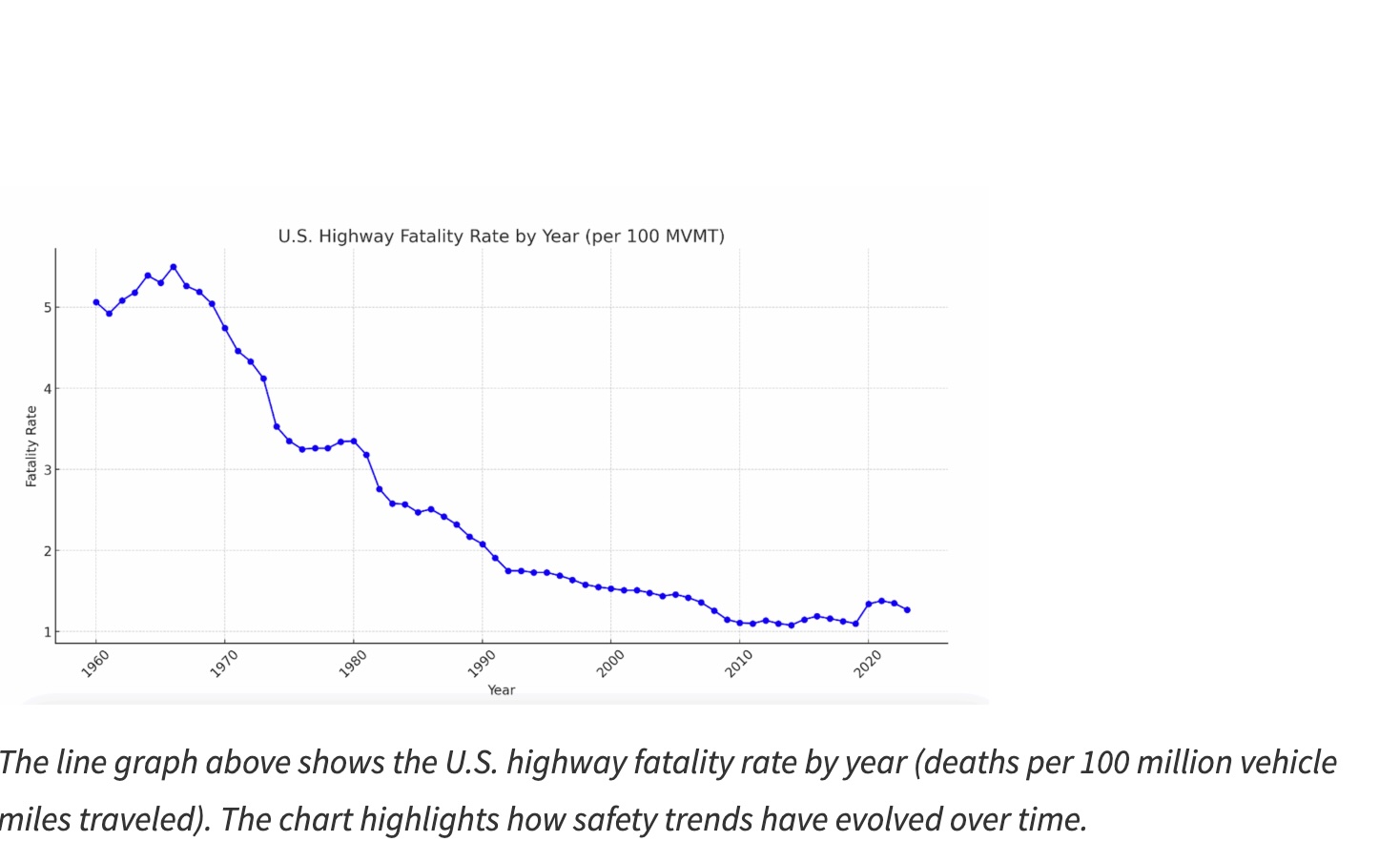
The line graph above shows the U.S. highway fatality rate by year (deaths per 100 million vehicle miles traveled). The chart highlights how safety trends have evolved over time.
Key Insight from the Chart: U.S. Highway Fatality Rates
· In 1960, the fatality rate was 5.06 deaths per 100 MVMT.
· Throughout the 1980s, fatalities continued to decline sharply, largely due to improvements in vehicle handling and braking systems.
· In contrast, the 2020s rates hover around 1.3–1.4 deaths per 100 MVMT, roughly a 70% reduction over 60 years.
This long-term improvement aligns with regulatory changes, safety innovations (e.g. seatbelts, airbags), and public campaigns, many of which are noted in the sheet’s timeline columns. This indicates that U.S. roads have become dramatically safer over time, even though media or political rhetoric may claim the opposite. It confirms that the fatality rate has dropped significantly since the 1960s. In addition, it highlights how industry innovation and highway improvements also contributed to the decline.
The Historical Context: Safety vs. Freedom
The modern U.S. safety regulatory regime traces its roots to Ralph Nader’s Unsafe at Any Speed (1965) and the resulting National Traffic and Motor Vehicle Safety Act (1966), which led to the creation of NHTSA in 1970. Since then, FMVSS (Federal Motor Vehicle Safety Standards) standards have steadily expanded from simple seat belts and interior padding to advanced airbags, electronic stability control, roof crush ratings, and side-impact testing.
These changes coincided with a significant reduction in highway fatality rates (from approximately 5.5 deaths per 100 million vehicle miles traveled (VMT) in the mid-1960s to about 1.1 by 2011)[1]. However, this drop began well before much of the FMVSS framework was fully implemented and was driven by improved vehicle dynamics, such as disc brakes, better suspensions, rack-and-pinion steering, and enhanced lighting systems.
Rising Costs, Heavier Cars
According to NHTSA data, FMVSS mandates added an estimated 171 pounds and $1,929 (in 2012 dollars) to the average passenger. Back in 2001, similar regulations had already imposed 125 pounds and $839 in costs.[2] These increases represent a significant burden on manufacturers and consumers, ultimately reducing vehicle fuel efficiency, raising sticker prices (now averaging nearly $38,000), and limiting affordability.
Safety Paradox: Are We Truly Safer Today?
Though FMVSS standards address crashworthiness, there are unintended consequences:
1. Reduced Visibility: Taller belt lines and smaller windows, required for structural strength, have impaired driver visibility. Studies note a sharp rise in pedestrian deaths, from around 4,600 annually (2000–2009) to over 7,300 by 2023.[3]
2. Weight Trade Offs: Heavier cars generally fare better in collisions, but the added mass can be detrimental in multi-vehicle accidents, and can also reduce fuel economy.
3. Stagnating Fatality Improvements: After hitting a low of 1.1 deaths per 100 MVMT (Million Vehicle Miles Traveled) in 2011, the rate has plateaued or even increased slightly, despite newer vehicles featuring more mandated safety gear.[4]
A Smarter Path Forward
Reevaluation of FMVSS 208 and 214:
· Prioritizing Vehicle Design Features: Features that enhance collision avoidance, such as improved visibility, handling, and shorter stopping distances.
· Consider Lighter-Weight, Lower-Cost Design Alternatives: Designs that align safety with fuel efficiency and affordability.
· Conduct Thorough Cost-Benefit Reviews: Reviews of post-2005 FMVSS changes, as their impact is less clear.
· Reassess Performance Metrics: Fatalities per 100 MVMT are no longer improving significantly despite rapid safety tech deployment.
Conclusion: Toward Balanced Safety
Automotive safety policy should evolve beyond crash survival to embrace accident avoidance, affordability, and environmental responsibility. The FMVSS approach that originated in the 1970s remains relevant, but its expansion into heavy, tech-laden vehicles risks diminishing returns, hidden costs, and unintended safety trade-offs.
The FMVSS should adopt a more nuanced regulatory strategy which would subject post 2007 and future regulations to a cost-benefit analysis and congressional scrutiny.
Henry Stowe is a longtime NMA member and advocate for motorists’ rights and balanced regulation.
1. https://crashstats.nhtsa.dot.gov/Api/Public/ViewPublication/809834?utm_source
2. https://crashstats.nhtsa.dot.gov/Api/Public/ViewPublication/809834?utm_source
3. https://crashstats.nhtsa.dot.gov
4. https://www.everycrsreport.com/reports/R44394.html?utm_source








John Stossel had a TV show about 15 years ago, where he brought out a chart from OSHA that showed how OHSA, since its inception in the 60’s, had reduced accident rates. Stossel then superimposed that chart over accident rates going back to 1920 showing significant reductions had occurred prior to OHSA and the graph was trending down anyway. Stossel questioned did government intervention continue the downward trend or was this already the trend?
I believe in the 80/20 rule. 80% of the problem can be eliminated with 20% effort. However, the last 20% of the problem will cost you 80% of your effort. Chasing diminishing returns. Moreover, you might even be adding to the problem with adding devices and other safety items i.e. safety air bags that kill.
Throw it in the woods.
Yes. The law of diminishing returns is a plausible explanation. I heard once that the Clean Air Act of 1970 cost $1.8 trillion (in 1990 dollars). The 1990 Clean air act was expected to cost $2.4 trillion. The first removed 90 percent of HC and CO and 75 percent of NOX from passenger cars. The Second one is supposed to do the rest at twice the cost.
Add to that the costs and potential increase in energy consumption costs to comply with open ended standards and its likely negative returns.
Regulations: Because enough is never enough.
Regulations: Because too much is never enough.
This sort of analysis is a fundamental reason I concluded vaxxines were at least useless, if not counterproductive or dangerous. Not sure if it was Stossel who did it, though.
One of the main diseases used to justify them is polio and Salk is the Moses of the field. But if you push the timeline back you’ll see the primary driver was indoor plumbing and sanitation that drives polio infection rates.
The machinations of the 1950s reduced the rate of decline because the faulty chemicals actually gave kids polio, not to mention a host of new illnesses. I don’t know if it was intentional misdirection (e.g. the Rockefeller medical subversion premise) or that Salk etc were genuine and scientifically blinded by ambition.
You can overlay almost every disease and see introduction of a vaxx was on the natural decline. And for some diseases, scarlet fever or strep for example, no vaxx has ever been produced and the decline is the same.
RE: “that drives polio infection rates” and, “actually gave kids polio”.
Go a step further:
https://drsambailey.com/resources/videos/corruption-and-medicine/toxicology-vs-virology-rockefeller-institute-and-the-criminal-polio-fraud/
…You can do it.
This is just like the idea that current FMVSS are causing more accidents, death, deprivation and inestimable sorrow on American highways. The fatality rates are higher than they were 15 years ago.