

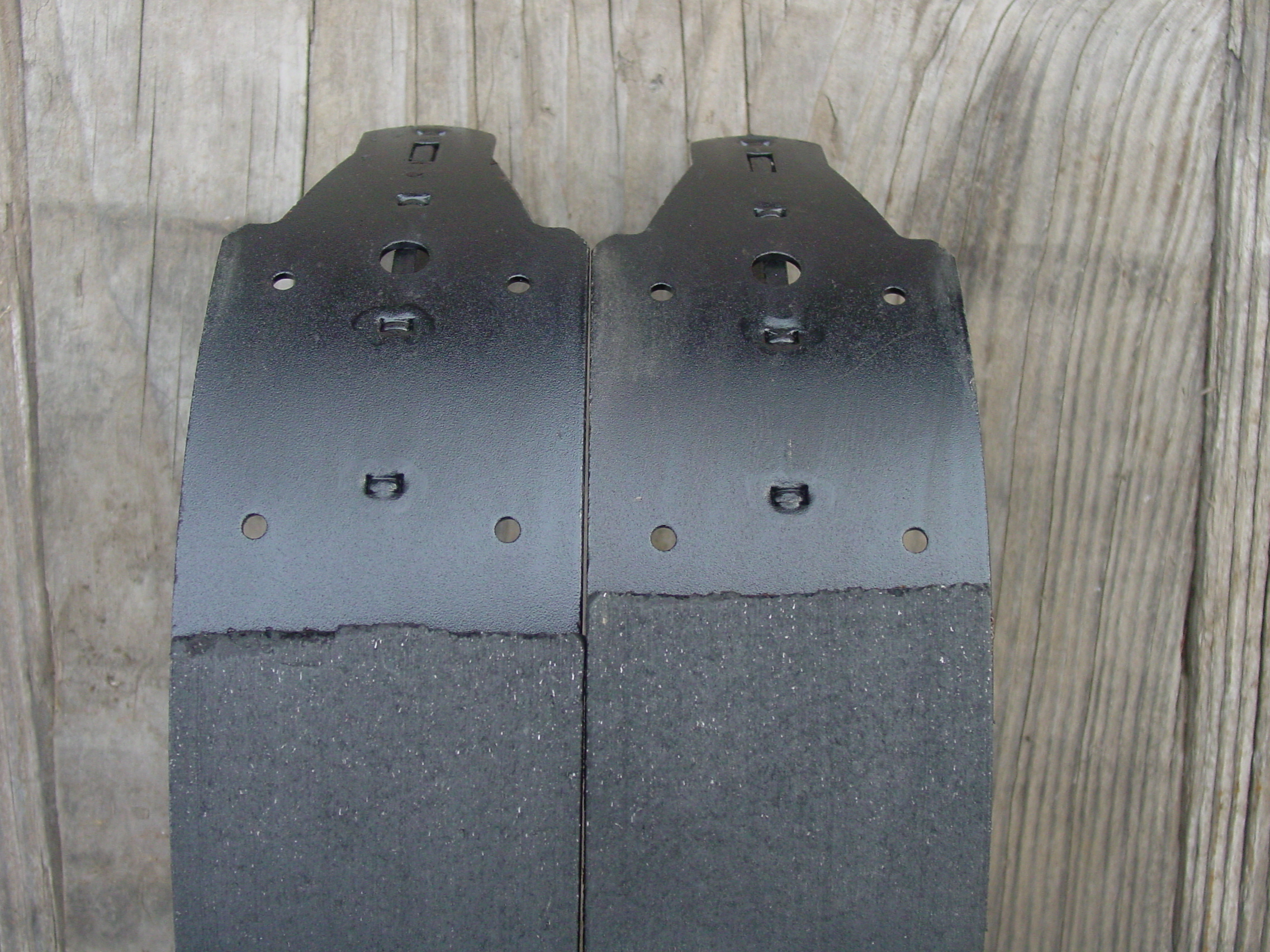

A reader sent me something about his recent experience with brake shoes he bought at a parts store. Holy bent connecting rod, Batman! I’ll let him speak for himself:
I recently purchased some brake shoes for a ’76 Chevy van. I use a local mom and pop shop and requested the better brand, which happened to be Wagner. Attached are some shots of the worst shoes I have ever seen since I’ve been changing brakes. (Which also happens to be around 1976).
My parts guy says that now the warehouses just send whatever they send. OOP! No more Centric! We’ll just have to cross that to a TruStop. OH! WAIT! Better make it a Dorman! He tells me that many of these companies are being bought by investment firms, so I followed the trail…
From dbusiness.com: “Federal-Mogul was acquired from Icahn Enterprises L.P. (Tenneco) for a total consideration of $5.4 billion to be funded through cash, Tenneco equity, and assumption of debt. Federal-Mogul Motorparts sells and distributes a broad portfolio of aftermarket brands, include ANCO, Beck/Arnley, Champion, FP Diesel, Sealed Power and Speed-Pro engine products, MOOG, and Abex, Ferodo, Jurid, and Wagner brake products and lighting.”
In 2020,Tenneco restructured its business into four business groups: Clean Air, DRiV, Performance Solutions and Powertrain. DRiV controls Wagner.
In 2022, Tenneco was acquired by Apollo Global management. From their site:
“Apollo is a high-growth, global alternative asset manager. In our asset management business, we seek to provide our clients excess return at every point along the risk-reward spectrum from investment grade to private equity with a focus on three investing strategies: yield, hybrid, and equity.” (Emphasis mine)
It’s all about the money. (As always. No surprise here.) Quality be damned. We have investors to please.
Res ipsa loquitur.
And oy meets vey.
. . .
If you like what you’ve found here please consider supporting EPautos.
We depend on you to keep the wheels turning!
Our donate button is here.
If you prefer not to use PayPal, our mailing address is:
EPautos
721 Hummingbird Lane SE
Copper Hill, VA 24079
PS: Get an EPautos magnet or sticker or coaster in return for a $25 or more one-time donation or a $10 or more monthly recurring donation. (Please be sure to tell us you want a magnet or sticker or coaster – and also, provide an address, so we know where to mail the thing!)
If you’d like a Baaaaa hat or other EPautos gear, see here!






FWIW, I just traded in a worn out ’14 Ford Transit Connect on another one from a Toyota dealer of all things. It had significantly less mileage/issues and was totally re-upped, including new brakes and rotors. The new brakes squealed like a stuck pig. Maybe I’m just lucky, because I’ve never experienced brake squeal (from new brakes) but my research led me to learn this is quite common these days. After a little while, I took a look and the “stop-rite” pads from NAPA on the passenger front and rear had backing plates so loose you could jimmy them around with a finger. Lotsa bad vibrations. Yeah, I thought about using the red goo to quiet them but they seemed not just slightly defective. So, I replaced them with “silent guard” ceramics that cost a whopping $20 more. No more squeal.
Wait . . . How did we get from private equity is shipping defective aftermarket parts to Toyota is building exploding engines due to compliance pressure?
To address the question head on I’ll say I don’t know. I’ve never worked for Toyota so I can only speculate what their problems might be.
Throughout the industry there has been an enormous shift away from building and testing prototypes (be it engines or full vehicles). Toyota was often considered the benchmark as it was consistently reducing prototype builds and testing faster than the domestic OEMs.
Management, leadership, c-suite, whatever you want to call them has been sold a bill of goods that computer simulation can replace physical testing. They see simulation as faster, cheaper, and more effective than physical testing. Unfortunately, simulation repeatedly fails to deliver on its promises. But like Government, each failure just results in a doubling down on what failed. They think they just need better simulation not a return to more prototype builds and physical testing. I’ve seen this first hand for decades.
Simulation doesn’t discover or account for an uncontrolled manufacturing process that accidentally leaves debris in an engine. Simulation doesn’t account for production tooling that can’t deliver assumed surface finishes and part tolerances. Physical prototype builds, dyno testing, and full vehicle testing are historically have been the means of discovering these sorts of development issues.
Reduce physical builds and testing, get more recalls and pissed off customers.
That’s my take of what is likely happening. But again, I’m biased by what I’ve seen at other companies and don’t know for sure what is happening to Toyota.
See also Harley M8 twin, “a million miles of testing!” Sure. In all that you didn’t discover oil spewing into the air cleaner from the head breather vent tubes. The dry sump crankcase that couldn’t evacuate quickly enough during spirited operation – resulting oil sumping the cases and destroy the engine if not caught in a few seconds? The transmission oil transfer to the primary drive case? Yea sure.
Two or three oil pump redesigns later an a vent added to the primary drive case all is well. You’ve only been building dry sump engines for, oh, A HUNDRED FRIKIN’ YEARS. Yes I did my own oil pump replacement as I was tired of oil cooled RH saddlebag via air cleaner drooling into the slipstream.
“It’s all about the money. (As always. No surprise here.) Quality be damned. We have investors to please.”
Huh? No one makes money by knowingly making, shipping, and distributing defective parts.
Are we to infer that these sort of mistakes & defective quality never happened during the heyday of American manufacturing?
Exchange the defective parts and life goes on.
What exactly is the take away?
Hi BID,
Here’s my hypothesis: Toyota and other manufacturers have had to rush into production new engines/drivetrains as a result of compliance pressure. There was no good reason to get rid of the superb 3.5 V6 (no turbos, no hybrid augmentation) used in so many Toyota vehicles for decades; nor the equally superb V8 that was used in Toyota and Lexus SUVs. But then along came Biden and his administration’s regs that those superb engines could not comply with. So they had to be replaced – quickly – with what may have been rushed designs that are without question more complicated designs… thoughts?
Exchange with more sh**ty parts? Brake pads are a vital component as is everything related. Wagner, Bendix, or OEM “were” dependable go to’s. Apparently not so much anymore. I haven’t bought brake pads or parts for several years so next time out looks like a deep dive on current quality will be required. I was a die hard Goodyear belts and hoses guy for years, all US made. Then off to Mexico they went.
Oil filters another issue, trusted brands gone haywire with poorly formed metal cores restricting flow.
> I haven’t bought brake pads or parts for several years so next time out looks like a deep dive on current quality will be required.
I needed to do the rear brakes on a 2012 Nissan Rogue earlier this year and went with these Raybestos pads:
https://www.rockauto.com/en/moreinfo.php?pk=5417019&cc=1501701&pt=1684&jsn=1
They were quite chunky when I put them in and have been working well ever since. No missing bits, unlike the shoes at the top of the page. They weren’t the cheapest pads available, but were still not expensive.
Looking them up again, Rock Auto has them listed under “premium” options, instead of “economy” or “daily driver.” That might be something to keep in mind when you next need to do a brake job, whether you’re buying from them or not.