


I’ve written before about the way federal “safety” requirements make it harder to comply with federal miles-per-gallon requirements (CAFE) by effectively forcing the vehicle manufacturers to make heavier vehicles that are harder for that reason to make more “fuel efficient.”
It is like trying to lose weight by having a diet Coke with your Big Mac.
Here’s an other one that’s of a piece: This demented soaking down of the roads with caustic brine slurry at the first hint that it might snow.
The salty slurry was all over the roads – again – in my part of SW Virginia the other day on account of flurries. We got a tail-end snow-shower from the big storm that dumped feet on parts of the Northeast. A dusting on the ground. Nothing on the road. But it was enough to trigger the Safety Cult into action. Man the trucks!
The brine must flow!
The slightest hint of snow, the prospect that there might be a little on the road, is enough to send the brine trucks rolling. Millions of gallons of corrosive, caustic slurry are sprayed from the backs of these trucks – turning the pavement white as it dries.
Turning our vehicles to ferrous oxide dust, too.
This stuff works like a cancer accelerant in terms of how effectively rots the undersides of a vehicle. Most people are aware of structural/frame rot and of course, perforated body panels and bubbling paint. Many are not aware – until they find out – how it first corrodes steel brake and fuel lines, bolts and other things underside a vehicle until they are confronted with the repair bill for replacing such parts, which are harder to replace because in many instances they cannot be unbolted but have to be cut off, due to the rust-eaten fasteners, etc.
But what about the environment?
Is it not – as Mr. Spock might have said – fascinating that concern for “the environment” is wanting? The same governmental authorities that literally sic the Hut! Hut! Hut! crew on the relative handful of people who’ve “deleted” diesel engine particulate traps and DEF systems send out fleets of brine trucks to dump what is obviously far worse – by dint of volume – for “the environment” than a handful of “deleted” diesels. Whatever you think about the “deleted” diesel dudes. in the grnad scheme of things, it’s not a meaningful imposition on “the environment.” The delete dudes may be obnoxious on a personal level but dumping millions of gallons of brine into “the environment” – multiple times each season, usually – is something more than merely obnoxious.
The disproportionate response on the one hand – toward the delete dudes and other minor miscreants vs. the indifferent attitude on the other – tells us it’s not actually about “the environment.”
So, what is it about?
In a word, saaaaaaaaaaafety!
More finely, it is about pandering to and assuaging the neurosis of people afflicted by the mind rot of Safetyism, which is the idea that everything must be done – no matter what it costs – to reduce the risk of anything that might be, to some degree, be “unsafe.” The problem here is that literally everything carries with it some degree of “unsafety” – in the sense that nothing can be made 100 percent risk-free – no matter what measures are taken. There will always be a degree of risk. This includes the risk of getting out of bed in the morning. Yet most of us get out of bed anyhow, because we have things to do.
Such as live. 
This is understood by every mentally right-in-the-head person. Life is inherently risky. Mentally right-in-the-head people take prudent steps to reduce risks – but are not paralyzed by dread of risk.
Mentally not-right-in-the-head people are. They are the people who wore (and some still wear) a “mask” in their car, when no one else was (or is) in their car. They are the people who get upset when they see someone else not wearing a helmet while riding a motorcycle. They are the ones who support using police to enforce seatbelt laws, a very bizarre thing when you stop to think about it for even a moment. Aren’t cops supposed to be concerned with protecting us from people who might or actually want to harm others – as opposed to (supposedly) protecting us from ourselves? Isn’t the latter a job for nannies?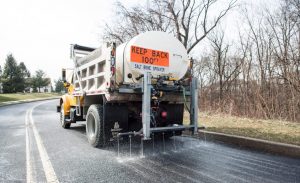
Back to the brine.
A right-in-the-head person might see it as justifiable to wash down the roads with corrosive salt in the event of a major storm.
But on account of the now-pervasive sickness that is Safetyism, the road crews soak down the roads every time it might snow, even if it never actually does. The Safety Cultists will say an ounce of prevention is worth a pound of cure. But you know what would serve better?
Learning how to drive when it snows. Learning not to be afraid of a little snow. Leaning not to be afraid of everything.
It’s not a big deal.
This of course triggers Safety Cultists – who are the same kinds of people who got triggered when some of us talked about being healthy so as to avoid getting sick.
. . .
If you like what you’ve found here please consider supporting EPautos.
We depend on you to keep the wheels turning!
Our donate button is here.
If you prefer not to use PayPal, our mailing address is:
EPautos
721 Hummingbird Lane SE
Copper Hill, VA 24079
PS: Get an EPautos magnet or sticker or coaster in return for a $25 or more one-time donation or a $10 or more monthly recurring donation. (Please be sure to tell us you want a magnet or sticker or coaster – and also, provide an address, so we know where to mail the thing!)
If you’d like a Baaaaa hat or other EPautos gear, see here!










I use fluid film to coat the underside of my truck. About $50/gallon. 1 gallon is good for coating it twice and inside the frame.
It is supposed to keep all that crap out. hope it does.
The DOT in my area started using this Brine crap for the roads, and I ended up with a rust spot on my old vehicle. I would rather deal with the cracked windshield than rust. Hell, everyone has cracks and lines on their windshields, it is just one of those aspects of long Winters. On one occasion when I was getting my old vehicle maintained, the service advisor said (per a DOT customer he had talked to), that the DOT guy related to him that they only use “…a little bit of salt” in with the customary gravel we are used to. I told the service advisor the next time he saw the DOT guy, to give him a glass of water, tell him there is just “..a little bit of poison in the water”, but that otherwise, it is safe for him to drink.
Salt the Whole Damned Car Business
A Phoenix man says he is stuck paying a loan on an SUV he cannot drive after Toyota Financial Services denied his warranty claim and his insurance company denied his claim as well, leaving the cause of his engine failure unresolved.
Jake Weir purchased a 2019 Toyota RAV4 as a certified pre-owned vehicle with approximately 60,000 miles and an active warranty. A few months ago, the engine failed without warning. “I accelerated a little bit. I heard a loud boom. Looked in my rearview mirror. Smoke everywhere,” Weir said.
Weir had the vehicle towed to the dealership, where technicians documented what the engine failure. The dealership told Weir the engine failed due to hydro lock, a condition caused by water entering the engine. Weir disputed that explanation.
“I would have had to have taken on water almost immediately for that to happen. The day that I left, it was 100 degrees outside, middle of September, not a cloud in the sky,” Weir told On Your Side. “They’re claiming to me that they found over a gallon of water in the car, which I don’t know how that’s possible.”
Toyota Financial Services denied his warranty claim. Weir then filed a claim with his insurance company. The insurer also denied the claim, citing “no evidence of water.” “The insurance company is telling me it was due to actual engine failure. In that case insurance wouldn’t cover it. That would be on the warranty,” Weir said.
Weir paid more than $1,000 out of pocket for the dealership to tear down the engine. He said he will not recover that money because the warranty claim was denied. He said he is still making loan payments on a vehicle he cannot drive.
https://www.azfamily.com/2026/02/25/phoenix-man-caught-dispute-over-toyota-warranty-insurance-after-engine-fails/
Just read this week about a recall of over 300,000 Nissan Rogues because their 1.5-liter engines can overheat and seize up. Looks like quality has gone to hell — and we’re the bagholders. A donkey cart is lookin’ better every day.
Hi Jim,
It sounds like the guy’s engine suffered a head gasket failure – that would account for the hydro-lock. So why did the head gasket fail on a five-year-old engine with only 66,000 miles? That suggests a defect to me.
Its annoying because it makes a humid day a wet road day if it gets warmer, and that’s when metal is most reactive to the salt as well, when its over 32 degrees. Salt is nowhere near as bad if its 0 degrees and dry out.
The worst is spring waiting for rain to flush it away before I pull out a motorcycle. Road Bikes have almost no resistance to salt unless you have an all aluminum and plastic sportbike or dirtbike. Salt will lift and bubble chrome and forks real quick, then you need new forks and seals
I would be curious to see what the “salt lobby” contributes to politicians to persuade them to buy excessive quantities of salt, and then, of course, the bureaucrats appointed by said politicians are tasked to spread salt hither and yon at the hint of any frozen precipitation. I would be amazed if there isn’t a connection. “Follow the money.”
It’s not the salt lobby, it’s the car insurance companies.
Because slippery roads result in more accidents.
Rust is not really their problem, so much.
I fucking hate road salt destroys cars I feel there in with car makers to get you to buy new cars faster buy rusting them out fast I uncoated my car my self for $40 really does keep from rusting it always amazes me people will pay 80k for new truck and not spend the small amount to undercoat it and it’s rusting away in 5 years.
They still mostly use old timey road salt, calcium chloride I think, around here. What frosts me is within an hour or two the plow goes by and throws all that salt into your front yard and ruins your lawn and any other vegetation.
Here is an article that shows some relative costs and benefits of different types of treatments:
https://www.greenindustrypros.com/snowpro/sand-salt-spreading/article/22942559/stars-tech-the-true-cost-of-deicing-rethinking-winter-road-maintenance-economics
Moving towards a “bare roads” policy and away from sand has caused a lot of damage.
There is no reason why we cannot go back to leaving a few inches of snow on the road and spreading some sand in strategic locations.
Anon
Not much salting around these parts, thankfully. Mostly sand. They salt more on the Tulsa streets. Any time we have to drive on this salt, we immediately as soon as we can, head to the manual car wash and spray down the underside.
I’ll tell you what though, that sand on dry street is slicker than ice!
This time of year the Sun is starting to rise a little earlier, get a little higher at noon and set a little later. This natural ice melting system will usually clear most of the slop off the highway by noon, side roads by 2:00pm. But that morning commute, man what a s***show! Everyone going 45 in a 75 zone, everyone stacked up behind clovers who should stop scheduling their doctors appointments at 8:00 and just hang out until 10:00, but there they are, because it’s essential they get there at the crack of dawn.
Salt also ruins roads.
Throw in those recently added center line rumble strips (because drivers are distracted/drowsy and too incompetent to maintain their lanes), add a few freeze/thaw cycles of the cupped water/ice and watch the road begin to crumble from the crown.
Just like the fashion industry, government creates both the supply and demand for potholes.
Applying the salt to the roads is someone’s spot at a government teat.
Exactly, there seems to be a fully institutionalized grift milking every distinguishable opportunity that appears. A neon nightmare in a billion white trucks destroying everything. “Dis a good job”
The real hell of it is, today’s cars are far better equipped to handle adverse weather conditions than they used to be, with their 4-wheel ABS disc brakes, traction and stability control, all wheel drive, and all-season radials. Gone are the days of manual drum brakes, rear wheel drive, and bias ply tires.
I also think it’s because of fear of lawsuits, which are rampant in our litigation lottery society.
It seems a goodly chunk of people have difficulty driving on dry roads in the sun. Add snow and it’s the clown Grand Prix. People who drive too fast and spin out, people who drive too slow and get stuck on a hill. Perhaps the brine is the governments attempt to pre-empt a need to own a fleet of tow trucks, and to keep the morning and evening commutes running reasonably smoothly.
Let’s not forget the flip side of excessive salting and brining of roads is the warning to stay inside whether or not sane rational people would have any problem dealing with the weather.
The link below is a real North Dakota weather advisory from when people could handle the truth.
North Dakota weather alert! Stay inside.
https://www.youtube.com/watch?v=x8hGIF9FljM
‘The salty slurry was all over the roads — again.‘ — eric
Yesterday I shuddered in horror upon reading this factoid in APe News: ‘In New York City, Mayor Zohran Mamdani got creative: spreading 143 million pounds of salt by Tuesday evening.’ That’s like a death sentence for the city’s vehicle fleet.
My first real-life experience of the benefits of a dual master cylinder (mandated by FMVSS since January 1, 1968) came in the NYC suburbs, when the rear brake line of my Jeep Cherokee corroded through and failed catastrophically, leaving it with only front braking. Duh! That ain’t safe — and really shouldn’t happen.
I know that reducing the freezing temperature of water requires an ionic solution. But can’t science find one that’s not so damned corrosive? Obviously auto makers are not going to help fund this vital anti-cancer research. /sarc
Morning Jim.
Cato the Elder said many times “Carthago delenda est”, well with all that sowing of salt I guess Mamdami is instead saying “NYC delenda est”.
Kids will be falling to sleep in history class in two thousand years when this is mentioned.
‘Back to the salt mine’ was a popular expression about work, during the Carter administration.
Now that quip is as obsolete as ‘It’s a free country, you know.’ 🙁
How about “If you see something; say something” but if you say something they’ll label you a racist hate monger.
Supposedly beet juice works well. Imagine the price tag.
I’m in NYC now. You should see how gross the grey salty slush makes literally everything. Mounds of blackened snow litter the sides of every road. A narrow grey slush covered shoveled path through each street corner, usually also filled with a puddle of salty water. Dog and bum pee add a touch of yellow. It’s grand!
‘Supposedly beet juice works well. Imagine the price tag.’ — BAC
America’s beet farmers stand ready to help, my friend.
And printing the ‘money’ they need is no problem whatsoever. 🙂
The streets will flow red with the blood of.. beets?
Don’t give them any ideas Jim,
We’re already cursed by the corn farmers putting ethanol in our gas. It’s costing me a bundle to keep my snowblower running this snowy season, paying $20/gallon for pure gas but it beats having to clean out and rebuild the carburetor every year.
Hi Mike.
I believe that marinas sell ethanol free gas. If so bring a gas can and fill it up there (they do charge a premium though).
Also the Project Farm YouTube channel did a long term test of fuel stabilizers and noted that they didn’t do much good but that Stabil brand did prevent corrosion in a carb, the video shows the test results.
There are a bunch of interesting Youtube vids about how to remove ethanol from gasoline.
I’ve never tried it myself. No need to, as many stations around here sell ethanol free in 87 and 91 octane.
My understanding is that you mix water with the gas, the ethanol bonds with the water and falls to the bottom. You remove the pure gasoline which is at the top. The big problem is that the ethanol was used to bump up the octane rating and without you have maybe 78 octane if I remember correctly.
Beet farming is insanely subsidized and ridiculously profitable, enough so that the “privilege” of growing them is controlled by a legal cartel which uses a multimillion dollar lottery.
And all my beet farmer neighbors get hundreds of thousands of dollars a year in ag subsidies and they all took hundreds of thousands in forgiven ppp loans.
But remember the poor farmers in their hundred k pickups when you complain about big government and welfare communism.
It’s called MDS, Molasses Desugared Syrup, and it is a by product after taking the sugar out to destroy your metabolism and the beet pulp out for animal feed. Messy stuff, but not so corrosive as CaCl, and it’s usually used to pre treat roads before a major midwestern storm so the stuff doesn’t stick down into a dense layer of compacted ice which lingers for weeks after a storm. Makes a really slimy film on your car.
“I know that reducing the freezing temperature of water requires an ionic solution.”
Doesn’t have to be ionic. The freezing point depression is based on the molality of the solution. The advantage of ionic is it becomes more than one “particle” in the solution. NaCl becomes two, for example. You get something similar with non-ionics, like beet juice, but that is generally called osmolality. Down side of them is they remain one “particle”, so it takes twice as much as NaCl to get the same effect.