

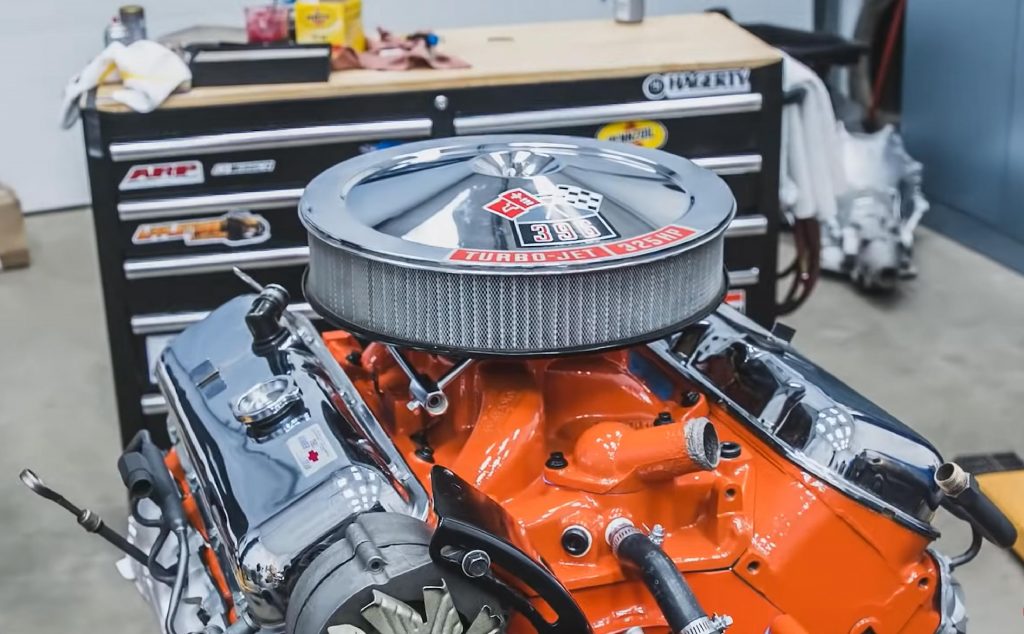

In muscle car circles, a big block is something special.
The term refers to what is literally as well as figuratively true. A big block is a V8 engine with a big block; i.e., it is physically larger on the outside than a small block. It also larger internally – in terms of its cylinder displacement. The classic example is the contrast between a Chevrolet big block V8 such as a 396, 427 or 454 and a small block 327 or 350.
Car people can tell the one from the other at a glance. The 396/427/454 are big engines – externally as well as internally (i.e., in terms of the size of their cylinders).
Some engines – such as the Pontiac V8 – can be big externally and internally as well as big externally and small internally. A Pontiac 455 looks the same on the outside as a 326. Both look big. You cannot tell the difference at a glance. It is necessary to look inside (or check the stampings).
Today’s analog of a “big block” is a little smaller.
I’m driving a 2026 Mazda 3 this week and it comes with one of the biggest four cylinder engines around – and it’s more than just that. This car’s 2.5 liter engine is huge – in comparison with the 1.5 liter (and even smaller) fours – and in some cases, threes – that are to be found under the hood of other modern cars. Even a number of luxury-brand cars come standard with 2.0 liter fours. Examples include the current BMW 5 Series and the Mercedes E-Class, both of which are much larger cars than the little Mazda as well as more than twice the cost. It says a lot about the Great Diminishment – about the acceptance of it – that so many people are willing to pay nearly $60,000 (the starting price range of a new BMW 5 Series or Mercedes E-Class) for a “luxury” car that comes standard with the kind of engine that used to come standard in economy cars.
It is interesting to note here that Mercedes and BMW have not adjusted the model designations to reflect the Great Diminishment. The Benz E350 used to come with a 3.5 liter V6. Hence E350. Today’s “E350” comes with a 2.0 liter four, so why not “E200”?
Because that would be telling. I mean, if this were not a diminishment, why not proudly tout “E200.”
Of course, relatively speaking, the 2.0 liter fours in the Mercedes E and the BMW 5 are “big.” So also the 3.4 liter V6 that comes standard in the Lexus GX550 I recently reviewed (this model used to be the GX460 and it used to come standard with a 4.6 liter V8. Like Benz and BMW, Lexus did not rechristen the GX to reflect the diminishment, because “GX340” would be telling.
The current Honda Accord comes with one of those 1.5 liter fours and several Buicks come standard with 1.2 liter three cylinder engines. These Buicks are not motorcycles, by the way. They are 3,200 lb. cars such as the 2026 Envista. The Great Diminishment is particularly evident as regards Buick, which was once famous for big things, including under the hood. The high water mark being the Electra 225 of the Before Time. The designation referred to its length – 225 inches – and keep in mind this was a car. Today, a full-size, half-ton truck with crew cab and a six foot bed such as the current Chevy Silverado is only about five inches longer than a ’70s-era Electra 225 and that full-size truck comes standard with a 2.7 liter four cylinder engine.
The Electra of the ’70s came standard with a 7.5 liter V8 engine.
It is a lot like noticing that what’s inside the box of whatever you bought at the supermarket has less inside than it used to – even though the price has gone up. The only thing that seems to be getting bigger in America is the cost of things – as well as Americans’ bellies. (Another interesting incongruence in that back in the Before Time, when things like cars and the engines they came standard with were big – and you got more in the box of whatever it was you bought at the supermarket – Americans themselves were not as big as they are now.)
In the context of the Great Diminishment, the little Mazda’s relatively big 2.5 liter four stands out like a 454 Chevy once did – relative to “little” 350 small block (which by today’s standards is regarded as a “big” V8). It is one of the lingering few engines of its type that is big enough to get by without needing to be augmented by a turbocharger, in order to force more power out of it. The italics are used to emphasize a dreary truth – another facet of the Great Diminishment – which is that the ever-smaller engines being pressed into service have to be forced to produce adequate power because without the turbo-boost, they’d be inadequate, being too small for the vehicles they’ve been tasked to move.
A 1.2 liter engine is big enough for a motorcycle because a motorcycle generally weighs less than 1,000 pounds. The Buick Envista weighs three times that. The turbo makes up for the smallness by literally cramming more air into the engine’s small cylinders, increasing the pressure inside the engine. Things that are under pressure tend to succumb to that pressure sooner. It’s why the use of turbochargers was once – in the Before Time – generally restricted to high-performance applications, where more power was desired from an engine that alreayd made plenty. Examples include the Porsche 911 – which even without the turbo has a six cylinder engine that is plenty big (and powerful) enough to deliver high-performance. Adding a turbo increases the performance. It is not a replacement for displacement.
The distinction is important.
Meanwhile, the Great Diminishment motors on. Also, the chocolate ration has been increased – and the war is won.
. . .
If you like what you’ve found here please consider supporting EPautos.
We depend on you to keep the wheels turning!
Our donate button is here.
If you prefer not to use PayPal, our mailing address is:
EPautos
721 Hummingbird Lane SE
Copper Hill, VA 24079
PS: Get an EPautos magnet or sticker or coaster in return for a $25 or more one-time donation or a $10 or more monthly recurring donation. (Please be sure to tell us you want a magnet or sticker or coaster – and also, provide an address, so we know where to mail the thing!)
If you’d like a Baaaaa hat or other EPautos gear, see here!








Applying the same new technology (optimized ports and combustion chambers, fuel and spark maps, boost, cams) to an “old school” V8 yields truly amazing results. Not so long ago a 500HP v8 was a nasty, intractable thing, able to sing at high rpm but only choke and gurgle at street rpm. Now a 1200hp v8 isnt that uncommon and has pretty good manners throughout the rpm range. And instead of 5-10mpg it will make about 15.
I do love my old school simple stuff, but the new tech is damn impressive.
The real question is why bother to spend the money on performance, or even a car, in a tyrannical police state where you can be abused and murdered by enforcers for going fast, or slow, or just drawing attention. And god forbid you wear a real seat belt (5 point harness) or refuse to wear a suicide strap shoulder belt.
2022 Subaru WRX here, 2.4 turbo, six speed manual. Sway bars, coil overs, and numerous other chassis/suspension bracing. 271 hp stock. I’ve added air intake, big intercooler, charge pipes, turbo inlet pipe. Had a pro tune on the dyno in February, she’s doing 334 wheel hp, 325 lb. ft. of torque reliably, no issues. I’m limited on the 91 octane available in my area. If I could get 93, another 15 or so hp. I will never own a boring “1.5 liter” whatever car. EVER.
It makes sense. Our men are becoming sissified little putzes. Why not our engines?
Toyota has a 2.5 v4 and it’s zippy good engine reasonable size not that lawn mower 1.3
You mean I4 I assume. I don’t think Toyota has ever made a V configuration 4 cylinder, but maybe.
The current A25 series is an I4 2.5L in the Camry, Highlander, RAV4, Lexus ES & NX.
However this proves Eric’s point. These cars used to get bigger engines, typically the 3.5L V6 and such.
Yes I meant 4 cylinder Toyota not long ago had lot of v6 and v8 options that would run for ever now it’s all turbo 4 or 6 the 6 has been having problems I would personally but the previous models with older engines
‘The Great Diminishment motors on. Also, the chocolate ration has been increased – and the war is won.’ — eric
Pure poetry! And in my little burg, pigs — more accurately, javelina — have taken to flying!
Sadly, though the war is won, our so-called ‘ally’ continues sandbagging us:
U.S. Searches for Airman as Israel Launches Fresh Strikes on Tehran
World peace will not prevail until a monstrous carbuncle on the face of humanity — a misbegotten little apartheid colony — is erased, and its stolen land returned to its rightful owners.
Big man, pig man
Ha, ha, charade you are
You well-heeled big wheel
Ha, ha, charade you are
Hey you, White House
Ha, ha, charade you are
You house-proud town mouse
Ha, ha, charade you are
— Pink Floyd, Pigs (Three Different Ones) (1977)
Read it and weep:
‘The petrodollar system was based on a quid pro quo: use American dollars in exchange for American protection. Iran has demonstrated that America cannot and will not protect the Gulf states. Given a choice between protecting the Gulf states and Israel, Israel will always come first.
‘The doom of the petrodollar was sealed recently when Volodymyr Zelenskyy signed deals with Saudi Arabia, Qatar, and the United Arab Emirates to help secure them from Iranian drone attacks.
‘Why should we expect the Gulf states to continue using dollars when America has brought them to the brink of destruction and they have been forced to turn to Ukraine for help?‘
‘This is how empires end: fools are put in charge, sycophants enable them, and those who know better are too cowardly to speak out.’
https://www.unz.com/article/theres-going-to-be-a-ground-invasion-of-iran/
Israel is our misfortune.
The before times had choices & variety, a 1.2L econobox honda CVCC, or a land yacht 8.2L Cadillac Sedan Deville. I’ve driven both and many in-between, but theres no replacement for displacement. And virtually all trucks came with V8’s base and bigger engines available, but also 6 jugs, if you were stingy.
And today, we celebrate 2.5L engines with 4 jugs, or 2.7L pickups with 4 bangers….Or Vey!!! How far we have fallen!!!
“My name is Ozymandias, King of Kings! Look upon my works, ye mighty, and despair!”
>6 jugs, if you were stingy.
Perfectly happy with the 300 c.i.d. straight 6 in my 1989 F150.
Port fuel injection, 4 speed (3 + granny) 2WD, dual tanks (30 gal. total)
Single cab, 8′ bed. IOW, an actual working man’s pickup.
Terrible gas mileage, by today’s standards, but WGASA.
The use of decent displacement straight 6 engines in trucks for decades not withstanding (a fine engine for work). It used to be common to find a 2.0L to 2.7L 4 cylinder in a small truck, back when that also meant you actually got a small truck. They eventually grew big enough to need a V6 (and some like the Dakota even got a V8) and now have lost those, too.
If Oldsmobile was still around and building cars; 442 would stand for something like 4 tires, 4 passengers and 2 wiper blades.
Sadly we went from “We Build Excitement” to “We Build Excrement”.
Not much left to get excited about when all they push is safety and fuel economy combined with nanny tech.
Four wheels, four cylinders, dual douchescreens.
‘We build excrement — but it’s really good shit!‘ — EeeVee Mary Barra
🙂
Thank you for the belly laugh, Landru! 🙂
I had a 1968 Buick Electra 225 for a couple of years.
Boy do I wish I still had that car!!
Personally, I am inclined to rate engines by power output & width of power band rather than by engine displacement, aber, Jedem das Seine.
For comparison, the BMW N52B30, used in the E90 model, and N20B20, used in the F30, compare as follows:
N52B30
straight 6
183 c.i.d.
215 hp
10.7 c.r. (N.A)
7000 rpm redline
20-25 mpg avg.
215/183 = 1.17 hp/c.i.
N20B20
straight 4
122 c.i.d.
241 hp
turbocharged
7000 rpm redline
23-26 mpg avg.
241/122 = 158 hp/c.i.
I do not have the power band curves to hand, but, having owned one of each vehicle, I can say my 2013 F30 definitely made power over a wider range than my 2006 E90.
Given the choice, I will pick the F30 every time.
Assessing on performance is a completely valid decision and there’s no question modern engines blow away these old big blocks on paper. HP per cubic inch, willingness to rev, power per gallon of fuel. Absolutely. For a performance car that may even be a fine compromise.
But it misses the point that a twin turbo 4 cylinder in a full size truck making these sort of power is not going to last long. A 302 or 351 in a F150 will run forever and is fixable.
Thing is the whole vehicle is now engineered to last one day past the warranty so no one cares about any of this.
>twin turbo 4 cylinder in a full size truck
Sounds like a bad idea, to me.
Trucks haul stuff, for which you need torque, preferably @ low RPM.
I got 25 years/240,000 mi. out of the original 300 CID straight six in my 1989 F150. Approx. 70,000 now on the NAPA remanufactured engine which replaced it.
Normally aspirated, port fuel injection, computer controlled. Runs very clean. Three sets of spark plugs, including the originals, in 25 years on the original engine. Replaced catalytic converter sometime after installing the new engine.
Talk to The Man:
https://bankspower.com
I don’t see any turbo kits for 4 bangers on the web site.
>modern engines blow away these old big blocks on paper
Even N.A. modern engines are much more sophisticated designs than, say, 1960s “big iron”, which were totally brute force.
The Chevrolet L72, e.g.,
https://tinyurl.com/429m46zx
displaced 427 c.i. & was rated, for most of its production life, @ 425 hp.
OHV, 2 valves per cylinder, carbureted, 11.1 compression ratio (factory). For higher performance, you needed to step up to RPO L88. One hp/c.i. was considered a “big deal”.
One of my brothers had a 1966 Chevelle with a “built” 427, which I think was a “bored out” 396, ran an L88 cam, aftermarket “high rise” intake manifold, custom exhaust headers & Holley carb. IIRC, he ran a single 4bbl, not dual quads.
The 396s were built either 2 bolt or 4 bolt main bearing caps. Only the 4 bolt mains were suitable for boring out to 427 c.i. The L88 cam was definitely “rumpa rumpa”.