

This one’s hard to believe, but it’s a fact. There’s only one mid-sized pick-up that even offers a six cylinder engine – and it’s the one that comes standard with one.
That one is the 2027 Nissan Frontier.
It is also one of only mid-sized trucks that’s still available in more than one (crew cab) configuration and which you can get with either a five foot or six foot bed (with the crew cab, too).
It’s also still got an analog (real gauges, not LCD displays) instrument cluster.
That’s the good news. There’s some not-so-good-news, too.
What It Is
The Frontier is Nissan’s mid-size pick up. Like the others in its class – the Toyota Tacoma, Ford Ranger and Chevy Colorado/GMC Canyon – it used to be a compact-sized truck. They are all mid-sized now and dimensionally, they are almost as big as the full-size trucks of the early 2000s, before those got super-sized.
They all used to come standard with fours – with sixes optional. Now they all come with fours – except the Frontier, which comes standard with a V6. Isn’t that wild?
The Frontier (per above) is also still available in extended (King Cab) and crew cab bodystyles. Most of the rest come only in crew cab form. The one thing you can’t get in a new Frontier that you can still get in one of its rivals – the Toyota Tacoma – is a manual transmission. The Frontier is automatic-only now.
Prices start at $32,4490 for the base S trim King Cab with 2WD and a six foot bed. Adding the optional 4WD system bumps the MSRP up to $35,490. The King Cab is only available in S trim, which means if you want the off-road upgrades that come with the Pro-X and Pro-4X trims, you have to buy a crew cab first.
Prices for the crew cab start at $33,890 for the S; the next up SV lists for $36,490 and for that you get 17 inch wheels (16s are otherwise standard) plus a better six-speaker audio system and rear seat USB ports. 4WD equipped models get a larger (12.3 inch) secondary LCD touchscreen.
The Pro-X ($38,890) comes with all-terrain tires and Bilstein shocks; the $42,190 Pro-4X comes with the same plus 4WD and skid plates for the transfer case and fuel tank.
What’s New For 2027
You can get some of the off-road gear that comes with the more expensive Pro-X and Pro-4X trims as part of a less pricey Sport Edition package with SV crew cabs.
The trim availability for the King Cab has been winnowed down to just the one.
What’s Good
V6 is standard.
Crew cab is optional.
Five or six foot bed available with either cab style.
What’s Not So Good
No lower-cost standard engine. Like the others in this class, the Frontier used to come standard with a four, with the six available as an option for those who wanted the extra power and were ok with paying extra for it.
No more manual transmission.
King Cab is only available in S trim – which means if you want any other trim you have to buy the crew cab.
Under The Hood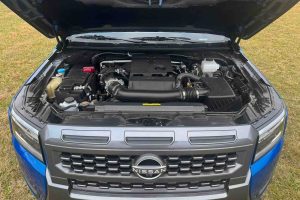
The Frontier – all trims – comes standard with a 3.8 liter V6 that makes 310 horsepower (and 281 ft.-lbs. of torque).
Some of the other trucks in this segment have fours that make more horsepower and torque, but they are fours – and to make equivalent (or better) horsepower and torque, they rely on turbocharging. Turbos make power via boost – which can be expressed as pressure. More air is forced into the engine, which (along with more fuel sprayed into the cylinders) creates a more powerful explosion inside the cylinders. The downside is that it is necessary to keep the four cylinder engine under pressure to get six cylinder horsepower and torque, which may mean shorter engine life. There are also more potential failure points – because there are more parts (e.g., the turbo itself plus peripherals such as intercoolers and specialized exhaust plumbing and so on).
The others in the class have gone to turbo (and hybrid-augmented) fours to deal with government regs – both here and in Europe – that demand ever-lower C02 “emissions” and fours help with that because when they are not on boost, there are moving less air than a six. Compliance pressures are also why the manual transmission – which was typically standard in pickups as recently as about a decade ago – are now all-but-gone. The Toyota Tacoma is the only truck in the class that even offers one – and it is only available in one (expensive) trim.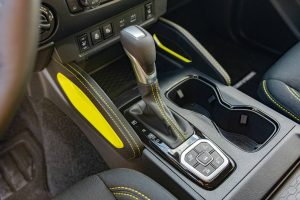
The Frontier’s V6 does get good gas mileage – 19 city, 24 highway – for a nearly full-size truck. To make the point, when the Frontier was last a compact-sized truck (back in 2004) and came standard with a much less powerful 2.4 liter four (no turbo, so just 143 horsepower) and a manual transmission, it only managed 20 city, 23 highway. The ’04 Frontier with the four was also only rated to pull up to 3,500 lbs. and even when equipped with its then-optional 3.3 liter V6, it maxed out at just 5,000 lbs.
The current Frontier comes standard with a 7,150 tow rating.
A nine speed automatic is the standard (and only available) transmission but you can still go 2WD or 4WD.
On the Road
If you have owned a full-sized truck but do not want to drive a super-sized truck, you will probably find the Frontier to be the right-sized truck.
It has about the same footprint – length, width and height – of an early-2000s full-size pickup, so it’s big, but not huge. There’s still some room on either side of you when you’re driving down a windy country road with blind curves, so you don’t sweat smacking mirrors with another big truck coming the other way. When you pull into a bank drive-through window, you don’t have to reach down awkwardly to grab the vacuum canister thing – and when you park, you can open the door and get out without having to slide out sideways, to avoid denting the side of whatever’s parked next to you.
The big V6 is the biggest plus. Not because it’s the strongest engine you can get in the class (the Toyota Tacoma’s iForce Max turbo-hybrid-augmented four touts 326 horsepower and 465 ft.-lbs. of torque) but because it fits. This is not a small truck – and neither are the others in the segment. When they were all still compact-sized, they came with fours as their standard engine and that fit. The fours don’t. Not really. If that weren’t true, then why the turbocharging and hybrid-augmenting? Well, because the fours need that to replicate the output of a six, which is what a big truck that weighs 4,466 lbs. ought to have under the hood – and would, were it not for compliance pressures.
Kudos are due Nissan for resisting those pressures.
The V6 also has the right sound, which is part of the fit. There is something off about starting a big truck’s engine and hearing a small truck’s engine. To be fair, the competitions’ turbo and hybrid-augmented fours feel bigger than they are. They generate great swells of torque at just above idle speed. Light pressure on the accelerator results in bounding leaps forward – but when you floor the accelerator (and the RPMs rise) their sound isn’t right – in a truck this big. The Frontier’s V6 has a deeper below, as you’d expect. This does of course mean you have to push down harder on the accelerator to get it to bellow – and that may seem like a not-good thing – but it is, because you probably won’t need to call on it to bellow very often. In contrast, the little turbo-hybrid-augmented fours feel easier-going because of all that torque down low and right there. But inside they are under a lot of pressure – and that pressure is constant. These little fours are in fact working harder almost all the time. The V6 is working a lot less hard almost all of the time.
Which do you think is more likely to still be tight 150,000 miles from now?
At The Curb
The main point of departure between the current Frontier and its compact-sized ancestor (last made in 2004) is not length but height and width. The current model is 210.2 inches long; the ’04 was 202.9 inches long. Eight inches isn’t that much difference in terms of fitting in the garage or sliding into a curbside parking spot.
The increase in height is much more pronounced. The current Frontier is 71.5 inches tall. The old, compact-sized Frontier was 63.2 inches tall. That’s not far from a foot taller (or shorter) depending on how you look at it. As it happens, I own an old, compact-sized Frontier – an ’02 model. I can easily reach the roof to wash it. I need a stool or bucket to stand on to reach the current Frontier’s roof. Also, the bed is higher up and so are the bedwalls. I reach down to get at stuff I put in the bed of my ’02 – but getting at the stuff I put in the bed of the new one requires tip-toes and a stretch. It is still, however, possible to get at stuff you put in the bed without needing a step-ladder – which all the super-sized half-ton trucks now come with.
It’s also nice that you can get the five foot or the six foot bed with either cab type.
Width is the other big dimensional difference.
The current model is 73 inches wide; the old (compact-sized) Frontier was a much svelter 63.2 inches through the hips. But it was also much cozier inside. You rubbed shoulders with your passenger. In the current Frontier, you do not. It feels like a full-size truck inside, which it basically is. But from the early 2000s big. Not the current super-sized big. To understand the difference, here’s a number: 79.9 inches. That’s how wide a current Ford F-150 is. That’s about half a foot wider than the Frontier – and when you’re on a windy country road with blind curves, that half-a-foot can make all the difference between smacking mirrors and not.
The rear seats in the king cab (extended cab) are tight, but not as tight as they used to be (back when the Frontier was a compact) and there are separate (though smaller) doors that facilitate better access than just two doors. Legroom is 26.2 inches, so it’s ok for kids and young teenagers but adults consigned to back there aren’t going to be happy. The crew can fixes that with four full-size doors and 33.2 inches of backseat legroom.
The Rest
The fact that Nissan has winnowed down the king cab’s availability to just the base S trim suggests the king cab is on the way out. The fact that it is only available in the base S trim will probably accelerate its retirement because probably many people who’d like a king cab – because they don’t need the bigger cab and might like to not pay extra for it – would like to get the equipment you can only get in the SV, Pro-X and Pro-4X trims, which you can only get by getting a crew cab.
For instance, the SV comes only with an ok four-speaker stereo. There’s no available factory upgrade. You have to buy the crew cab SV to get a better, six-speaker stereo. You also cant get the king cab with other-than 16-inch wheels and the base cloth upholstery.
Also, the entry price point has increased bigly. Back in ’04, you could buy a new (compact-sized) Frontier for about $15k. Even factoring inflation into the mix, that’s still only about $24k in today’s devalued dollars. The current Frontier is a much stronger, more capable and nicer truck in every way. But it’s also much more expensive. They all are, which is arguably sad because affordable little trucks were a great way to avoid spending a lot of money on a new vehicle. Unfortunately, that’s no longer true.
The Bottom Line
If you’re wanting a big (but not huge) pick-up that doesn’t come only with a small engine, your decision comes down to one.
. . .
If you like what you’ve found here please consider supporting EPautos.
We depend on you to keep the wheels turning!
Our donate button is here.
If you prefer not to use PayPal, our mailing address is: EPautos 721 Hummingbird Lane SE Copper Hill, VA 24079