

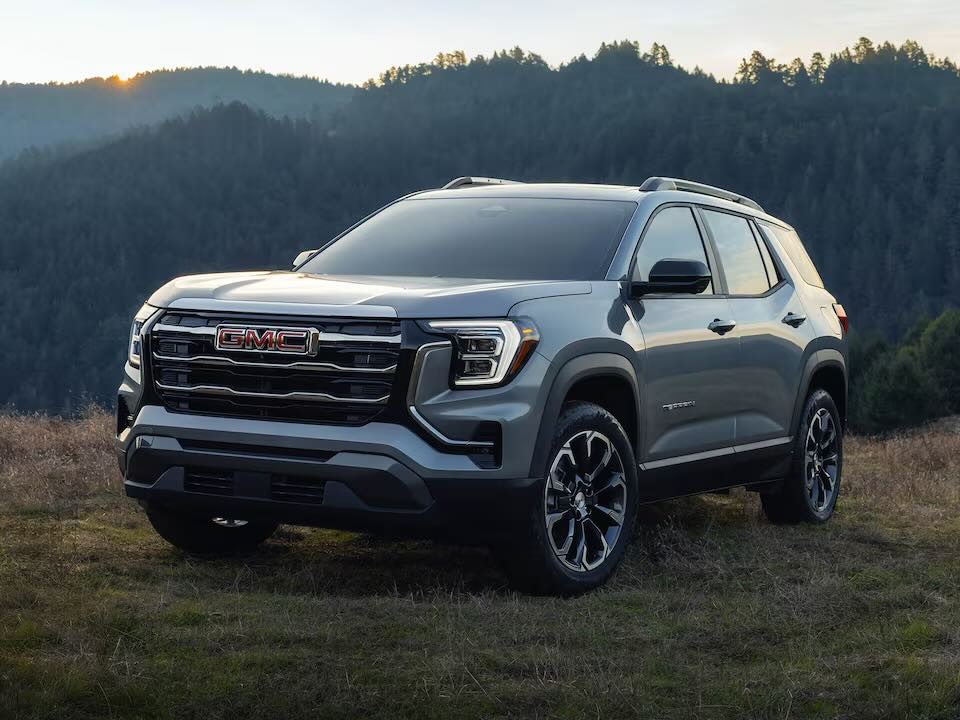

Lots of people decide to buy a nicer Chevy Tahoe – in the form of the GMC Yukon. It’s a similar thing as regards the GMC Terrain – which is basically a nicer Chevy Equinox. You pay more for the GMC-badged version of the same basic thing, of course. But it’s worth the extra to some.
What It Is
The Terrain is a compact crossover related to the Chevy Equinox. Both are mechanically identical but have slightly different exterior and interior styling. The Terrain – being a GMC and so a notch up the brand-prestige ladder in the GM hierarchy – costs a bit more ($30,200 to start for the base Elevation trim vs. $28,900 for the base LT Equinox) but in addition to the different looks and the GMC badge, you also get more standard equipment, such as a larger (15 inch) tablet-style LCD touchscreen vs. the smaller (11.3 inch) screen that comes standard in the Chevy, as well as a better six-speaker audio system, standard heated front seats, four USB ports, remote start and navigation with Google apps.
There are two other Terrain trims.
The $39,400 AT4 adds AWD plus all-terrain tires, an off-road-tuned suspension, skid plates and roof rack. The Equinox offers a similar package of off-road upgrades in the Activ trim ($33,600) but without some of the extras that come standard with the Terrain AT4, such as the skid plates and off-road suspension turning.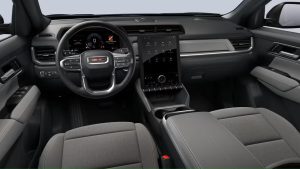
The top-of-the-line Terrain trim is the Denali ($41,900) which is luxury-themed and bundles a softer, comfort-tuned suspension, heated rear seats (and ventilated front seats), LED foglights and Denali-specific interior/exterior trim. AWD is also standard.
Chevy does not offer a Denali-equivalent (or similar) iteration of the Equinox.
What’s New for 2026
The AT4 and Denali trims are new additions to the Terrain trim/equipment lineup.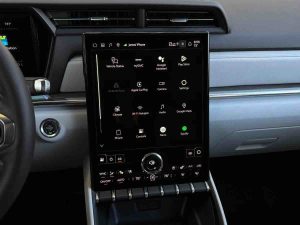
What’s Good
An upgraded iteration of the Chevy Equinox, available with equipment and features that aren’t available with the Equinox.
Exceptionally roomy up front (44 inches of legroom) and still pretty roomy in back (39.7 inches of legroom).
Base price is only slightly higher than Equinox’s base price.
What’s Not So Good
Standard 1.5 liter engine is the only available engine.
Standard CVT automatic is the only available transmission.
Max tow rating is only 1,500 lbs. – and you have to buy AWD to get that. FWD versions of the Terrain are only rated to pull up to 800 pounds.
Under The Hood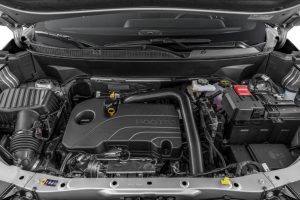
Like its Chevy-badged counterpart, the Terrain – every trim – comes with a turbocharged 1.5 liter four cylinder engine that touts 175 horsepower and 184 ft.-lbs. of torque. That is not a lot of engine (or horsepower) to move a 3,446 pound vehicle – and it shows. It takes this GMC almost 9 seconds to get to 60. It feels (and sounds) longer than that – about which more follows below.
The more substantive detraction is subtler. It may not manifest for several years. It may not manifest at all. But 1.5 liters is less engine than many motorcycles that weigh less than 1,000 pounds have. These bike engines – which would be denoted as 1500 cc engines in a motorcycle context – don’t need to be turbocharged because a 1500 cc engine is amply big enough (and powerful enough) to move a motorcycle decently, without straining. But a 1.5 liter engine (in a four wheel context) is much too small and lacking in power – on its own – to move a 3,400 lb. vehicle decently, without straining.
Without a turbo, the Terrain’s 1.5 liter engine would probably make around 120 horsepower (and a lot less torque, the get-you-going power that gives a car the feeling of power – or the lack of it). It would take all day to get to 60 – if it ever got there at all. Hence the turbo, to boost the output of this under-sized engine. When boosted, it makes about as much power as an adequately sized V6 would make without a turbo. Five or so years ago, a V6 would have been standard or at least available in a vehicle like this.
The V6 would use a bit more gas, of course – but not that much more. Equipped with its 1.5 liter turbo’d four, the Terrain touts 26 city, 28 highway. If it had a V6 instead, the mileage would probably be about 22 city, 26 highway. It is not something that makes much difference to the vehicle’s owner, in terms of saving on gas money. But it does make a huge difference in terms of CO2 “emissions,” which are always “emitted” whenever gas is burned. A V6 without a turbo always has six cylinders pumping but a small four has two fewer cylinders pumping and when it is not under boost, it “emits” less gas (CO2) and that is the regulatory compliance reason why GMC and so many other car brands are putting such tiny turbocharged engines in vehicles that in the past would have come standard with or at least offered a V6.
But what is the problem with the turbo’d tiny engine?
It is the pressure it’s under to make adequate power. Internal parts are subjected to more stress and heat and the parts (such as bearings) are smaller and so the stress is more concentrated rather than absorbed by a larger surface area part. As a generally true thing, this tends to mean a shorter service life for those parts. Maybe not. Parts can be designed to be tougher; oiling and cooling systems can be improved to transfer heat more effectively.
Only time – and miles – will tell.
The Terrain’s standard (and only) transmission is a CVT automatic, leaving the only drivetrain choice the decision to stick with the standard FWD layout or spring for the available AWD system. The AWD system will improve traction but comes at the cost of hauling. FWD iterations of the Terrain are rated to pull up to 1,500 lbs., which is the weight (plus a small load) of a small trailer. You can hook up and haul a riding mower or a couple of dirt bikes.
If you get the AWD, the tow rating goes down by almost half to just 800 pounds.
On The Road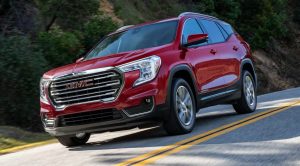
In stop-and-go, slow-pokey traffic, the Terrain does not feel (or sound) underpowered. But when you need it to move out smartly, it does. Even with turbo-boost, the 1.5 liter’s 175 horsepower isn’t enough to overcome close to two tons of dead weight – 3,400-ish pounds of Terrain plus a couple hundred pounds more of you and maybe a passenger or two. The CVT automatic doesn’t help. Floor the accelerator pedal and the CVT lets the engine spin close to its redline and – if you keep your foot down – the CVT will keep the engine spinning fast (and loud).
This is normal.
This is what CVTs are supposed to do; i.e., they are designed t get the engine spinning to the RPM where it makes power – which for this engine is 5,600 RPM. A conventional automatic would let the engine speed decrease as the transmission shifts up through its forward gears, but the CVT holds the revs until the driver backs off the pedal. If the engine makes more-than-enough power to get the vehicle going reasonably quickly, the driver will only rarely need to put his foot all the way down and in that case, the CVT is smooth and quiet; no “shift shock” during the 1-2, 2-3, 3-4 gear changes as the vehicle accelerates, as would be the case with a transmission that shifts. But when the engine makes just barely enough power and the driver demands all the power there is, the CVT enhances the feeling (as well as the sound) of under-poweredness and that is the case here.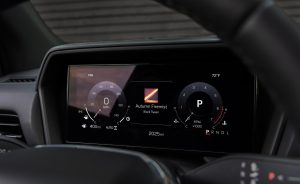
This is unfortunate because if this little GMC had a little more engine, it’d be otherwise appealing. Its weight makes it feel beefy – in a good way. As in not flimsy. The doors close solidly and once they are closed you don’t feel like you’re driving something small, even though the Terrain is just 181 inches long (a smaller footprint than a Honda Civic sedan, which us 184.8 inches long). GMC’s intention was to make the Terrain look – and feel – like larger GMCs, such as the mid-sized Acadia and the effort is nine-tenths successful. If the Terrain at least offered the Acadia’s standard 2.5 liter four as an option it’d be hard to fault this smallest GMC. A torquey diesel would solve the power problem too. Unfortunately, federal regs have gotten so onerous that it is very difficult to get a diesel through the pipeline anymore (which is why there almost no diesel engines available in anything besides a 2500/3500 series heavy-duty truck or cargo van).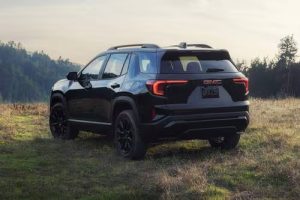
The gas mileage is an upside – but only in slow-pokey, stop-and-go traffic. On the highway, if you keep up with the traffic that’s typically going at least 70 – you’ll probably find you’re averaging around 26 MPG (as I did during my weeklong test drive). That’s not terrible – but it’s also about what you’d get out of a similar vehicle with a larger engine that didn’t have to work so hard to keep up.
This is the Dirty Little Secret of today’s little-engine’d but heavy vehicles; the little engine doesn’t use much gas when it’s not on boost. But it needs the boost to get you going faster than slow-pokey and that burns more gas than you may have been led to believe would be the case.
At The Curb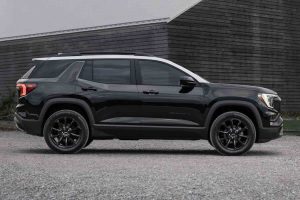
As mentioned, the Terrain is pretty small – but doesn’t look it. And by the numbers, it’s actually pretty big – on the inside.
The driver and front seat passenger have 44 inches of legroom and the back seat occupants get nearly 40. That’s a neat trick. Sometimes a small vehicle will advertise generous legroom up front, which it has because there’s much less room in back. What that ends up meaning is that for people – adults – to be able to ride in the back, the people up front have to scooch their seats several inches forward. So much for all that legroom. But that’s not the case here. Though it is small – on the outside, four full-size adults adults can ride comfortably in the Terrain and five (three in back) reasonably comfortably.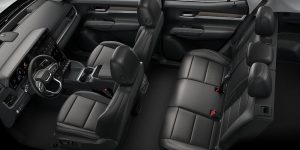
It’s also pretty comfortable on your wallet. $30k to start – sticker, before you dicker – for what amounts to a nicer iteration of the Equinox – one with standard heated front seats and steering wheel, heated exterior mirrors, all the power options and the new dual LCD main instrument (11 inches) and oversize (15 inch) tablet-style secondary LCD screen that you can’t get (yet) in the Equinox is a pretty decent deal in today’s new vehicle market.
The AT4 offers a degree of off-road capability that’s also unusual in the class – and for the price.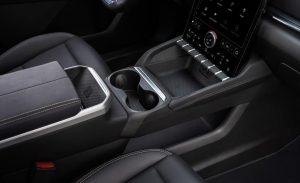
A final thing in the Terrain’s favor is that it’s unusual. Put another way, it’s not a Toyota or Honda or Subaru crossover – like so many other people are driving.
Not that there’s anything wrong with those other crossovers. It’s just that it seems everyone’s got one. This one is different in that sense – and that’s something.
The Rest
The huge, Tesla-emulating LCD touchscreen will appeal to those who like touchscreens, just as the standard array of “assistance” technologies – including one that “assists” those who have difficulty noticing bicyclists on the road – will appeal to those who like being “assisted.” If you don’t like these things, you are in the same basic position as people who don’t like seat belt buzzers and air bags in that they are becoming inescapable in new vehicles generally.
The Bottom Line
The Terrain can be a seen as nicer Equinox, which is pretty much how GMC wants buyers to see it.
. . .
If you like what you’ve found here please consider supporting EPautos.
We depend on you to keep the wheels turning!
Our donate button is here.
If you prefer not to use PayPal, our mailing address is:
EPautos
721 Hummingbird Lane SE
Copper Hill, VA 24079
PS: Get an EPautos magnet or sticker or coaster in return for a $25 or more one-time donation or a $10 or more monthly recurring donation. (Please be sure to tell us you want a magnet or sticker or coaster – and also, provide an address, so we know where to mail the thing!)
If you’d like a Baaaaa hat or other EPautos gear, see here!









Just finished with one as my rental car. 250 miles on the clock when I picked it up. Roomy. Nice ride. No guts. *Total Nanny State* with buzzing alerts and such. Didn’t even try to turn on the radio/infotainment. No way in hell I’d ever buy one. <- I actually say that about every new car now. Maybe I'll hang on to my 14 VW Jetta, 2.5L, 5cyl, 5spd after I retire.
My 2012 4,500 lb., 283 HP 3.6 V6 Ram C/V with 102.000+ miles, with original spark plugs, averages 22-23 MPG running locally up-and-down my mountain top home, and approaches 25.5 MPG on interstates. Riddle me that, little breathless 1.5 Turbo GMC.
Looks cramped up front, narrow seats and a knee knocker squared off center console.
I can’t believe anyone used to a normal V6 engine and a 6 speed automatic would ever buy one of these.
‘in addition to the different looks and the GMC badge, you also get more standard equipment, such as a larger (15 inch) tablet-style LCD touchscreen vs. the smaller (11.3 inch) screen that comes standard in the Chevy.’ — eric
It’s like the old joke about a contest in which first prize is a 1-week vacation in Gary, Indiana … and second prize is a 2-week vacation in Gary. So much winning!
‘Standard 1.5 liter engine is the only available engine. Standard CVT automatic is the only available transmission.’
Tell me again — GMC is supposed to be a prestige badge, but it sells vehicles equipped with this low-end, econobox drivetrain? Looks like GMC will be following Oldsmobile and Pontiac into oblivion soon.
Get a brain, Mary!!
My daughter’s 2013 Equinox LTZ with 3.6 L V6 has 301 hp and gets to 60 mph in 6.7 seconds. It has a 6-speed automatic, not a CVT. (Got it used for $4,500 two years ago.)
This new Terrain? — Quelle rétrogression !
This seems like one of the vehicles where turning off the A/C will get you on the highway faster. Like having Captain Picard say “divert all power from life support to the main thrusters”
It is impossible for someone like me to get past the 1.5L engine. On a mid-size SUV. Good lord!
Morning, Dood –
It is getting a little (ha!) absurd, isn’t it? My Kaw ZRX has an engine only slightly smaller (1200 cc, 1.2 liters).
175 horsepower in a 3,400-pound vehicle? Ridiculous. Not to mention from a 1.5 liter engin that belongs in a lawn mower and a miserable, whining CVT that will give up the ghost at 100k miles if you’re lucky.
GM didn’t design this vehicle, but the government and its insane regulations. No thanks, I’ll pass.
Because the only (((Terrain))) this vehicle is going to run over and flatten is your wallet and bank account!!!
Goyims..
Morons &…
Chuckleheads…
YMMV….
Why did they name this “Terrain”?
The only terrain it’s capable of navigating is probably a parking lot.
No 4×4, tiny engine that can’t, no towing to speak of.
It’s kind of cheap and nice for grandma to ride in I guess.