



If you let your kid live with you until he’s 40, he’ll probably have a hard time making it on his own. Maybe the same sort of thing is playing out on the road. Cars have never been easier to drive yet it seems people are having a hard time driving them.
Competently, that is.
Here’s a sample to make the point:
The driver – if you want to call him that – could not keep his late-model car in its travel lane. He repeatedly swung wide – off onto the shoulder – and then over-corrected across the double yellow. Is it that difficult to center a modern vehicle in between the lanes? Fifty years ago, when the typical car – especially the typical American car – had overboosted power steering and a primitive, literally truck-like suspension system (solid axle, leaf springs) and not-especially-grippy tires – it did take more skill to keep the thing in its travel lane, especially if you were moving fast. Today, people who drive slow – in cars such as the one in this video, that have precise steering, grippy tires and much more competent suspensions (along with lots of “assistance” systems) have great difficult keeping their cars within the travel lane.
My hypothesis is that there’s a relationship – and inverse one – between the increased capabilities of cars and the decreasing abilities of drivers. Basically, it is centered on this premise: Expect less of drivers and you will get worse drivers. There is also something more. It is the implicit assumption of incompetence that attends the proliferation of “assistance” systems. The word speaks for itself. A driver who needs “assistance” is by definition someone who is not fully capable. This begs a question almost no one seems to ask, which is whether it’s a desirable thing to have lots of drivers who need “assistance” behind the wheel of potentially very dangerous things? Lawn darts – if you remember them – got taken off the market because kids would sometimes throw these heavy, metal tipped things up into the air as hard as they could. Then they would come down. Sometimes, someone might be standing where they came down.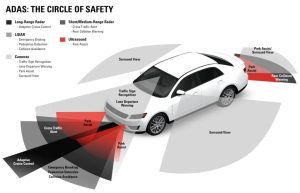
No one – back then – thought to fit the lawn darts with “technology” that would prevent them from impaling someone when they descended back to earth.
On the other hand, rather than take the lawn darts away from everyone, maybe the right approach would have been to train the kids in their safe and responsible use. Kids can be trained to safely and responsibly handle far more potentially dangerous things, such as firearms. They used to be – and on account of that, what is styled “gun crime” was exceedingly rare. It is now more common because lots of kids are not trained to be safe and responsible around guns but have access to guns because their parents are irresponsible. Or just not there.
It is much the same with respect to cars and driving. Expectations are low and the result is low (as in low-performance). Yet it is considered almost cruel – even sinful – to expect people who operate potentially dangerous machinery to be competent to operate the machinery. It’s too difficult! Too challenging! This is not stated openly, of course – but is it not implicit in the proliferation of all this “assistance” technology? Rather than expect more from drivers, more is expected of cars. Most new cars have steering correction (Lane Keep Assist, to keep the car fromt wandering out of its travel lane) and automatic braking (to address the problem of drivers who forget to brake, or don’t notice the impending necessity because they are too engrossed in texting someone) and Park Assist (because this most basic competence is no longer required as a condition of acquiring a license to drive) and Back-Up Assist (because so many people are backing over and into things) and so on.
The result? Drivers who need even more “assistance.”
This creates an even worse danger, too. A bad driver in the ’70s was somewhat kept in check by the low capabilities of his car. It didn’t feel safe at high speed, specially in the curves. So he moderated his speed. It is common today for people to drive much faster than they are safely capable of driving – because the car gives them the false confidence to do that.
Drivers in the pre-ABS era driver knew that if they followed the car ahead of him too closely and that car suddenly braked, their own car would not be able to stop. If they slammed on the brakes, the wheels would lock up and their car would go into a skid. So they were more careful about following too closely. Cars were once just more difficult to drive – especially trucks, which often had manual transmissions and always handled terribly. People learned to drive – competently – because they had to.
They no longer have to – and you can see the results for yourself, every time you go for a drive.
. . .
lemIf you like what you’ve found here please consider supporting EPautos.
We depend on you to keep the wheels turning!
Our donate button is here.
If you prefer not to use PayPal, our mailing address is:
EPautos
721 Hummingbird Lane SE
Copper Hill, VA 24079
PS: Get an EPautos magnet or sticker or coaster in return for a $25 or more one-time donation or a $10 or more monthly recurring donation. (Please be sure to tell us you want a magnet or sticker or coaster – and also, provide an address, so we know where to mail the thing!)
If you’d like a Baaaaa hat or other EPautos gear, see here!










As usual, you are correct, Sir.
The psychology applies to everything in life because everyone, to some degree, will allow others to perform tasks so we don’t have to. The scale ranges from “Hands On” to “Lamprey” levels.
Anecdotally, when our kids were in junior high school GovCo wanted to implement School Based Health Clinics because some parents weren’t providing “adequate care” (as GovCo bureaucrats saw it) for their kids. I tried to point out that by providing a clinic a certain number of parents who had been providing for their kids would gladly let GovCo take over the job. It encourages sloth and irresponsibility. The more GovCo provides the more people will take that bait. GovCo thrives on this model. More “services” to more people for more time. It’s nothing more than a GovCo full-employment program. Same with the “drug war” and everything else GovCo does.
Why?
Because they’re self-serving parasites.