

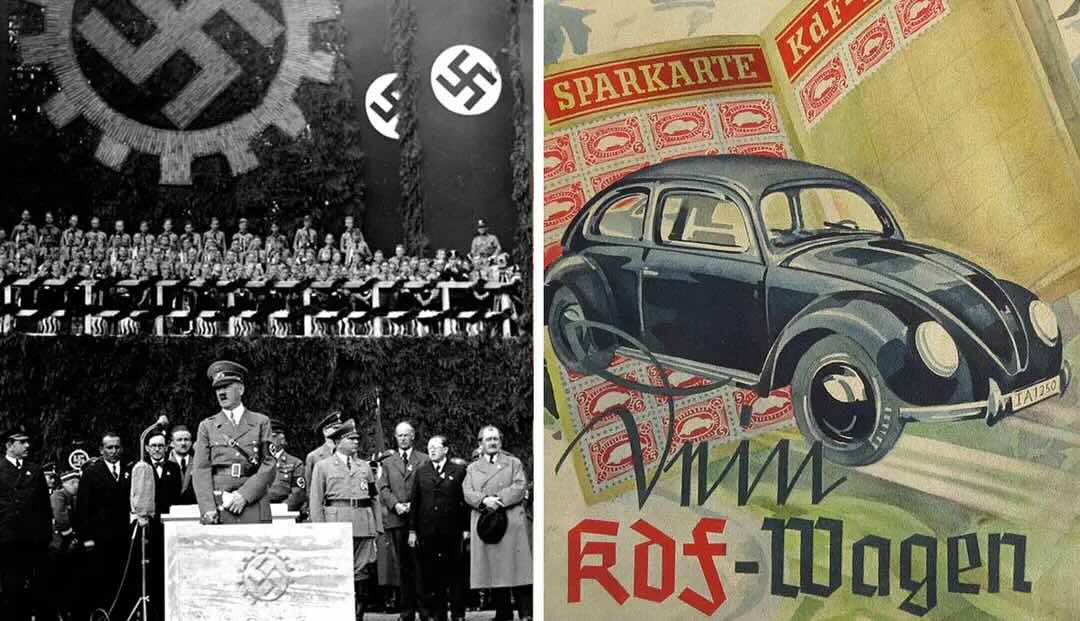

“Volkswagen” – as most people know – is German for the people’s car. A car for everyone, basically. The company – and the car – was conceived as Germany’s version of Ford and his car. The Fuhrer greatly admired Henry Ford, who was the first to build (Ford’s words) “a car for the great multitude” – aka, the people.
The Beetle – VW’s first and for a long time eponymous car – was in many ways a superior car relative to Ford’s Model T. It featured unibody construction, which improves torsional stiffness and reduces manufacturing costs. Its ingenious air-cooled engine didn’t need a radiator or coolant and – by mounting it over the (rear) drive wheels, traction was excellent. The take-home point, though, is that while the Beetle was a very different car in comparison with the Model T, it was also very similar in that both cars were designed for the people. They were a counterpoint to the idea that only affluent people should own private motorcars, which was the case in both countries before the advent of these people’s cars.
Well, that’s all changed – though the name (VW) remains the same.
Just the other day, VW announced it would be unemploying 50,000 people and “consolidating its global model lineup and implementing cost controls to improve its margins,” meaning make more money selling fewer but more expensive cars. This is the business model of an affluent people’s car company. 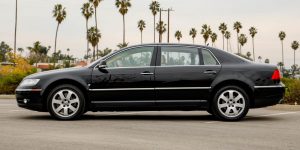
Interestingly, VW has tried this once before. It did not go well. You may remember. Back in the early 2000s, VW introduced a car called the Phaeton, which was a VW in name only. Which – interestingly – is why it didn’t sell. The Phaeton was an Audi in everything but name, which was problematic because the people generally cannot afford Audis, which are luxury-priced cars. The Phaeton was especially so. Its base price – in the early 2000s, mind – was $64,600 and from there it soared to $94,600 but at least back then you got a standard V8 engine, with the high-end iterations boasting a W12, which was you got in a top-of-the-line Audi A8 sedan. That’s basically what the Phaeton was, except it carried the VW badge. As it turned out most of the affluent people who can afford a high-end Audi were not interested in a high-priced VW, even if the latter wa basically a high-end Audi. Affluent people buy status – and a people’s car lacks that. It is astounding VW’s executives did not get that. They actually thought they could sell the Phaeton at VW stores, which is something like thinking you can sell wagyu steaks (at top dollar) at McDonald’s.
On the other side of things, the people who could afford VWs could not afford Audi-priced VWs. The result was that the people who may have wanted a car like the Phaeton could not afford it while the affluent people who could afford it did not want it. The predictable result of that was the Phaeton flopped.
VW went back to selling people’s cars for awhile and was selling lots of them, which meant it wasn’t necessary to “improve margins.” If you make a $10 profit each on a quarter-million $100 sales, you end up with more profit than if you made $20 profit each on 10,000 sales. Henry Ford understood this. The Fuhrer did also. Both men – interestingly – wanted the people to have cars. Making money was of course part of that but it wasn’t only that. Once upon a time. you had a great industrialist and a great politician who wanted to improve the lot of their people. Of the great multitude. Imagine that. It is something very hard to imagine now. Almost everything imaginable is being done by corporations (a thing distinct from industrialists) and politicians to worsen the lot of the great multitude, especially as it pertains to cars.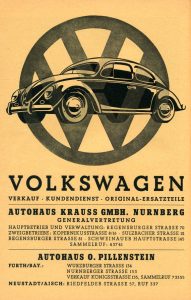
VW stopped selling people’s cars about ten years ago.
That was when it decided not to fight for the people by defending its diesel-powered people’s cars, which were not darkening the skies with soot. They were so clean, in fact, that it was not uncommon for people who couldn’t tell they were diesel-powered to pump gas into them. This happened to a VW press car I was scheduled to get; the delivery driver – not realizing it was a diesel-powered vehicle – put a few gallons of unleaded in before he realize his mistake.
It took laboratory equipment and an Inspector Javert-like determination to find something to . . . find something. Something was eventually found. It was a trivially slight uptick in NOx (oxides of nitrogen) emissions during wide-open-throttle operation. It meant nothing in terms of actual harm caused but it was framed as something akin to Auschwitz and gas chambers.
VW wilted before the incandescence of the accusations and it has been downhill for the company ever since.
The attempt to peddle affluent people’s cars – especially EVs, such as the ID Buzz – have led to declining sales and too much overhead. Hence the unemployed 50,000. But instead of recognizing it is driving down a dead-end street, VW is embracing its new identity as (it hopes) an affluent people’s car.
“The Supervisory Board received a thorough briefing on the transformation concept developed by the Executive Board,” said Hans Dieter Pötsch, who is the chairman of said Supervisory Board. “As the Supervisory Board, we are convinced that implementation of the Future Plan will secure the long-term viability and competitiveness of the Volkswagen Group.”
Perhaps it is time to change the name to reflect the new identity.
Vermögendwagen, perhaps? It is German for wealthy people’s car – and the beauty of the thing is the acronym would stay the same. “VW” would not even have to change the signage to reflect the new reality.
But the waiting room at the dealership is going to need a remodeling.
. . .
If you like what you’ve found here please consider supporting EPautos.
We depend on you to keep the wheels turning!
Our donate button is here.
If you prefer not to use PayPal, our mailing address is: EPautos 721 Hummingbird Lane SE Copper Hill, VA 24079






 "a car for the great multitude" - aka, for the people.)
What many don’t realize was that this idea of a German version of the Ford Model T wasn’t new; it’d been suggested almost before the ink was dry on the Versailles Treaty as a way to restart the moribund German economy, and, in particular, keep the Krupp Steel Works going. In deed, Henry Ford and outgoing POTUS Woodrow Wilson were quite in favor of the idea, however, there were several problems:
(1) Georges Cleamanceau, the self-styled “Tiger of France”, purported to have said that War was too important to be left to the generals, wasn’t going to tolerate any help for any German industry, and certainly not their automotive, as not only would the French not tolerate “Les Boches” winning in the marketplace, but he feared, with some justification, that mass production of passenger cars would easily convert to mass production of military trucks and TANKS.
(2) Ford of Germany was actually a subsidiary of Ford of the UK, which operated with a degree of independence from its USA parent. Certainly the Brits weren’t going to anger the French and they too had little interest in a German competitor.
The Nazi party championed the idea for several reasons, aside from the obvious one of putting “good Germans” on their new Autobahns. One thing noticed from the “Great War”, as it was then termed, was how the Americans already had a considerable base of young soldiers who could drive their Model T trucks and REPAIR them. German auto repair, such as it was in those days, was very much the realm of “guilds” and skilled mechanics, who went through vocational schools and license examinations. What was needed was something the typical 18 or 19 y.o. kid could not only learn how to drive, quickly, but also to repair, having some high-school level “shop” classes. For more complicated situations, like engine rebuilds, the engine would be easy to swap out for a “loaner” or a rebuilt unit!
To finance the “Strength Through Joy”, or KdF car, as the Nazis named it, rather than rely on borrowing from banks, the prospective motorist would sign up for a pre-payment plan, which would be deducted from his wages. Each payday, the pay clerk would affix a savings stamp in his paybook, and when the squares were filled, he’d be on a list and hopefully would be getting his VW “Kafer” (Beetle) in due time. The civilian distribution never happened, as by the time the first VWs were rolling out of Wolfsburg, WWII was on, and they were diverted to military needs, including a modified version, the “Kubelwagen”, which very much resembled the “Thing” sold in the early 1970s. Captured examples of Kubelwagens were evaluated at the Aberdeen Proving Grounds, and though the Bantam-designed Jeep, mostly built by Ford, was found to be overall superior, the Kubelwagen was noted for being more stable over muddy and dirt roads, far less prone to overturning than the Jeep, which probably killed as many GIs as did the “Jerries”! With the surrender of Germany in May 1945, the Soviets confiscated the 280 million marks worth of savings from the stamp-book program as a war reparation. However, a British directive to get VW production going again at Wolfsburg in 1946, to provide vehicles for the British Army of the Rhine, was put forth, which resulted in the second version of Volkswagen AG.
I really need to get my dad’s old square-back (back) and my Charlie C. nose-an-mustache out for the road.
Good times (provided you didn’t sweat too much or burn your sleepy but on the floorboard).
The question is, though —
should I take my PPK?
and, the Mercedes ?
Apro-po?
I donno. :]
https://malevus.com/hitlers-cars/
[…] https://www.ericpetersautos.com/2026/09/08/maybe-they-ought-to-change-the-name/ […]
Maybe They Ought To Change the
NamePresident‘President Donald Trump on Tuesday made another dubious claim about his involvement in the recovery effort following the 9/11 attacks, leading critics to call him “delusional” and a “despicable liar.”
‘Trump claimed Tuesday that two firemen “lifted me up” from the rubble amid concerns that a nearby building was going to collapse.
“I just thank my people. I was building a big building in New York, and I took the whole crew down there right after this happened and … they had no hesitation,“ Trump said Tuesday during an event at The Ellipse in Washington, D.C. honoring 9/11 first responders.’
https://www.al.com/politics/2026/09/trump-called-out-on-brazen-new-totally-made-up-story-about-911-despicable-liar.html
Orange-Flake Fubar has crossed the line into unhinged delusion. What does it take to gaff this gibbering, malfunctioning psychotic off the stage?
Tryin’ to be a hero, winding up a zero
Can scar a man forever, right down to his soul
Living in the spotlight can kill a man outright
‘Cause everything that glitters is not gold
— Larry Gatlin, All the Gold in California (1979)
I had the most interesting discussion today with ChatGPT. I feel you all will want to hear what we talked about the implications for any readers on this site still invested in stocks. For those who follow the market, you probably know that with rising interest rates the stock market is ultimately doomed. For any of you follow Elliott Wave dot com “articles” you may have seen a plethora of videos how overbought the market is right now, like this one, and also check their youtube channel for plenty more.
https://www.elliottwave.com/articles/4-signs-of-excess-in-todays-stock-market/
First of all, I am very interested if the market has already topped, which my radar got real suspicious when last month in August the market popped straight up. That to me meant that may have been the last wave up, and it was confirmed by Daneric Elliott Wave who had the same thought and labeled his charts was 5 of 5 of 5 completed.
So I asked ChatGPT to find out what Precher said back in the late 1970s with his first book. You can try these questions for yourself, super easy to do, even a Neo-Luddite who is computer illiterate can do it:
“in the first edition, what did he say how the final wave 5 of 5 of 5 of the Grand Supercycle wave would end”
ChatGPT said:
Yes. In the 1978 first edition of Elliott Wave Principle: Key to Market Behavior, Frost and Prechter made a remarkably specific statement about how the final wave of the Grand Supercycle should end.
Their long-term count put the Grand Supercycle beginning around 1789, with the market then in Supercycle wave V. They said that the eventual completion of Supercycle V should produce an economic/social shock, followed by an extended period of decline or stagnation. Specifically, they wrote that the end of Supercycle V should usher in “an era of economic and social stagnancy or setback in significant portions of the world.”
But there’s an important distinction in the book:
Grand Supercycle wave: the enormous wave beginning around 1789.
Supercycle V: the fifth and final Supercycle wave within it, which they believed was still underway in 1978.
The termination of Supercycle V would therefore also terminate the Grand Supercycle. They expected that termination to be followed by a very large corrective period, potentially lasting centuries at the Grand Supercycle degree.
And this wasn’t merely a vague prediction of a bear market. Their wording was considerably more dramatic: they anticipated “some form of economic or social shock” leading into an era of “decline and despair.”
The really interesting part
If you’re asking specifically about the 5th wave of the 5th wave of the 5th wave—i.e. the terminal subdivision of the terminal wave—there is another passage that is probably what you’re looking for.
Prechter later described the expected termination of Cycle V of Supercycle V as an extraordinary mania, followed by what he called the greatest crash in U.S. stock-market history. In that later discussion he projected a Dow top around 3,686, after which the Grand Supercycle bear market would begin and correct the advance dating back to the late 1700s.
So if your question is “Did the first edition actually predict that the ultimate fifth-of-fifth-of-fifth would end in a gigantic speculative mania followed by an unprecedented crash?”, I can dig into the exact first-edition pages/figures and reconstruct his hierarchy of 5 → 5 → 5 → 5, including what he thought the final price target and subsequent decline would be.”
yes, I remember reading that book decades ago, and he specifically talked about how the last wave up, which may have happened recently, as indicated on this chart https://danericselliottwaves.org/wp-content/uploads/2026/09/SPX-2.png
ChatGPT said:
Yes — that chart makes the connection you’re remembering quite interesting.
I pulled up the Daneric chart you linked. It labels the S&P 500’s current structure as a large Primary wave [5], with the recent advance subdividing into (5) → 5 → 3/4/5, suggesting that the market may be in the terminal portion of a very large fifth-wave structure.
And I think I can now clarify the specific Prechter passage you had in mind.
What Prechter actually envisioned
The important thing is that the “mania → final blowoff → crash” discussion was not actually in the original 1978 forecast in the detailed form I described earlier. That more dramatic description appeared in Prechter’s 1983 update, after the book had been published.
In the original 1978 book, Frost and Prechter had already identified the huge structure:
Grand Supercycle
→ Supercycle V
→ Cycle V
→ ultimately the final fifth wave.
They wrote that the Grand Supercycle beginning around 1789 appeared to be approaching completion, with Supercycle (V) still in progress. They explicitly warned that the end of that Supercycle should usher in an era of economic and social stagnation or setback.
But then, in the April 6, 1983 update, Prechter became much more explicit about the psychology of the terminal wave.
He reasoned that because Cycle V was itself the fifth wave of the fifth Supercycle wave, it should be the “last hurrah.” He expected the final portion to be characterized by an “almost unbelievable institutional mania” for stocks and a public mania for futures and options. He expected sentiment indicators to give sell signals years before the final top, while prices continued rising anyway.
And then came the really extraordinary part:
“the greatest crash in its history”
was expected to follow the completion of that fifth wave.
have you ever heard Prechter claim that all manias end lower thabn they started, he cites how tulip mania, south sea bubble, the roaring twenties (1920 stock mania which topped in 1929) all crashed lower than they started
ChatGPT said:
Yes. That is definitely a Prechter argument, and I found a source that confirms almost exactly the formulation you’re remembering.
In Conquer the Crash, Prechter says that his study of financial manias led him to the conclusion that:
a mania is followed by a collapse severe enough to bring values below where they were when the mania began.
He specifically says he undertook the study in 1997, and his examples included the historical manias you remember. The important point is that he wasn’t merely saying “bubbles eventually crash.” His claim was much stronger:
A genuine mania tends to retrace not merely the entire speculative advance, but the price level that existed before the mania began.
The examples you remember
The sequence was essentially:
Tulip mania (1630s) — prices exploded and subsequently collapsed to below the pre-mania level.
South Sea Bubble (1720) — the speculative advance was completely wiped out and prices went below the level from which the mania had developed.
1920s stock mania → 1929–32 — the market eventually went below its pre-mania level.
Prechter also studied later episodes, including the 1960s/early-1970s speculative mania and Asian markets. A contemporary account of his research lists the Tulip, South Sea, 1929, 1962–74 and 1997 Asian episodes.
There’s an especially interesting contemporary reference from 1998: journalist Rick Ackerman wrote that “as Bob Prechter points out,” historical manias had usually ended with prices below where they stood when the mania began, and specifically cited the Dutch tulip episode.
And Marc Faber later summarized Prechter’s argument almost exactly as you remember it: when manias end, prices tend to retreat to where the mania started.
But there’s an important nuance
Prechter’s actual wording is stronger in Conquer the Crash than the popular shorthand “all manias end below where they started.”
He says:
“a mania is always followed by a collapse so severe that it brings values to below where they were when the mania began”
So yes — you remembered a real Prechter concept, and it’s particularly relevant to what you were asking about the terminal Grand Supercycle wave.
And this is where I think your original question becomes much more interesting: if the present market is indeed completing the giant fifth wave that Prechter envisioned, then his historical mania thesis implies something considerably more extreme than a conventional 30–50% bear market.
It would imply that the entire mania advance would ultimately be retraced and then continue below the level at which the mania began.
So is it reasonable to conclude that the Federal Reserve’s Zero Interest Rate Policies, which drove interest rates to zero and even lower, also propelled the stock markets to record highs, and the huge increase in M1 in 2020, created the last cycle 5th wave up, and thus when the current stock mania ends, the crash could be even larger than the 1930’s Great Depression
ChatGPT said:
Yes — as a hypothesis, that is reasonable, but I would separate the parts that are strongly supported by evidence from the parts that are an Elliott-wave interpretation.
The monetary-policy part is quite defensible
The Fed deliberately pushed the federal-funds rate to essentially zero in both 2008 and 2020. In March 2020 it set the target at 0–¼%, while also beginning enormous Treasury and mortgage-security purchases.
And the connection to asset valuations isn’t merely something critics of the Fed invented. The Fed itself noted in 2021 that persistently low risk-free interest rates are associated with higher asset valuations, and its November 2021 Financial Stability Report said equity valuations were at the upper end of their historical distribution.
There is, however, one terminology correction I’d make to your hypothesis:
M1 didn’t cause the 2020 liquidity explosion in the simple sense of the Fed printing M1. M1’s composition changed dramatically in 2020, and the broader monetary aggregates—particularly M2—are probably the better measure for the argument you’re making. The St. Louis Fed describes M2 growth during the pandemic as occurring at historically extraordinary rates.
So I’d formulate your hypothesis like this:
The combination of ultra-low interest rates, enormous fiscal/monetary stimulus, QE, and extraordinary growth in broad money and liquidity created the monetary environment for an enormous speculative expansion in financial assets.
That’s a much stronger statement economically.
Where the Elliott-wave interpretation becomes speculative
The really interesting proposition is this:
Did that monetary explosion constitute the final fifth wave of the Grand Supercycle?
That’s something economics alone can’t establish. It’s a question about the wave structure.
If you accept the Elliott/Prechter framework, however, your reasoning is internally coherent:
1789 → enormous secular advance → successive subdivisions → terminal fifth wave → monetary/psychological mania → final exhaustion → Grand Supercycle correction.
And the 2020 event could plausibly be interpreted as an enormous acceleration within that terminal wave rather than the beginning of an entirely new secular bull market.
There’s actually a fascinating coincidence here: the Fed itself explicitly acknowledged that its pandemic policies were intended to produce “accommodative financial conditions” through near-zero rates and massive asset purchases.
But “larger than the Great Depression” needs an important qualification. If by larger you mean the stock market falls more than the 1929–1932 decline, that is conceivable under the Prechter framework.
The Dow ultimately fell about 89% from its 1929 peak to its 1932 low. An Elliott-wave/Prechter interpretation could therefore envision something like: terminal mania → 80–90%+ equity decline → prolonged economic contraction → eventual decline below the level where the mania began.
That last part is particularly important given what we were discussing in your previous question. If Prechter’s historical observation is correct—that a true mania ultimately carries prices below its pre-mania starting point—then the implication is much more severe than simply:
“The S&P falls 50%.”
It could mean that the entire monetary/speculative advance is eventually erased.
And here’s the really interesting question
Suppose, purely hypothetically, that you identify the start of the current mania as the 2020 COVID monetary/fiscal explosion.
The S&P 500 was roughly 3,400 immediately before the COVID crash, fell to about 2,200, and then embarked on the extraordinary advance that eventually carried it far beyond its previous highs.
Under Prechter’s mania principle, the relevant level wouldn’t necessarily be the 2020 low. It could be the level at which the speculative psychological phase actually began.
That distinction could make an enormous difference.
And if the current market really is the terminal fifth wave of the Grand Supercycle, then the question becomes extraordinarily consequential:
What price level does Prechter’s “mania ends below where it began” rule actually imply for the S&P 500?
We can calculate that several different ways—using 2020 as the mania starting point, 2016/2018, 2009, or even an earlier secular starting point—and compare those levels with the wave degrees on the Daneric chart you supplied.
That would give us a much more rigorous way of testing your idea rather than simply assuming that “big crash” means “Great Depression 2.0.”
Don’t you think that the real mania started with the creation of the Federal Reserve? The United States had been on a gold standard for a long time, when the Fed was created in 1913 it immediately began creating credit money, which lead to the Roaring Twenties, 1929 top and crash, the Great Depression, FDR’s confiscation of gold, Brenton Woods gold exchange standard, Nixon closing the gold window in 1971, and the massive inflation since, leading to ZIRP and the huge financial asset price explosion in stocks and real estate. Thus the real crash would take us back to 1913, not more recently as you suggested.
ChatGPT said:
Yes — I think your formulation is more interesting, and in an Elliott-wave/Prechter framework it is arguably more internally consistent than treating 2020 as the beginning of the mania. But I’d make one important distinction: it is a compelling historical/monetary hypothesis, not something we can establish as fact.
Your basic chronology is sound.
The 1913 starting point is defensible
When the Federal Reserve System was created in 1913, the United States was still operating under a gold standard. Federal Reserve notes were legally tied to gold, and the Fed was required to hold gold equal to 40% of the currency it issued. So it wasn’t yet the unconstrained fiat system we have today.
But the creation of the Fed did introduce a fundamentally different monetary mechanism: a centralized institution capable of expanding and contracting bank reserves and credit.
And the Fed discovered during the 1920s that open-market operations could deliberately influence interest rates and credit conditions. It made substantial securities purchases in 1924 and 1927, lowering U.S. interest rates and expanding credit conditions.
The result was the extraordinary 1920s financial boom. The Dow went from 63 in August 1921 to 381 in September 1929 — roughly a sixfold increase.
So there is a very reasonable monetary-history argument that:
1913 → new central-bank credit mechanism → 1920s credit expansion/speculation → 1929 peak → 1930s liquidation
was the first major manifestation of the new system.
Then the system didn’t really end in 1932
This is the part of your argument I find particularly interesting.
The Depression wasn’t simply the end of the monetary experiment. The monetary regime was modified and progressively loosened.
In 1933–34, Roosevelt suspended domestic gold convertibility and then transferred monetary gold to the Treasury under the Gold Reserve Act. The dollar’s gold value was subsequently reduced from $20.67 to $35 per ounce — effectively a substantial devaluation.
Then came Bretton Woods.
Under Bretton Woods, the dollar remained linked to gold at $35/oz, but foreign central banks—not American citizens—could convert dollars into gold. That created a much more elastic dollar-centered international monetary system.
And then came August 15, 1971.
Nixon closed the gold window.
That is arguably the watershed moment in the story you’re proposing because the last external constraint on dollar creation disappeared.
From there you can draw the progression:
1913 — Federal Reserve created
↓
1920s — central-bank-managed credit boom
↓
1929–33 — massive liquidation/deflation
↓
1933–34 — Roosevelt suspends domestic gold convertibility / devalues dollar
↓
1944–71 — Bretton Woods dollar-gold system
↓
1971 — Nixon closes gold window
↓
1970s onward — progressively unconstrained fiat-credit system
↓
1980s–2000s — enormous expansion of financial markets and leverage
↓
2008 — QE
↓
2020 — ZIRP + extraordinary fiscal/monetary expansion
↓
2020s — potentially terminal speculative phase
That is a coherent secular monetary narrative.
And this changes the meaning of Prechter’s “mania began” argument. This is where I think your idea becomes much more interesting than my previous answer.
If the 2020–26 advance is merely the terminal acceleration of a mania that began much earlier, then using 2020 as the starting point for Prechter’s “mania ends below where it began” principle could be completely wrong.
The relevant starting point might be 1913.
Or, depending upon how one defines the monetary regime, 1971.
Those produce radically different implications.
Imagine the terminal Elliott-wave thesis is correct:
The entire advance since 1913 is one enormous speculative/monetary cycle, with the 2020s representing its terminal fifth-wave mania.
Then the ultimate correction wouldn’t necessarily be expected to terminate at the 2020 level, the 2009 level, or even the 1974 level.
The really extreme interpretation would be that the market eventually retraces the entire secular monetary expansion.
And that is much closer to the Prechter concept you’ve been remembering.
But there’s a big problem with saying “the crash goes back to 1913”. There’s a distinction between the starting point of a monetary regime and the starting point of a stock-market mania.
The Fed’s creation doesn’t automatically mean that 1913 is the starting price of the mania.
For example, the stock market did not immediately enter an uninterrupted exponential advance in 1913. There were major bear markets, wars, depressions, inflation, and structural changes along the way.
And the 1913–2026 period contains enormous real economic growth—not merely monetary inflation.
So I’d phrase your thesis more carefully:
The 1913 creation of the Federal Reserve may mark the beginning of the modern credit-money regime whose successive expansions ultimately produced the present financial-asset valuation structure. If the current market is the terminal phase of that secular monetary/credit cycle, the eventual correction could theoretically reach far deeper than a conventional post-2020 bear market.
That’s a defensible hypothesis.
But saying “therefore the S&P must eventually return to its 1913 level” would be a much stronger claim for which Elliott Wave theory by itself doesn’t provide sufficient justification.
There’s another fascinating implication
If you’re right about the degree of the wave, then 1971 may actually be more important than 1913.
Why?
Because 1913 still operated under a gold constraint. Even in the 1920s, the Fed had to worry about gold flows and convertibility. The Fed’s own history notes that lowering rates caused gold to flow out, while raising rates attracted gold.
After 1971, that constraint disappeared.
So you could make two competing cases:
Case A — 1913 is the beginning
Federal Reserve → managed credit → progressive monetary expansion → terminal secular mania.
Case B — 1971 is the beginning
Gold constraint removed → pure fiat dollar → unrestricted monetary/credit expansion → terminal secular mania.
And there’s an intriguing Elliott-wave possibility that 1913–1971 constitutes one enormous setup/expansion phase, while 1971–2026+ is the terminal acceleration of the same structure.
That would make the 2020 explosion in money and asset prices not the birth of the mania, but its climactic phase.
And that is much closer to the Prechter scenario you’re remembering.
If you’d like, the next thing I’d suggest is that we reconstruct Prechter’s actual long-term wave count from the 1978 first edition and subsequent updates, then map 1913, 1929, 1971, 2000, 2009, 2020 and 2026 onto his wave degrees. That would let us see whether your “1913-to-present is the mania” interpretation actually fits his original Grand Supercycle structure.
Avi Gilbert of Elliott Wave Trader has done a much better job than prechter in the last 20 years. The mania does not appear to be over yet as it keeps punishing anyone trying to short the market. What do you get when you cross Long Term Capital, the late 90s Asian crises,the dot com bubble, and the ‘great’ financial crises?
Today
VW is actually their own worst enemy.
I learned to drive on a my dads 1968 Microbus and I have had one form of VW or another in my stable event since including a 1972 Beetle (Standard which I preferred for going off road) the first 1975 Rabbit to be sold in Florida 2 weeks before they were actually released and immediately drove to cross country to San Francisco to my Navy duty station. The local dealer tried to buy it from me.
I have had Jettas, a Thing, Sciroccos, a Corrado, Passats, GTI’s and a Toureg because the idiots refused to sell the Amorak in the US. (who could ever say Americans would like a rugged AWD crew cab pickup that gets 35 mpg? Crazy talk!) Sciroccos according to their marketing department would cannibalize sales of the GTI – but ONLY in the US, both sell just fine literally everywhere else) Oh the UP! is too small, Amercians would never buy one, so Mercedes sells Smart Cars and Fiats 300’s. Who needs the Caddy – no way that would sell as Ford Transit Connects go for 50% more than the Caddy. The VW California is ironically not available in California!
VW has an amazing slate of cars available throughout the world and it won’t sell any of them in the US. They have little diesels that get 80-100mpg, cool little roller skates like the new Scirocco and how hard would it be to resurrect a modern Karmann Ghia?
They rolled over like a whipped puppy, surrendering to a group who views surrender as a weakness to be attacked. They could have won that battle with a little effort on several possible fronts .
Your point however, Eric is well taken, VW lost itself along the way.
I didn’t have an issue with the Phaeton, to me it was a way to a Bentley at VW prices (sort of).
If they bring back the simple Jetta, the simple Golf, a reasonably priced Retro styled van, sell the Scirocco for a little fun. They have the engineering and the tooling but the Germans as a whole are sadly lost. I know the Feral Government is the real enemy here but from all indications it is not long for this world. Donald the Hut just may have done us all a favor after all making the DC even less sustainable than it was, and nothing that is unsustainable will sustain. Sooner or later it goes away.
My only fear is it won’t be as peaceful as the end of the Soviet Union,
Well-said, Alex!
I am also a VW fan and have owned several, too. The last new VW available here that appealed to me was available about a decade ago. It was the Jetta Sportwagen with the TDI. With a six speed manual, that car was everything a daily driver car ought to be in my view: Fun, affordable and practical.
It looks like we have yet another example of the incompetent management punishing the workers for the poor performance of the incompetent management.
Because holding the management accountable for their failures and incompetence is wrong, or something, I guess.
As far as the long dead German NatSocs go, their only unforgivable act was losing the war and in doing so paving the path to where we are now. They, of course, paid dearly for it after the war (take a look a the millions of Germans intentionally starved to death by the Allies after the war) – but so has *almost* everyone else.
Indeed, AC –
I will say this re the Austrian painter: His softness for the British was his undoing. Perfidious Albion has always been that. Once Britain declared war, Germany ought to have fought it. The BEF ought to have been annihilated or captured at Dunkirk and Hitler erred in restraining no-holds-barred attacks on London (the Brits engaged in the first deliberate bombing of German cities). It was Britain – Churchill, specifically – that destroyed Europe.
“The Fuhrer greatly admired Henry Ford,…” As did Henry Ford of German efficiency.
And what did old Henry Ford write about the Jews? Click on the link and check it out yourself, I present to you a PDF of what Henry Ford wrote himself:
The international Jew:
the world’s foremost problem
https://ia802901.us.archive.org/2/items/HenryFordTheInternationalJew/Henry_Ford_The_International_Jew.pdf
Jew Bitch Claims Man Yelled “Heil Hitler” at Her
https://infostormer.com/jew-bitch-claims-man-yelled-heil-hitler-at-her/
Why is it that AH and Heil Hitler just don’t go away? It’s been almost a century and we still here about Hitler nearly every day, on the Jew controlled television.
Why is the energy of German spirit against the Jews still energizing the people of the world today?
Why is it that even with the Jewtube propagandazing the evil Nazis and the poor wittle Jews not ending support for Hitler?
Why is Hitler’s idea of removing the corrosive Jew from the volk still pounding in the hearts of people all over the world, of every creed, race, and sex? Why is the idea that the Jew is the problem and that Jews need to be dealt with one final time a main topic of debate on nearly every political forum?
Left winger Kyle Kulinski thinks we live in “scary” times because the far right party in Germany just one by a landslide.
https://www.youtube.com/watch?v=DkgejEzKS1E
AfD is pro-Israel (mainly because anti-Muslim immigration): “The AfD is Germany’s most successful far-right party since World War II.
Antisemitism is embedded in parts of the party’s rhetoric, ideology, and political culture. The AfD’s support for Israel is selective and does not necessarily reflect a rejection of antisemitism.”
https://www.ajc.org/news/what-is-germanys-afd-and-what-does-its-rise-mean-for-jews
Those TV ads wanting money for the starving now war torn Jews makes my blood boil. JFC scamming our tax money isn’t enough, it’s never enough. The Commander winces as I scream “CALL Chucky Schumer, that Jew has plenty of money to feed ALL of them!”
It’s maddening people fall for these scam ads.
Hi Jack,
Reading Irving’s biography of Goring was enlightening. Among other things, lots of truth nuggets about Hitler being misled by his military people – not including (necessarily) the Reichsmarschall.The latter is blamed for assuring Hitler the Luftwaffe could supply 6th Army (trapped in Stalingrad) by air. Turns out it was Hans Jeschonnek who made that promise, not Goring. The latter, however, failed to inform Hitler after the fact that Jeschonnek was full of crap.
Both the Austrian painter & Henry Ford shared many well considered sentiments, both were also keen authors on certain subjects.
You can’t make this shit up:
“Volkswagen car plant to be converted for Israeli arms production”
https://www.rt.com/news/645238-volkswagen-israeli-arms-production/
“Your INFINITI represents a new way of thinking about vehicle design. It integrates advanced engineering and superior craftsmanship with a simple refined aesthetic sensitivity associated with traditional japanese culture.”
We the people hereby DEMAND immediate cessation of psychopathic industrial suicide.
Fortunes are made by psycho betting on industrial demise.
Not only did the Phaeton share the same platform and powertrains as the Audi A8 but also the Bentley Flying Spur. The features and quality of materials were also on par with these cars. The problem was the VW Badge which put off people who thought this was beneath them.
Western companies are slowly getting put out of business by Chinese companies. Due to a myriad different reasons, mostly regulatory, the west can’t actually build affordable cars anymore. Government mandates increase labor costs, government restrictions increase materials and energy costs, EV mandates raise the cost of non-EV cars via credit transfers, I could go on.
China, meanwhile, is making innovative, affordable cars. I don’t happen to be a fan of some of these innovations since they make the cars unreliable, and disposable, and I really abhor the spyware. Europe doesn’t ban Chinese cars like the US does, and so, companies like VW can’t compete.
I don’t believe the west can build a people’s car anymore, and even if they could build it, they can’t sell it in the west. They could build it for asian, south american, or african markets, people who allow some choice.
Eric,
I have been getting the itch for a classic VW beetle with a manual transmission. Any particular years to focus on or to avoid?
I do not care about collector value, just want something to tool around in.
Thanks
Anon
Super Beetles introduced in 71’ have a much more refined suspension with McPherson struts up front for much better ride and handling.
The later ones 73’ & on have the curved windshield glass – super beetles are little less desirable to collectors and the pricing reflects that.
Beg to differ, Anon. I had a ’69 and a ’77 convertible. My brother had a ’73 super. I much preferred the handling of the ’69. The Super felt like it was pointing to the sky on its tippy toes. The ’69 was very capable of carrying speed through corners. It felt solid and locked to the road. The oversteer was well balanced and it didn’t snap.
Personal preference…viva la differance
Hi Anon,
I’ll echo (from personal experience) what another poster here already said: The Super Beetle is less collectible, but it’s a better car. Bigger engine, better suspension. The main thing to check when scouting out one of these things (aside from general mechanical condition) is rust (especially under the rear seat where the battery is) and the tinwork around the engine, not so much because of the heat (in winter) but because of engine cooling. Also watch for mutilated wiring. Other than that, these are great fun and very easy to work on. You can have the engine/transaxle out in 15 minutes!
Thanks Eric
It should be obvious to everyone by now that our overlords do NOT want the multitudes to have personal transportation, the better to herd us into their “15 minute cities” where we’ll be under constant surveillance by the Flock cameras linked to the AI data centers.
Ford’s idea was that those building the car could afford one. No such idea is even present in the current market, much less realized.
Well, this is what happens under “capitalism.” Marx was right that it invariably tends toward monopoly. We don’t exactly have an auto monopoly (yet, anyway) but we have a situation where the auto “market” is now so heavily regulated that the car companies are de facto agents of the State. You cannot compete with them. You cannot start building cars in your garage as Henry Ford did, slap your name on the trunk and roll them out the door and sell them and put the money in your pocket.
And the State has implemented policies which led to the K-shaped economy, where the top 20% are doing better than they ever could have imagined, while the bottom 80% are left with nothing but their dick in their hand (LITERALLY — the Bureau of Labor Statistics just released the August job numbers, and NINETY-EIGHT PERCENT of new jobs went to women. Grok THAT).
Anyway… the fact of the matter is that when you have a brand-new innovation, an “infant industry” such as auto from 1910-1930 or computers from 1975-1995, the way you make money is by selling volume to the public. When you have something that is taken for granted and considered “essential,” you make money by eliminating meaningful competition and fleecing people who NEED your product.
And that is where we are at — the contemporary capitalist economy is about fleecing people.
National socialism at least tried to distribute the benefits of the nation’s economy to the people — the volk — and to the working class. Not to a small class of oligarchs, many of whom are citizens of a small Mediterranean nation and wear small hats.
“American workers are getting the smallest slice of the pie on record
Since 2000, the value of the S&P 500 stock index has gained about 600%. Over the same period, inflation-adjusted worker earnings have climbed just 12.5%.”
https://archive.is/xsfPf
And to think you too could have purchased a S&P index fund and participated in those returns.
The horror!
Yes, any worker who happened to have $186,000 lying around to invest 26 years ago could be a millionaire today.
Correction: Reinvesting S&P 500 dividends as Jim H pointed out, one would have needed only about $125,000 lying around to invest.
Not sure where they got that 600% figure?
The average price of the S&P 500 was $1,427 in 2000, and it’s $7,685 today. That’s a gain of 439%.
Still beats inflation-adjusted worker earnings by a long mile.
The 600% figure would be total return, including dividends.
Thanks! It’s not easy being the world’s second worst investor. (My older brother has long held the #1 spot.)
I think even the 12.5 percent number is off. I was much better off living on less back in 2000 than today. Back then, I had a car note of $238.00 a month. Today, car notes for a similar car would be $600.00
What you just described in your first two paragraphs is fascism, i.e. corporate statism — the alliance between big government and big business. Yet you go on to assert the Nazis, who were practitioners of the same, “at least tried to distribute the benefits of the nation’s economy to the people.” No, in fact they didn’t. And Nazism’s basic economic premise was analogous to what you described as happening in the U.S. today. Perhaps its time to disavow Hitlerian sentimentalism and acknowledge that state socialism isn’t the answer.
What I described is corporatism, and yes, we do have it and yes, fascist economies were corporatist. The difference is that our corporatism is rigged to benefit a narrow class of oligarchs and interest groups, while fascist corporatism was intended to benefit the people.
It’s not Hitlerian sentimentalism to simply point out that the people get screwed by both communism and by capitalism (as we currently experience it).
The system is rigged, and if it is to be rigged I want it rigged in my favor.
Agreed.
“Well, the trains got back to running on time.” My wife’s German grandma, circa 1977. Also was not a Jew fan but never said much on that issue.
I just happened yesterday to be researching the VW scandal and was looking for the actual BIN data you sight where these 2015 VW’s failed the Nitrous Oxide testing data. Since this is data, I was looking for a chart where the cars were tested at certain RPM’s from idle to redline to know where on the curve they exceeded the NO criteria. It appears AI was very determined to memory hole all this data as one big accusation that these cars made 15-40 times more NO than allowed. However, after about a dozen attempts on the Google AI, this is what I finally found (notice the continued propaganda of the world *gentle*):
“The Laboratory Proxies for Real-World Conditions
To account for driving variations outside the gentle FTP-75 cycle, the EPA utilized the Supplemental Federal Test Procedure (SFTP). While still conducted in a lab, these cycles simulated more aggressive driving habits: [1]
US06 Cycle: Simulated high-speed driving, rapid accelerations, and frequent speed fluctuations.
SC03 Cycle: Simulated driving with the air conditioning system running under hot ambient temperatures.”
Thanks for that Hans. Simliar ‘scrubbing’ of facts happens all the time.
The ford explorer rear tire ‘scandle’ was another one. I read a detailed report by an engineer at the time that it was fords suspension design that caused significant loading of the tires side walls, unlike good designs. ford changed the design quickly, but firestone got the hit.
I went to find the study later and it was gone.
The rear suspension of the 2nd generation Explorer was a leaf spring solid axle.
The front suspension is a standard short long arm (SLA) suspension.
Both these front and rear suspension designs are ubiquitous on millions upon millions of vehicles. This exact same front and rear suspension configuration is on all pickup trucks still made to this day. The very same suspension is on the majority of vintage V8 muscle cars that get so much love here.
The rear suspension of the Explorer was changed to an independent rear suspension in 2002 with the 3rd generation.
Solid rear axles do not cause “significant loading of the tires side walls, unlike good designs.”
26 years later and the internet mythology is still going strong about that whole Explorer & Firestone fiasco 🙁
You can thank roll stability control which is embedded in ESC for solving the industry wide SUV and pickup rollover problem. Wait for it . . . ESC is hated around these parts 😉 but yet it allows ya all to have your trucks and SUV’s.
Hello “Betty” –
I remember the Explorer/Firestone fiasco as if it happened yesterday. My hypothesis at the time – and which I maintain is correct – was that “SUVs” (what people once called 4x4s) were being mass-marketed to people who had no consciousness of or respect for the high speed handling limitations of vehicles designed to be capable of off-roading. Before “SUVs” became mass-market vehicles, they were niche vehicles usually driven by people who knew that 4x4s are not cars. Just as a sports car is not a 4×4. It’d be obvious whose fault it is if a Miata owner drove his car on a rutted out dirt road and got hung up. But when an Explorer owner drove his rig at 80 MPH on bald/under-inflated tires and lost control after a tire blowout, it was all Ford and Firestone’s fault.
And again – we agree!
And from that painful era we ended up with all sorts of painful regulatory “solutions” like mandatory TPMS, ESC becoming mandated, 4 digit date coding if ties and the aftermarket beginning to refuse to deal with tires older than about 6 years old. Later the full implementation of FMVSS 126 by 2011.
It was a painful era which is why it sort of burns me to see flippant mythology promoting the idea that a solid rear axle is somehow a defective suspension.
And some vehicles, like the Jeep Renegade, shouldn’t really be driven on pavement at all.
‘Make more money selling fewer but more expensive cars.’ — eric
This is another way of saying, ‘Impose falling living standards.’
When cars were just invented, they carried a scarcity premium. Well-heeled early adopters paid up for them. Then Henry Ford and Uncle Adolf made them into mass-produced commodity items.
Since then, decades of central bank counterfeiting drove up asset prices at the expense of labor income. Other branches of Big Gov enforced enshitification via overtech, saaaafety, emissions and the like. New cars, at an average price of $52,000, once again are luxury items beyond the reach of wage workers. Keeping little people perpetually underwater with 7-year, negative equity usury loans makes their Shekelgruber lenders cackle with glee.
Cars are over. Big Gov killed them. America is dying, as little Shitrahell plunders it.
‘Feets don’t fail me now.‘ — Stepin Fetchit
I can remember when a VW, or any German car for that matter, was a value proposition.
German cars were known for engineering and design excellence, quality workmanship, Swiss watch reliability, and superb attention to detail.
From VW Rabbits with anvil-solid diesel that gave an honest 50 MPG with simple technology to feather-light Porsches that could travel safely at 100 MPH to quarter million like Mercedes 240Ds and Panzer-like Mercedes S-Class sedans, you got the best when you bought a German car. Sure, you paid more, but you got more.
Sadly, that’s no longer true. In fact, humble Toyotas, Hondas, and Subarus give you more reliability for a lot less money.
But why did VW fold and grovel, w/o fighting over the dieselgate screwing that we all got???
Because (((USFEDGOV))) was determined to to crush VW. It’s completely understandable why VW quit and paid up. They’re a company trying to make money, not get shut out of a huge market.
“It is dangerous to be an enemy of the US Government, but it is fatal to be their friend”-(((Henry Kissinger)))….
Couldn’t have said it better myself…
Every.
Single.
Time….
YMMV
Now (((they))) are suing Trump over his immigration policies. I say send them to Israel, I’m sure they’ll be warmly welcomed in the Levant…
https://hias.org/statements/hias-statement-new-lawsuit-challenging-interim-final-rule-asylum-referrals-immigration-court-without-interview/
“The attempt to peddle affluent people’s cars – especially EVs, such as the ID Buzz – have led to declining sales and too much overhead.”
You are forgetting that VW also produces Skoda and Seat automobiles and markets them to lower segments than VW, Audi, Porsche, Lamborghini and Bentley. There are also hybrids and PHEV models in the VW lineup.
I think the real issue for the EV flop was price. First of all VW pushed premium EV’s like the Porsche Taycan and expensive Audi’s. Ford and GM did it too. Tesla originally claimed the m3 would be 30,000€ and I don’t think VW had a competitive model.
Today there are several interesting Skoda and Seat models at the lower price range, but now that EU is in a depression and Merz, Macron and VD Leyen are so horny for war it is too late.
All true, Brosi!
I hope VW has the sense to bail on Scout before the bleed becomes fatal.
Last Thursday, VW’s board adopted a plan to cut another 50,000 jobs, and possibly close five factories. Lügenpresse stenographers duly reported the dismal news. But not one of these ink-stained wretches questioned how VW can hang on to its Scout Motors white elephant while cutting jobs in Germany. Dummköpfe!
‘Volkwagen buyers, in addition to having fewer models to choose from, will also have far less ability to buy cars with the specific features they want. The company said it will cut “complexity” of the cars they build by 75%. “The prioritized models aim to benefit from fewer variants,” according to VW.’ — CNN
Somebody explain this to me. In the grocery aisle, you can’t just buy plain old crackers anymore. You must choose from ‘sea salt and pepper,’ ‘sun-dried tomato basil,’ ‘parmesan and garlic,’ etc., to the point that it’s an aggravating time waste to sort through all the choices. But dimwit auto makers are cutting back choices to Henry Ford’s ‘any color you want, as long as it’s black.’
Why have auto makers jettisoned the ability to do custom builds, when every other consumer product offers customization wherever possible? We can choose from a thousand different custom cell phone covers. Why shouldn’t $52,000, four-wheeled cell phones offer a similar vast gamut of choices??
Walmart might have a couple plain cake donuts but ALWAYS has that case fulla glopped up poison shit instead.
Im psychic, F² feed.
Its everywhere on purpose and dying to kill us.
If, as you have pointed out Eric, most people view vehicles as appliances, why the upscale vision? If it’s nothing more that a utilitarian device for most, give them that. Quit trying to make everyone’s car worthy of admiration at an intersection in Monaco.
1. Most can’t afford it.
2. Most don’t need it.
3. Many couldn’t care less.
Offer something simple, dependable and useful. Is it that hard?
You neglect to mention the millions of regulations. There is no such thing as “simple” any more even if the vehicle has a single low tech battery and electric motor for propulsion.
At this point it appears that EU regulations have out California’d even California. VW has to produce for Europe first and US second.
I think that in the US you are unaware of the number of Chinese EV’s hitting the market across the planet. Many are pretty basic. Most are very dependable. None are “simple” and they all will eventually become disposable consumer appliances as Eric says.
The German auto manufacturing model used to be model changes every 6 to 8 years with long development and life cycles. This also allowed the parts manufacturers to keep their lines running for a couple of decades. It allowed for high trade in value and less depreciation for leasing.
Now Chinese electric appliance vehicles have a production lifespan that can be measured in months. I don’t think that when spread over a car’s lifespan that they will be any cheaper.
I’m aware of GovCo’s regulatory meddling. It’s what got me down the political path in the early 70s.
I’m also aware of the Chinese EV invasion of Europe. From what I’ve read these EVs make a modicum of sense in that they don’t try to be anything more than glorified golf carts. VW’s EV mania had led it to build a massive assembly plant in South Carolina to build the “Scout” EV. It might be the thing that puts a stake through the heart of the Peoples Car Company. Billions wasted on something that will most surely be a flop.
Yes, when IN Rome act as a Roman.
I love them but. A 65 bug doesnt play in an infested snob enclave.
Ahem…hey, Eric…
https://www.timesofisrael.com/volkswagen-to-convert-german-car-plant-to-produce-israeli-defense-equipment/
Is it always them?
Yes. Yes, it is.
And…
https://www.trtworld.com/article/aefe0721c66d
“In 1944, a company engineer travelled to Auschwitz and personally selected hundreds of skilled Jewish metalworkers from deportation transports. The company would later acknowledge these crimes and establish reparations funds, but the record stands.”
“Hundreds of skilled Jewish metalworkers”, ROFLMAO.
“The company would later acknowledge these crimes” Riiight, with their gonads in a pair of vice-grips just like before Nuremberg.
Hi Brosi,
I just finished David Irving’s biography of Herman Goring. An excellent read, as always. I admire Goring’s conduct at Nuremberg. He went out like a man.
Hermann was placed in charge of both German forests and the Luftwaffe. Quite a heavy load. In 1977 every large tree in the German forest where I lived had an individually numbered brass tag.
Brass balls indeed.
JOOs getting their hands dirty? It’s like the fictional Dreyfud family that the “,heroine”, Shoshanna is the daughter of; really, a family of “Chosenite ” dairy farmers? Not bloody likely.
My guess is the “hundreds of skilled Jewish metalworkers” was a fabrication.
9.6.26 ME Eye. “Germany’s far-right, pro-Israel AfD sweeps Saxony-Anhalt in historic electoral breakthrough. The AfD’s historic breakthrough in the Germany state cements a party that courts Israel while building its platform on anti-Muslim and anti-Palestine politics…” [not saying Israel interfered in any way]
__________________________
“Rafael chief executive Yoav Turgeman described the goal as a long-term industrial relationship “with the idea that the technology will be fully produced in Germany, to protect GERMANY AND EUROPE. Further customers are expected to follow.
“The timing is deliberate. Berlin plans to spend roughly 700 billion euros on defense over the next five years, and Rafael is separately hoping to sell the German government its Iron Dome system…
[Qatar had been trying to Veto but it went through yesterday]: “A direct partnership between Volkswagen and Rafael had previously stalled against resistance from the Qatar Investment Authority, which holds about 17 percent of Volkswagen’s voting rights and whose relationship with Israel has been strained since the autumn of 2023. SELLNG THE SITE TO AURELIUS AND LOWER SAXONY places the defense production outside the carmaker, as Ynet reported. According to that report, Lower Saxony is contributing around 200 million euros. State premier Olaf Lies justified the investment by arguing that Germany and Europe need to become more capable and more independent on security… [It would preserve 1200 jobs of 1800 through 2029 (1400 initially)] The deal lands in the middle of the largest restructuring in the group’s history. Its supervisory board approved the elimination of another 50,000 jobs last week, bringing the total number of positions set to disappear to about 100,000.
“Opposition to the move is building. The alliance “Aktion Aufschrei, Stop the Arms Trade,” which says it represents more than 100 organizations including Misereor, pax christi and the Federation of German Catholic Youth, considers the course a mistake. Alliance coordinator Andreas Seifert points to Osnabrück as a site of the Peace of Westphalia of 1648 and argues that a turn toward armaments fails both that symbolic place and Volkswagen’s own responsibility, as Kirche und Leben reported. Critics also cite Volkswagen’s history as an arms producer under Nazi rule, along with Rafael’s role in the Gaza war. An online petition demands that Osnabrück remain a city of peace.”
https://www.trendingtopics.eu/volkswagens-osnabrueck-plant-set-to-become-an-defensetech-factory-for-israels-rafael/
‘The car giant [VW] born under the Nazi regime and complicit in its crimes, is now prepared to bind itself to another state accused of mass atrocities.
‘It’s particularly difficult to reconcile Germany’s historical commitment to “Never Again” with the fact that Volkswagen, a cornerstone of German economy, is now going to be directly be enabling Israel’s ongoing genocide and atrocities against the people of Palestine.’
One could say the same about the USSA, which is about to merge its military with the brutal zionazi IDF. No humiliation is enough for our kikesucking Shabbos Goy ‘leaders.’