

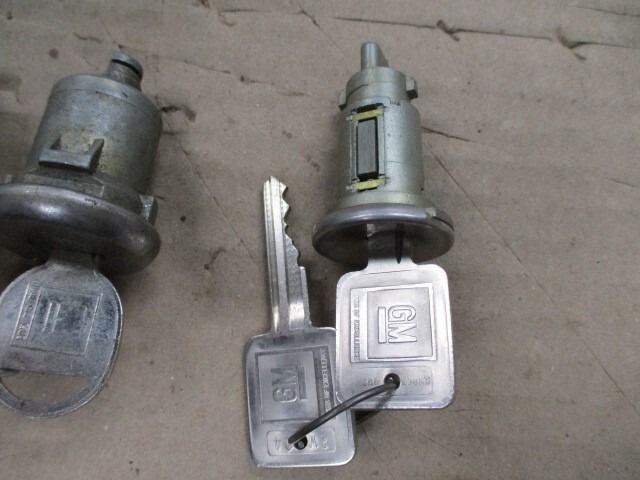

Today, when you buy a new car, you get a fob instead of a key. Before there were fobs, you got two keys – one for the ignition and one for the locks (doors, trunk, etc.). One of the advantages of this was that you could hide a key somewhere (a common thing to do was to put it in a magnetic box and attach it to the car’s underside) that would let you get in if you locked yourself out but would not unlock the ignition switch, so even if someone else found that key, they wouldn’t be able to start the engine and steal the car.
How about outside hood releases?
Pretty much all cars had these until that began to change in the ’80s – which was around the time what had been a high trust society began to become less so. In the high-trust times, cars had outside hood releases because you generally didn’t have to worry about someone popping your hood and messing with the engine. Or stealing your battery. Most new and late-model vehicles have dual-releases, too. There’s the main one – inside the vehicle – that you pull first, which “pops” the hood enough that you can reach under the lip and manually release the catch that lets you raise the hood.
Hand cranks to lower and raise the side glass –
These used to be as common as power window switches are now, because power windows were once considered a luxury feature and they were usually optional in most cars. The last new vehicles that even offered with manual roll-up/down window cranks were the Jeep Wrangler JL and Gladiator, through the end of 2024. Power windows are, of course, a convenience. But they are also an expense. The making standard of previously luxury features (other examples of this include AC) is why almost all new cars are luxury-priced cars.
Air cleaner lids –
Most cars made since the early 2000s – or even longer ago – have boxes that house the air filter, which is typically square or rectangular. These often have snaps and some have screws that require tools to open. In the past, most cars had oval air filters that sat underneath a lid that was typically held in place by a single wingnut. Sometimes, two (mostly foreign brand vehicles). The nice thing was the lid could easily be removed without tools and without getting your hands dirty, even. But the round air cleaner housings are bulky and packaging considerations led to the plastic box, usually offset to the left or right of the engine rather than sitting on top of it – which is no longer necessary because all modern cars have port fuel injection, so there’s no carburetor or throttle body sitting on top of the engine.
Analog clocks – 
If you’re ancient enough to remember, fancy cars used to have fancy analog clocks. Cartier, for instance – in Oldsmobiles and Cadillacs, back in the land yacht era. You may – if you’re ancient enough to remember – recall the background tick-tick-tick sound you could hear if you were just sitting in the car with the ignition off (obviously, the clock had to be on all the time to keep accurate time). These clocks generally stopped telling time after a few years, on account of the mechanism getting sticky. Modern/digital clocks are more reliable but devoid of any signs of life, very much of a piece with modern cars themselves.
The three year loan –
It takes six years – sometimes longer – to pay off most new cars. This is a function of most new cars starting – on the low end – in the mid-high $20k range and “transacting” (that is, selling) for $52k-plus, on average. A long time ago, in a galaxy far, far away, low-end cars could be bought for around $2,000-$2,500 and pretty nice ones were in the $4,000-$5,000 range. It took about half as long to pay off the loan, which is why people back then were able to buy new cars more frequently than today. On the downside, they had to – because in those days, the typical new car was getting to be a worn out (and probably rusty) car by the time it was six or seven years old. On the upside, those getting-worn-out six-or-seven-year-old cars were dirt cheap as used cars. Most people could afford to pay cash for one and so didn’t have to make any payments on one. Modern cars usually don’t begin to wear out before they’re 12-15 years old and often go a lot longer than that.
The downside is the payments last a lot longer than they used to – and they are a lot higher, too.
. . .
If you like what you’ve found here please consider supporting EPautos.
We depend on you to keep the wheels turning!
Our donate button is here.
If you prefer not to use PayPal, our mailing address is: EPautos 721 Hummingbird Lane SE Copper Hill, VA 24079









[…] https://www.ericpetersautos.com/2026/09/08/remember-these-3/ […]
I recently looked at a 1994 Land Cruiser to potentially add to my collection. The power windows were all in various stages of not operating or slow. Seat motors and switches had just been rebuilt for like $3,000. It makes the vehicle age poorly when you are constantly battling these electronic nuisances like being able to roll your windows down.
My 97 Tacoma on the other hand is all manual and I even have two keys since I had to replace the ignition switch (went with Genuine Toyota) after the key got stuck in the original one. Lasted about 200k miles though.
Takeaway here is the more analog Toyota from that era, the Tacoma, actually feels nicer on the inside than the far more premium LC because it’s virtually Impossible to keep all the electronics in perfect Working order.
Hi Analogue, just out of curiosity, this year I went to the dealership to see how much a new touch screen would cost in my newer vehicle. In case I ever had to replace it. It is a whopping, $5,000 bucks! Thankfully, the “info-tainment” system is separate from the heater, so if it went out, I would not freeze my butt off at -40 below zero. In retrospect, when the five CD stereo in my old WRX went out (it had satellite radio), I replaced it with a nice, one CD Pioneer, which had beautiful sound. That, for only a couple hundred bucks at the time. Newer is definitely not better. And who would have ever thought that we would one day be reminiscing about old school, analogue (no pun intended) hand-crank windows and hand controlled door locks. I would really laugh if they brought back the dimmer switch location to the floorboard (ha ha)!
Roger that, Aanlogue
On the upside, the power windows in old, pre CANBUS/network’d vehicles are easy to fix, assuming you can get the parts (which you usually can). The switch is just a simple switch; the wiring isn’t Borg-like and the electric motors and stuff behind the door panels is straightforward. If you can replace an alternator or water pump yourself, you ought to be able to repair/replace a not-working power window apparatus.
That said, I agree – I’d rather have manual roll ups. My ’02 Nissan ’em but (oddly) my ’76 TA does not. It came with power windows.
My 15 year old car has a door fob but still uses a key (although with a chip inside) to start it. They still put door lock cylinders in this vehicle even though it has the remote unlock. I so rarely use the fob that the battery goes dead and I don’t notice. Could be dead a month, a year, I have no idea. I’ve only replaced the battery I think twice in the whole ownership. But even with the fob and fancy chip key (which they do for anti-theft) I rather like that they you can get a hardware store to make you a plain metal key that you can hide that will at least open the door. It won’t start the car if you lose the chip key but it still lets you solve the problem of locking your keys in the car and unlock the steering column (which might be needed if you want to have it towed). If I really wanted to I could bypass the reader in the column that sense the chip in the key but that’s not a in-the-field repair. The simple solution to that is tape a chip key under the dash, the not simple solution is have a car tuner reprogram the ECU not to use the immobilizer.
I hide a spare key on the outside of the vehicle, usually underneath. Saved me once a couple hundred miles from home. And it’s nice to know that when my wife and daughters travel to the coast without me every year, they could still get home without much ado if even if one of them loses the key.
My 2005 Chrysler 300 has an analog clock in the center of the dash. It’s still working 21+ years later! My 79 Firebird has one in the gauge cluster, but only the second hand keeps working, the minutes and hours are stuck, probably somewhere in the 70’s. Lucky them.
I’m on the 5th try getting the 2018 Jeep key fob to work reliably for more than a week. Per the Jeep forums using a name brand 2032 series battery is mandatory for success. So out went the nearly new generic and yesterday a Duracel 2032 got installed. Today was zero defects and it will activate remote start from way inside the house instead of being no more than one wall / 20 ft away. Hope that’s it.
RE: power windows, very nice till they quit with a window halfway. Daughters Acura MDX, 5 years ago with the front windows halfway down summer day. Get back in, start up, no window power, zero. Great. Fuse intact, now head scratching. Fortunately the Acura forum, common failure the wire harness from the drivers door will fracture a wire inside its’ insulation cover. Wire harness off Amazon the door connection is outside so no panel removal, nice! The other end not so easy. Took several hand contortions inside the kick panel area to get it hooked up. I have long narrow chick type hands otherwise forget it. That was the fix! Now imagine out on a road trip windows down and dead, a thunderstorm about to arrive.
Meanwhile the 91 Silverado hand crank-ers work perfectly fine 35 years on. As do all the manual key locks.
Back in ’03 when my daughter was 10 I was borrowing my dad’s pickup to move some stuff into our new house. My daughter was sitting in the passenger seat and looked at the door panel and asked, “Dad, what is this thing?” She was looking at a small arm with a plastic knob on the end of it.
I said, “Why don’t you move it and find out.”
She did, and when the window started to go down she said excitedly, “This is the coolest thing ever! Every car should have these!”
She’d never seen a window crank before, and her window button was almost always locked so she’d never had the freedom to roll her own window up and down. By the way, she’s now a honest-to-goodness gear-head …
New ain’t always better.
Another youngin mind blower, vinyl records via decent stereo system. My grandson couldn’t believe it. He about jumped out of his skin when I lit up Steve Miller ‘Jungle Love’ that opening whistle was an eye opener. “How is that possible from that big plastic disk?”
Re: Steve Miller, should be opening synthesizer
Wish there was a way to hide a key nowadays, bumpers and wheel wells being plastic you can’t use anything magnetic; I used to keep a key taped inside the air cleaner but as mentioned you can’t open the hood from the outside anymore. Locked my keys in the trunk a couple months ago and had to endure the humiliation of calling my wife to bring me her keys to retrieve mine, luckily I wasn’t too far away and she was home at the time.
The median income for families was $9,870 In 1970.
The average price for a new car was about $3,500
As a percentage of income, cars were not any more affordable in 1970. And to the point of the article, didn’t remain in service as long.
Financing a vehicle has been a popular way for the masses to waste money and to limit their ability to build wealth.
Maff is hard.
9870 / 3500 = 2.82
St. Louis Fed says median family income is 105K. Cox Automotive says average transaction price on a new car is 50K.
105000 / 50000 = 2.1
Cars were much more affordable in 1970.
Fair.
Now do the math adjustments to account for the standardization of power windows, power locks, AC, power steering, high end stereos, etc., that would not have been in a 1970s car purchase.
Then do the adjustment to account for cars now having a useful life that is about double what it was in the 70s.
Then do the intangible adjustment for being able to start your car in -20F weather without any issues. Do the adjustment for not having vapor lock in the heat of the summer.
The reality is that if you adjust vehicle content back to what it was in 1970 your ratios fall apart.
No.
How about YOU do the adjustments for repairs. My 1972 Chevelle incurred $12 in repairs over the 13 years and 150,000 miles I drove it.
Repair #1: Oil sending unit leak. Cost: $4
Repair #2: Rubber diaphragm for choke dry rotted. Cost $8
Can any 2026 model beat that? Spoiler alert. No.
Wow – no tires in 150k miles impressive!
No muffler & exhaust rust out? No spark plug wires, distributor caps, plugs?
Impressive.
It’s too bad that a 1970’s style economy car simply doesn’t exist today for those who can’t afford today’s average car.
I love modern cars (everything pre-spyware), but I think it’s a shame that there’s no such thing as car culture among young people due to cheap cars no longer existing. Even old cars are no longer cheap.
I would disagree that there is no more car culture among the young. They are the ones who are bringing their junk to car meets, making the old men with perfectly restored classics shake their heads, but I love it. Even though a lot of them are thugs and punks (to us geezers), they customize whatever they can get their hands on. They make their junk piles louder and faster and care enough about them to show them off at car meets, which is the definition of hotrodding.
God bless and long live the rat rod culture!
I second that, Philo!
My buddy’s son (he’s 20) has what you might call several “sexual chocolate” vehicles, including an old Grand Marquis that would make the Grand Marquis himself stroke out!
There’s plenty of pockets of car culture, just not necessarily old iron like you or I might like. Lots of kids around here build up based on what they can afford which is (mostly) Japanese or Euro coupes & hot hatches and they also seem to like to customize pickups.
“St. Louis Fed says median family income is 105K.”
Where do you get this info?
“Real Median Household Income in the United States
“2024: 83,730
“Updated: Sep 9, 2025 1:19 PM CDT
“Next Release Date: Not Available”
https://fred.stlouisfed.org/series/mehoinusa672n
Median FAMILY income: $105,800
https://fred.stlouisfed.org/series/MEFAINUSA672N
For federal statistical data (such as the Census Bureau data tracked via FRED), a family is defined as a group of two or more people related by birth, marriage, or adoption who live together.
2026 (AI) “According to U.S. Census Bureau data, approximately 15% to 22% of American households and families earning a six-figure income ($100,000 to $149,999) are single-earner units.”
1970 (AI) While specific cross-tabulations for an exact dollar amount down to single versus multiple earners are not isolated as a single statistic in historical Census reports, macro-level data from the U.S. Bureau of Labor Statistics shows that the vast majority of families near or below the median income level at the time relied on a SINGLE PRIMARY WAGE EARNER, with wives’ earnings accounting for a minority share (around 27%) of overall married-family income across the broader national average.”
______________________
2026 Approximately 33% of U.S. households—or roughly 40 million families—have exactly one vehicle available for personal use.
In 1970, about 47.7% to 48% of American households owned a single car, which amounted to roughly 30.2 million households.
AI: “In 1970, the average price for a brand-new car ranged between $3,400 and $4,000.
Ford Maverick: Around $1,995
Dodge Dart (V8): Around $2,800
Plymouth Road Runner/Charger: Around $3,500
Lincoln Mark III: Around $9,000
Context and Affordability
Income Ratio: A new vehicle typically cost about one-third of a standard family’s total annual income at the time.
Inflation Adjustment: A $3,500 car from 1970 has the equivalent purchasing power of roughly $22,000 to $23,000 today.”
_____________________________
AI “The most popular family car in the United States in 1970 was the Chevrolet Impala, with a starting retail price of roughly $2,900 to $3,500 depending on the specific body style (such as the four-door sedan or hardtop).
Overview of the 1970 Chevrolet Impala
Popularity: Full-size American sedans like the Impala and its sibling the Ford Galaxie dominated family driveways.
Pricing: Base manufacturer suggested retail prices (MSRP) typically hovered around $2,950 for standard V8 configurations, though options like air conditioning, upgraded radios, and automatic transmissions added a few hundred dollars more. Legacy: It offered immense interior room, large trunk capacities, and powerful V8 engine choices that defined the classic American family road trip vehicle of the era.
_________________________
1970 Ford Galaxie 500 Overview
Popular Body Style: The 4-door sedan and 4-door hardtop versions of the Galaxie 500 served as mainstream, high-volume family haulers.
Original Cost:
4-Door Sedan base price: $3,137
4-Door Hardtop base price: $3,208
Key Features: Spacious interior bench seating designed for large families, standard V8 or optional big-block engine choices, and Ford’s reliable 3-speed Cruise-O-Matic automatic transmission.
The most popular family vehicle in the U.S. today that isn’t a pickup truck is the Toyota RAV4, a compact crossover SUV with a starting price of roughly $29,800 to $33,350 depending on the specific trim and configuration.
Why Families Choose It
Reliability: Built with a long-standing reputation for dependability and high resale value.
Efficiency: Excellent fuel economy, featuring standard hybrid options on recent models.
Space: Practical cargo room and comfortable seating for daily errands or road trips
____________________
The Honda CR-V is the second most popular family SUV in the U.S. today, with a starting price of about $32,370.
(Note: If counting all vehicle types including pickup trucks, the Chevrolet Silverado is the second best-selling vehicle overall, starting around $37,000.)
_______________________
The average price of a new car in the U.S. is $49,855, according to July 2026 data from Kelley Blue Book.
Price Breakdown by Vehicle Type
Prices vary a lot depending on the type of vehicle you want to buy:)
Full-size pickup truck: $66,980
Midsize SUV: $50,144
Compact SUV: $37,745
Subcompact SUV: $31,052
Compact car: $27,904
Please stop AI ing. Please. Please write your own comments. Please.
On the darker side, remember the idiotic device called a ‘bumper jack’ which came standard on all cars in the mid 20th century? Here’s one:
https://tinyurl.com/35mrpjut
This fool contraption required lifting the body through the entire spring travel, before the wheel lifted off the ground. It wasn’t very stable, so plenty of victims got injured or killed when the stupid things tumped over.
But now auto makers have gone us one better — not even including a spare, just a ridiculous tube of tire repair goop. If elected president, I will make auto execs eat the whole tube of tire goop at gunpoint … then smack their skulls with a rifle butt! 🙂
Ever notice how yr local tire shop Boy Scout grifters act like Stans sealant technology doesnt exist ?
Why are brick n mortars failing ?
One of the peculiarities of my 61 Mercedes 190Db (60mpg at 38mph per the factory manual) is that it came with a separate key for EVERYTHING. The doors, the ignition, the trunk, the fuel door, and the glove box all have their own unique, high quality steel key.
I remember the glove box key, but my parents didn’t have a mercedes: (AI) “In the 1960s, many cars used a two-key system where the glove box and trunk often shared a separate key from the ignition.
“The Purpose of Two KeysValet Parking: You could give the square ignition key to a parking valet or mechanic.
“Security: This kept valuables locked safely inside the trunk and glove box because the ignition key could not open them.”
It is ironic, in how that the more technologically advanced we get, whether with vehicles, or health care (or anything else), in the end, we end up with more expensive cars that are far less reliable (less fun to drive), and last a fraction of what the older vehicles used to. We are living longer, but are far sicker for it.
One tiny step away from a herd of tax slave cattle for psycho 9 year olds to torture for fun. . .
But but but.. No way that can be
The greatest tragedy isn’t remembering all these neat inventions and that they were clever and innovative ways to start cars, roll windows, tell time and open hoods and air cleaners….
It’s that the replacements for all these and more, are actually steps backwards and immensely more expensive and ultimately, more trouble than they’re worth.
Oy Vey!!!
All government is bad…
YMMV….